Please Wait
Applying Filters...
Menu
Xls

Digital Content read-more

Create Content with PharmaCompass, ask us

DATA COMPILATION #PharmaFlow

read-more
read-more
FDA approvals drop 24% in H1 2025; GSK’s UTI med, Vertex’s non-opioid painkiller lead pack of first-in-class meds
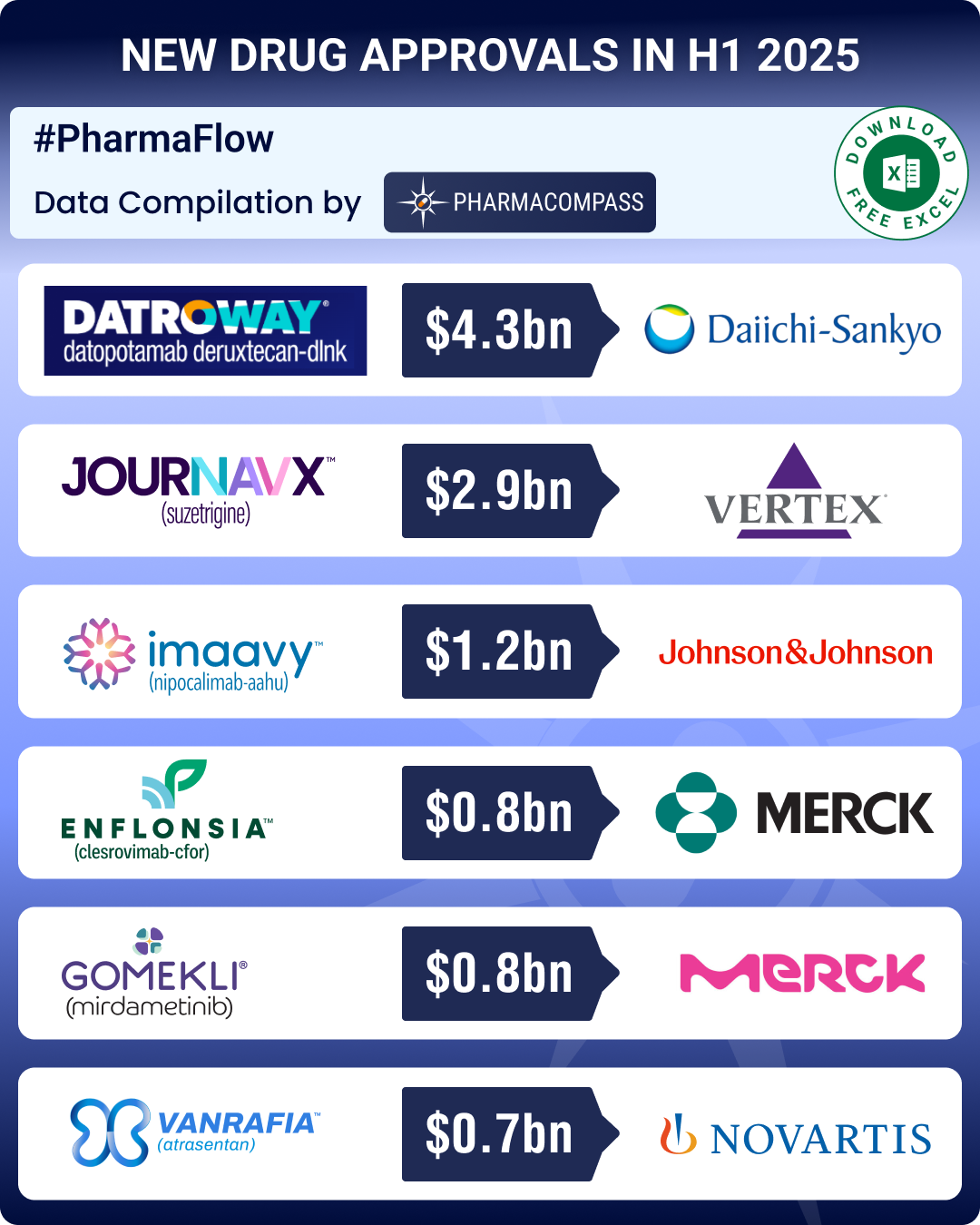
It has been a turbulent year for the US Food and Drug Administration (FDA), marked by reductions in both staff and budget, shake-ups at the top and a reduction in inspections. This upheaval has clearly impacted the functioning of the agency, with reports of missed deadlines and reduced responsiveness. This disruption resulted in a slowdown in new drug approvals in the first half of 2025 (H1 2025), as opposed to the same period last year. Incidentally, drug approvals in H1 2024 were also down by 19 percent compared to H1 2023. FDA’s Center for Drug Evaluation and Research (CDER) approved 16 novel drugs in H1 2025, down from 21 in H1 2024, a decline of nearly 24 percent. Of these, nine were small molecules and seven were biologics. The period saw eight first-in-class therapies get CDER’s approval, as opposed to 17 in H1 2024. FDA’s Center for Biologics Evaluation and Research (CBER) approved seven biologics in H1 2025, compared to eight in the same period last year. In comparison, both Health Canada and the European Medicines Agency (EMA) reported a strong rebound in approvals and authorizations, respectively. Health Canada approved 20 drugs in H1 2025, as opposed to 10 in H1 2024. Similarly, EMA authorized 19 new therapies in H1 2025, compared to 15 in H1 2024. Notably, EMA’s pending decisions increased to 25 in H1 2025, from 14 in the same period last year, while conditional authorizations remained static at five. This underscores EMA’s active regulatory pipeline, suggesting that more drugs could be approved in Europe soon.   View New Drug Approvals in H1 2025 with Estimated Sales (Free Excel Available) Vertex’s non-opioid painkiller, GSK’s antibiotic for UTI, Merck’s RSV antibody bag FDA nods Oncology remained the single largest category in H1 2025 with seven new drugs being approved by the FDA, followed by four rare diseases and disorders and as many infections and infective diseases.  The eight drugs that were designated first-in-class in H1 2025 are: Journavx (Suzetrigine), Imaavy (nipocalimab), Emrelis (telisotuzumab vedotin), Blujepa (gepotidacin mesylate), Qfitlia (fitusiran), Avmapki Fakzynja Co-Pack (avutometinib potassium/defactinib hydrochloride), Tryptyr (acoltremon), and Andembry (garadacimab). In January, a new class of non-opioid pain therapy made a debut — FDA approved Vertex Pharmaceuticals’ Journavx (suzetrigine). This first-in-class oral analgesic could bring in US$ 2.9 billion in sales for Vertex by 2030. The half year also saw a new oral antibiotic — GSK’s Blujepa (gepotidacin) — for treating uncomplicated urinary tract infections (uUTIs) bag FDA approval. This is the first new antibiotic for uUTIs in nearly three decades. It treats infections caused by resistant pathogens such as E. coli and K. pneumoniae. In June, Merck’s Enflonsia (clesrovimab), a long-acting monoclonal antibody, won FDA approval to prevent respiratory syncytial virus (RSV) lower respiratory tract disease in neonates and infants entering their first RSV season. A single 105 mg dose provides protection for about five months, the length of a typical RSV season. Enflonsia could bring in US$844 million in annual sales by 2030.   View New Drug Approvals in H1 2025 with Estimated Sales (Free Excel Available)  FDA approves four meds for rare diseases, including SpringWorks’ Gomekli, Novartis’ Vanrafia In H1 2024, rare genetic diseases had witnessed some significant approvals. The trend continued in H1 2025. In February, Gomekli (mirdametinib), developed by SpringWorks Therapeutics, became the first approved therapy for neurofibromatosis type 1 (a genetic disorder that causes tumors to grow on nerve tissues) in adult and pediatric patients who have symptomatic plexiform neurofibromas (benign, complex nerve tumors) not amenable to complete resection. Analysts expect peak sales of around US$ 0.8 billion by 2030. Post this approval, SpringWorks got acquired by Merck KGaA for approximately US$ 3.9 billion. The same month, Ono Pharma-owned Deciphera’s Romvimza (vimseltinib) became the first oral therapy approved for another rare disease known as symptomatic tenosynovial giant cell tumor. This is a benign but aggressive growth that can be painful. This new drug offers patients an option beyond surgery. In March, Sanofi’s Qfitlia (fitusiran) was approved for routine prophylaxis in hemophilia A or B, with or without inhibitors. And in April, Novartis’ Vanrafia (atrasentan) was granted accelerated approval for IgA nephropathy (a chronic autoimmune kidney disease), which is at the risk of rapid progression. Vanrafia could bring in sales of over US$ 735 million by 2030. Johnson & Johnson secured approval for Imaavy (nipocalimab-aahu) for generalized myasthenia gravis (a chronic autoimmune disease that causes muscle weakness) in adults and adolescents. Imaavy’s sales could cross US$1.17 billion by 2030. Rare diseases continue to attract regulatory attention, with the trend carrying into the current quarter. July witnessed two noteworthy rare-disease approvals — Ekterly (garadacimab), CSL’s once-monthly prophylactic treatment for hereditary angioedema (a genetic disorder that causes recurrent episodes of swellings), and Sephience (pegvaliase-abcx), BioMarin’s new therapy for phenylketonuria (a rare metabolic disorder).   View New Drug Approvals in H1 2025 with Estimated Sales (Free Excel Available)  FDA greenlights new oncology therapies, including Astra’s Datroway, AbbVie’s Emrelis The field of oncology saw some notable new drug approvals. In January, Datroway (datopotamab deruxtecan), an antibody-drug conjugate (ADC) developed by AstraZeneca and Daiichi Sankyo, was granted approval for adults with unresectable or metastatic, hormone receptor-positive, HER2-negative breast cancer. Later, in June, the FDA granted accelerated approval  to AstraZeneca;s Datroway for adults with locally advanced or metastatic, EGFR-mutated non-small cell lung cancer. The drug’s peak annual sales are projected at about US$ 4.2 billion by 2030. In May, Emrelis (telisotuzumab vedotin-tllv), AbbVie’s ADC was granted FDA’s accelerated approval. Emrelis treats locally advanced or metastatic non-squamous non-small cell lung cancer (NSCLC) characterized by significantly increased levels of the c-Met protein in cancer cells. FDA also approved a companion diagnostic test — Roche's Ventana — in May to determine the c-Met protein biomarker status in order to identify patients eligible for Emrelis.  The same month, FDA also granted accelerated approval to Verastem’s Avmapki Fakzynja Co-pack, a dual oral therapy for adults with KRAS‑mutated recurrent low‑grade serous ovarian cancer (LGSOC). This novel regimen combines two inhibitors — avutometinib and defactinib — to disrupt critical signaling pathways that fuel tumor growth. In ophthalmology, Alcon re-entered the prescription pharmaceutical market with Tryptry (acoltremon), a first-in-class TRPM8 agonist for dry eye disease, which stimulates corneal nerves to increase tear production.   View New Drug Approvals in H1 2025 with Estimated Sales (Free Excel Available)  Our view The changes in the FDA are clearly having a far-reaching impact on the global pharmaceutical industry. There have been reports of drugmakers losing confidence in the FDA, which has been a gold standard for drug regulation. Some American biotechs are shifting early trials outside of the US. With EMA and Health Canada authorizing/approving a larger number of drugs in H1 2025, we do see some changes underway that may eventually reshape drug development.  

Impressions: 7741

https://www.pharmacompass.com/radio-compass-blog/fda-approvals-drop-24-in-h1-2025-gsk-s-uti-med-vertex-s-non-opioid-painkiller-lead-pack-of-first-in-class-meds

#PharmaFlow by PHARMACOMPASS
28 Aug 2025

WEEKLY NEWS RECAP #Phispers

read-more
read-more
Six CAR-T therapies to carry boxed warning for secondary cancer; Sanofi buys Inhibrx for about US$ 2.2 billion
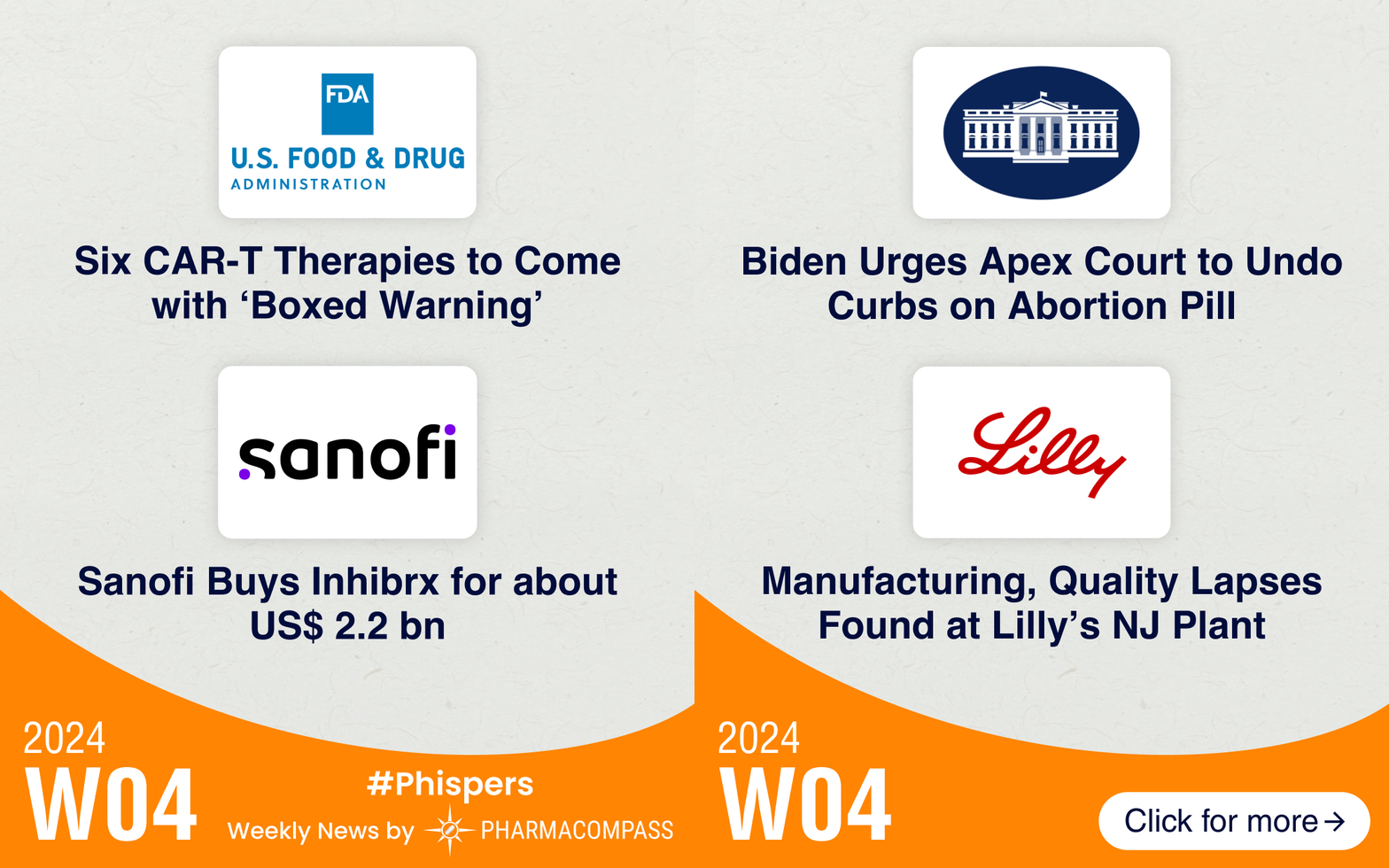
The US Food and Drug Administration (FDA) has mandated “black box” warnings on six major CAR-T cancer therapies over the risk of developing secondary cancer.Two experimental gene therapies that work on mutations of the OTOF gene reportedly cured profound deafness in young children.The Biden Administration has urged the US Supreme Court to reverse an August 2023 ruling that curbs access to abortion pill mifepristone by barring telemedicine prescriptions and mail shipments of it.Eli Lilly’s New Jersey plant is back in the news, as the FDA reportedly found “eight separate deficiencies” concerning manufacturing processes and quality controls.Johnson & Johnson’s Stelara raked in over US$ 10 billion last year. Meanwhile, the drugmaker agreed to resolve talc probes in 42 states in the US through a tentative settlement of US$ 700 million.In acquisitions, Sanofi forked out US$ 2.2 billion to buy Inhibrx, a clinical-stage biopharma, to gain access to its experimental treatment for a rare disease.FDA mandates ‘boxed warning’ on six CAR-T therapies over secondary cancer riskFDA has issued letters to six manufacturers of cancer therapies that use CAR-T technology to add a serious warning on their label (i.e. boxed warning), after the agency found a serious risk of developing secondary cancer associated with those therapies.These therapies include Bristol-Myers Squibb’s Abecma and Breyanzi, Janssen Biotech’s Carvykti, Gilead’s Yescarta, Novartis’ Kymriah, and Kite Pharma’s Tecartus.“Boxed warnings” or “black box warnings” are reserved for the highest safety warnings to bring attention to the major risks of a treatment.Amgen’s osteoporosis drug to carry boxed warning: Amgen’s blockbuster drug Prolia to treat bone loss was also hit with a boxed warning requirement as it raises the risk of severe hypocalcemia (low calcium levels) in patients with advanced chronic kidney disease (CKD), especially those on dialysis.Biden urges Supreme Court to undo curbs on major abortion pillIn June 2022, the US Supreme Court had ended its recognition of a constitutional right to abortion by overturning an earlier ruling (of 1973). And later that year, an umbrella group of anti-abortion doctors and activists in the US had claimed that the FDA had unlawfully approved Danco Laboratories’ mifepristone.Now, the Biden Administration has urged the apex court to reverse an August 2023 ruling that curbs access to the pill by barring telemedicine prescriptions and mail shipments of it.The apex court’s ruling in this case is expected by June-end, months before the November presidential elections.The pill had been legal in the US since 2000. The two drug-regimen was approved for use in pregnancies of up to 10 weeks. A patient is first given mifepristone to induce an abortion, followed by misoprostol to empty the uterus. Over the last two decades, the FDA, the American College of Obstetrics and Gynaecologists (ACOG) and other mainstream medical bodies have maintained that both drugs are safe.Since 2016, the FDA had further eased access to the drug by allowing doctors to meet patients via telemedicine, and issue prescriptions over email.Lilly, Refreshgene’s gene therapies cure congenital deafness in clinical trialsThe week brought some good news for those with congenital deafness. According to Reuters, an experimental gene therapy being developed by a Chinese company restored hearing in children with congenital deafness. Five of six young children with profound deafness experienced hearing recovery and improvements in speech recognition six months after being treated with the therapy from Refreshgene Therapeutics. All the children had profound deafness caused by mutations of the OTOF (otoferlin) gene.In another early-to-mid-stage trial of Eli Lilly’s investigational gene therapy AK-OTOF, the hearing of an 11-year-old boy was restored. The boy was born deaf. The boy could hear within 30 days of a single administration of AK-OTOF.After 2021 DOJ probe, fresh manufacturing, quality lapses found at Lilly’s NJ plantEli Lilly’s New Jersey plant, which was subject to a Department of Justice (DOJ) probe back in 2021, has now been found to have several manufacturing problems. According to a Reuters report, the FDA has detected “eight separate deficiencies” at the plant. The issues included problematic tracking of manufacturing processes and quality controls. There were also lapses in the calibration of equipment and the company failed to appropriately maintain facilities and equipment.The Indianapolis-based drugmaker told Reuters the inspection took place in July, after it had asked FDA for “additional flexibility” in the manufacturing process for migraine treatment Emgality (galcanezumab-gnlm). Drugs manufactured at the facility include diabetes medicine Trulicity (dulaglutide), and cancer therapies Cyramza (ramucirumab) and Erbitux (cetuximab). Lilly has said safety, quality, and supply of current or planned products remain unaffected.J&J to pay US$ 700 million to settle talc probe in 42 US statesJohnson & Johnson confirmed it has reached a tentative settlement of US$ 700 million to resolve probes by US states into whether it misled consumers about the safety of its talcum powder. The deal includes 42 states and Washington DC. The settlement does not extend to private plaintiffs’ cases against the company, some of which are expected to go to trial later this year.Stelara crosses US$ 10 billion in 2023 sales: J&J’s blockbuster Stelara (ustekinumab) clocked sales of US$ 10.86 billion in 2023. The psoriasis drug’s sales are expected to drop 3 percent in 2024 to US$ 10.54 billion. The first biosimilar for the drug, Amgen’s Wezlana (ustekinumab-auub), is expected to be launched in 2025.Sanofi buys rare disease drugmaker Inhibrx for about US$ 2.2 billionSanofi has agreed to buy California-based clinical-stage biopharmaceutical company Inhibrx for about US$ 2.2 billion. The acquisition is aimed at acquiring the biopharma’s mid-stage experimental treatment INBRX-101, which will bolster the French drugmaker’s rare genetic disease portfolio. Inhibrx’s other investigational drugs will be spun off into a different company, known as Inhibrx, in which  Sanofi will hold an 8 percent stake. INBRX-101 is a potential treatment for Alpha-1 Antitrypsin Deficiency (AATD), a rare disease that causes the lung tissue to progressively deteriorate.Meanwhile, there was news that the Walgreens Boots Alliance is looking into the possibility of selling its specialty pharmacy company Shields Health Solutions for over US$ 4 billion.  

Impressions: 2737

https://www.pharmacompass.com/radio-compass-phisper/six-car-t-therapies-to-carry-boxed-warning-for-secondary-cancer-sanofi-buys-inhibrx-for-about-us-2-2-billion

#Phispers by PHARMACOMPASS
25 Jan 2024

NEWS #PharmaBuzz

read-more
read-more

https://www.prnewswire.com/news-releases/glyconex-announces-positive-topline-results-for-phase-iii-clinical-trial-of-denosumab-biosimilar-spd8-302796158.html

PR NEWSWIRE
11 Jun 2026

https://www.gov.uk/drug-device-alerts/class-4-medicines-defect-notification-teva-uk-ltd-ponlimsi-denosumab-60mg-solution-for-injection-in-pre-filled-syringe-el-26-a-slash-27

PRESS RELEASE
04 Jun 2026

https://www.prnewswire.com/news-releases/mabwell-announces-nmpa-approval-of-supplemental-application-for-additional-indications-of-maiweijian-denosumab-injection-302778306.html

PR NEWSWIRE
21 May 2026

https://www.pharmiweb.com/press-release/2026-04-21/biocon-receives-health-canada-approval-of-bosaya-denosumab-and-vevzuo-denosumab-biosimilars-t

PHARMIWEB
21 Apr 2026

https://www.businesswire.com/news/home/20260416509744/en/Samsung-Bioepis-Highlights-Consistent-Efficacy-of-SB16-OBODENCE-Denosumab-Across-Osteoporosis-Patient-Subgroups-at-WCO-IOF-ESCEO-2026

BUSINESSWIRE
17 Apr 2026

https://firstwordpharma.com/story/7181847

FIRSTWORD PHARMA
16 Apr 2026