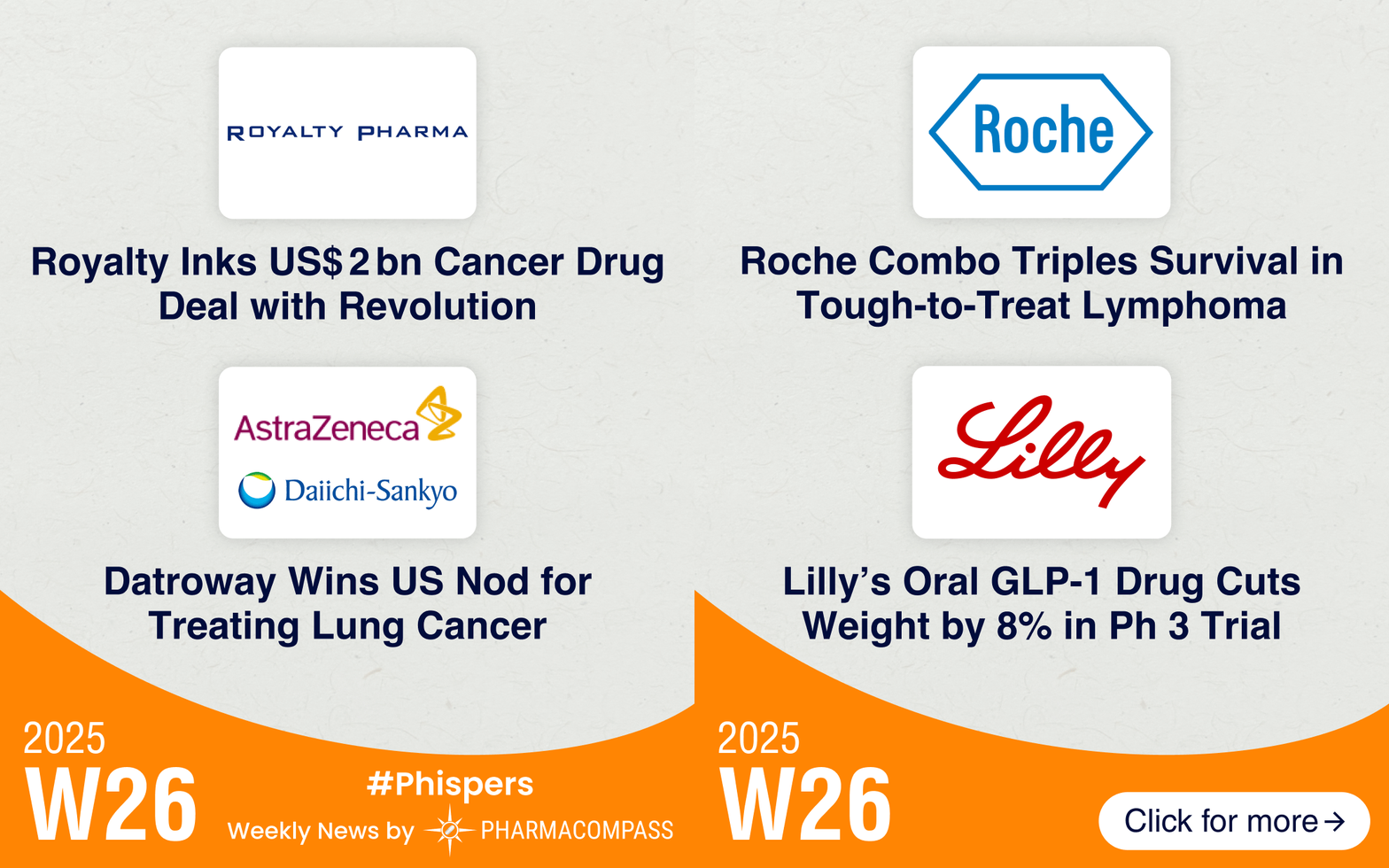
In news this week, Royalty Pharma committed up to US$ 2 billion to Revolution Medicines for their promising pancreatic and lung cancer drug daraxonrasib. The US Food and Drug Administration (FDA) granted accelerated approval to AstraZeneca and Daiichi Sankyo’s Datroway, a treatment for lung cancer.The agency also approved Cycle Pharma’s Harliku (nitisinone) for an ultra-rare genetic disorder and Sanofi-Regeneron’s Dupixent (dupilumab) for adult patients with bullous pemphigoid, a debilitating autoimmune skin disorder. In the mental health space, Compass Pathways’ psilocybin-based therapy COMP360 successfully met its primary endpoint in a phase 3 trial for treatment-resistant depression.Eli Lilly’s oral GLP-1 drug orforglipron delivered compelling results in late-stage trials, positioning itself as a convenient alternative to injectable diabetes medications. Roche celebrated a significant win as their Lunsumio-Polivy combination therapy tripled progression-free survival in lymphoma patients compared to standard chemotherapy. However, Stuart Therapeutics faced disappointment when its dry eye disease drug ST-100 failed to meet its primary endpoint in a phase 3 trial. And the US withdrew funding to Gavi, a global alliance that helps buy vaccines for the world’s poorest children. The Gates Foundation is stepping in, committing US$ 1.6 billion over five years.Royalty Pharma inks US$ 2 bn deal
with Revolution Medicines for cancer drugRoyalty
Pharma and Revolution
Medicines have struck an
agreement, wherein Royalty will provide up to US$
2 billion to fuel the development and commercialization of daraxonrasib, a promising med that targets pancreatic ductal adenocarcinoma and non-small cell lung cancer (NSCLC).Under
the terms, Royalty Pharma has committed
up to US$ 1.25 billion in ‘synthetic royalty financing’, releasing an initial US$ 250 million immediately, with future payments tied to
milestones such as positive phase 3 data and an FDA approval. Synthetic royalty
financing allows companies to raise capital by selling a part of their future
revenues, while retaining ownership of an asset. The deal also includes US$ 750 million
in secured debt.Astra-Daiichi’s ADC Datroway wins US approval for lung cancerFDA
has granted accelerated
approval to Datroway (datopotamab deruxtecan), a precision
cancer therapy developed by AstraZeneca and Daiichi
Sankyo, for the
treatment of adults with locally advanced or metastatic epidermal growth factor receptor (EGFR)-mutated NSCLC who have previously received EGFR-directed therapy and platinum-based chemotherapy. This marks the first US approval of a TROP2-directed antibody-drug conjugate (ADC) for lung cancer.Datroway is an ADC that targets the TROP2 protein, which is over-expressed in various cancers, including NSCLC. By delivering cytotoxic agents directly to cancer cells, it aims to minimize damage to healthy tissues.FDA
had previously approved Datroway for the treatment of certain forms of breast
cancer, making this its second US approval in less than six months.FDA okays Cycle Pharma’s med for ultra-rare genetic disorder: FDA has
approved Cycle Pharmaceuticals’ Harliku (nitisinone),
the first
and only treatment for alkaptonuria (AKU), a debilitating ultra-rare genetic disorder. AKU causes harmful build-up of homogentisic acid, resulting in tissue pigmentation, arthritis, and potentially serious cardiac and renal complications.Dupixent okayed for rare skin disease: FDA has approved Sanofi and Regeneron’s
Dupixent (dupilumab) for
adult patients
with bullous pemphigoid, marking the first and
only targeted biologic treatment for this debilitating autoimmune skin
disorder. This is the eighth FDA approval granted to Dupixent.Compass Pathways’ depression therapy reduces severity of symptoms in studyCompass
Pathways has announced
that its investigational psilocybin-based therapy, COMP360, has achieved the primary
endpoint in its first phase 3 trial (COMP005) for treatment-resistant depression (TRD). The study demonstrated that a single 25 mg dose of COMP360 led to a statistically significant and clinically meaningful reduction in depressive symptoms, compared to placebo at six weeks, as measured by the Montgomery–Åsberg Depression Rating Scale (MADRS). This is the first time a synthetic psilocybin has shown efficacy in a phase 3 trial for TRD.Lilly’s oral GLP-1 drug orforglipron delivers positive results in late-stage trialEli Lilly’s
experimental oral
GLP-1 receptor agonist, orforglipron, has
delivered compelling late-stage results in adults with
type 2 diabetes. Over 40 weeks, the highest dose produced
approximately 7.9 percent weight loss, comparable to outcomes seen with
injectable semaglutide and tirzepatide.As a
non-peptide, small molecule oral pill orforglipron offers
once daily dosing without food or water restrictions. It also does
not require refrigeration, and may reduce production and distribution costs.
Eli Lilly plans to seek regulatory approval for weight management by the end of
2025 and for type 2 diabetes in 2026.Meanwhile,
its investigational
antibody, bimagrumab, has shown remarkable
results in preserving muscle mass when paired with Novo Nordisk’s GLP‑1 therapy, Wegovy (semaglutide), according to mid-stage data presented at the American Diabetes Association meeting.Roche’s Lunsumio-Polivy scores late-stage win in lymphoma trialRoche has
unveiled positive
results from a pivotal late-stage trial evaluating subcutaneous
Lunsumio (mosunetuzumab) plus intravenous Polivy (polatuzumab
vedotin) in transplant-ineligible
patients with relapsed or refractory large B-cell lymphoma (LBCL). The regimen
produced a median progression-free survival (PFS) of 11.5 months, triple that
of the chemotherapy arm.Stuart Therapeutics’ dry eye disease drug fails late-stage tear testStuart
Therapeutics’ phase
3 trial of ST-100 (vezocolmitide) has
failed to show a statistically significant improvement in tear
production. The trial was assessing whether the drug could truly enhance tear
volume in dry eye disease. Stuart plans to launch another study and intends to engage with the FDA to confirm the design of
this additional trial, and the regulatory path to the approval of ST-100.US stops funding to GAVI; Gates steps
in to provide US$ 1.6 bn over five yearsThe US is withdrawing
funding to Gavi, a global alliance that helps buy vaccines for the world’s poorest children. Health Secretary Robert F. Kennedy Jr said Gavi had
ignored the science in immunizing children across the world. He also said that the US “will not deliver on a US$ 1.2 billion pledge made by the Biden administration until the organization changed its processes,” New York Times reported. According to
RFK Jr, America has provided US$ 8 billion in funding to Gavi since 2001.Meanwhile,
the Gates Foundation said it will commit
US$ 1.6 billion over the next five years to support Gavi. The vaccine alliance is
looking to raise US$ 9 billion for its work from 2026 to 2030.
















 Share
Share