Please Wait
Applying Filters...
Menu
Xls

Digital Content read-more

Create Content with PharmaCompass, ask us

DATA COMPILATION #PharmaFlow

read-more
read-more
CEP Q1 2026 Update: CEP 2.0, EDQM’s new guidelines strengthen ecosystem; Indian firms top list of CEPs issued
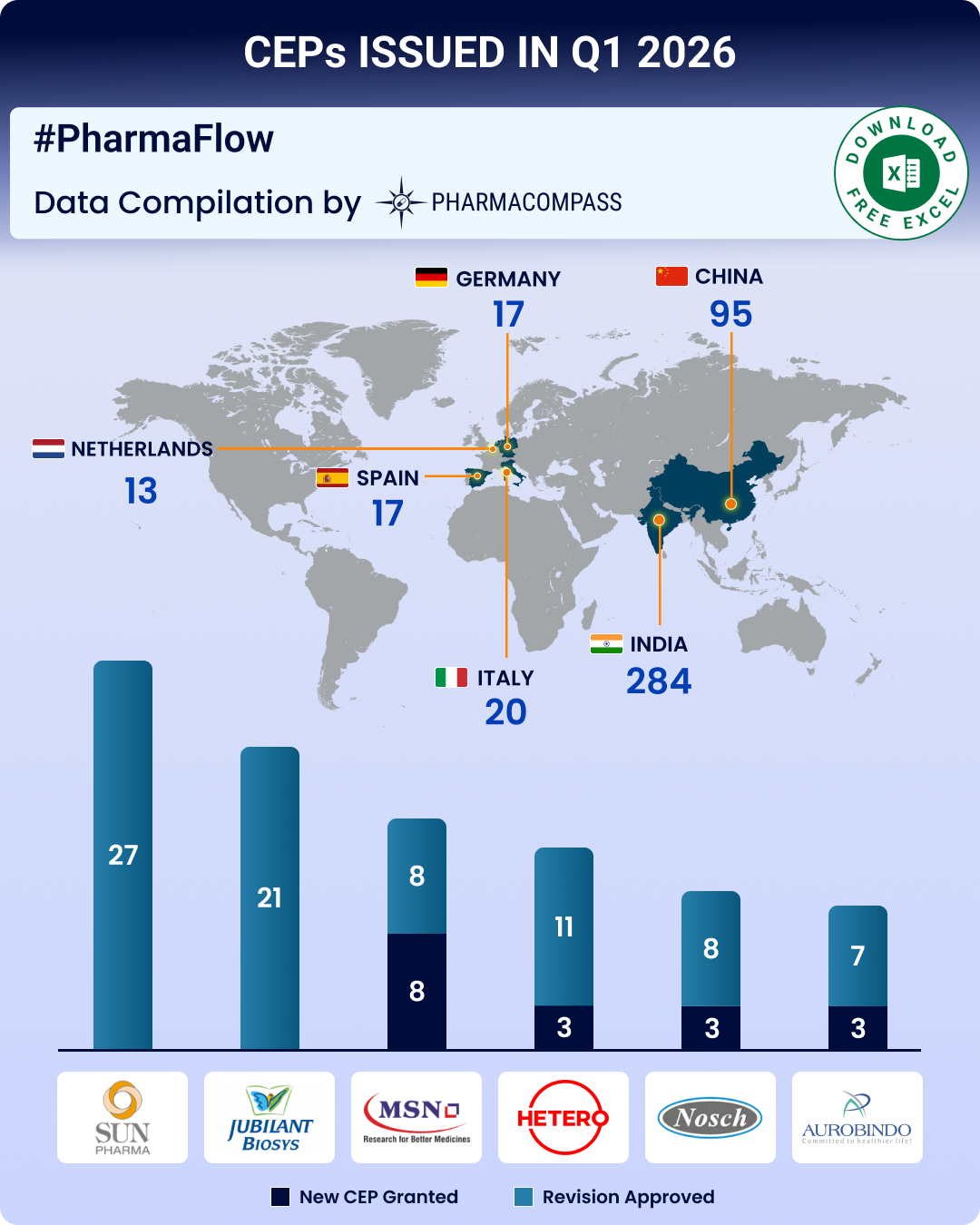
PharmaCompass is introducing a new regulatory update that tracks developments in Certificates of Suitability to the Monographs of the European Pharmacopoeia, referred to as CEPs. These certificates are a critical regulatory instrument in the global pharmaceutical supply chain.Also known as a Certification of Suitability (COS), CEPs are issued by the European Directorate for the Quality of Medicines and HealthCare (EDQM), with or without inspection of the manufacturing site. A CEP must be renewed every five years from its original issue date to remain valid, regardless of any revisions made during the interim period. However, a CEP does not replace Good Manufacturing Practice certification.CEPs are recognized as a trusted reference for API quality, thereby simplifying global registration strategies. Apart from Europe, the CEP system is widely used by many regulatory authorities, including those in Canada, Australia, Brazil, Singapore and South Africa. View CEPs Issued in Q1 2026 (Power BI Dashboard, Free Excel Available)CEP 2.0 enhances regulatory clarity, brings efficiency, global interoperability There are several types of CEPs, depending on the nature of the substance and evaluation. The most common type is the Chemical CEP, which confirms that a chemically synthesized API meets standards for purity and impurity control. Then there are Herbal CEPs for herbal substances and preparations.Another key category is the TSE CEP, which addresses risks associated with transmissible spongiform encephalopathies in animal-derived materials. In addition, there are Combined CEPs that may cover multiple aspects, such as chemical quality, TSE risk, and sterility. However, biological products such as vaccines and blood products fall outside the scope of the CEP framework.In 2023, the CEP system underwent a major transformation with the introduction of CEP 2.0, which marks a shift from a largely document-based system to a more structured, transparent, and digitally aligned model. This makes it easier for companies to manage compliance while improving trust among global regulators.While increasing data and compliance requirements for API manufacturers, CEP 2.0 enables better regulatory clarity, streamlined dossier integration, and stronger global acceptance. Overall, CEP 2.0 is designed to enhance regulatory clarity while making the system more efficient and globally interoperable. View CEPs Issued in Q1 2026 (Power BI Dashboard, Free Excel Available)Indian firms issued maximum CEPs; Sun Pharma and its subsidiaries, Jubilant Biosys top listIndia topped the charts for CEPs issued, both in terms of new CEPs and revisions in the first quarter (Q1) of 2026. Indian companies were issued 81 new CEPs in Q1 2026 (as against 40 in Q1 2025) and 203 revisions (as against 129 in Q1 2025). In comparison, Chinese companies were issued 42 new CEPs in Q1 2026 (against 25 in Q1 2025) and 53 revisions (against 67 in Q1 2025). Italy came a distant third, followed by Germany and Spain.India’s Sun Pharmaceuticals and its subsidiaries topped the list of companies with the maximum number of CEPs issued— while no new CEP was issued, 27 CEPs were revised in Q1 2026. At second place was Jubilant Biosys — 21 CEPs were revised in Q1 2026.In terms of products, the maximum CEPs were issued for amlodipine besylate (a calcium channel blocker used for treating hypertension), followed by sitagliptin phosphate (a type 2 diabetes medicine) and pregabalin (a drug used to treat neuropathic pain, fibromyalgia, seizures, and generalized anxiety disorder). Both amlodipine besylate and sitagliptin phosphate had not been issued new CEPs or revisions in Q1 2025. View CEPs Issued in Q1 2026 (Power BI Dashboard, Free Excel Available)EDQM introduces new guidelines to accelerate CEP assessments The EDQM charges fees for various services related to CEPs that depend on the type of request or regulatory activity involved. In general, fees apply to handling CEP applications, revisions or renewals and for offering technical advice (where applicants seek scientific or regulatory guidance).In March 2026, the EDQM introduced two new guidelines aimed at accelerating CEP assessments. The first is a reliance-based assessment pathway, which allows regulators to leverage prior approvals from trusted authorities, such as those in the EU, UK, Australia, Canada, and the WHO pre-qualification program. The second is a fast-track assessment route designed to expedite reviews in situations such as medicine shortages and to support initiatives like the EU Critical Medicines Act.Timelines have been significantly compressed under these new pathways. Initial evaluations are completed within 46 working days, compared to up to 115 days under the standard procedure. Applicants are given 30 calendar days to respond to queries, after which regulators complete the final assessment within 23 working days.Another important regulatory update relates to electronic submissions. From April 1, 2026, the EDQM will reject non-compliant CEP applications at the point of submission. All applications must include a validated electronic Common Technical Document (eCTD) dossier along with a proper validation report, submitted in line with the updated Common European Submission Portal (CESP) guidelines. Taken together, these developments signal a more rigorous yet efficient CEP ecosystem. View CEPs Issued in Q1 2026 (Power BI Dashboard, Free Excel Available)Our viewThe shift to CEP 2.0 signals a move toward greater transparency, digitalization, and global regulatory alignment. Though enhanced disclosure and stricter e-submission requirements may increase the compliance burden, especially for smaller manufacturers, the long-term gains are expected to be significant. Going forward, companies that invest in data quality and regulatory readiness stand to gain from these changes.

Impressions: 2593

https://www.pharmacompass.com/radio-compass-blog/cep-q1-2026-update-cep-2-0-edqm-s-new-guidelines-strengthen-ecosystem-indian-firms-top-list-of-ceps-issued

#PharmaFlow by PHARMACOMPASS
09 Apr 2026

STOCK RECAP #PipelineProspector

read-more
read-more
Pipeline Prospector November 2025: Kimberly-Clark to buy Kenvue for US$ 48.7 bn; FDA approves Novartis’ gene therapy
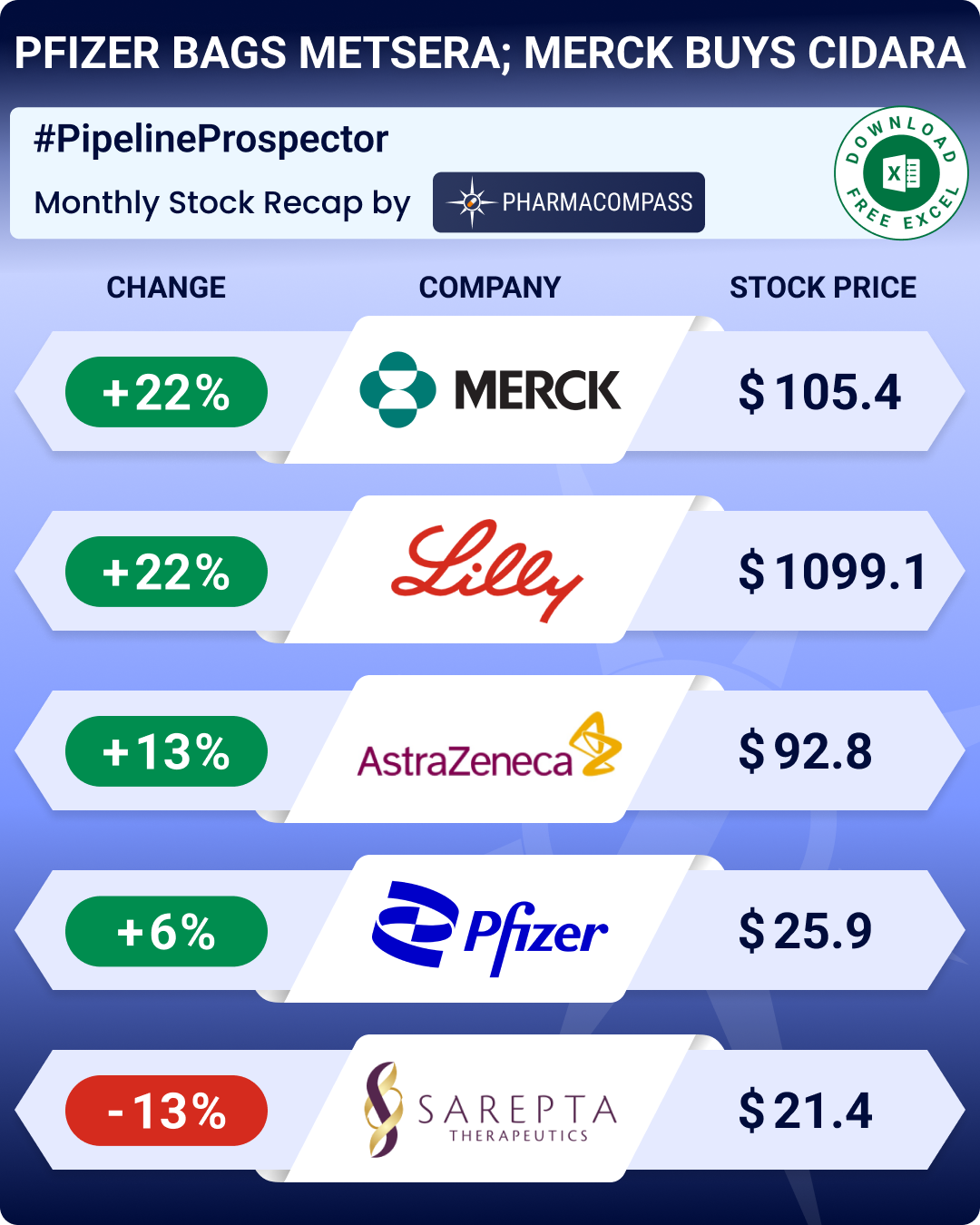
November saw several big ticket acquisitions across the consumer health and biopharma space, including the US$ 48.7 billion acquisition of Johnson & Johnson’s consumer health unit Kenvue by Kimberly-Clark and Pfizer’s up to US$ 10 billion acquisition of obesity-focused biotech Metsera. Additionally, the trend of companies announcing capacity expansions continued unabated.The month saw several key drug approvals by the US Food and Drug Administration (FDA), including Kura Oncology-Kyowa Kirin’s Komzifti (ziftomenib) for treating adults with relapsed or refractory acute myeloid leukemia (AML) with an NPM1 mutation.The indices rose substantially during the month. The Nasdaq Biotechnology Index (NBI) rose 8.85 percent, from 5,344.91 at the end of October to 5,818.03 by November-end. The SPDR S&P Biotech ETF (XBI) gained 10.97 percent from 110.98 to 123.16. The S&P Biotechnology Select Industry Index (SPSIBI) also advanced 9.08 percent — from 8,789.93 to 9,588.09. Access the Pipeline Prospector Dashboard for November 2025 Newsmakers (Free Excel)Pfizer clinches up to US$ 10 bn deal for Metsera; Merck to buy Cidara for US$ 9.2 bnPfizer inked an agreement worth up to US$ 10 billion to acquire obesity-focused biotech Metsera. The deal ended a competitive bidding process between Pfizer and Novo Nordisk. Pfizer had filed lawsuits, alleging that Metsera breached an earlier merger agreement. Metsera accepted Pfizer’s revised offer after raising concerns about potential antitrust risks associated with Novo’s competing bid. In early November, Kimberly-Clark announced the acquisition of Johnson & Johnson’s consumer health unit — Kenvue — in a cash-and-stock deal valued at US$ 48.7 billion. The merger will create a consumer health company with expected annual revenue of about US$ 32 billion and a portfolio of highly-valued brands, including Tylenol (paracetamol), Neutrogena, Aveeno, and Listerine.Merck announced the acquisition of Cidara Therapeutics in a deal valued at US$ 9.2 billion. The acquisition gives Merck access to an experimental influenza antiviral designed to provide season-long protection with a single dose. Its stock rose 22 percent in November.Johnson & Johnson is buying Halda Therapeutics for US$ 3.05 billion in cash. Halda, a Connecticut-based biotech, adds early-stage cancer programs to J&J’s pipeline, including a lead candidate in prostate cancer.Like Pfizer and Novo Nordisk, Lundbeck and Alkermes were also embroiled in a bidding war for Avadel Pharmaceuticals. Lundbeck later withdrew from the race, clearing the way for Alkermes, which eventually agreed to acquire Avadel for US$ 2.37 billion.Drugmakers continued to announce plans to expand capacities. Eli Lilly (whose stock rose 22 percent in November) announced plans to invest US$ 3 billion to build an oral medicines manufacturing site in the Netherlands to support its experimental GLP-1 pill, orforglipron. It will also invest more than US$ 1.2 billion to expand its facility in Puerto Rico.AstraZeneca said it will invest US$ 2 billion to expand its manufacturing capacity in Maryland (US). And Novartis said it will set up a flagship manufacturing hub in North Carolina, post a trade agreement that lowers US tariff rates on Swiss imports. Access the Pipeline Prospector Dashboard for November 2025 Newsmakers (Free Excel) FDA approves Komzifti for leukemia; Bayer’s Hyrnuo wins accelerated approval for lung cancerFDA approved Komzifti (ziftomenib), a once-daily pill from Kura Oncology and Japan’s Kyowa Kirin, for adults with relapsed or refractory acute myeloid leukemia (AML) with an NPM1 mutation.The agency also expanded the approval of Epkinly (epcoritamab), developed by AbbVie and Genmab, for use as a second-line treatment of relapsed or refractory follicular lymphoma.The agency also granted accelerated approval to Bayer’s Hyrnuo (sevabertinib) for people with non-squamous non-small cell lung cancer (NSCLC) that has recurred or spread and carries a specific HER2 mutation.Moreover, FDA approved UCB’s Kygevvi (doxecitine and doxribtimine), the first treatment for thymidine kinase 2 deficiency (TK2d), a rare inherited mitochondrial disorder that leads to progressive muscle weakness and respiratory complications.Further, FDA approved Redemplo (plozasiran sodium), Arrowhead Pharmaceuticals’ first marketed drug for adults with familial chylomicronemia syndrome (FCS), a rare genetic disorder that causes extremely high levels of triglycerides in the blood that can cause acute pancreatitis. During the month, Arrowhead’s stock price went up by 31 percent.FDA also granted accelerated approval to Otsuka’s Voyxact (sibeprenlimab-szsi) to help reduce excess urinary protein in adults with IgA nephropathy, a chronic kidney disease.Separately, FDA approved Novartis’ gene-replacement therapy Itvisma (onasemnogene abeparvovec-brve) for patients aged two years and older with spinal muscular atrophy (SMA) caused by an SMN1 mutation. Itvisma uses the same active ingredient as Zolgensma and is the first approved gene therapy for a broader SMA population.Other than these, the regulator approved the Padcev (enfortumab vedotin) and Keytruda (pembrolizumab) regimen for people with muscle-invasive bladder cancer who cannot receive cisplatin-based chemotherapy. The combination is the first and only approved regimen that can be used before and after surgery. Access the Pipeline Prospector Dashboard for November 2025 Newsmakers (Free Excel) Bayer’s asundexian shows benefit in strokes; Novo’s Rybelsus fails Alzheimer’s trialsThe month saw several trial wins. For instance, Bayer reported positive phase 3 results for asundexian, an experimental blood thinner that lowered the risk of repeated strokes without increasing major bleeding. In another phase 3 trial, Amgen’s Repatha (evolocumab) reduced major cardiovascular events in adults without prior heart attack or stroke when added to statins or other therapies.Cogent Biosciences (stock up 146 percent in November) reported strong phase 3 results for bezuclastinib in combination with sunitinib in patients with gastrointestinal stromal tumor (GIST) whose disease had progressed after earlier treatment.In trial failures, Novo Nordisk’s oral semaglutide pill, Rybelsus, failed to slow Alzheimer’s disease progression in two large phase 3 trials. The studies showed no benefit over placebo in more than 3,800 people with early-stage disease.The agency also paused two phase 3 studies of Intellia’s gene-editing therapy nexiguran ziclumeran after a patient developed severe liver problems. The share price of the company fell by 33 percent over the month.November wasn’t a good month for Sarepta (its stock was down 13 percent). The company said its late-stage trial of casimersen and golodirsen for Duchenne muscular dystrophy did not meet its main goal. Moreover, FDA added a boxed warning to Sarepta’s gene therapy Elevidys (delandistrogene moxeparvovec-rokl) following the deaths of two non-ambulatory children from acute liver failure. Access the Pipeline Prospector Dashboard for November 2025 Newsmakers (Free Excel) Our viewAfter a few difficult years marked by stock-market volatility and disruptions in global supply chains, the pharmaceutical sector is finally showing signs of sustained growth and stability. The uptick in big-ticket M&A activity is a clear indicator of the industry’s confidence. These are all huge positives as we move closer to 2026. Access the Pipeline Prospector Dashboard for November 2025 Newsmakers (Free Excel) 

Impressions: 3092

https://www.pharmacompass.com/pipeline-prospector-blog/pipeline-prospector-november-2025-kimberly-clark-to-buy-kenvue-for-us-48-7-bn-fda-approves-novartis-gene-therapy

#PharmaFlow by PHARMACOMPASS
04 Dec 2025

WEEKLY NEWS RECAP #Phispers

read-more
read-more
J&J’s 2026 sales may cross US$ 100 bn; FDA delays fast-track reviews of drugs under Trump’s voucher program
In 2022, Pfizer had crossed US$ 100 billion in revenue owing to its Covid products. While that was a one-off, Johnson & Johnson has been growing organically and has projected its revenues to cross US$ 100 billion in 2026.In regulatory news, the US Food and Drug Administration (FDA) has delayed fast-track reviews of two drugs selected under the Trump administration’s National Priority Voucher Program, citing safety and efficacy concerns. The FDA has also extended review timelines for Boehringer Ingelheim’s lung cancer drug zongertinib and Eli Lilly’s oral obesity drug orforglipron.In deals, GSK announced the acquisition of US-based RAPT Therapeutics for US$ 2.2 billion to gain global rights to an experimental food allergy drug. Indian drugmaker Sun Pharmaceutical is reportedly exploring a potential US$ 10 billion acquisition of US-based Organon.Pfizer exited ViiV Healthcare, selling its stake in the HIV-focused company for US$ 1.9 billion. Japan’s Shionogi increased its stake from 10 percent to 21.7 percent, while GSK retained its majority holding in ViiV Healthcare. Meanwhile, Genentech said it will invest nearly US$ 2 billion to expand its manufacturing facility in North Carolina (US).New research published in The Lancet Obstetrics, Gynaecology & Women’s Health found no evidence linking the use of paracetamol during pregnancy to autism or other neurodevelopmental disorders.In clinical trials, Moderna and Merck said long-term data showed their mRNA cancer vaccine candidate, when combined with Keytruda, significantly reduced the risk of recurrence or death in high-risk melanoma patients.FDA delays fast-track reviews of two drugs due to safety, efficacy concernsThe FDA has delayed reviews of two drugs selected for the Trump administration’s Commissioner’s National Priority Voucher Program after internal reviewers raised safety and efficacy concerns. Reviews were pushed back for Disc Medicine’s experimental blood disorder drug bitopertin due to questions over trial data and potential abuse risk, and for Sanofi’s type 1 diabetes therapy Tzield (teplizumab-mzwv) following adverse event reports, including seizures, blood clotting and one patient death.FDA also extended review timelines for Boehringer Ingelheim’s lung cancer drug zongertinib and Eli Lilly’s oral obesity drug orforglipron, with the latter now facing a target action date of April 10, 2026. Launched in June 2025, the fast-track program aims to cut drug review times to one or two months.J&J posts US$ 94.2 bn in 2025 sales; expects to touch US$ 100 bn in 2026Johnson & Johnson has projected its 2026 revenue in the range of about US$ 100 billion to US$ 101 billion, exceeding analyst expectations. In 2022, Pfizer became the first biopharma company to reach US$ 100 billion in revenue due to its Covid-related products. While this was a one-off, J&J’s outlook reflects more diversified and sustained growth. The company reported 2025 sales of US$ 94.2 billion, up 6 percent year-on-year. Darzalex (daratumumab) remains J&J’s largest growth driver, generating US$ 14.4 billion in 2025 sales.GSK to acquire RAPT Therapeutics for US$ 2.2 bn, gains global rights to food allergy drugBritish drugmaker GSK said it will acquire US-based RAPT Therapeutics in a deal valued at US$ 2.2 billion. Through this deal, GSK will acquire global rights to the experimental food allergy drug ozureprubart, excluding rights in mainland China, Macau, Taiwan and Hong Kong. The acquisition marks GSK’s first major deal under the new CEO Luke Miels.Pfizer exits ViiV Healthcare, Shionogi doubles stake: GSK and Japan’s Shionogi have said Pfizer will exit ViiV Healthcare in a transaction that values Pfizer’s 11.7 percent stake in the HIV-focused company at about US$ 1.9 billion. Shionogi will pay US$ 2.13 billion for newly issued shares, increasing its stake in ViiV Healthcare from 10 percent to 21.7 percent, while GSK will retain its 78.3 percent majority holding. ViiV Healthcare was established by GSK and Pfizer in 2009, with Shionogi joining as a shareholder in 2012.Sun Pharma exploring US$ 10 bn acquisition of beleaguered Organon, says reportIndia’s largest drugmaker, Sun Pharmaceutical Industries, is exploring a potential acquisition of US-based Organon, according to a report published in The Economic Times. The proposed transaction could be valued at around US$ 10 billion. Organon has a debt burden of about US$ 9.5 billion. Sun Pharma, however, has described the report as speculative.Genentech commits nearly US$ 2 bn to expand US facility: Genentech, a member of the Roche Group, announced that it will more than double its initial investment in a new biomanufacturing facility in Holly Springs, North Carolina. It will now invest US$ 2 billion in the facility. The site will manufacture next-generation treatments for metabolic conditions, including obesity, using advanced biomanufacturing, automation, and digital technologies to improve efficiency, sustainability, and US-based supply capacity. Roche has committed to invest US$ 50 billion in the US over the next five years in order to avoid tariffs and create 12,000 jobs.Paracetamol use in pregnancy found to be safe; research dismisses links to autismParacetamol (acetaminophen/Tylenol) is safe to use during pregnancy when taken as recommended, according to a review published in The Lancet Obstetrics, Gynaecology & Women’s Health. The team conducted a systematic review and meta-analysis of 43 studies, including three large sibling-comparison studies covering more than 260,000 children for autism and hundreds of thousands for ADHD and intellectual disability, and found no significant link between prenatal paracetamol use and these conditions. The review was conducted in response to claims made by US President Donald Trump that the drug could be linked to autism.Keytruda-mRNA therapy combo show long-term survival in high-risk melanomaMerck and Moderna have reported five-year follow-up results from a phase 2b trial on their mRNA neoantigen therapy — intismeran autogene. The therapy reduced the risk of recurrence or death by 49 percent when used in combination with Keytruda (pembrolizumab) in patients with high-risk melanoma. Intismeran autogene, formerly known as mRNA-4157, is a personalized therapeutic cancer vaccine designed to generate T-cell responses targeting a patient’s specific tumor.Nxera Pharma posts phase 3 win for its insomnia drug: Nxera Pharma announced positive top-line results from a phase 3 trial in South Korea evaluating daridorexant 50 mg in adult and elderly patients with insomnia.  The company plans to submit a marketing authorization application in South Korea in Q1 2026, with approval expected in Q1 2027.  

Impressions: 1758

https://www.pharmacompass.com/radio-compass-phisper/j-j-s-2026-sales-may-cross-us-100-bn-fda-delays-fast-track-reviews-of-drugs-under-trump-s-voucher-program

#Phispers by PHARMACOMPASS
22 Jan 2026

NEWS #PharmaBuzz

read-more
read-more

https://economictimes.indiatimes.com/industry/healthcare/biotech/pharmaceuticals/gsks-calpol-a-well-known-trademark-high-court/articleshow/131185628.cms

ECONOMICTIMES
19 May 2026

https://www.businesswire.com/news/home/20260515316406/en/Bayer-Introduces-Midol-in-Motion-Empowering-Menstruators-to-Find-PMS-Relief-Through-Movement

BUSINESSWIRE
15 May 2026

https://economictimes.indiatimes.com/industry/healthcare/biotech/pharmaceuticals/paracetamol-may-get-costlier-as-vizag-chemists-warn-3040-drug-cost-surge-amid-iran-war-led-pharma-cost-shock/articleshow/130335244.cms

ECONOMICTIMES
17 Apr 2026

https://www.reuters.com/business/healthcare-pharmaceuticals/tylenol-pregnancy-not-linked-with-autism-danish-study-finds-2026-04-13/

REUTERS
13 Apr 2026

https://economictimes.indiatimes.com/industry/healthcare/biotech/pharmaceuticals/rising-costs-of-key-chemicals-choke-production-at-drug-ingredient-makers/articleshow/129785958.cms

ECONOMICTIMES
25 Mar 2026

https://economictimes.indiatimes.com/industry/healthcare/biotech/pharmaceuticals/india-pharma-production-hit-by-propane-shortage-vitamin-hormone-supply-at-risk/articleshow/129610214.cms

ECONOMICTIMES
16 Mar 2026