Please Wait
Applying Filters...
Menu
Xls

Digital Content read-more

Create Content with PharmaCompass, ask us

DATA COMPILATION #PharmaFlow

read-more
read-more
FDA approves record eight biosimilars in H1 2024; okays first interchangeable biosimilars for Eylea
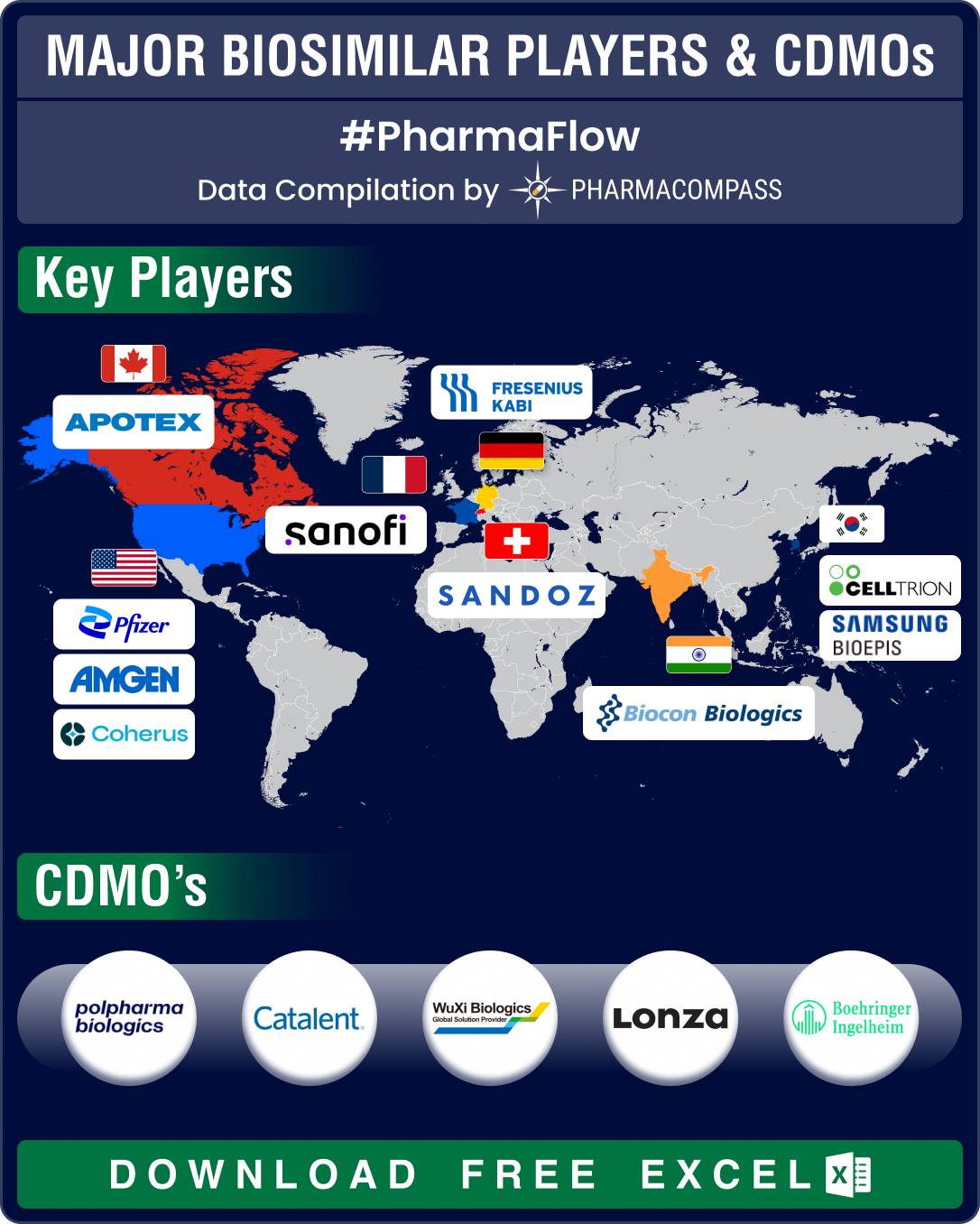
Biologics, or complex drugs that are derived from living organisms, have revolutionized treatment of various conditions such as cancer, autoimmune diseases, and chronic illnesses. In 2023, eight out of 10 of the world’s top-selling drugs were biologics, including Merck’s Keytruda, AbbVie’s Humira, and Sanofi’s Dupixent.Due to their high costs, accessibility of biologics has been a challenge. That’s why biosimilars, or game-changing copycats of biologics that provide highly similar yet more affordable alternatives to established biologics, are becoming popular.The first biosimilar — Sandoz’ Zarxio — was approved by the US Food and Drug Administration (FDA) in 2015. Its reference biologic was Amgen’s Neupogen (filgrastim).  Since then, the global market for biosimilars has been growing at an impressive pace — between 2015 and 2020, it grew at a whopping compounded annual growth rate (CAGR) of 78 percent, touching US$ 17.9 billion in size. It is expected to continue growing at a CAGR of 15 percent and reach a size of about US$ 75 billion by 2030.Major biosimilar players include Amgen, Sandoz, Samsung Bioepis, Pfizer, Biocon Biologics, Celltrion, Stada Arzneimittel, Accord Healthcare, Fresenius Kabi, Coherus Biosciences, Apotex, and Sanofi. The increasing demand for biosimilars has propelled growth in contract manufacturing. Some of the leading contract manufacturing organizations (CMOs) and contract development and manufacturing organizations (CDMOs) that manufacture biosimilars are Polpharma Biologics, Catalent, Pfizer CentreOne, Lonza, Boehringer Ingelheim BioXcellence, Thermo Fisher Scientific, WuXi Biologics, and FUJIFILM Diosynth Biotechnologies.Access the Interactive Dashboard for Biosimilar Developments (Free Excel)Amgen, Sandoz top list of ‘approved biosimilars’; FDA okays 8 copycats in H1 2024Over the recent years, regulatory agencies like the FDA and the European Medicines Agency (EMA) have established rigorous approval pathways for biosimilars.Since 2015,  FDA has approved 53 biosimilars, while the EMA has approved 86 biosimilars. Among the US, European and Canadian markets, Amgen and Sandoz are tied in the first place with 13 approved biosimilars each. Samsung Biologics has nine approved biosimilars, followed by Pfizer with eight and Biocon Biologics with seven. In the first half of this year, FDA set a record by approving eight biosimilars — the highest for H1 of any year. EMA has okayed six biosimilars so far in 2024.In 2023, five biosimilars were approved by the FDA with just one being okayed in the first half. The year marked the end of exclusivity for Humira after 20 years, in which it netted a total of US$ 200 billion in sales. AbbVie’s flagship autoimmune drug has a record 10 biosimilars.Johnson & Johnson’s Stelara also lost exclusivity in 2023 and as many as 11 drugmakers hope to bring its biosimilars to the market. Amgen’s Wezlana was the first biosimilar to Stelara, and it was approved as interchangeable by FDA in October last year.Access the Interactive Dashboard for Biosimilar Developments (Free Excel) FDA approves first interchangeable biosimilar for Eylea, cuts regulatory feeDeveloping a biosimilar costs both money and time. According to Pfizer, developing a biosimilar can take five to nine years and cost over US$ 100 million, not including regulatory fees.In October 2023, FDA slashed its fees with the program fee at US$ 177,397, down from US$ 304,162. The application fees for products that require clinical data has been set at US$ 1,018,753, down from US$ 1,746,745. The application fee for products that don’t require clinical data has been set lower — at US$ 509,377 —  down from US$ 873,373 set earlier. This reduction in application fee has propelled demand for contract manufacturing of biosimilars.There has also been a rise in approvals of interchangeable biosimilars this year. Interchangeable biosimilars meet additional requirements and may be substituted for its reference product by a pharmacist without consulting the prescriber. This year saw FDA approve the first interchangeable biosimilars for bone cancer drug denosumab (Prolia and Xgeva) in Jubbonti and Wyost as well as for eculizumab (Soliris) in Bkemv.In May, FDA approved the first interchangeable biosimilars for eye drug aflibercept (Eylea) in Opuviz and Yesafili. Other biosimilars approved in 2024 include Simlandi for adalimumab (Humira), Tyenne for tocilizumab (Actemra), Selarsdi for ustekinumab (Stelara), and Hercessi for trastuzumab (Herceptin).Access the Interactive Dashboard for Biosimilar Developments (Free Excel) Merck’s Keytruda, BMS’ Opdivo, Novartis’ Cosentyx brace for biosimilar competitionHealthcare spending in the US is projected to rise from US$ 4.5 trillion in 2022 to US$ 6 trillion by 2027. While biologics involve just two percent of prescriptions, they account for 46 percent of all pharmaceutical spending. In 2022, US$ 252 billion was spent on biologics.Biosimilar-related savings in 2023 were estimated to be US$ 9.4 billion in the US and € 10 billion (US$ 10.68 billion) in Europe. With expensive and widely used drugs like AbbVie’s Humira, J&J’s Stelara, and Regeneron’s Eylea coming under competition, US savings are projected to reach US$ 181 billion through 2027. Between 2026 and 2032, about 39 blockbusters are set to lose exclusivity in the US and Europe. Merck’s Keytruda (pembrolizumab) was the world’s top-selling drug last year, generating US$ 25 billion in sales. Its patent is set to expire in 2028 with sales expected to drop 19 percent to US$ 27.4 billion in 2029 from US$ 33.7 billion the previous year. Samsung Bioepis and Amgen initiated phase 3 trials of pembrolizumab in April and May of this year, respectively.Opdivo (nivolumab), belonging to the same class of drugs, competes with Keytruda and is also set to lose patent protection in 2028. It hauled in US$ 10 billion in total global sales in 2023 for Bristol Myers Squibb. The key patents of Novartis’ Cosentyx (secukinumab) are set to expire between 2025 and 2026. Cosentyx saw sales of US$ 5 billion in 2023. Taizhou Mabtech Pharmaceutical and Bio-Thera Solutions are conducting phase 3 trials of secukinumab.Access the Interactive Dashboard for Biosimilar Developments (Free Excel) Our viewWith over 2 billion people worldwide unable to access life-saving medicines, biosimilars hold the key to healthcare accessibility. In 2023, a record 13 biosimilars were launched in the market — the highest for a single year. And this included nine much-anticipated biosimilars to AbbVie’s Humira.  In April this year, FDA announced a Biosimilars Action Plan to streamline the development of biosimilars. With a sharp focus on biosimilars, we expect more records to be broken in the near term. New launches of biosimilars to drugs like J&J’s Stelara, Regeneron’s Eylea and Merck’s Keytruda will surely help in creating new records.

Impressions: 4509

https://www.pharmacompass.com/radio-compass-blog/fda-approves-record-eight-biosimilars-in-h1-2024-okays-first-interchangeable-biosimilars-for-eylea

#PharmaFlow by PHARMACOMPASS
27 Jun 2024

WEEKLY NEWS RECAP #Phispers

read-more
read-more
Advent to sell generic unit to PE firm GTCR for US$ 4.8 billion; Novo shapes up for obesity race by cutting 9,000 jobs
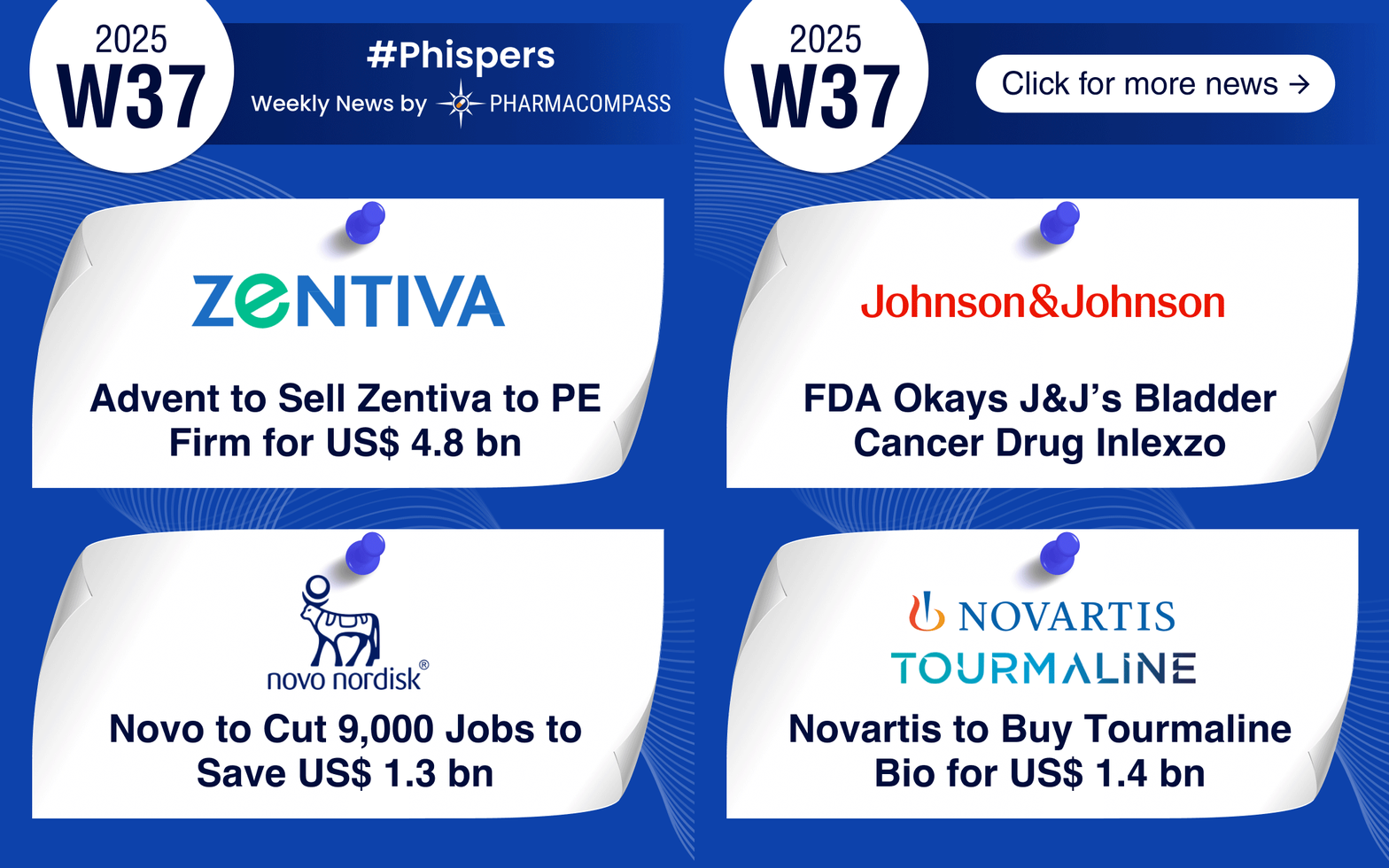
In this week’s news, Advent International has agreed to sell the Czech generic drugmaker Zentiva to private equity firm GTCR for US$ 4.8 billion. Novartis is set to acquire New York-based Tourmaline Bio for US$ 1.4 billion, thereby adding a late-stage cardiovascular therapy to its portfolio. Samsung Biologics has secured a US$ 1.3 billion manufacturing agreement with an undisclosed US drugmaker. And Hengrui Pharmaceuticals has licensed its phase 3 heart drug to Braveheart Bio in an over US$ 1 billion deal.Danish drugmaker Novo Nordisk is planning to cut 9,000 jobs and save US$ 1.3 billion annually, as it struggles to catch up with its arch rival Eli Lilly in the obesity drug market space.In drug approvals, the US Food and Drug Administration (FDA) has approved Johnson & Johnson’s Inlexzo for high-risk bladder cancer patients, and expanded the approval for Takeda’s Vonvendi. The regulator has also flagged quality lapses at Indian drugmaker Sun Pharma’s Halol plant.In clinical trials, Eli Lilly’s approved blood cancer med Jaypirca has shown strong results in a phase 3 blood cancer trial, advancing it as a potential first-line treatment option. And BioNTech and China’s Duality Biologics said their investigational breast cancer drug, trastuzumab pamirtecan, did better than Roche’s Kadcyla in a late-stage study.GTCR to buy generic drugmaker Zentiva in US$ 4.8 billion dealPrivate equity firm GTCR has agreed to buy Czech generic drugmaker Zentiva from Advent International in a deal valued at €4.1 billion (approximately US$ 4.8 billion), the Financial Times reported. Boston-based Advent had purchased Zentiva from Sanofi in 2018 for €1.9 billion (around US$ 2.18 billion) and is now exiting at more than double that value. Zentiva, headquartered in Prague, makes generic and over-the-counter medicines such as paracetamol and co-codamol. The deal comes just a week after private equity group CapVest bought a majority stake in rival Stada for €10 billion (US$ 11.7 billion), showing rising interest in Europe’s generics sector.Permira looks to sell Cambrex: Private equity firm Permira is planning to sell Cambrex, a US-based contract drug manufacturer organization (CDMO), in a deal that could be worth up to US$ 4 billion, the Financial Times reported. Permira had bought Cambrex in 2019 for US$ 2.4 billion.Novo shapes up for obesity race: cuts 9,000 jobs to save US$ 1.3 bn annuallyNovo Nordisk, the Danish drugmaker that manufactures Ozempic and Wegovy (both semaglutide), will cut 9,000 jobs — or about 11 percent of its workforce — in its biggest restructuring ever. Of the total, about 5,000 cuts will be in Denmark, marking the country’s largest round of layoffs. The move is aimed at saving 8 billion Danish kroner (around US$ 1.3 billion) annually, which will be reinvested into drug development and sales. The shake-up comes as Novo struggles to catch up with Eli Lilly, which has overtaken it in the booming obesity drug market. Novo’s sales growth has slowed down and the company has issued three profit warnings in 2025.Novartis to buy Tourmaline Bio for US$ 1.4 bn: Novartis will acquire Tourmaline Bio for US$ 1.4 billion. The boards of both companies have unanimously approved the deal, which is expected to close in the fourth quarter of 2025. FDA okays J&J’s bladder cancer drug Inlexzo; expands approval of Takeda’s VonvendiFDA has approved Johnson & Johnson’s Inlexzo (gemcitabine intravesical system), a new drug delivery system for patients with high-risk non-muscle invasive bladder cancer (NMIBC) who do not respond to a type of immunotherapy (known as Bacillus Calmette-Guérin therapy) and are ineligible or unwilling to undergo bladder removal surgery. Inlexzo slowly releases the chemotherapy drug gemcitabine inside the bladder. Inlexzo offers a less invasive alternative and is also being tested in other bladder cancer settings.The regulator has also expanded the approval for Takeda’s Vonvendi (vonicog alfa), a treatment for a lifelong, inherited bleeding disorder known as von Willebrand disease (VWD). With the expanded approval, Vonvendi can now be used as a prophylaxis to reduce frequency of bleeding episodes in adults with VWD. It can also be used in children who suffer from VWD (for on-demand and preoperative management of bleeding).Hengrui licenses its phase 3 heart drug to Braveheart; Samsung Biologics signs US$ 1.3 bn dealHengrui Pharmaceuticals has licensed its phase 3 drug HRS-1893 to Braveheart Bio, a Delaware-based startup founded in 2024.Braveheart will hold exclusive rights to develop and commercialize HRS-1893, a therapy for obstructive hypertrophic cardiomyopathy (oHCM), outside mainland China, Hong Kong, Macao and Taiwan. HRS-1893 reduces abnormal heart muscle contraction and helps prevent ventricular thickening in oHCM.Under the terms of the agreement, Hengrui will receive US$ 65 million upfront from Braveheart Bio, along with US$ 10 million in additional near-term payments once the transfer of certain technologies has been completed.Samsung Biologics’ US$ 1.3bn deal: Samsung Biologics has signed a 1.8 trillion won (US$ 1.3 billion) manufacturing agreement with an undisclosed US-based drugmaker. The contract, running through 2029, marks the company’s second-largest deal since it was founded in 2011.Lilly’s Jaypirca shows strong results in first-line blood cancer trialEli Lilly said its blood cancer drug Jaypirca (pirtobrutinib) slowed disease progression in people with newly diagnosed chronic lymphocytic leukemia (CLL) or small lymphocytic lymphoma (SLL). The phase 3 study found that patients taking Jaypirca lived longer without their cancer getting worse compared to those on standard treatments.Launches AI platform to support drug discovery:  Eli Lilly has launched TuneLab, an artificial intelligence platform designed to speed up drug discovery. Lilly is now inviting early-stage biotechs to make use of its drug discovery models provided through this machine learning platform, which has been trained on years of Lilly’s research. Lilly has said the platform could lower costs, reduce animal testing, and accelerate development of new medicines.BioNTech, DualityBio’s breast cancer med beats Roche’s Kadcyla in late trialBioNTech and China’s Duality Biologics said their investigational breast cancer drug, trastuzumab pamirtecan, did better than Roche’s Kadcyla (ado-trastuzumab emtansine) in a late-stage study. The trial tested patients with advanced HER2-positive breast cancer who had already been treated with chemotherapy and Herceptin. The companies plan to seek approval in China.FDA flags Sun Pharma’s Halol plant for quality lapses: FDA has classified Sun Pharma’s Halol plant in Gujarat (India) as Official Action Indicated (OAI) post an inspection from June 2 to 13. The site is already under import alert. Sun Pharma has said it will work with the FDA to fix the issues and ensure compliance. 

Impressions: 1219

https://www.pharmacompass.com/radio-compass-phisper/advent-to-sell-generic-unit-to-pe-firm-gtcr-for-us-4-8-billion-novo-shapes-up-for-obesity-race-by-cutting-9-000-jobs

#Phispers by PHARMACOMPASS
11 Sep 2025

NEWS #PharmaBuzz

read-more
read-more

https://endpoints.news/roche-says-its-investigational-breast-cancer-pill-could-outsell-herceptin/

ENDPOINTS
23 Apr 2026

https://economictimes.indiatimes.com/industry/healthcare/biotech/biocon-biologics-to-introduce-3-new-biosimilars-for-cancer-treatment/articleshow/126376289.cms

ECONOMICTIMES
06 Jan 2026

https://www.prnewswire.com/news-releases/actinium-pharmaceuticals-announces-atnm-400-data-demonstrating-potent-efficacy-in-triple-negative-breast-cancer-and-ability-to-overcome-endocrine-and-her2-targeted-therapy-resistance-being-presented-at-the-san-antonio-breast-cance-302629128.html

PR NEWSWIRE
01 Dec 2025

https://www.prnewswire.com/news-releases/prestige-biopharma-and-biosidus-enter-exclusive-license-agreement-for-tuznue-commercialization-in-latin-america-302626228.html

PR NEWSWIRE
26 Nov 2025

https://www.globenewswire.com/news-release/2025/10/20/3169816/0/en/Teva-and-Prestige-Biopharma-Enter-License-Agreement-for-Tuznue-Commercialization-in-Europe.html

GLOBENEWSWIRE
20 Oct 2025

https://www.prnewswire.com/news-releases/alteogen-receives-european-commission-approval-for-aflibercept-biosimilar-eyluxvi-alt-l9-302558913.html

PR NEWSWIRE
17 Sep 2025