Please Wait
Applying Filters...
Menu
Xls

Digital Content read-more

Create Content with PharmaCompass, ask us

DATA COMPILATION #PharmaFlow

read-more
read-more
Top Pharma Companies & Drugs in 2025: Lilly vaults eight spots to emerge at the top; GLP-1 drugs dominate list
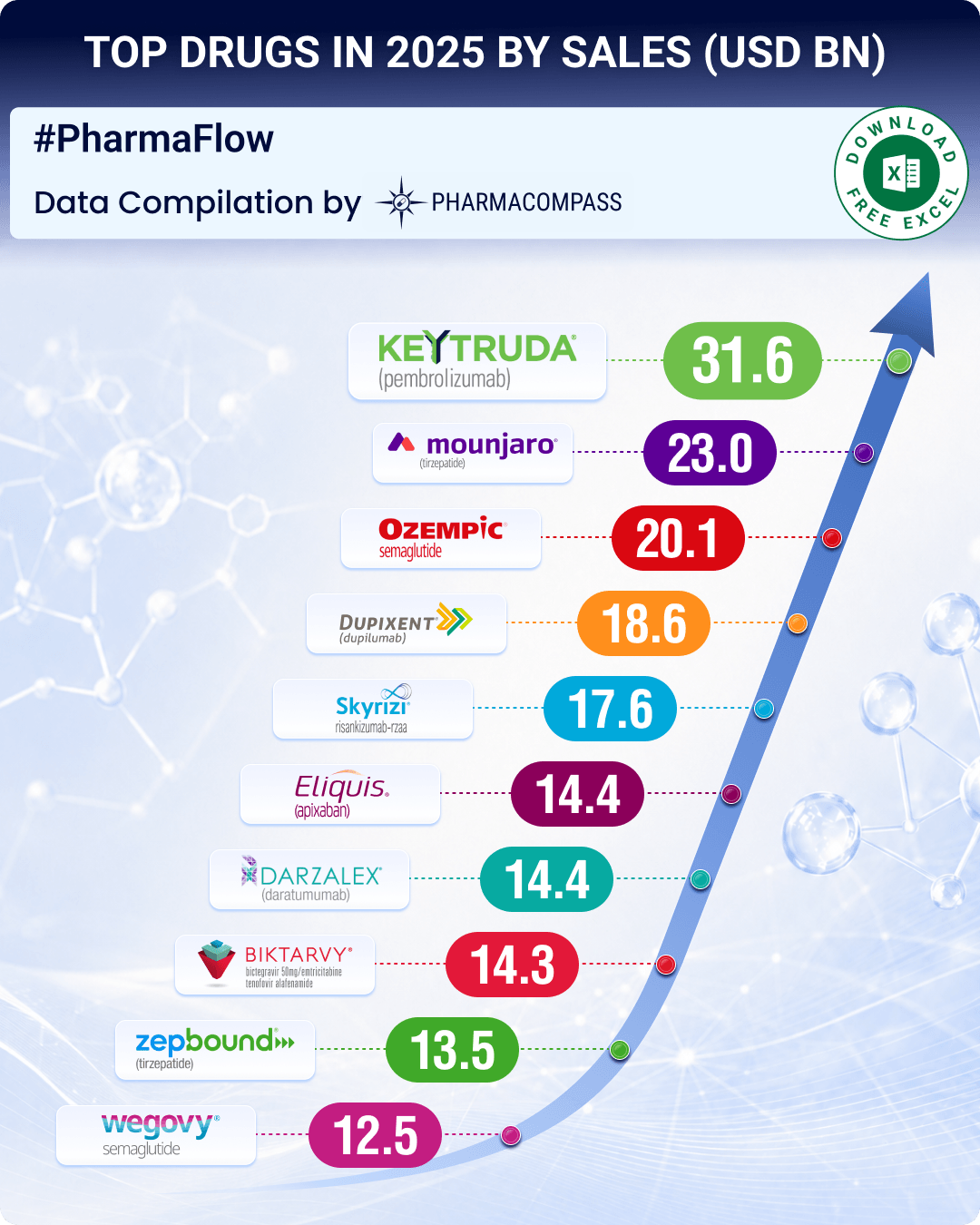
For the pharmaceutical industry, 2025 was a watershed year when obesity drugs settled firmly in the mainstream market. Glucagon-like peptide-1 (GLP-1) receptor agonists that treat diabetes and help in weight loss, dominated our top 10 list of drugs with four entries — Mounjaro (tirzepatide), Ozempic (semaglutide), Zepbound (tirzepatide) and Wegovy (semaglutide).In 2024, the top 10 drugs generated a total revenue of US$ 142 billion. This figure rose significantly in 2025, climbing to US$ 180.02 billion, reflecting strong growth.The year unequivocally belonged to Eli Lilly. The Indiana-headquartered drugmaker made a dramatic ascent, leaping from the ninth spot in 2024 to the numero uno position in our top drugmakers’ list for 2025. It posted 45 percent growth in sales, which rose to US$ 65.18 billion in 2025.In terms of therapeutic areas, oncology saw the maximum sales (at US$ 229.1 billion), followed by immunology (US$ 126.8 billion), infectious diseases (US$ 99.2 billion), diabetes (US$ 95.8 billion), neurology (US$ 70.4 billion), cardiology (US$ 67.6 billion) and hematology (US$ 29.3 billion). View Our Interactive Dashboard on Top Drugs in 2025 by Sales (Free Excel Available)Lilly zooms past Pfizer on back of tirzepatide franchise; Roche, AbbVie, J&J make it to top five Eli Lilly’s spectacular climb to the number one spot was driven by Mounjaro and Zepbound. Mounjaro leapt from the eighth spot in 2024 (when its sales stood at US$ 11.5 billion) to the number two position in 2025, raking in US$ 23 billion. Lilly’s other GLP-1 drug, Zepbound, also broke into the top 10, debuting at number nine with sales of US$ 13.5 billion. Taken together, Lilly’s tirzepatide franchise hit US$ 36.50 billion in 2025, surpassing Merck's Keytruda (pembrolizumab).At the number two position was Pfizer, with sales of US$ 62.58 billion. Notably, not a single Pfizer drug made it to the top 10 list. Pfizer’s sales fell by 1.63 percent in 2025, from US$ 63.63 billion in 2024. The decline was attributed to lower Covid‑19 revenues due to reduced infection rates, which impacted Paxlovid (nirmatrelvir/ritonavir) sales, and a narrower US vaccine recommendation, which affected Comirnaty (tozinameran) sales.Roche came third, reporting sales of CHF 47.7 billion  (US$ 62.10 billion) in 2025, compared to CHF 46.2 billion (US$ 50.86 billion) in 2024.At number four was AbbVie — it reported full-year net revenues of US$ 61.16 billion in 2025, compared to US$ 56.33 billion in 2024. The company’s immunology portfolio remained a key driver, bringing in US$ 30.41 billion in sales. Skyrizi (risankizumab) — approved for plaque psoriasis, psoriatic arthritis, Crohn’s disease, and ulcerative colitis — emerged as a major growth engine, with sales of US$ 17.56 billion.Rounding out the top five was Johnson & Johnson, whose innovative medicine division reported sales of US$ 60.4 billion, up from US$ 56.9 billion in 2024. View Our Interactive Dashboard on Top Drugs in 2025 by Sales (Free Excel Available)Merck’s Keytruda retains top-selling drug status, followed by Lilly’s Mounjaro, Novo’s OzempicMerck’s Keytruda retained its position as the world’s best-selling drug for the third consecutive year, generating approximately US$ 31.6 billion in sales, up from US$ 29.5 billion in 2024 and US$ 25 billion in 2023. Keytruda has become the pillar of cancer immunotherapy, with over 40 indications. The launch of Keytruda Qlex, a subcutaneous formulation co-administered with berahyaluronidase alfa, has further strengthens its lifecycle.Amongst other oncology drugs, J&J’s Darzalex (daratumumab) generated US$ 14.4 billion in sales, taking it to the number seven spot. Its strong performance has been supported by Darzalex Faspro, a subcutaneous formulation launched in 2020 that significantly reduces administration time. Growth from Darzalex and other brands helped offset the decline in Stelara (ustekinumab), whose sales fell 41 percent to US$ 6.1 billion, from US$ 10.4 billion in 2024.Among diabetes, obesity and metabolic drugs, Lilly’s Mounjaro was at the number two spot,  followed by Novo Nordisk’s Ozempic at number three. Ozempic posted sales of US$ 20.09 billion. Lilly’s Zepbound was at the ninth spot, with sales of US$ 13.54 billion. Novo’s Wegovy was tenth, with sales of US$ 12.5 billion. Together with Rybelsus, Novo’s semaglutide franchise generated approximately US$ 36.1 billion in 2025 sales.In immunology, Sanofi and Regeneron’s Dupixent (dupilumab) stood fourth and maintained its leadership with sales of US$ 18.6 billion. Dupixent is now approved across nine indications.At fifth position was another immunology drug — AbbVie’s Skyrizi (risankizumab). It has emerged as AbbVie’s key growth engine post‑Humira (adalimumab), delivering 49.87 percent growth and generating US$ 17.56 billion in 2025 sales. First approved in April 2019 for plaque psoriasis, it is now approved across four indications.The other drugs in our top 10 list were Eliquis (apixaban) and Biktarvy (bictegravir/emtricitabine/tenofovir alafenamide). Eliquis, co-developed and commercialized by Bristol Myers Squibb and Pfizer, stood sixth with sales of US$ 14.4 billion. Gilead’s Biktarvy (bictegravir/emtricitabine/tenofovir alafenamide) held the number eight position, with sales of US$ 14.3 billion in 2025. The drug commands over 52 percent of the US market for HIV treatments. View Our Interactive Dashboard on Top Drugs in 2025 by Sales (Free Excel Available)Astra’s revenue rises by 8.6 percent; Merck, Novartis, Sanofi, Novo make it to top 10 AstraZeneca’s revenues increased 8.6 percent to US$ 58.73 billion, compared to US$ 54.10 billion in 2024, though its ranking fell from fifth to sixth position in 2025. Astra’s revenue growth was driven by strong performance across oncology, cardiovascular, renal and metabolism, respiratory and immunology, and rare disease portfolios. Farxiga (dapagliflozin), a drug used to manage blood sugar, was a key driver, generating US$ 8.4 billion in revenue in 2025.At number seven was Merck, with sales of US$ 58.1 billion, reflecting a modest growth of 1.3 percent, which was driven by Keytruda.Novartis stood eighth on our 2025 list (against seventh in 2024), with net sales of US$ 54.5 billion in 2025, up from US$ 50.3 billion in 2024. Sanofi landed at the ninth position, with sales of US$ 51.7 billion, against US$ 42.6 billion in 2024. Novo Nordisk rounded out the top ten, posting revenues of DKK 309.06 bn (US$ 48.7 billion) in 2025 — a growth of 21.37 percent compared to DKK 290.40 billion (US$ 40.2 billion) in 2024 — driven primarily by its obesity and diabetes care portfolio. View Our Interactive Dashboard on Top Drugs in 2025 by Sales (Free Excel Available)Our viewThe 2025 rankings confirm what analysts have been expecting for some time — that the market for anti-obesity drugs could reach US$ 100 billion by 2030. The four GLP-1 drugs in our 2025 list together generated combined revenue of approximately US$ 70 billion. At this pace, the US$ 100 billion market size may arrive sooner than projected, perhaps as early as 2026 or 2027.

Impressions: 646

https://www.pharmacompass.com/radio-compass-blog/top-pharma-companies-drugs-in-2025-lilly-vaults-eight-spots-to-emerge-at-the-top-glp-1-drugs-dominate-list

#PharmaFlow by PHARMACOMPASS
11 Jun 2026

STOCK RECAP #PipelineProspector

read-more
read-more
Pipeline Prospector October 2025: Novartis to buy Avidity for US$ 12 bn; FDA approves Bayer’s med to treat hot flashes
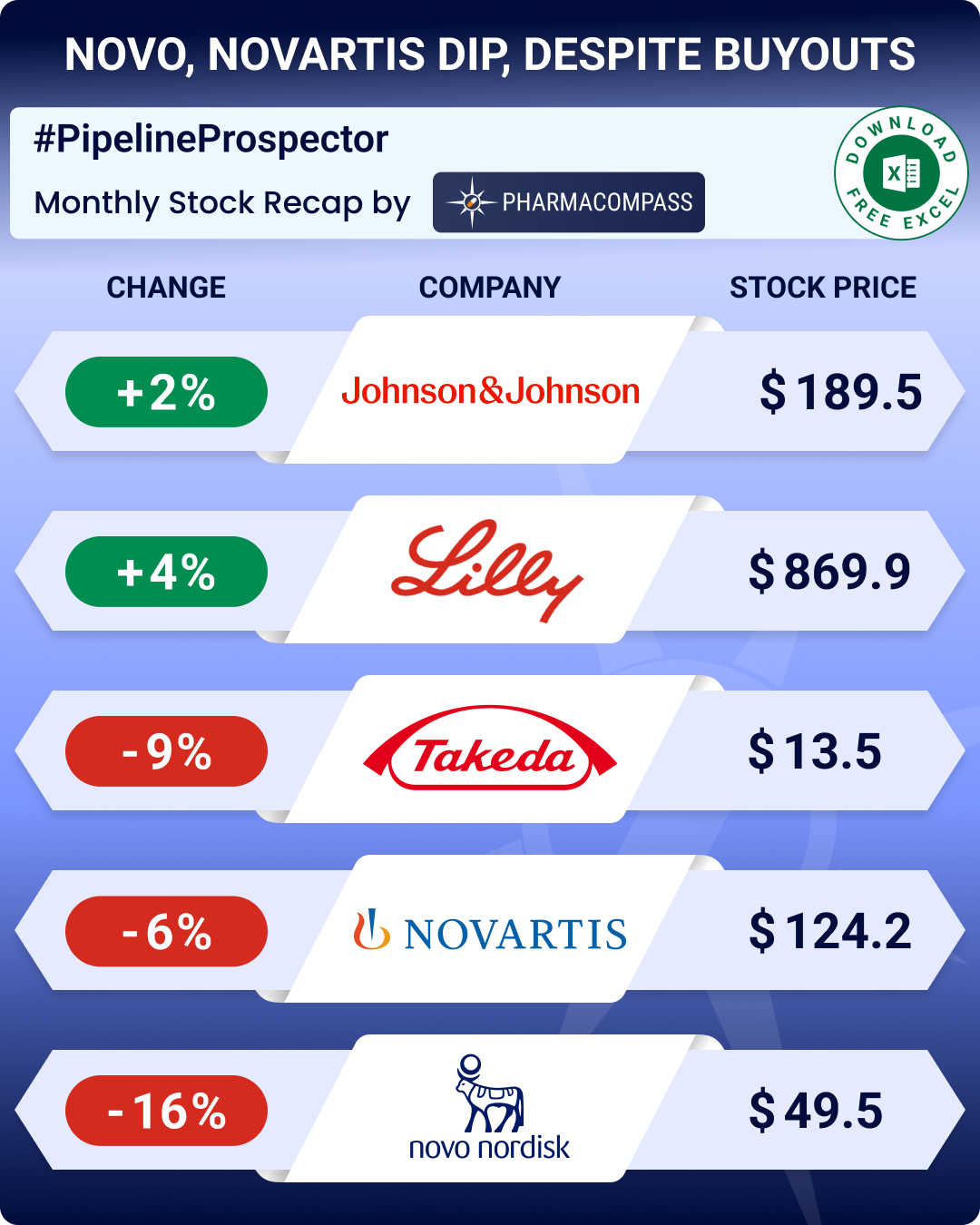
October was abuzz with dealmaking. Pharma majors such as Novartis, Novo Nordisk, and Bristol Myers Squibb (BMS) led the acquisition wave, targeting innovative platforms in rare muscle disorders, metabolic diseases, and next-generation cell therapy for autoimmune diseases. The US Food and Drug Administration (FDA) approved Bayer’s Lynkuet (elinzanetant) — the first-of-its-kind oral non-hormonal drug to treat moderate to severe hot flashes in menopausal women. The agency also expanded the indication for Teva Pharmaceuticals and Medincell’s schizophrenia drug received Uzedy (risperidone), allowing it to be used for the maintenance treatment of bipolar I disorder in adults.In clinical trials, companies such as Eli Lilly and AstraZeneca reported positive data, while Moderna and Alector announced late-stage trial setbacks.The pharma indices continued to march upwards. The Nasdaq Biotechnology Index (NBI) rose nine percent, climbing from 4,916.11 at the end of September to 5,366.46 in October, while the SPDR S&P Biotech ETF (XBI) gained 13 percent from 100.11 to 112.71. The S&P Biotechnology Select Industry Index (SPSIBI) also advanced 13 percent from 7,805.59 to 8,789.9. Access the Pipeline Prospector Dashboard for October 2025 Newsmakers (Free Excel) Novartis to acquire Avidity for US$ 12 bn; Novo in up to US$ 5.2 bn deal to buy Akero The month saw several big M&A deals. Novartis entered into an agreement to acquire Avidity Biosciences for about US$ 12 billion in cash, in a bid to bolster its portfolio of treatments for rare muscle disorders. In September too, Novartis had struck four deals valued at over US$ 14 billion.Novo Nordisk announced it will acquire Akero Therapeutics, a San Francisco-based clinical-stage biotech, in a deal valued at up to US$ 5.2 billion. The agreement includes an upfront payment of US$ 4.7 billion, with additional milestone payments contingent on FDA approval of Akero’s lead candidate, efruxifermin, by mid-2031. Efruxifermin is being developed as a treatment for metabolic dysfunction-associated steatohepatitis (MASH), a serious liver disease.Bristol Myers Squibb announced the acquisition of privately-held biotech Orbital Therapeutics in a US$ 1.5 billion all-cash deal. Orbital is developing new generation, RNA-based medicines.France’s Ipsen announced the acquisition of ImCheck Therapeutics for up to €1 billion (approximately US$ 1.16 billion) to enhance its oncology pipeline. Access the Pipeline Prospector Dashboard for October 2025 Newsmakers (Free Excel)  FDA approves Bayer’s non-hormonal drug to treat hot flashes in menopausal women; okays Teva’s Uzedy for bipolar I disorderOctober brought good news for menopausal women dealing with hot flashes. FDA approved Bayer’s Lynkuet (elinzanetant) — the first-of-its-kind oral non-hormonal drug to treat moderate to severe hot flashes in menopausal women.Teva Pharmaceuticals and Medincell received FDA’s approval for expanding the indication of Uzedy (risperidone). An injection of Uzedy can be administered once a month as a maintenance treatment of bipolar I disorder in adults. Uzedy was approved in 2023 for schizophrenia.FDA also expanded the approval of Novo Nordisk’s Rybelsus (semaglutide) for use in adults with type 2 diabetes to reduce the risk of major adverse cardiovascular events. Rybelsus, the first and only FDA-approved GLP-1 drug, was first approved in 2019.Meanwhile, Glaukos’ Epioxa (riboflavin 5'-phosphate) was cleared by the FDA for treating keratoconus, a rare, progressive eye disorder that thins and bulges the cornea. The non-surgical therapy offers an incision-free option for patients at risk of vision loss.FDA also approved Regeneron’s immunotherapy Libtayo (cemiplimab) to help prevent relapse in adults with high-risk cutaneous squamous cell carcinoma after surgery and radiation. Access the Pipeline Prospector Dashboard for October 2025 Newsmakers (Free Excel)  Innovent, Takeda sign up to US$ 11.4 bn oncology deal; J&J to spin off its orthopedics businessInnovent Biologics has signed a deal worth up to US$ 11.4 billion with Takeda Pharmaceutical to co-develop two next-generation cancer therapies. The collaboration covers an antibody-drug conjugate (ADC) and a fusion protein, targeting a range of solid tumors, including lung, colorectal, gastric, and pancreatic cancers. Takeda will hold commercialization rights for both therapies outside the US and Greater China, while the companies will jointly develop and commercialize one of the drugs, IBI363, in the US.Novo Nordisk has signed a deal worth up to US$ 2.1 billion with Omeros Corporation for rights to develop and commercialize zaltenibart (OMS906), Omeros’ experimental drug for rare blood and kidney disorders. The deal strengthens Novo Nordisk’s rare disease portfolio.Massachusetts-based Zenas BioPharma entered into a licensing agreement worth over US$ 2 billion with China’s InnoCare Pharma for orelabrutinib, an oral treatment for multiple sclerosis (a chronic disease in which the immune system attacks the brain and spinal cord).  And Johnson & Johnson announced it will spin off its orthopedics business, DePuy Synthes, into a separate company within 18 to 24 months.Besides these deals, the month saw several capacity expansions. Merck broke ground on a US$ 3 billion plant at its Elkton, Virginia campus, as part of a wider US$ 70 billion commitment to expand manufacturing, R&D, and capital projects in the US. Similarly, AstraZeneca announced a US$ 4.5 billion investment to build a state-of-the-art manufacturing facility in Virginia, as part of its US$ 50 billion investment plan for the US.Eli Lilly said it plans to invest over US$ 1 billion in India over the next few years to boost drug manufacturing and supply through partnerships with local producers. Lilly will also invest over US$ 1.2 billion to expand its manufacturing site in Puerto Rico. Access the Pipeline Prospector Dashboard for October 2025 Newsmakers (Free Excel)  Lilly’s orforglipron scores trial wins in diabetes; Astra-Daiichi breast cancer med shows promise Eli Lilly’s oral GLP-1 drug orforglipron scored two major phase 3 wins in diabetes, outperforming AstraZeneca’s Farxiga (dapagliflozin) and a placebo in separate studies.In a phase 3 trial, AstraZeneca’s experimental drug baxdrostat significantly lowered blood pressure in patients with treatment-resistant hypertension. AstraZeneca and Daiichi Sankyo’s Datroway (datopotamab deruxtecan), an antibody-drug conjugate, significantly improved survival in patients with metastatic triple-negative breast cancer compared to chemotherapy in a phase 3 clinical trial.In trial failures, Moderna said it will stop developing its experimental vaccine, mRNA-1647, designed to prevent cytomegalovirus (CMV), a virus that can cause birth defects, after it failed to meet the main goal in a phase 3 trial. Similarly, Alector stopped developing its GSK-partnered experimental dementia drug, latozinemab, after it failed to help patients in a major phase 3 trial. Access the Pipeline Prospector Dashboard for October 2025 Newsmakers (Free Excel)  Our viewWith drugs like Bayer’s Lynkuet bagging approval, we see both innovation and competition steering the pharma industry into 2026. Novo Nordisk’s US$ 8.5 billion bid to acquire US-based obesity biotech Metsera, surpassing Pfizer’s US$ 7.3 billion offer, underscores where much of the excitement lies — the rapidly expanding US$150 billion weight loss drugs market. The pharmaceutical industry seems to be on a high-speed treadmill, with no scope for sluggishness. Access the Pipeline Prospector Dashboard for October 2025 Newsmakers (Free Excel)  

Impressions: 5637

https://www.pharmacompass.com/pipeline-prospector-blog/pipeline-prospector-october-2025-novartis-to-buy-avidity-for-us-12-bn-fda-approves-bayer-s-med-to-treat-hot-flashes

#PharmaFlow by PHARMACOMPASS
06 Nov 2025

WEEKLY NEWS RECAP #Phispers

read-more
read-more
Novo targets MASH with up to US$ 5.2bn Akero buy; BMS acquires cell therapy developer Orbital for US$ 1.5 bn
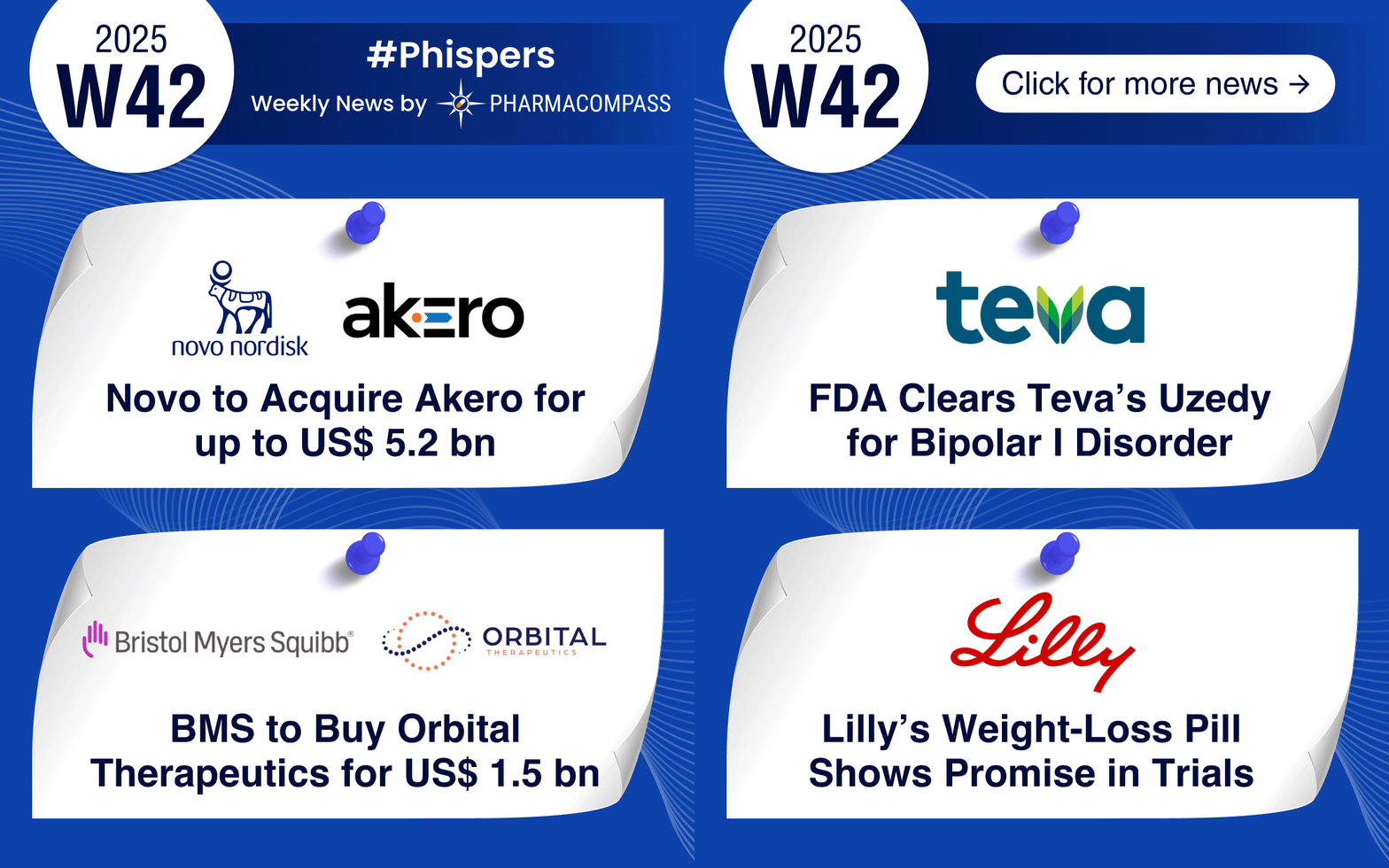
In this week’s Phispers, Novo Nordisk and Bristol Myers Squibb (BMS) struck multi-billion-dollar acquisitions to expand their metabolic and cell therapy portfolios, respectively. Takeda deepened its AI-driven drug discovery collaboration with Nabla Bio to develop protein-based drugs. And Boehringer Ingelheim signed a licensing agreement with South Korea’s AimedBio to develop a potential best-in-class antibody-drug conjugate (ADC) therapy for cancer.In approvals, the US Food and Drug Administration (FDA) approved Teva and Medincell’s Uzedy as maintenance therapy for bipolar I disorder and expanded the use of AbbVie’s Rinvoq for ulcerative colitis and Crohn’s disease. The agency also added a safety warning to Johnson & Johnson and Legend Biotech’s Carvykti.In clinical trials, Pfizer reported promising results from its phase 3 HER2+ breast cancer study, raising hopes for a first-line treatment. And Eli Lilly’s experimental weight loss drug — orforglipron — showed superior blood sugar control in diabetic patients across two late-stage trials.Meanwhile, several pharmaceutical companies announced plans to sell medicines directly to patients in the US and cut prices ahead of the planned launch of TrumpRx.gov in early 2026. Separately, US lawmakers revived a softer version of the Biosecure Act, which could reshape global biotech partnerships and benefit non-Chinese contract manufacturers.Novo to acquire Akero for up to US$ 5.2 bn; signs up to US$ 2.1 bn licensing deal with OmerosNovo Nordisk has agreed to acquire Akero Therapeutics, a South San Francisco-based clinical-stage biotech developing treatments for metabolic diseases, for up to US$ 5.2 billion. The deal includes an upfront payment of US$ 4.7 billion, with additional payments linked to Akero’s lead drug, efruxifermin, receiving an FDA approval by mid-2031. Efruxifermin is being developed to treat metabolic dysfunction-associated steatohepatitis (MASH), a serious liver disease linked to obesity and diabetes. Novo plans to advance the drug’s phase 3 trials and integrate it with its existing metabolic portfolio, including obesity drug Wegovy (semaglutide).Novo also signed a licensing deal worth up to US$ 2.1 billion with American biotech Omeros for the latter’s experimental drug for rare blood and kidney disorders. Under the deal, Novo gains exclusive global rights to develop and commercialize Omeros’ drug zaltenibart.BMS to buy cell therapy developer Orbital for US$ 1.5 bn; Takeda expands AI deal with Nabla BioBristol Myers Squibb will acquire privately-held biotech Orbital Therapeutics for US$ 1.5 billion in cash. Orbital is working on in vivo CAR-T, a novel approach to treat autoimmune diseases. With this deal, BMS expands its portfolio and gains access to its lead candidate, OTX-201, designed to target autoimmune diseases. Unlike traditional CAR-T therapies made outside the body, OTX-201 works inside the body. The patient’s own body becomes the site of CAR-T cell generation, bypassing the need for external cell engineering.Takeda expands AI drug discovery deal with Nabla Bio: Japanese drugmaker Takeda Pharmaceutical has signed a new multi-year partnership with US-based biotech Nabla Bio to use artificial intelligence (AI) for designing protein-based drugs. The agreement builds on a 2022 collaboration between the two companies.Boehringer licenses cancer drug from AimedBio: Boehringer Ingelheim has signed a global licensing agreement worth up to US$ 991 million with South Korea-based biotech AimedBio to develop a potential best-in-class antibody-drug conjugate (ADC) therapy for cancer.FDA expands use of Teva-Medincell’s Uzedy as maintenance treatment for bipolar I disorderFDA has approved Teva Pharmaceuticals and Medincell’s Uzedy (risperidone) as a once-monthly extended-release injection for the maintenance treatment of adults with bipolar I disorder (a serious mental illness marked by alternating episodes of mania and depression). Uzedy, previously approved in 2023 for schizophrenia, is the first subcutaneous, long-acting formulation of risperidone.Expands use of AbbVie’s Rinvoq: AbbVie’s Rinvoq (upadacitinib), an oral medicine for inflammatory bowel disease, has received FDA approval with a broader use. It can now be prescribed to adults with moderately to severely active ulcerative colitis or Crohn’s disease not only if standard treatments — known as TNF blockers (or drugs that reduce inflammation in the immune system) — don’t work, but also if doctors feel TNF blockers are not suitable for a patient.Adds boxed warning to J&J’s Carvykti: FDA has added a boxed warning to J&J and Legend Biotech’s CAR-T therapy Carvykti (ciltacabtagene autoleucel), used to treat multiple myeloma. The warning highlights the risk of immune effector cell-associated enterocolitis (IEC-EC), a serious intestinal inflammation that can cause diarrhea, stomach pain, weight loss, and, in severe cases, bowel perforation or sepsis.Pfizer’s drug shows promise as maintenance therapy for HER2+ breast cancerPfizer reported positive results from its phase 3 trial, testing oral drug Tukysa (tucatinib) as a first-line maintenance therapy for HER2-positive metastatic breast cancer. The study showed Tukysa significantly delayed disease progression or death while maintaining a tolerable safety profile. Currently approved for later-line HER2+ breast cancer, Tukysa could now move into early-line treatment, offering a chemotherapy-free maintenance therapy option to breast cancer patients.Lilly’s orforglipron scores two trial wins in diabetes: Eli Lilly’s experimental weight loss drug — orforglipron — showed superior blood sugar control in diabetic patients across two late-stage trials. In one trial, the drug beat AstraZeneca’s Farxiga (dapagliflozin)at lowering patients’ blood sugar levels. In the second trial, it performed better than placebo on the same measure in patients who were also taking insulin.Drugmakers expand direct-to-patient sales, offer discounts ahead of TrumpRx.gov launchSeveral pharmaceutical companies are offering drugs directly to patients in the US and cutting prices, after Trump’s push to lower prescription costs and reduce middlemen like pharmacies and insurers. The US administration plans to launch TrumpRx.gov in early 2026, a website providing discounted medicines. AbbVie, Bristol-Myers Squibb, Eli Lilly, Novo Nordisk, Pfizer, Roche, Sanofi, and Zealand Pharma have announced initiatives, including discounted sales and direct-to-consumer shipping.Astra joins TrumpRx program: British drugmaker AstraZeneca has reached an agreement with Trump administration to lower US drug prices and sell some medicines directly to patients through the TrumpRx.gov website. Eligible patients with prescriptions for chronic diseases could receive discounts of up to 80 percent off list prices.Senate okays new version of Biosecure Act: The US Senate has approved a new version of the Biosecure Act that seeks to limit American biotech and pharmaceutical companies from working with Chinese firms that are considered national security risks. The measure, added as an amendment to the National Defense Authorization Act (NDAA), replaces an earlier, stricter version that had directly named Chinese companies, such as WuXi AppTec and WuXi Biologics. 

Impressions: 1219

https://www.pharmacompass.com/radio-compass-phisper/novo-targets-mash-with-up-to-us-5-2bn-akero-buy-bms-acquires-cell-therapy-developer-orbital-for-us-1-5-bn

#Phispers by PHARMACOMPASS
16 Oct 2025

NEWS #PharmaBuzz

read-more
read-more

https://www.prnewswire.com/news-releases/lilly-to-present-new-data-on-foundayo-mounjaro-and-retatrutide-at-the-american-diabetes-associations-86th-scientific-sessions-building-toward-a-new-era-of-choice-in-diabetes-and-obesity-care-302783855.html

PR NEWSWIRE
28 May 2026

https://www.accessdata.fda.gov/scripts/cder/daf/index.cfm?event=overview.process&ApplNo=220679

FDA
06 May 2026

https://octaviuspharma.com/blogs/anti-diabetic-dc-granules-sitagliptin-empagliflozin-dapagliflozin-metformin-formulations/

PRESS RELEASE
04 May 2026

https://economictimes.indiatimes.com/industry/healthcare/biotech/pharmaceuticals/lupin-launches-generic-anti-diabetic-tablets-in-us/articleshow/130433349.cms

ECONOMICTIMES
22 Apr 2026

https://www.fda.gov/drugs/drug-alerts-and-statements/fda-approves-first-generic-dapagliflozin-tablets

FDA
13 Apr 2026

https://www.prnewswire.com/news-releases/lupin-launches-dapagliflozin-tablets-in-the-united-states-302739436.html

PR NEWSWIRE
10 Apr 2026