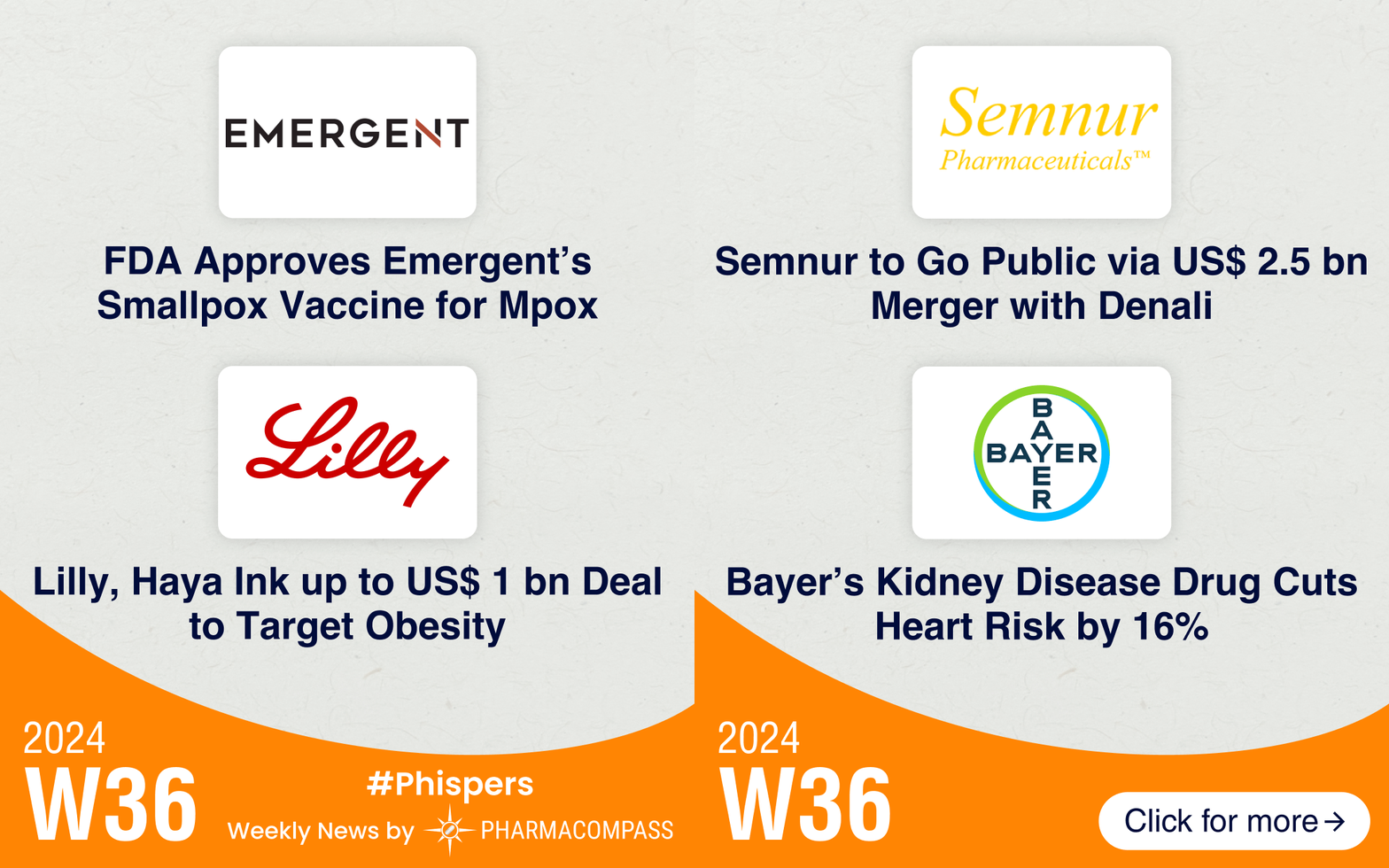
This week saw the US Food and Drug Administration (FDA) respond to the global monkeypox (mpox) public health emergency by expanding the approval of Emergent BioSolutions’ smallpox vaccine ACAM2000 for mpox.Eli Lilly has signed a potential US$ 1 billion multi-year
deal with Swiss biotech Haya Therapeutics in order to deepen its capabilities
in the obesity space.In the realm of multiple sclerosis (MS), Sanofi’s tolebrutinib has missed primary endpoints in two late-stage trials. However, it became the first drug to demonstrate a reduction in disability progression for non-relapsing secondary progressive MS.Recursion Pharmaceuticals reported mixed data for its AI-identified drug candidate REC-994 in treating a rare brain condition. And Arrowhead’s plozasiran showed promise in treating a rare lipid disorder in a late-stage trial.Meanwhile, Semnur Pharmaceuticals, a developer of non-opioid pain therapies, is merging with a special purpose acquisition company Denali Capital Acquisition in a deal worth US$ 2.5 billion. The new entity will be publicly listed. Similarly, Eli Lilly’s partner BioAge has revealed its plans to come out with an initial public offering (IPO), the proceeds of which will be used to capitalize on the obesity market.And a Reuters report has revealed that despite price negotiations under the Inflation Reduction Act (IRA), the 10 drugs with maximum price under Medicare still cost double or more than what drugmakers have agreed upon in Australia, Canada, Japan and Sweden.FDA approves Emergent Bio’s smallpox vaccine for monkeypoxFDA has signed off on the approval of Emergent BioSolutions’ smallpox vaccine ACAM2000 for mpox. ACAM2000 joins Bavarian Nordic’s Jynneos as the only FDA-approved shots for mpox. Both contain the vaccinia virus that is closely related to though less harmful than the viruses that cause mpox and smallpox. Unlike an injection, ACAM2000 is a bifurcated vaccine needle used to make a series of small pokes on the skin. Emergent’s shot cannot be administered to people with weakened immune systems, like those with HIV.Lilly signs up to US$ 1 bn
deal with Haya; shares knowhow to make Olumiant in AfricaEli Lilly is deepening its prowess in
the obesity space and has signed a potential US$ 1 billion multi-year deal with Swiss
biotech Haya Therapeutics. Lilly will utilize Haya’s RNA-guided genome platform to
target obesity and other metabolic conditions.The drugmaker is also licensing its manufacturing know-how for its rheumatoid arthritis (RA) treatment — Olumiant — to Egypt’s Eva Pharma. This will help localize the drug’s production in Africa. Eva would supply Olumiant to 49 countries in Africa by 2026.Sanofi’s tolebrutinib misses two endpoints, but hits goal in treating non-relapsing MSThe most advanced MS drug candidate in Sanofi’s pipeline, tolebrutinib, has missed primary
endpoints in two late-stage trials, the French drugmaker said. While tolebrutinib failed to best Sanofi’s established MS drug Aubagio (teriflunomide), it surprisingly hit its
main goal in a third phase 3 study, making it the first and only med to show a
reduction in disability progression in non-relapsing secondary progressive
multiple sclerosis (nrSPMS). While less common, nrSPMS has no approved therapies
and a population with significant unmet medical need. Sanofi got its hand on
the drug via its US$ 3.68 billion acquisition of Principia
Biopharma in 2020.Recursion’s rare brain disease drug shows mixed data: Nvidia-backed Recursion Pharmaceuticals said its investigational molecule REC-994 met its safety and tolerability
goals, the primary endpoints
of a mid-stage study on patients with a rare brain-related condition, known as
cerebral cavernous malformation. However, REC-994, which was identified by its AI-driven platform Recursion OS, showed mixed results with regard to its efficacy. Though the MRI showed benefits, after 12 months, there were no improvements reported by patients or doctors.Keytruda flunks phase 3 lung,
skin cancer trials: Merck is scrapping two late-stage trials of
Keytruda (pembrolizumab) in early-stage non-small cell lung cancer
(NSCLC) in those who are inoperable or have refused surgery, and a type of skin cancer called cutaneous
squamous cell carcinoma. Interim analysis showed Keytruda with radiation
failed to demonstrate an improvement in event-free survival or overall survival
compared to a placebo and radiation.Arrowhead touts late-stage
data from lipid disorder study on plozasiranOne of the highly anticipated results seen at the European
Society of Cardiology was from Arrowhead Pharmaceuticals’ late-phase trial of plozasiran for a
rare lipid disorder. The siRNA candidate reduced
triglycerides by 80 percent and reduced the risk of developing acute
pancreatitis by 83 percent. After 12 months, less than 5 percent of patients
taking plozasiran had an acute pancreatitis event compared to 20 percent taking
the placebo. This could set up a market clash with Ionis that also has an
RNA-based therapeutic for lipid diseases in its pipeline.Bayer’s Kerendia cuts heart risk: In
a late-stage trial, Bayer’s Kerendia (finerenone) slashed
the risk of cardiovascular death and first and recurrent heart failure
events by 16 percent compared to a placebo. The med is approved for chronic
kidney disease associated with type 2 diabetes.Semnur to go public via US$
2.5 bn SPAC merger with Denali CapitalSemnur Pharmaceuticals, a wholly-owned subsidiary of Scilex Holding Company, is merging with a special purpose
acquisition company (SPAC) Denali Capital Acquisition, in a
deal worth US$ 2.5 billion. The new company will be
called Semnur Pharmaceuticals, Inc. and be publicly listed. Semnur focuses
on the development and commercialization of novel non-opioid pain therapies.BioAge’s IPO: Lilly’s partner BioAge has revealed its plans to come out with an IPO
whose proceeds will be used to capitalize on the obesity market. BioAge has a candidate in phase 2 trials — azelaprag — that works by mimicking apeline, a protein that the body secretes in response to exercise. The trial is assessing azelaprag with Lilly’s tirzepatide to help lower body weight.Despite price negotiations
under IRA, Americans still pay double or more for medsThe US government recently unveiled the new maximum prices for the first set of 10 high cost medicines. These negotiations were held under the Biden Administration’s Inflation Reduction Act.As per a Reuters news report, despite negotiations, these drugs cost double and in some cases five times what drugmakers have agreed to in four other high-income countries — Australia, Japan, Canada and Sweden.US to ease shortage of ADHD drugs: The US has been facing a shortage of ADHD drugs for years. In order to meet the shortfall, the US Drug Enforcement
Administration (DEA) has raised the production limit for Takeda’s ADHD drug Vyvanse (and its generic versions) by 24 percent.















 Share
Share