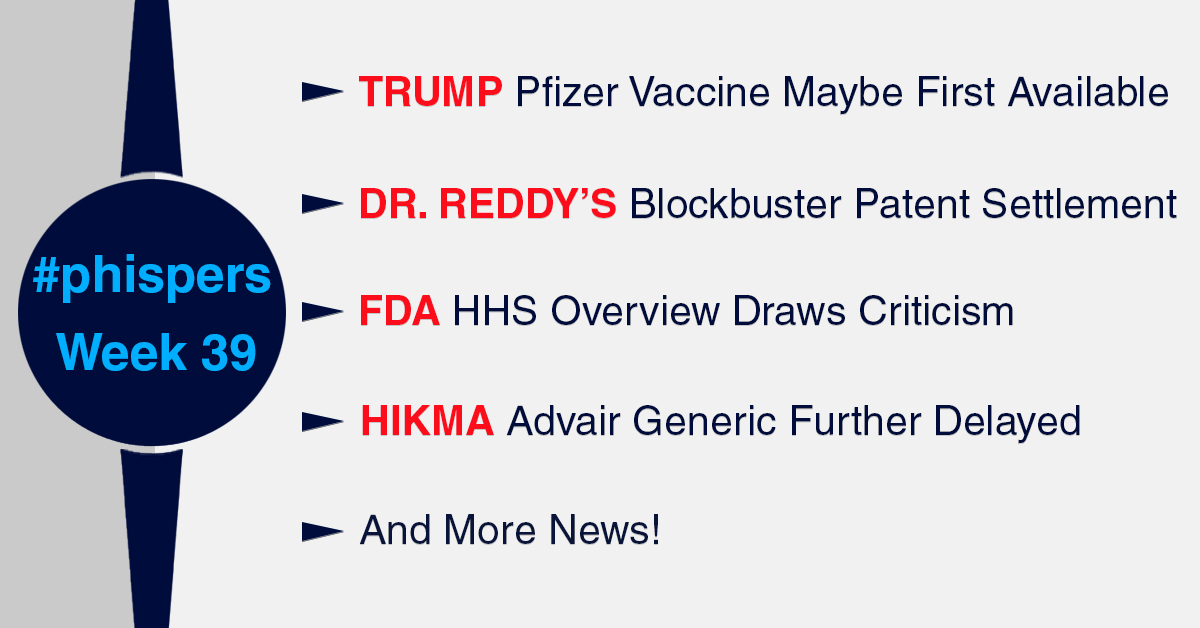
This week, Phispers has lots of updates on experimental vaccines for Covid-19.
US President Donald Trump has said Pfizer could get an approval in the coming weeks for its vaccine.
Four drugmakers shared comprehensive roadmaps on how they are evaluating their vaccine candidates to allay fears of consumers over the safety of their vaccines.
And AstraZeneca said its Covid-19 vaccine trial in the US is still on hold.
In other vaccine news, German biotech firm BioNTech, which is developing a vaccine with Pfizer, bought a Novartis
site in Germany to increase its output of vaccine doses.
Through a memo, the HHS secretary Alex Azar has stripped the USFDA and other health agencies, under his purview, of their rule-making ability.
After giving its guidance on airborne transmission of Covid, the CDC withdrew it, terming it as a mistake.
In M&A news, gene sequencing company Illumina
bought Grail for US$ 8 billion and Roche acquired Inflazome for US$ 451 million.
Indian drugmaker Dr Reddy’s settled its patent litigation with Celgene over Revlimid.
And Hikma Pharmaceuticals received
a minor complete response letter (CRL) from the USFDA for its generic version
of GlaxoSmithKline’s Advair Diskus.
Vaccine Updates: Pfizer shot may get EUA soon; four firms share protocols; Astra’s trial still on hold
This week,
the US President Donald Trump said that American drug giant Pfizer Inc could secure approval of a Covid-19 vaccine in the coming weeks. This would
be the first vaccine to secure an approval in the US. A vaccine by Johnson & Johnson could come later, Trump said.
“Pfizer’s doing really well,” he told Fox
News, adding “Johnson & Johnson ... they’ll probably be a little later.” He also cited efforts by Moderna Inc and AstraZeneca Plc.
A New
York Times report said Moderna and Pfizer bowed to public pressure and released
comprehensive roadmaps of how they are evaluating their vaccine candidates.
Typically, companies do not share these documents until the trials are
complete. After Moderna and Pfizer, AstraZeneca also revealed details of its
vaccine trials. And on Wednesday, Johnson & Johnson followed suit.. According to a report
published in The Washington Post, J&J’s vaccine aims to protect people with a single shot and
J&J will recruit up to 60,000 participants in its international trial. This
is the fourth vaccine to enter Phase 3 trials in the US.
The step
to share protocols was taken by companies to bring more transparency to how
they are testing their vaccine candidates. Polls also revealed that Americans
are wary of accepting a Covid vaccine amid growing suspicion that Trump’s drive to produce a vaccine before the
election day (November 3) could result in the product being unsafe. Pew
Research Center recently reported that the percentage of people who said they
would get the vaccine if it were available today has dropped to just over 50
percent from 72 percent in May.
“We want to ensure that what we know is shared with the public, with the media, with clinicians who aren’t part of the company so we can develop confidence,” said Stéphane
Bancel, Moderna's CEO. Moderna’s
study will involve 30,000 participants, and Pfizer’s
44,000.
Meanwhile,
AstraZeneca said its Covid-19 vaccine trial in the United States is still on hold. Two trial volunteers in the UK have so far reported side effects from Astra’s vaccine.
Pfizer’s vaccine isn’t coming without side-effects either. The company has said participants were showing mild-to-moderate side effects when given either Pfizer’s experimental coronavirus vaccine or a placebo in an ongoing late-stage study. Over 12,000 study participants had received a second dose of Pfizer’s vaccine.
Pfizer is developing this vaccine with its German partner BioNTech.
With the
trial data in public domain, scientists are comparing the vaccine candidates on
their design, assumptions, endpoints and other major differences. Scientists
are also analyzing which candidate is likely to get an Emergency Use Approval
(EUA) prior to November 3. Their analysis confirms that Pfizer could apply for
an EUA within the coming weeks.
A report
published in The Washington Post, however, said that the FDA is expected to come out with a tough
standard for an EUA of a Covid vaccine this week, which will make it difficult
for any vaccine to get the nod before election day. But such news has done the rounds before, and Politico
had carried this news earlier this month.
Dr Reddy’s settles patent suit with BMS over Celgene’s Revlimid
Last year,
when Bristol Myers Squibb (BMS) had acquired Celgene for US$ 74 billion,
analysts had wondered if it was worth the price, citing patent challenges to Celgene’s top-selling cancer drug, Revlimid. One such litigation was with
Indian
drugmaker Dr Reddy’s Laboratories.
Last week, there was news that Dr Reddy’s had settled its litigation with Celgene over patents for Revlimid. As per the settlement,
Celgene has agreed to provide Dr Reddy’s with a license to manufacture and sell a
limited amount of Revlimid beginning March 2022. In addition, Celgene has
agreed to provide Dr Reddy’s with a license to Celgene’s patents
required to manufacture and sell an unlimited quantity of generic Revlimid in
the US from January 31, 2026.
The Dr Reddy’s-Celgene deal follows a separate agreement struck by Celgene that allows India's Natco Pharma to start with a
limited generic launch in March 2022.
Revlimid
is a prescription medicine used to treat adults with multiple myeloma in
combination with dexamethasone. It was fourth in PharmaCompass' list of top 10 selling drugs in
2019 and pulled in US$ 5.8 billion in global revenues in the first
half of 2020 alone. In India, Dr Reddy’s share price hit a 52-week high on the Bombay
Stock Exchange, after news of the settlement with Celgene for Revlimid emerged.
Celgene
had signed another agreement last year that allows Alvogen to sell
generic Revlimid sometime after March 2022. Alvogen has already launched a
Revlimid generic in some European countries. All three firms can roll out
unlimited Revlimid generics in the US after January 31, 2026.
Meanwhile,
Dr Reddy’s has signed a deal with the Russian Direct Investment Fund (RDIF), Russia’s sovereign wealth fund, to cooperate on clinical trials and distribution of the Sputnik V vaccine in India. Following regulatory approval in India, RDIF will supply 100 million doses of the vaccine to Dr Reddy’s.
HHS
overview of FDA action draws criticism; CDC withdraws guidance on airborne
transfer of Covid
Recently,
eight senior career civil servants, who direct the work of the various centers
at the FDA, had said in an opinion piece
published in USA Today that they are committed to making decisions
guided by the best evidence. “Our approach has been and must remain the gold standard that all can rely upon,” they had said.
However,
in a surprise move, Alex Azar,
the US Secretary of Health and Human Services (HHS), asserted his authority by
publishing a statement that all new rules require Azar’s signature. Until now, new rules were typically signed by agency lawyers and bureaucrats. It’s not clear how Azar’s memo will impact the FDA’s
day-to-day operations, and agency officials are reportedly still trying to
decipher it.
“This was simply pushing a reset button,” said Azar’s
top aide Brian Harrison. “This is good governance and should have no operational impact.”
Expectedly,
the move has faced severe criticism from the scientific
community. Some are also debating whether the FDA chief Stephen Hahn should
resign over the matter. For some critics, the new memo is in line with the centralization of power
in the hands of Trump loyalists and it potentially blazes a path where the FDA
could be side-stepped for an EUA on an early Covid-19 vaccine.
“I’ve never seen such a complete political overruling of the agency,” said one former HHS official. “It makes me worried about what’s to come.”
CDC’s volte-
face on airborne transmission: This week, Atlanta-based Centers for Disease Control and
Prevention (CDC) revised its guidelines and reverted to acknowledging that the “main way” the novel coronavirus spreads is through droplets and aerosols. CDC also removed language about airborne transmission
it had posted just days earlier.
The guidance on airborne transmission had been posted on Friday. CDC says it was posted by mistake. “A draft version of proposed changes to these recommendations was posted in error to the agency’s official website. CDC is currently updating its recommendations regarding airborne transmission of SARS-CoV-2 (the virus that causes Covid-19). Once this process has been completed, the update language will be posted,” Jason McDonald, a CDC spokesman, told CNN.
While it
is known that SARS-CoV-2 can spread through droplets among people standing less
than six feet apart, research has continued to explore whether or not the virus
suspends in aerosolized particles in the air, transmitting it to people more
than six feet away.
BioNTech buys Novartis site for making vaccines; CEO says shot can be fridge-stored
Pfizer and BioNTech are working at a feverish
pace to bring their experimental vaccine to the market. In order to boost its output by several hundred million
doses by 2021, German biotechnology company BioNTech is buying a production
site in Marburg (Germany) from Novartis to produce its Covid-19 vaccine. Pfizer and BioNTech’s vaccine is based on the messenger RNA (mRNA) technology.
BioNTech’s Chief Executive, Ugur Sahin, said its vaccine candidate could be amongst the first in the Western world to get reviewed by regulators. It is likely to be reviewed by regulators in late October or early November. The Novartis site is part of a complex started in 1904 by pioneering immunologist and Nobel laureate for medicine, Emil von Behring. BioNTech has not revealed the price it paid for this site.
Meanwhile,
BioNTech expects that its experimental Covid-19 vaccine can be stored at refrigerator temperatures for at least two weeks, seeking to dismiss
concerns that the compound may have to be deep-frozen. Sahin said tests have
confirmed the genetic compound remains stable at 2 to 8 degrees Celsius for
five days. Storability at those conditions can be two weeks or longer, he
added.
Illumina buys Grail for US$ 8
billion; Roche pays US$ 451 million for Inflazome
Illumina,
a gene sequencing company, has bought Grail Inc for US$ 8
billion. Grail has designed a technology that uses modern genetic sequencing
tools along with data science to detect cancer earlier than other competing
products on the market.
Cancer
screening is a US$ 100 billion market that is growing rapidly. Therefore, Grail’s technology has tremendous scope.
“Grail extends Illumina’s portfolio to include cancer screening, diagnosis and cancer monitoring, creating a portfolio of best-in-class, proprietary tests in each of the major oncology testing application areas,” Illumina said in a statement. The deal includes US$ 3.5 billion in cash and US$ 4.5 billion in Illumina shares.
Interestingly,
Grail was spun off from Illumina in
2016. Illumina originally invested US$ 100 million in the spinout, and
currently owns 14.5 percent of the company’s outstanding shares.
Roche buys Inflazome: Roche has acquired Inflazome for US$ 451
million (€380 million) upfront to gain control of treatments for
inflammatory diseases.
Inflazome develops orally available
NLRP3 inflammasome inhibitors to address a wide variety of inflammatory
diseases. The deal gives Roche rights to a
pipeline of oral NLRP3 inhibitors led by two clinical-phase drugs Inflazome is
developing as treatments for Parkinson’s and other diseases.
Hikma receives CRL from the FDA for its generic version of GSK’s Advair Diskus
Hikma Pharmaceuticals has received a minor complete
response letter (CRL) from the US Food and Drug Administration (FDA) in
relation to its abbreviated new drug application (ANDA) for the generic version
of GlaxoSmithKline’s Advair Diskus (fluticasone propionate and salmeterol inhalation powder).
According to a press statement, “Hikma is working closely with the FDA to quickly address the small number of questions raised in the CRL.” Once answered, Hikma can expect to receive a response from the FDA within 90 days. “Hikma now expects to receive approval for its generic Advair Diskus in early 2021,” the statement said.
“As a result, generics revenue is now anticipated to be in the range of US$ 710 million to US$ 730 million and core operating margin to be in the range of 18 percent to 19 percent for 2020 full year,” it added.


















 Share
Share