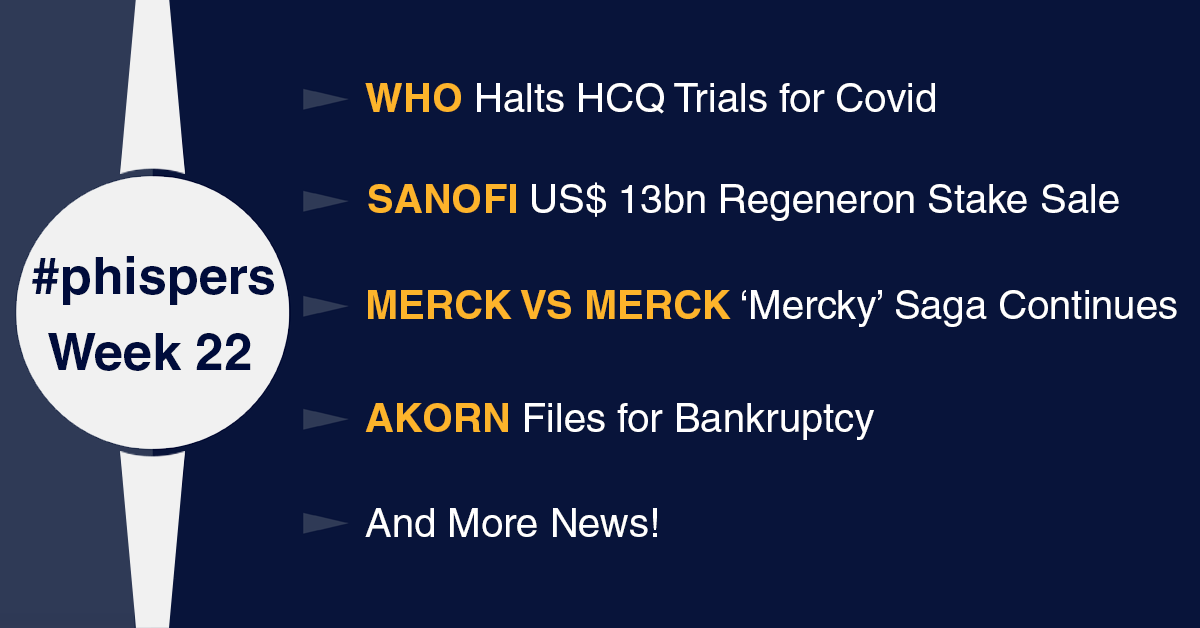
This week, Phispers brings you updates on clinical trials for Covid-19 treatments and vaccines.
While the WHO halted trials of HCQ for the novel coronavirus due to safety concerns, clinical data on remdesivir suggested that the drug is superior to any other standard treatment being given to Covid-19 patients.
The first remdesivir generic was launched in Bangladesh, and India approved applications of Cipla and Hetero Labs to manufacture and sell remdesivir.
In vaccine development, China’s CanSino Biologics
reported positive early data, and British drugmaker AstraZeneca received a US$ 1.2 billion commitment from the US government for its efforts to develop a vaccine.
The US has also pledged to buy at least 300 million doses of any vaccine that clears all tests by October.
Merck is also joining the race for a Covid-19 vaccine.
In non-Covid news, Sanofi is selling most of its long-held stake in American drugmaker Regeneron to create a war chest that will help it focus on reshaping its drug pipeline.
After losing to Merck US in 2016, Merck of Germany won a case against Merck US for the latter’s use of the name “Merck” in the UK. And after facing a series of problems, American drugmaker Akorn filed for bankruptcy.
WHO halts trials of HCQ
for Covid after large study shows increased risk of death
After news of a study of over 96,000 Covid-19
patients published in The Lancet last week, there is word on malaria drug hydroxychloroquine (HCQ) from
the World Health Organization (WHO). The agency has temporarily halted trials of HCQ
as a possible treatment for coronavirus due to safety fears.
In the study, published in The Lancet, nearly 15,000
out of the 96,000 Covid-19 patients were given HCQ or a related form chloroquine, either alone or along with an antibiotic. The study found that these
patients were more likely to die in hospital and develop heart rhythm
complications than other Covid patients in a comparison group.
The study said: “We were unable to confirm a benefit of hydroxychloroquine or chloroquine, when used alone or with a macrolide, on in-hospital outcomes for Covid-19. Each of these drug regimens was associated with decreased in-hospital survival and an increased frequency of ventricular arrhythmias when used for treatment of Covid-19.”
HCQ was part of WHO’s international clinical trial named ‘Solidarity’ announced in March to help find an effective treatment for Covid-19. Over 100 countries are participating in The Solidarity Trial, which compares four treatment options against standard of care, to assess their relative effectiveness in treating Covid-19. The drugs are — remdesivir, HCQ, lopinavir with ritonavir; and lopinavir with ritonavir plus Interferon beta-1a (a drug used to treat multiple sclerosis).
The WHO said this week that
trials in the HCQ arm in several countries are being “temporarily” suspended as a precaution. And until there is sufficient evidence, WHO has cautioned
physicians and medical associations against recommending or administering these
unproven treatments to patients with Covid-19. It has also raised concerns
over reports of individuals self-medicating themselves with HCQ and chloroquine
and causing themselves serious harm.
The US President Donald Trump
has repeatedly promoted the drug. He even called HCQ a game-changer and had said
last week that he has been taking the drug to ward off the virus.
On March 28, the US Food and
Drug Administration (FDA) had granted emergency use authorization (EUA) to HCQ and chloroquine products to treat Covid-19, based on thin
evidence of their efficacy.
Mandeep
Mehra, one of the authors of the
study published in The Lancet said the research shows that the FDA
should withdraw that authorization.
Covid vaccine update: China’s CanSino reports
positive early data; Astra gets funding from US
After Moderna, there is news that China’s CanSino Biologics has reported
positive data from its Phase I trial for a vaccine for Covid-19. In an article
published in The Lancet, CanSino Biologics published data supporting its safety in
patients.
Samples of blood from a group of 108
vaccinated adults showed both neutralizing antibodies and T-cell responses
against the novel coronavirus in most of those tested. Whether the vaccine
protects against Covid-19 infection or not can only be confirmed through
further studies.
Healthy adult volunteers in
Wuhan, China, received a single intramuscular injection of either a low, middle
or high dose of the vaccine. There were no serious adverse events. The most
common adverse reactions were fever, fatigue, headache and muscle pain. Like
Moderna, CanSino is moving its vaccine candidate into Phase II. The mid-stage
trial is underway in Wuhan.
A day prior to when the Phase I
data was published, CanSino had struck a deal with
Canada’s Precision
NanoSystems for the development of an mRNA lipid nanoparticle vaccine
against Covid-19.
Over 100 vaccine candidates
against SARS-CoV-2 are in development, with about 12 in human testing designed
to mainly evaluate safety.
Astra’s Covid vaccine gets US$ 1.2 billion pledge: The US government has pledged
to commit up to US$ 1.2 billion to AstraZeneca for its efforts to develop a vaccine for Covid-19. It has also pledged to obtain at least 300
million doses of any vaccine that passes all the tests by October.
This way, the US has secured almost a third of
the first 1 billion doses planned for AstraZeneca’s
experimental Covid-19
vaccine, as the world struggles to look for treatments
and get their economies back to work.
As part of the deal with the
Biomedical Advanced Research and Development Authority (BARDA), AstraZeneca will begin
late-stage clinical trials this summer with roughly 30,000 people in the US.
The British drugmaker is developing the
vaccine along with the Oxford University.
In a statement, Health and
Human Services Secretary Alex Azar called the contract a “major milestone” in Operation Warp Speed, a program launched by the Trump administration to accelerate Covid-19 medical products to the American public.
The agreement between the US
government and the British drugmaker came days after the UK government pledged US$ 79 million to AstraZeneca and indicated the deal will provide access to 30 million
doses in September. AstraZeneca has said it has arranged enough production
capacity to make 400 million doses by fall this year.
Sanofi to sell US$ 13 billion Regeneron stake;
create war chest for new drug pipeline
French drugmaker Sanofi SA is selling most of its long-held stake in Regeneron Pharmaceuticals Inc. This is likely to give Sanofi a war chest
of around US$ 13 billion to help the drugmaker reshape its drug pipeline as it
plans to focus more on rare diseases and oncology drugs.
American drugmaker Regeneron said it had agreed to repurchase approximately US$ 5 billion of its shares
directly from Sanofi. The French drugmaker had bought the stake in early 2013.
Sanofi has been disengaging
itself from Regeneron for more than a year now. Last year, Sanofi and Regeneron had
unveiled plans to restructure their longstanding partnership. And now, the
French drugmaker has plans to unload about
22.8 million Regeneron shares, a stake sale that could bring in around US$ 13
billion. The proceeds are likely to be used for dealmaking, say news reports.
The partnership between the two companies “has been one of the most productive in the industry,” Paul Hudson,
CEO of Sanofi, said in a statement. While Sanofi “remains committed” to their partnership, Hudson said the “proceeds from this transaction will help further” Sanofi’s ability to execute its “strategy to drive innovation and growth.”
Though it intends to sell its
equity investment, Sanofi also said the move would not change the ongoing
collaboration between the two groups.
Remdesivir update:
Clinical trial data published; first generic launched in Bangladesh
On May 22, the New England
Journal of Medicine (NEJM) published a study on the
preliminary findings of the clinical trials undertaken by the National
Institute of Allergy and Infectious Diseases (NIAID) on Gilead’s remdesivir, which is being considered as a potential treatment for
Covid-19.
The study suggests that the
drug is superior to any other standard treatment currently being given to
coronavirus patients as it has shown improvement in recovery time.
According to a post on NEJM’s Twitter
handle, in this double-blind, randomized control trial in 1063 adults hospitalized with Covid-19, a 10-day course of intravenous remdesivir was found to be superior to placebo in shortening the time to recovery.
The estimates of mortality at 14 days were 7.1 percent in the remdesivir group
and 11.9 percent in the placebo group.
Last month, NIAID had said in a
statement that patients who had received the drug had a 31 percent faster
recovery time than those who did not and were able to leave the hospital on day
11 as compared to standard 15-day discharge time. Following this, on May 1, the
US Food and Drug Administration had given emergency use authorization to the
Gilead drug.
Post the emergency approval to
remdesivir, India has approved applications
of Cipla Ltd and Hetero Labs to manufacture and sell remdesivir. This
way, India has waived the requirement for undertaking local clinical trials, in
a move to get Indian patients faster access to the drug.
The drugmakers will be required
to conduct Phase-IV (post treatment) trials in India to help identify any
unforeseen side effects on patients, a report published in The Economic
Times said.
Earlier this month, five
generic drugmakers Cipla Limited, Ferozsons Laboratories, Hetero Labs Limited, Jubilant Lifesciences and Mylan had signed non-exclusive
voluntary licensing agreements with Gilead Life Sciences, the patent holder of
remdesivir.
Meanwhile, Bangladesh-based Beximco Pharmaceuticals has launched generic remdesivir for the treatment of Covid-19. This is the world’s first generic remdesivir. The company is donating remdesivir to the Bangladesh government for supply to the government hospitals. The medicine will be given free of cost at these hospitals.
Avigan trial continues
despite negative reports: In April, a subsidiary of
Japanese company Fujifilm — Fujifilm Holdings Corp — had launched a Phase II clinical trial of its influenza drug Avigan (favipiravir)
to treat Covid-19 patients. Avigan, a drug that was approved in Japan in 2014, specifically targets RNA
polymerase required for influenza virus replication.
The drug has not shown apparent efficacy in treating Covid-19 in clinical trials so far. Japan’s Prime Minister Shinzo Abe had said
he was hoping for the approval of Avigan by the end of May.
While medical experts have
voiced concerns about rushing to approve the drug, the lead researcher in the
Avigan trial for coronavirus has
said it’s too early to make a
call on whether it works or not, He has also shrugged off negative reports
about the interim results, saying patients are still being enrolled. The final
results of the trial for the antiviral are expected around July.
‘Mercky’ saga continues: Merck KGaA wins case against US-headquartered MSD
Back in January 2016, we had reported on how, the two Mercks — Merck of Germany and Merck of the US and Canada — had accused each other
of violating the Coexistence Agreement drafted in 1955 (and revised in 1970).
The two companies had fought over their Facebook page. Around the same time, the German Merck — Merck KGaA — had also objected to the US company’s use of the name “Merck” in the UK. In 2016, Merck KGaA had lost that case.
But last week, on appeal, a London judge ruled that
the US-headquartered Merck Sharp & Dohme (MSD) violated the trademark
rights of Merck KGaA enshrined in their decades-old co-existence agreement over their shared nomenclature. And that the US corporation had infringed on Merck KGaA’s copyright numerous times. The judge reviewed 16 instances
brought forth by Merck KGaA.
Merck enters race for
Covid vaccine: US-headquartered Merck has also joined the race for the
Covid-19 vaccine. In fact, the company has a three-pronged strategy for getting
into Covid vaccine. First, it is buying Vienna-based biotech —Themis — for an undisclosed amount. Themis is developing an experimental Covid-19 vaccine based on a measles vaccine that could go into human trials soon. Through this acquisition, the American drugmaker will be picking up a vaccine that’s been based on
discovery work undertaken at the Institut Pasteur, a French non-profit private
foundation named after Louis Pasteur.
Second, it has entered into a collaboration on another vaccine with the nonprofit International AIDS Vaccine
Initiative (IAVI). This deal is for the development of a vaccine related to
Merck’s existing Ebola vaccine that could enter
human studies later this year.
And third, it has inked a deal
with Ridgeback Biotherapeutics, and is licensing an
experimental antiviral drug from the Miami-based biotech focused on orphan and
infectious diseases.
“We are committed to making a contribution to the eradication of Covid-19,” Roger Perlmutter, who heads Merck Research Laboratories, said.
Manufacturing problems,
data-integrity issues drive Akorn to bankruptcy
Akorn, which has seen a series of problems over the last few years, has filed its Chapter 11 petition in the Delaware bankruptcy court. Some weeks back, the
specialty drugmaker had said it has given up on finding itself a buyer amidst the broader uncertainty due to the Covid-19 pandemic.
The Illinois-based company
listed as much as US$ 10 billion of debt and US$ 10 billion of assets in its
Chapter 11 petition.
Akorn said it has reached an
agreement with lenders representing more than 75 percent of its secured debt.
The lenders will collectively make an initial, stalking horse bid for the sale
of its business. The lenders will provide additional liquidity to fund business
operations during this process, the company said.
In April 2018, Fresenius had walked away from a US$ 4 billion takeover of Akorn, citing an investigation wherein Akorn had materially breached the FDA’s
data integrity requirements.
Akorn then got sued by its
shareholders for concealing data integrity problems that caused them to
lose money when the truth went public. In August 2019, Akorn put the issue to rest
by settling with its shareholders.
Akorn has received several FDA warning letters over the last year or so. It received warning letters for its Somerset (New Jersey) manufacturing facility in June 2019, and for its Decatur (Illinois) facility in January 2019. Then in February 2019, the company’s
Amityville (New York) facility was hit with another warning letter.
The company generated net sales of US$ 682 million last year, which were down 2 percent from the US$ 694 million generated in 2018.














 Share
Share