Please Wait
Applying Filters...
Menu
Xls

Digital Content read-more

Create Content with PharmaCompass, ask us

DATA COMPILATION #PharmaFlow

read-more
read-more
FDA’s December 2025 OPOE list features 784 prescription drugs, 73 OTC drugs
This week, PharmaCompass brings you key highlights of the US Food and Drug Administration’s December 2025 list of Off-Patent, Off-Exclusivity Drugs (OPOE) without an approved generic. The OPOE list gets updated every six months.This list highlights drug products that have lost patent protection and regulatory exclusivity, but remain without approved generic competition in the US market. With this list, the FDA hopes to bolster competitiveness in the generics market, improve transparency and encourage the development and submission of abbreviated new drug applications (ANDAs) in markets with little competition.Since December 2021, FDA has been publishing two versions of the OPOE list — one for prescription (Rx) drug products and the other for over-the-counter (OTC) drug products that are approved and marketed under a new drug approval (NDA).  Access the Interactive Dashboard on FDA's December 2025 List of OPOE Drugs (Free Excel)Injectables continue to dominate FDA’s OPOE Rx list; 73 OTC drugs figure in Dec listFDA’s December 2025 OPOE Rx list includes 784 drug products that currently have no approved generics. Out of these, 296 are injectables and 126 are oral solid dosage forms (such as tablets, capsules and modified release forms). In June 2025, the OPOE Rx list had 765 drug products without an approved generic, out of which 304 were injectables, while 109 were oral solid drug forms. The increase in drug products from 765 to 784 from June 2025 to December 2025 was due to the inclusion of additional dosage strengths in the OPOE Rx list. Otherwise, no new drugs were added to the December 2025 OPOE Rx list.The December 2025 OPOE list has 73 OTC drugs, slightly higher than the 69 drugs in the June 2025 list. Among the 73, 21 are oral solid dosage forms.Among the OTC drugs on the December 2025 OPOE list are ibuprofen and ibuprofen sodium (for pain and inflammation), pseudoephedrine hydrochloride and phenylephrine hydrochloride (nasal decongestants), nizatidine and famotidine (for gastroesophageal reflux disease), loratadine, cetirizine hydrochloride and chlorpheniramine maleate (for allergy relief), loperamide hydrochloride (anti-diarrheal), and orlistat (for weight management). Access the Interactive Dashboard on FDA's December 2025 List of OPOE Drugs (Free Excel)FDA fast-tracks initiatives to accelerate market entry of generics, biosimilarsFDA has launched several regulatory initiatives designed to accelerate the market entry of generics and biosimilars. In October 2025, the agency announced a new pilot prioritization program for the review of ANDAs that aims to encourage and reward investment in drug manufacturing, research and development and strengthen the pharmaceutical supply chain in the United States.Separately, FDA has also come out with a new draft guidance that seeks to simplify biosimilarity studies and reduce unnecessary clinical testing. Through a separate initiative, the agency also plans to make it easier for biosimilars to be developed as interchangeable with brand-name biologics, thereby helping patients and pharmacists choose lower-cost options. Access the Interactive Dashboard on FDA's December 2025 List of OPOE Drugs (Free Excel) Our viewThe global generic drugs market was valued at US$ 445.62 billion in 2024 and is projected to reach US$ 728.64 billion by 2034, growing at a compound annual growth rate of 5.04 percent from 2025 to 2034. With several diabetes, immunology, oncology and cardiology drugs slated to face patent expirations this year, and continued pressure on drugmakers to improve affordability, we believe the generic market could grow at an even faster rate in the near term.

Impressions: 3352

https://www.pharmacompass.com/radio-compass-blog/fda-s-december-2025-opoe-list-features-784-prescription-drugs-73-otc-drugs

#PharmaFlow by PHARMACOMPASS
22 Jan 2026

STOCK RECAP #PipelineProspector

read-more
read-more
Pipeline Prospector October 2025: Novartis to buy Avidity for US$ 12 bn; FDA approves Bayer’s med to treat hot flashes
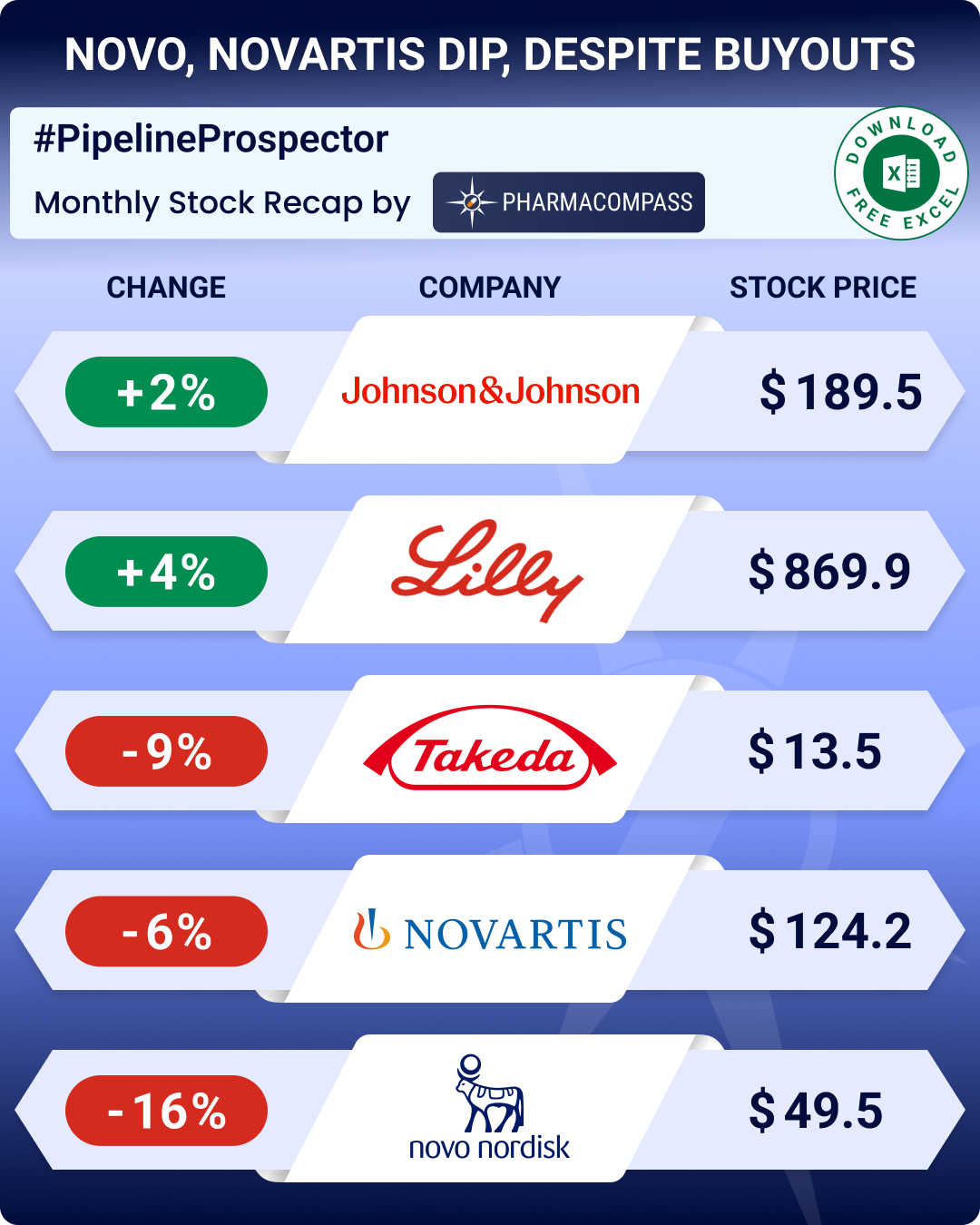
October was abuzz with dealmaking. Pharma majors such as Novartis, Novo Nordisk, and Bristol Myers Squibb (BMS) led the acquisition wave, targeting innovative platforms in rare muscle disorders, metabolic diseases, and next-generation cell therapy for autoimmune diseases. The US Food and Drug Administration (FDA) approved Bayer’s Lynkuet (elinzanetant) — the first-of-its-kind oral non-hormonal drug to treat moderate to severe hot flashes in menopausal women. The agency also expanded the indication for Teva Pharmaceuticals and Medincell’s schizophrenia drug received Uzedy (risperidone), allowing it to be used for the maintenance treatment of bipolar I disorder in adults.In clinical trials, companies such as Eli Lilly and AstraZeneca reported positive data, while Moderna and Alector announced late-stage trial setbacks.The pharma indices continued to march upwards. The Nasdaq Biotechnology Index (NBI) rose nine percent, climbing from 4,916.11 at the end of September to 5,366.46 in October, while the SPDR S&P Biotech ETF (XBI) gained 13 percent from 100.11 to 112.71. The S&P Biotechnology Select Industry Index (SPSIBI) also advanced 13 percent from 7,805.59 to 8,789.9. Access the Pipeline Prospector Dashboard for October 2025 Newsmakers (Free Excel) Novartis to acquire Avidity for US$ 12 bn; Novo in up to US$ 5.2 bn deal to buy Akero The month saw several big M&A deals. Novartis entered into an agreement to acquire Avidity Biosciences for about US$ 12 billion in cash, in a bid to bolster its portfolio of treatments for rare muscle disorders. In September too, Novartis had struck four deals valued at over US$ 14 billion.Novo Nordisk announced it will acquire Akero Therapeutics, a San Francisco-based clinical-stage biotech, in a deal valued at up to US$ 5.2 billion. The agreement includes an upfront payment of US$ 4.7 billion, with additional milestone payments contingent on FDA approval of Akero’s lead candidate, efruxifermin, by mid-2031. Efruxifermin is being developed as a treatment for metabolic dysfunction-associated steatohepatitis (MASH), a serious liver disease.Bristol Myers Squibb announced the acquisition of privately-held biotech Orbital Therapeutics in a US$ 1.5 billion all-cash deal. Orbital is developing new generation, RNA-based medicines.France’s Ipsen announced the acquisition of ImCheck Therapeutics for up to €1 billion (approximately US$ 1.16 billion) to enhance its oncology pipeline. Access the Pipeline Prospector Dashboard for October 2025 Newsmakers (Free Excel)  FDA approves Bayer’s non-hormonal drug to treat hot flashes in menopausal women; okays Teva’s Uzedy for bipolar I disorderOctober brought good news for menopausal women dealing with hot flashes. FDA approved Bayer’s Lynkuet (elinzanetant) — the first-of-its-kind oral non-hormonal drug to treat moderate to severe hot flashes in menopausal women.Teva Pharmaceuticals and Medincell received FDA’s approval for expanding the indication of Uzedy (risperidone). An injection of Uzedy can be administered once a month as a maintenance treatment of bipolar I disorder in adults. Uzedy was approved in 2023 for schizophrenia.FDA also expanded the approval of Novo Nordisk’s Rybelsus (semaglutide) for use in adults with type 2 diabetes to reduce the risk of major adverse cardiovascular events. Rybelsus, the first and only FDA-approved GLP-1 drug, was first approved in 2019.Meanwhile, Glaukos’ Epioxa (riboflavin 5'-phosphate) was cleared by the FDA for treating keratoconus, a rare, progressive eye disorder that thins and bulges the cornea. The non-surgical therapy offers an incision-free option for patients at risk of vision loss.FDA also approved Regeneron’s immunotherapy Libtayo (cemiplimab) to help prevent relapse in adults with high-risk cutaneous squamous cell carcinoma after surgery and radiation. Access the Pipeline Prospector Dashboard for October 2025 Newsmakers (Free Excel)  Innovent, Takeda sign up to US$ 11.4 bn oncology deal; J&J to spin off its orthopedics businessInnovent Biologics has signed a deal worth up to US$ 11.4 billion with Takeda Pharmaceutical to co-develop two next-generation cancer therapies. The collaboration covers an antibody-drug conjugate (ADC) and a fusion protein, targeting a range of solid tumors, including lung, colorectal, gastric, and pancreatic cancers. Takeda will hold commercialization rights for both therapies outside the US and Greater China, while the companies will jointly develop and commercialize one of the drugs, IBI363, in the US.Novo Nordisk has signed a deal worth up to US$ 2.1 billion with Omeros Corporation for rights to develop and commercialize zaltenibart (OMS906), Omeros’ experimental drug for rare blood and kidney disorders. The deal strengthens Novo Nordisk’s rare disease portfolio.Massachusetts-based Zenas BioPharma entered into a licensing agreement worth over US$ 2 billion with China’s InnoCare Pharma for orelabrutinib, an oral treatment for multiple sclerosis (a chronic disease in which the immune system attacks the brain and spinal cord).  And Johnson & Johnson announced it will spin off its orthopedics business, DePuy Synthes, into a separate company within 18 to 24 months.Besides these deals, the month saw several capacity expansions. Merck broke ground on a US$ 3 billion plant at its Elkton, Virginia campus, as part of a wider US$ 70 billion commitment to expand manufacturing, R&D, and capital projects in the US. Similarly, AstraZeneca announced a US$ 4.5 billion investment to build a state-of-the-art manufacturing facility in Virginia, as part of its US$ 50 billion investment plan for the US.Eli Lilly said it plans to invest over US$ 1 billion in India over the next few years to boost drug manufacturing and supply through partnerships with local producers. Lilly will also invest over US$ 1.2 billion to expand its manufacturing site in Puerto Rico. Access the Pipeline Prospector Dashboard for October 2025 Newsmakers (Free Excel)  Lilly’s orforglipron scores trial wins in diabetes; Astra-Daiichi breast cancer med shows promise Eli Lilly’s oral GLP-1 drug orforglipron scored two major phase 3 wins in diabetes, outperforming AstraZeneca’s Farxiga (dapagliflozin) and a placebo in separate studies.In a phase 3 trial, AstraZeneca’s experimental drug baxdrostat significantly lowered blood pressure in patients with treatment-resistant hypertension. AstraZeneca and Daiichi Sankyo’s Datroway (datopotamab deruxtecan), an antibody-drug conjugate, significantly improved survival in patients with metastatic triple-negative breast cancer compared to chemotherapy in a phase 3 clinical trial.In trial failures, Moderna said it will stop developing its experimental vaccine, mRNA-1647, designed to prevent cytomegalovirus (CMV), a virus that can cause birth defects, after it failed to meet the main goal in a phase 3 trial. Similarly, Alector stopped developing its GSK-partnered experimental dementia drug, latozinemab, after it failed to help patients in a major phase 3 trial. Access the Pipeline Prospector Dashboard for October 2025 Newsmakers (Free Excel)  Our viewWith drugs like Bayer’s Lynkuet bagging approval, we see both innovation and competition steering the pharma industry into 2026. Novo Nordisk’s US$ 8.5 billion bid to acquire US-based obesity biotech Metsera, surpassing Pfizer’s US$ 7.3 billion offer, underscores where much of the excitement lies — the rapidly expanding US$150 billion weight loss drugs market. The pharmaceutical industry seems to be on a high-speed treadmill, with no scope for sluggishness. Access the Pipeline Prospector Dashboard for October 2025 Newsmakers (Free Excel)  

Impressions: 5634

https://www.pharmacompass.com/pipeline-prospector-blog/pipeline-prospector-october-2025-novartis-to-buy-avidity-for-us-12-bn-fda-approves-bayer-s-med-to-treat-hot-flashes

#PharmaFlow by PHARMACOMPASS
06 Nov 2025

WEEKLY NEWS RECAP #Phispers

read-more
read-more
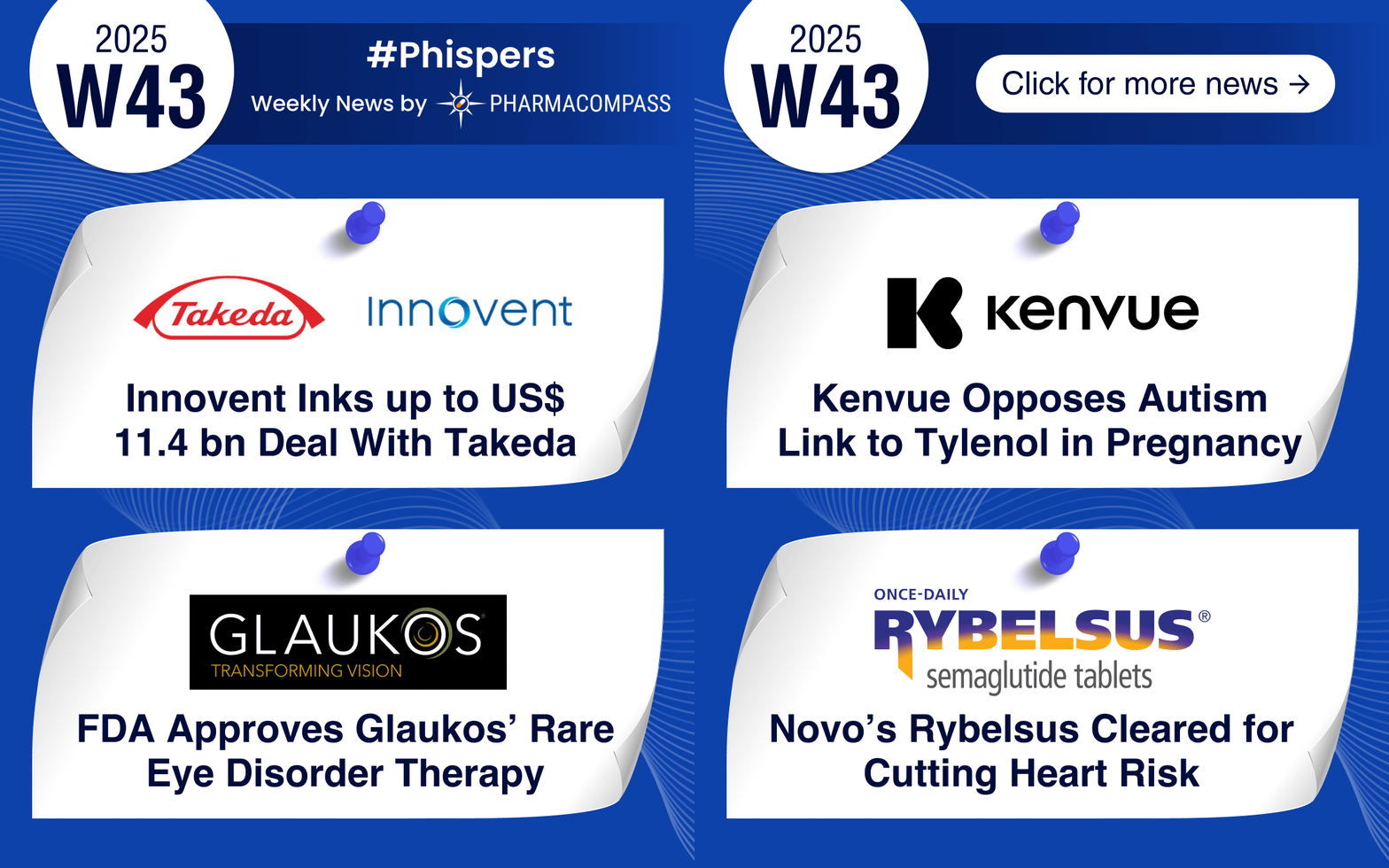
Innovent, Takeda ink up to US$ 11.4 bn oncology deal; FDA clears Novo’s Rybelsus to reduce heart risk in diabetics
In this week’s Phispers, China’s Innovent Biologics signed one of the largest cross-border biotech deals in Asia. Under this up to US$ 11.4 billion deal, Innovent will co-develop immuno-oncology and antibody-drug conjugate (ADC) therapies along with Japan’s Takeda. In the US, Merck broke ground on a US$ 3 billion manufacturing facility in Virginia. And French drugmaker Ipsen announced the acquisition of ImCheck Therapeutics for up to €1 billion (US$ 1.16 billion) to strengthen its oncology pipeline.In drug approvals, the US Food and Drug Administration (FDA) cleared Novo Nordisk’s Rybelsus (oral semaglutide) to reduce cardiovascular risk in adults with type 2 diabetes. The agency also approved Glaukos’ Epioxa for treating keratoconus, a progressive eye disorder. It expanded the approvals of Roche’s blood cancer drug Gazyva to treat active lupus nephritis (a severe kidney complication) and Amgen-AstraZeneca’s Tezpire as an add-on maintenance treatment for chronic rhinosinusitis with nasal polyps.In clinical trials, Novartis’ intravenous (IV) therapy delayed disease progression in early-stage metastatic prostate cancer. Similarly, the combination of Pfizer-Astellas’ Padcev and Merck’s Keytruda cut the risk of death by 50 percent in muscle-invasive bladder cancer. And AstraZeneca-Daiichi’s Datroway extended survival in patients with triple-negative breast cancer.In other news, the Novo Nordisk Foundation has moved to take control of Novo Nordisk’s board. And Kenvue has urged US regulators to reject a petition seeking an autism warning on Tylenol’s label for use during pregnancy, citing insufficient scientific evidence.China’s Innovent inks up to US$ 11.4 bn cancer drug deal with Japan’s TakedaInnovent Biologics has signed an up to US$ 11.4 billion deal with Takeda Pharmaceutical to co-develop next-generation cancer therapies. Under the agreement, China’s Innovent Biologics will receive US$ 1.2 billion upfront and up to US$ 10.2 billion in milestone payments from Takeda to co-develop immuno-oncology and ADC therapies. The deal covers late-stage drugs for non-small cell lung cancer and colorectal cancer, with Takeda taking rights outside the US and Greater China, and Innovent co-commercializing in the US.Ipsen to acquire ImCheck Therapeutics: French drugmaker Ipsen is acquiring ImCheck Therapeutics for up to €1 billion (US$ 1.16 billion) to strengthen its oncology pipeline. The deal centers on ICT01, a potential first-in-class monoclonal antibody being tested in acute myeloid leukemia.Merck breaks ground on drug plant in US: Merck has broken ground on a US$ 3 billion pharmaceutical manufacturing facility at its Elkton, Virginia, campus, which is part of a broader US$ 70 billion US investment in manufacturing, R&D, and capital projects.FDA approves Novo’s Rybelsus to reduce risk of adverse heart events in diabeticsFDA has approved Novo Nordisk’s Rybelsus (oral semaglutide), making it the first and only oral GLP-1 therapy to reduce the risk of major adverse cardiovascular events (MACE) — including heart attack, stroke, and cardiovascular death — in adults with type 2 diabetes who are at high cardiovascular risk, regardless of whether they have had a prior event. It is approved for both primary and secondary prevention in this population. Rybelsus was first approved in 2019 to improve glycemic control in adults with type 2 diabetes.Foundation seizes board control: Novo Nordisk’s majority shareholder, the Novo Nordisk Foundation, is taking control of the company’s board after a disagreement between the board and the foundation over its future governance. Following the disagreement, the chairman and six other independent board members resigned. The move comes as sales of weight-loss drug Wegovy and diabetes drug Ozempic (both semaglutide) have fallen due to competition from Eli Lilly and US pricing pressures. The foundation wants a sharper focus on the US market and backs incumbent CEO Mike Doustdar’s restructuring efforts, including 9,000 job cuts, to restore growth.FDA approves Glaukos’ Epioxa to treat keratoconus, a rare, eye-disorderFDA has approved Glaukos’ Epioxa (riboflavin 5'-phosphate) for treating keratoconus, a rare, progressive eye disorder that thins and bulges the cornea, causing distorted vision and increasing the risk of blindness. Epioxa provides an incision-free alternative to surgery.Roche’s Gazyva approved for lupus nephritis: FDA has approved Gazyva (obinutuzumab), developed by Roche’s Genentech, for adults with active lupus nephritis (a severe kidney complication), marking the drug’s first non-cancer indication. Gazyva is approved for certain blood cancers.Expands use of Amgen-Astra’s Tezpire: FDA has approved Amgen and AstraZeneca’s Tezspire (tezepelumab) as an add-on maintenance treatment for adults and children aged 12 and older with inadequately controlled chronic rhinosinusitis with nasal polyps. This condition causes long-term sinus inflammation and noncancerous growths, leading to congestion, facial pain, and loss of smell. Tezspire is already approved for severe asthma.Novartis’ Pluvicto shows benefit in metastatic prostate cancerNovartis’ Pluvicto (lutetium (177Lu) vipivotide tetraxetan), an intravenous therapy that delivers targeted radiation directly to prostate cancer cells, significantly delayed disease progression in patients with metastatic hormone-sensitive prostate cancer. In the phase 3 trial, combining Pluvicto with standard hormone therapy reduced the risk of progression or death by 28 percent.Padcev-Keytruda combo shows benefit in bladder cancer: Pfizer and Astellas’ Padcev (enfortumab vedotin-ejfv), combined with Merck’s Keytruda (pembrolizumab), significantly improved outcomes in patients with muscle-invasive bladder cancer who cannot take cisplatin (intravenous route) chemotherapy. In a late-stage trial, the combination reduced the risk of cancer recurrence, progression, or death by 60 percent and cut the risk of death by 50 percent compared with surgery alone.Datroway extends survival in metastatic breast cancer: AstraZeneca and Daiichi Sankyo’s drug Datroway (datopotamab deruxtecan) significantly improved survival in patients with metastatic triple-negative breast cancer compared to chemotherapy in a late-stage trial.GSK’s oral antibiotic drug matches intravenous treatment for complicated UTIsGSK and Spero’s experimental oral antibiotic tebipenem HBr proved as effective as intravenous treatment in a phase 3 trial for complicated urinary tract infections, including drug-resistant cases.Moderna halts birth defect vaccine program: Moderna said it will discontinue the development of its experimental vaccine — mRNA-1647 — to prevent cytomegalovirus (a virus that can cause birth defects) after the shot failed to meet the main goal in a phase 3 trial.Kenvue seeks rejection of ‘autism warning’ request on Tylenol labelKenvue, maker of Tylenol (acetaminophen), has asked US regulators to reject a request to add an autism warning to its painkiller’s label for use during pregnancy. The petition cites studies suggesting a link between acetaminophen and neurodevelopmental disorders. Kenvue and the FDA, however, note that no causal relationship has been proven. 

Impressions: 1561

https://www.pharmacompass.com/radio-compass-phisper/innovent-takeda-ink-up-to-us-11-4-bn-oncology-deal-fda-clears-novo-s-rybelsus-to-reduce-heart-risk-in-diabetics

#Phispers by PHARMACOMPASS
23 Oct 2025

NEWS #PharmaBuzz

read-more
read-more

https://www.accessdata.fda.gov/scripts/cder/daf/index.cfm?event=overview.process&ApplNo=219910

FDA
17 Oct 2025

https://www.accessdata.fda.gov/scripts/cder/daf/index.cfm?event=overview.process&ApplNo=219910

FDA
17 Oct 2025

https://www.pharmacompass.com/pdf/news/premier-pharmacy-labs-issues-voluntary-nationwide-recall-of-all-unexpired-sterile-drug-product-lots-due-to-lack-of-sterility-assurance-1560923636.pdf

FDA
18 Jun 2019

https://www.pharmacompass.com/pdf/news/avedro-incs-photrexa-viscous-riboflavin-5-phosphate-dextran-approved-in-us-treatment-of-keratoconus-1461067032.pdf

FDA
15 Apr 2016