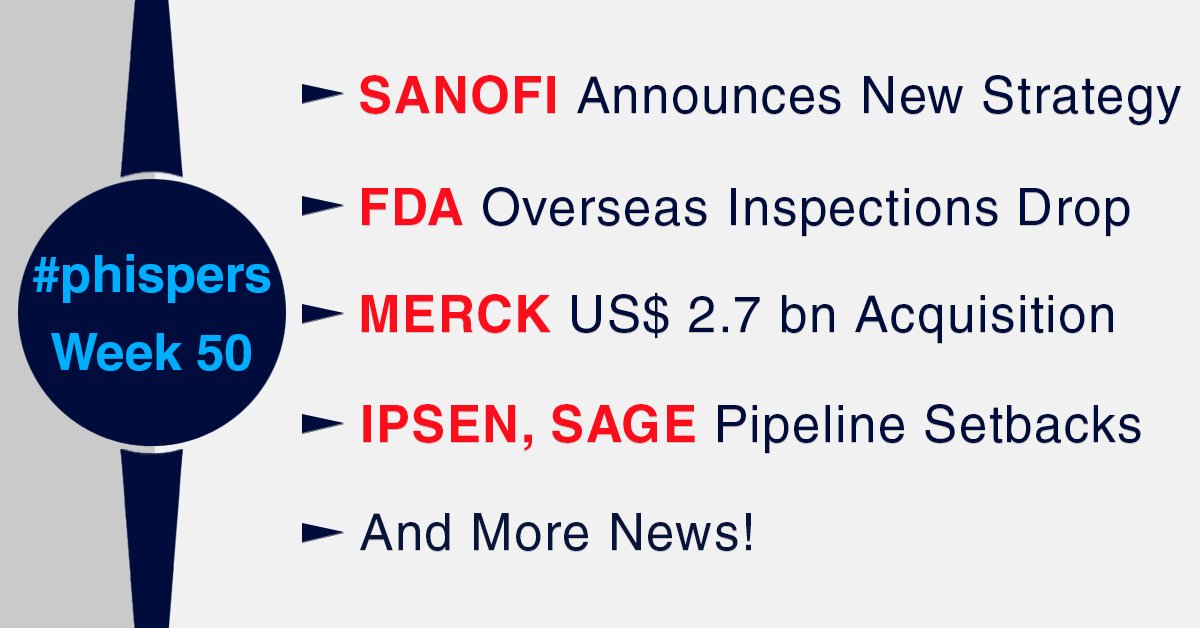
This week in Phispers, we bring you the major announcements made by Sanofi’s new CEO Paul Hudson at its strategy meet.
The French drugmaker has decided to give up finding new cures for diabetes and heart diseases, and focus on cancer cures.
In the US, FDA’s overseas drug inspections have fallen by 10 percent, despite rising concerns about the safety and quality of drugs sourced from other countries.
After sartans and ranitidine, regulators across the world are looking into whether formulations of the diabetes drug metformin contain cancer-causing impurities.
Novartis CEO Vas Narasimhan spoke of the firm’s drug pipeline which includes over 80 major submissions in the next two years, even as the FDA approved three generic versions of its top selling multiple sclerosis drug Gilenya.
Meanwhile, Merck bought ArQule’s kinase inhibitor for US$ 2.7 billion
and experimental drugs from Ipsen, Sage and Enzyvant faced
setbacks.
Sanofi to give
up finding new diabetes drugs; buys US-based biotech for US$ 2.5 billion
The
new CEO of French drug giant Sanofi — Paul Hudson — announced the company’s new strategy this week. A major announcement in its strategy was that the manufacturer of the world’s top-selling insulin — Lantus — is giving up finding new diabetes
drugs.
While
Sanofi’s top rivals in diabetes, Novo Nordisk and Eli Lilly, are investing heavily
in new classes of diabetes drug, the French drugmaker is abandoning its
attempts after years of failed endeavors at bringing a new blockbuster to the
market. Moreover, in recent years, uproar from patients about the price of
insulin, and tough actions from insurers and pharmacy-benefit managers, have
hurt revenue from Lantus.
As part of Hudson’s broad strategic overhaul, Sanofi is also ending research into cardiovascular diseases. This is another area that Sanofi has found challenging, with sales of its cholesterol-lowering drug — Praluent — taking a hit over pricing concerns.
“To be out of cardiovascular and diabetes is not easy for a company like ours with an incredibly proud history,” Hudson said. “As tough a choice as that is, we’re making that choice.”
Sanofi
also announced the US$ 2.5 billion acquisition of biotech Synthorx Inc, a deal that will boost
its pipeline of cancer immunotherapies.
Sanofi
is investing in its more buoyant businesses like rare diseases and making a
further push in the cancer market. The company would focus on vaccines and treatments like its promising eczema medicine Dupixent. Hudson also said growing sales of Dupixent, which is sold with the US
biotech Regeneron, would be Sanofi’s top
priority. Annual sales of Dupixent
could surpass US$ 10 billion, said Hudson, who joined Sanofi as its CEO in September. The
drugmaker is also planning to cut costs by US$ 2.23 billion (€2 billion) by 2022.
FDA’s overseas drug inspections drop by 10 percent, despite concerns over safety, quality
While America’s reliance on imported
pharmaceuticals and ingredients has increased, congressional investigators have said inspections of foreign
drugmakers by the US Food and Drug Administration (FDA) have fallen in recent years. This is despite the rise
in concerns over the safety and quality of generic drugs.
According to a report by the Government Accountability Office
(GAO), FDA inspections of overseas drug manufacturers declined by 10 percent
from 2016 to 2018. A key reason for this decline is that the FDA has fewer
inspectors. The agency has also struggled to fill jobs abroad.
Similarly, drug-plant
inspections in the US dropped 13 percent.
Over the last year,
numerous drugs and APIs made overseas, including widely used heart and stomach
medicines, have been recalled amid growing evidence and concern over them being
tainted with potential carcinogens.
“Many establishments manufacturing drugs for the US market may never have been inspected by the FDA,” said Mary Denigan-Macauley, director of health care for the GAO, in prepared testimony for the hearing.
Janet Woodcock, director of FDA’s Center for Drug Evaluation and Research, defended FDA’s approach. She also discussed the vulnerabilities of FDA’s foreign inspection program. She said FDA is looking to hire 50 new inspectors, but there are difficulties.
“Even if the agency succeeds in hiring a new investigator, it can take 1.5 to 2 years of training to bring them to a fully proficient level,” Woodcock said in her written testimony. At present, FDA has only 12 foreign-based drug investigators and 90 percent of its foreign inspections are conducted by US-based inspectors.
Earlier, FDA used to conduct unannounced foreign drug
manufacturing inspections. However, the agency discontinued that initiative in
2015. Pre-announcement of foreign inspections gives time to companies to
correct mistakes before they are spotted by the regulators, says the GAO
report.
A Bloomberg
investigation this year documented how drugmakers in
China, India and the US frequently ignored test results, and their pills failed
to meet US standards.
After sartans,
diabetes drug metformin being tested for cancer causing impurities
Last
week, Singapore’s
Health Sciences Authority (HSA) recalled three out of 46 locally
marketed formulations of the popular diabetes drug metformin after determining they contained N-nitrosodimethylamine (NDMA) “above the internationally acceptable level.” The three drugs were marketed by Singapore-based Glorious Dexa Singapore and Pharmazen Medicals Pte Limited.
According
to HSA, the risk posed by the three medicines is low as they “have only been supplied locally for a short period of time since last year.”
Post
the HSA announcement, several regulators including the US Food
and Drug Administration (FDA), European Medicines Agency (EMA), Health Canada
and the UK’s
Medicines and Healthcare products Regulatory Agency (MHRA) said they are
looking into whether formulations of metformin contain NDMA impurities.
The
FDA, EMA, Health Canada and MHRA also said there is no evidence that any
metformin medicines distributed in their respective jurisdictions are affected.
They advised patients to continue taking their medicine as prescribed.
An EMA statement said, “the levels of NDMA in the affected non-EU metformin medicines are very low and appear to be within or even below the range that people can be exposed to from other sources, including certain foods and water”.
The
FDA is also telling companies to
test their drugs for NDMA before making them available. The move is part of the
FDA’s
broader push to investigate a range
of drugs for the presence of NDMA.
As generics of
Gilenya get FDA nod, Novartis CEO talks of blockbusters in its pipeline
Last
week, the FDA approved three generic versions of
Swiss drugmaker Novartis AG’s top-selling multiple
sclerosis (MS) medicine Gilenya. Novartis had been defending patents on
Gilenya in the United States to block generic rivals.
The
approval allows HEC Pharm Co Limited, Biocon Limited and Sun Pharmaceutical Industries Limited to produce the
drug for the treatment of relapsing forms of MS in adult patients.
Meanwhile,
the Novartis CEO Vas Narasimhan has said the Swiss drug giant is planning more than 80 major
submissions to regulators for drug approvals from 2020-2022 in the US, Europe,
Japan and China. The submission figure is up from the 60 that the Swiss
drugmaker had said it was planning for the 2019-2021 period.
Out
of those 80 drugs, 25 could become new blockbuster
drugs that could eventually top US$ 1 billion in sales. In China, Novartis is
planning 50 submissions between 2019 and 2023.
In
2019, Novartis bagged approvals for several potential blockbusters such as
multiple sclerosis drug Mayzent, spinal muscular atrophy gene
therapy Zolgensma, breast cancer medicine Piqray, wet AMD drug Beovu and
sickle cell disease drug Adakveo.
The
company is planning new submissions in its core disease areas of oncology,
neuroscience, ophthalmology, respiratory, CRM (cardiovascular, renal and
metabolism), and IHD (immunology, hepatology and dermatology).
The drugmaker has more than 160 projects in clinical development and more
than 500 ongoing clinical trials.
Merck buys
ArQule for US$ 2.7 billion to strengthen its oncology pipeline
US-headquartered
Merck, which is known as MSD (short for Merck Sharp & Dohme) outside the United States and Canada, has entered into a definitive
agreement to acquire ArQule through its subsidiary for US$ 2.7
billion.
ArQule
is a publicly traded biopharmaceutical company focused on kinase inhibitor
discovery and development for the treatment of patients with cancer and other
diseases.
The deal is expected to close in the first quarter of 2020. It would give Merck access to ArQule’s experimental treatment ARQ 531 — a novel, oral Bruton’s
tyrosine kinase (BTK) inhibitor currently in a Phase 2 dose expansion study for
the treatment of B-cell malignancies.
BTK
inhibition has been shown to prevent B-cell receptor signaling that is critical
for the survival and proliferation of leukemic cells in many B-cell
malignancies.
After
Pfizer’s acquisition of Array BioPharma for US$ 11.4 billion and Eli Lilly’s purchase of Loxo Oncology for US$ 8 billion over the last one year, Merck’s US$ 2.7 billion bid for ArQule is yet another instance of a large drug company
increasing its focus on oral kinase inhibitors for treating cancer.
Merck has a strong
focus in cancer immunotherapy, and its blockbuster drug Keytruda crossed US$ 3 billion in sales in the
latest quarter.
Experimental
drugs of Ipsen, Sage, Enzyvant face setbacks
In
April this year, Ipsen completed the US$ 1 billion
acquisition of Clementia Pharmaceuticals. And last week, there
was news that the FDA has placed two trials of palovarotene — Clementia’s key late-stage clinical asset — on partial clinical hold.
Palovarotene is an investigational retinoic acid receptor gamma (RARγ) selective agonist, for the treatment of two rare bone disorders — fibrodysplasia ossificans progressiva (FOP) and multiple osteochondromas (MO) — and other diseases.
FDA
staff took the action in response to cases of early growth plate closure in
children on the retinoic acid receptor gamma agonist.
“The partial clinical hold was issued following recent safety reports submitted by the company to the FDA of cases of early growth plate closure in pediatric patients with FOP treated with palovarotene,” Ipsen said in a statement.
Enzyvant’s therapy rejected by FDA: The FDA has cited manufacturing concerns in a complete response
letter (CRL) rejecting Enzyvant’s therapy RVT-802.
Enzyvant is a subsidiary of Roivance Sciences. It received the CRL
this week.
RVT-802
is a tissue-based therapy in development for congenital athymia.
While
there were no questions about the therapy’s safety or efficacy,
the agency raised questions about how it is produced.
CEO Rachelle Jacques said the questions raised can be resolved and the FDA’s rejection does not affect the firm’s plans to pursue
approval in Europe, or to develop the therapy for other T-cell disorders.
Meanwhile,
Sage Therapeutics Inc said last week that its
experimental fast-acting drug aimed at treating severe depression failed a closely-watched study. The trial data shocked investors who were betting on the success of SAGE-217.
“Expectations were so high for a positive outcome... this is going to be a painful setback for many,” said JP Morgan analyst Cory Kasimov.










 Share
Share