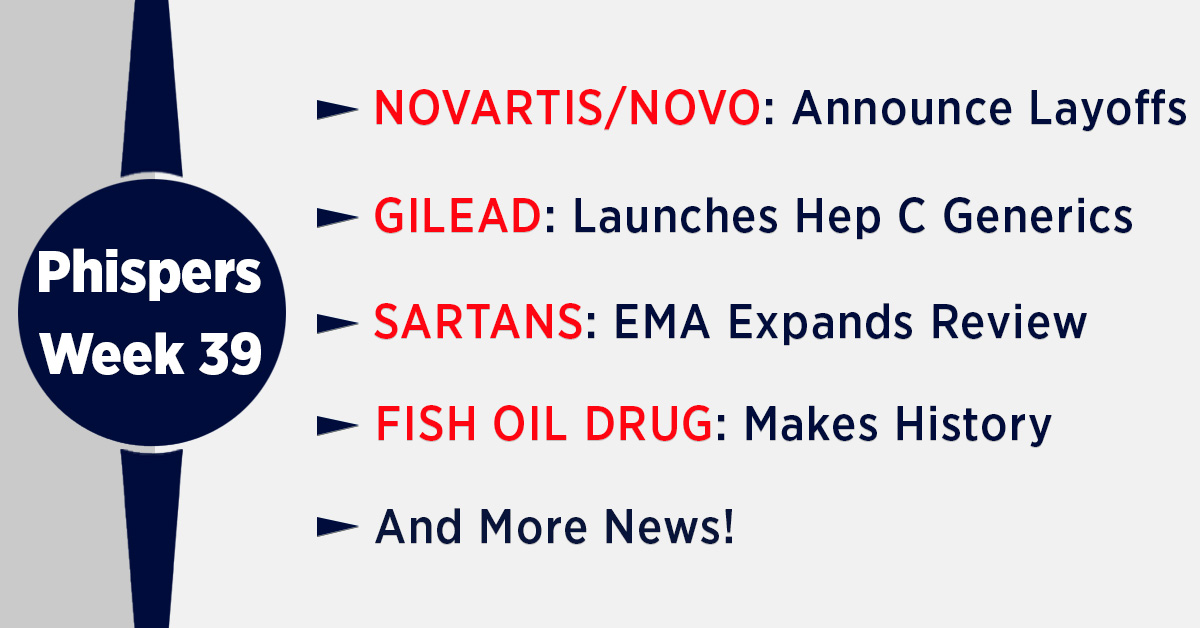
This week, Phispers brings you new twists to the valsartan impurities saga.
First, the FDA posted its observations at Zhejiang Huahai Pharmaceuticals, post a recent inspection of its Linhai (China) site.
Second, the EMA said it will expand its review to all sartans, such as candesartan, irbesartan, losartan and olmesartan to get to the root cause of impurities.
And in the US, two New Yorkers filed a class action suit against four companies that sold valsartan.
In other news, biopharma company Amarin’s prescription formulation with fish oil — Vascepa — showed significant drop in serious cardiovascular outcomes.
Novartis tied up with Tencent Holding to take advantage of China’s fast-growing healthcare market. Gilead announced launch of authorized generics of its hepatitis C virus treatments.
And Novartis and Novo Nordisk announced layoffs in their home countries.
Valsartan saga: FDA posts observations at Huahai; EMA
expands review; class action suit filed in NY
This week too, the valsartan impurities
saga continues unabated. On September 21, the US Food and Drug Administration
(FDA) posted an 11-observation, highly redacted Form 483 issued to Zhejiang Huahai Pharmaceutical on its website.
The American agency had conducted a two-week inspection at Huahai’s API manufacturing facility at Linhai (Zhejiang province, China) in the last week of July through the first week of August. It revealed the absence of a formal risk assessment of critical changes made which could impact the quality of intermediates or APIs produced at the site.
In the Form 483, the FDA criticized the management for making process changes
without thoroughly testing them.
In December 2013, Huahai had filed an amendment to its Drug Master File indicating
that the amendment was submitted for minor changes for drug substance
manufacturing, when its own internal change classified the change as a
critical one.
Between December 2016 and August 2017, Huahai initiated 17
OOS (out of specifications) investigations for failure of an impurity
specification (potentially genotoxic) and in all 17 cases, the batches were
reprocessed without developing a preventive action plan as 13 out of the 17 OOS
results were attributed to lab error, five to production errors and two were
believed to be a combination of lab and production errors.
Huahai was found to release finished APIs manufactured
from crude intermediates with OOS levels of genotoxic impurities without
conducting a thorough investigation.
Post the valsartan scandal, the FDA issued a draft
change control guideline that was released earlier this month.
In Europe, the Committee for Medicinal Products for
Human Use (CHMP) is expanding its review of impurities in valsartan following the detection of very low levels of N-nitrosodiethylamine (NDEA) in
another active substance, losartan, made by Hetero Labs in India.
As a result of the detection of this impurity by German
authorities, the review will now include medicines containing four other ‘sartans’ (or blood pressure medicines), such as candesartan, irbesartan, losartan and olmesartan.
The review will evaluate the root cause for the presence of
both N-nitrosodimethylamine (NDMA) and NDEA, their possible impact on patients and measures that
can be taken to reduce or eliminate these impurities from future batches.
As if this was not enough, a class action lawsuit was filed by two New Yorkers — Elizabeth Duffy and John Duffy — in the valsartan impurities case.
The lawsuit targets companies that distributed or sold valsartan blood pressure medications that were contaminated with NDMA. The lawsuit names four companies as defendants. Two distributed the recalled valsartan. The other two are pharmacies that sold it. These companies are — Solco Healthcare US LLC, Prinston Pharmaceutical Inc, Walgreens and Throggs Neck Pharmacy.
Amarin’s fish oil drug shows 25 percent drop in serious cardiovascular outcomes
Amarin Pharmaceuticals, a biopharma company, made history this week in the field of heart
medicines with its proprietary, prescription formulation of fish oil called,
known as Vascepa (Ethyl eicosapentaenoic acid). The clinical trial
results revealed that Vascepa, which contains omega-3 fatty acids, reduced the
risk of deaths, heart attacks, strokes and other serious cardiovascular
outcomes quite significantly.
Amarin designed its cardiovascular outcomes study, known as
REDUCE-IT, on the hope that Vascepa could meet the primary endpoint with a 15
percent risk reduction. The study involved 8,179 patients. The result, however,
showed a significant 25 percent risk reduction.
“This is absolutely the most significant study in the field of cardiovascular risk reduction since the statins were introduced,” Dr. Matthew Budoff, a cardiologist at UCLA and a Vascepa study investigator, said.
The result is likely to transform the fortunes of Amarin.
There are several treatments for heart-related ailments, such
as statins and PCSK9 inhibitors. In the case of statins, clinical trials
have proven a positive link between lowering of cholesterol and the prevention
of fatal heart attacks and strokes.
The newer class of injectable cholesterol-lowering medicines
known as PCSK9 inhibitors from Amgen, Regeneron Pharma, and Sanofi reduce cardiovascular risk by 15 percent. With a 25 percent reduction risk for patients, Vascepa could be the next cardiovascular blockbuster therapy.
John F. Thero, Amarin’s president and chief executive, said Vascepa could “lead to a new paradigm in treatment” to further reduce the significant cardiovascular risk. Vascepa was approved by the FDA in 2012 to treat people with high levels of triglycerides, a type of fat found in blood. But the product’s commercial output has been modest — last year, its sales totaled US$ 181 million because there was no
scientific proof linking triglyceride lowering to improved cardiovascular
outcomes.
In fact, all previous studies investigating different
formulations of omega-3-containing products have been unsuccessful. In August this year, a 15,000-patient
study of a different prescription-grade fish oil called Lovaza (Omega-3 acid ethyl esters) failed to detect any improvement in heart benefits.
Novartis to cut 2,150 jobs in Switzerland; Novo to slash
400 in Denmark, China
Earlier this month, we had carried news that Swiss drug major Novartis plans
to increase its operating margins. Jörg
Reinhardt, the chairman of Novartis, had said one of the means of achieving
this was by cutting jobs in Switzerland.
This week, there is news that Novartis will cut 2,550 jobs in Switzerland and Britain over the next four years. While
Switzerland will see 2,150 job cuts, Grimsby in northeast England will see 400 retrenchments.
This is being seen as a measure to boost profits and focus on new medicines.
Novartis currently employs around 124,000 people worldwide.
However, post the planned spin-off of its eye-care unit Alcon in early 2019
that number will reduce to less than 100,000 people by 2022, CEO Vas Narasimhan
said.
Novartis is shifting its focus to gene therapies and
biologics like arthritis treatment Cosentyx. According to Narasimhan, the job cuts were needed to help him boost the drugs unit’s operating margin to around 35 percent of sales, from 31.3 percent now.
“Our medicines portfolio is evolving from high-volume products to more specialized and more personalized innovative
medicines,” Narasimhan said.
Unions criticized the move. “There will be massively damaging side effects for Swiss workers, the drug industry and Switzerland’s export economy,” Employees Switzerland wrote in a statement. “We’re not going to let Novartis destroy Basel as a center of industry.”
Meanwhile, Bagsværd, Denmark-headquartered Novo Nordisk said it will lay off 400 staff in Denmark and China. This is
being undertaken in order to divert funding towards investment in biological
and technological innovation.
The
firm, which employs more than 42,000 people in 79 countries, has seen growth slowdown due to pricing pressures in
the United States, from where it sources about half its revenue.
“This is not a cost-cutting exercise,” Novo’s chief science officer Mads Krogsgaard Thomsen said in an interview, adding that the company’s research and development budget will be larger in 2019 than this year.
“Our analysis shows that we have a surplus of manual labor and are lacking competences in the digital sphere, informatics, data science, artificial intelligence and automations,” he added.
Novartis continues its tech investments, signs deal with China’s Tencent
Swiss drugmaker Novartis is tying up with Shenzhen-based Tencent Holdings Ltd to take advantage of China’s fast-growing healthcare market.
The two companies will pursue more deals in the digital realm. The collaboration will focus on heart diseases and give patients access to Tencent’s health services, including reminders to take their medication and information about the condition of their health.
Vas Narasimhan, the CEO of Novartis, said the company plans to expand its efforts in China to scout for new business opportunities, partly focused on data. Narasimhan aims to more than double Novartis’ sales in China over the next five years.
Narasimhan is drawing inspiration from technology firms, and is tapping data to cut its failure rate and narrow down the company’s focus on cutting-edge drugs.
The idea is to make Novartis more competitive at a time when costs to develop new medicines are rising and the industry’s returns on investment are sliding.
Last week, we had reported on how Novartis is trying to rebuild its image, post multiple bribery scandals, the most recent one being the revelation earlier this year that it paid US$ 1.2 million to Donald Trump’s former lawyer, Michael Cohen.
With a population of 1.4 billion people, China is the
second-largest pharma market after the US. Factors like changes in diet,
pollution and heavier workloads have led to increase in obesity, diabetes and
other diseases among its people, making China a key market for drug companies.
Tencent operates the WeChat messaging and payment app,
while Novartis, based in Basel, is betting on new drugs including heart
medicine Entresto, psoriasis treatment Cosentyx and breakthrough cancer therapies aimed at curing lethal diseases to drive its growth in the coming years.
Last year, Novartis’ Kymriah became the first CAR-T (chimeric antigen
receptor-T-cell) therapy to win approval in the US, and Narasimhan has said China wants to be a leader in that field. Several Chinese companies have jumped into CAR-T, which involves extracting a patient’s immune system cells and modifying them to attack cancer.
Gilead to launch generics of its hepatitis C
virus treatments via new subsidiary
How do companies mitigate the threat of generic drugs and
biosimilars? By launching the generic versions of their own branded drugs. For
instance, recently, Mylan launched the generic version of its life-saving allergy injection EpiPen.
The latest company to launch generic versions of its
branded drugs is Gilead Sciences. The
Foster City, California-based Gilead said on Monday it is launching the authorized generic versions of its leading chronic hepatitis C virus (HCV) treatments in the United States — Epclusa (sofosbuvir 400mg/velpatasvir 100mg)
and Harvoni (ledipasvir 90mg/sofosbuvir 400mg) — through a new subsidiary, Asegua Therapeutics LLC.
The authorized generics will launch at a list price
of US$ 24,000 for the most common course of therapy and will be
available in January 2019.
Gilead will benefit from this authorized generic in several
ways. For instance, in the case of authorized generics, wholesalers typically
get a lower percentage of the sales, and pharmacy benefit managers will not get
the rebates that they were used to in the branded drug sales.
According to a statement issued by Gilead: “Since the launch of Gilead’s first HCV medication in 2013, the average price paid for each bottle of medicine in the United States has decreased by more than 60 percent off of the public list prices, across health insurers and government payers.”
Yet, Gilead added that these discounts may not always
translate into lower costs for patients due to the complexity and structure of
the US healthcare system.
Gilead said insurance companies will have the choice
of offering either the authorized generics or the branded medications for both Epclusa
and Harvoni.
The news comes a day after, a court in Brazil invalidated the exclusivity patent for the drug sofosbuvir, sold under the brand name Sovaldi.
As Brazil holds its presidential elections next month, center-left presidential candidate Marina Silva along with local pharmaceutical manufacturers Farmanguinhos-Fiocruz, Blanver and Microbiologica Quimica e Farmaceutica have been fighting for the right to produce a significantly cheaper, generic version of the Gilead drug.
Farmanguinhos has proposed to Brazilian health officials to produce a generic version of sofosbuvir for $8.50 per pill, about a quarter of the price charged by Gilead in Brazil.














 Share
Share