April and May were tough months, with oil prices rising globally due to the war in the Middle East. Yet, the world of pharmaceuticals continued to witness large M&A deals and collaborations.A highlight was the slew of deals signed with artificial intelligence firms — Bristol Myers Squibb (BMS) signed a strategic agreement with Anthropic to deploy Claude Enterprise
across its entire global operations; Eli Lilly signed a DNA editing deal worth up to US$
2.25 billion with AI-driven firm Profluent Bio; and Merck partnered with Google Cloud to
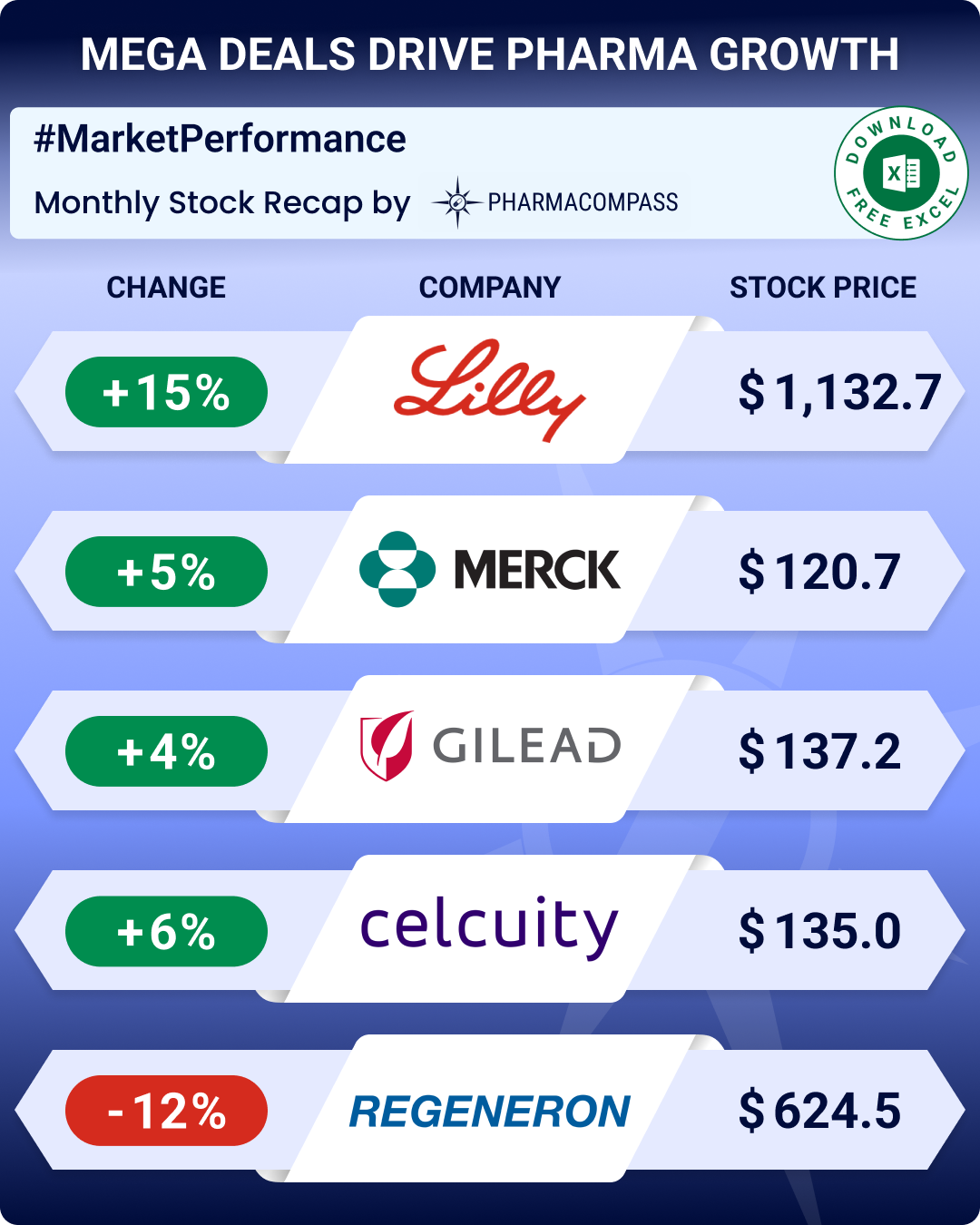
enhance its digital backbone as an AI-enabled enterprise.The indices continued to inch upwards. The Nasdaq Biotechnology Index (NBI) increased from 5,819.43 at the end of April to 5,989.81 at the end of May. The SPDR S&P Biotech ETF increased from 130.62 to 136.69. The S&P Biotechnology Select Industry Index (SPSIBI) increased from 10,262.80 to 10,689.60. Meanwhile, the S&P 500 increased from 7,234.54 to 7,580.06. Access the Pipeline Prospector Dashboard for May 2026 Newsmakers (Free Excel)Lilly on acquisition overdrive: buys Kelonia for up to US$ 7 bn,
three vaccine makers for US$ 3.8 bn Buoyed by the success of its obesity drugs Zepbound (tirzepatide) and Foundayo (orforglipron), Eli Lilly has been on a shopping
spree. So far, Lilly has made 10 acquisitions in 2026.In
April, Lilly acquired clinical-stage biotech, Kelonia Therapeutics, for up to US$ 7 billion,
and Ajax Therapeutics for up to US$ 2.3 billion in cash. Privately-held Kelonia is pioneering cancer treatments such as in vivo gene delivery. Ajax’s lead asset, AJ1-11095, is an investigational drug currently in early-stage clinical
trials for the treatment of rare blood cancers.In
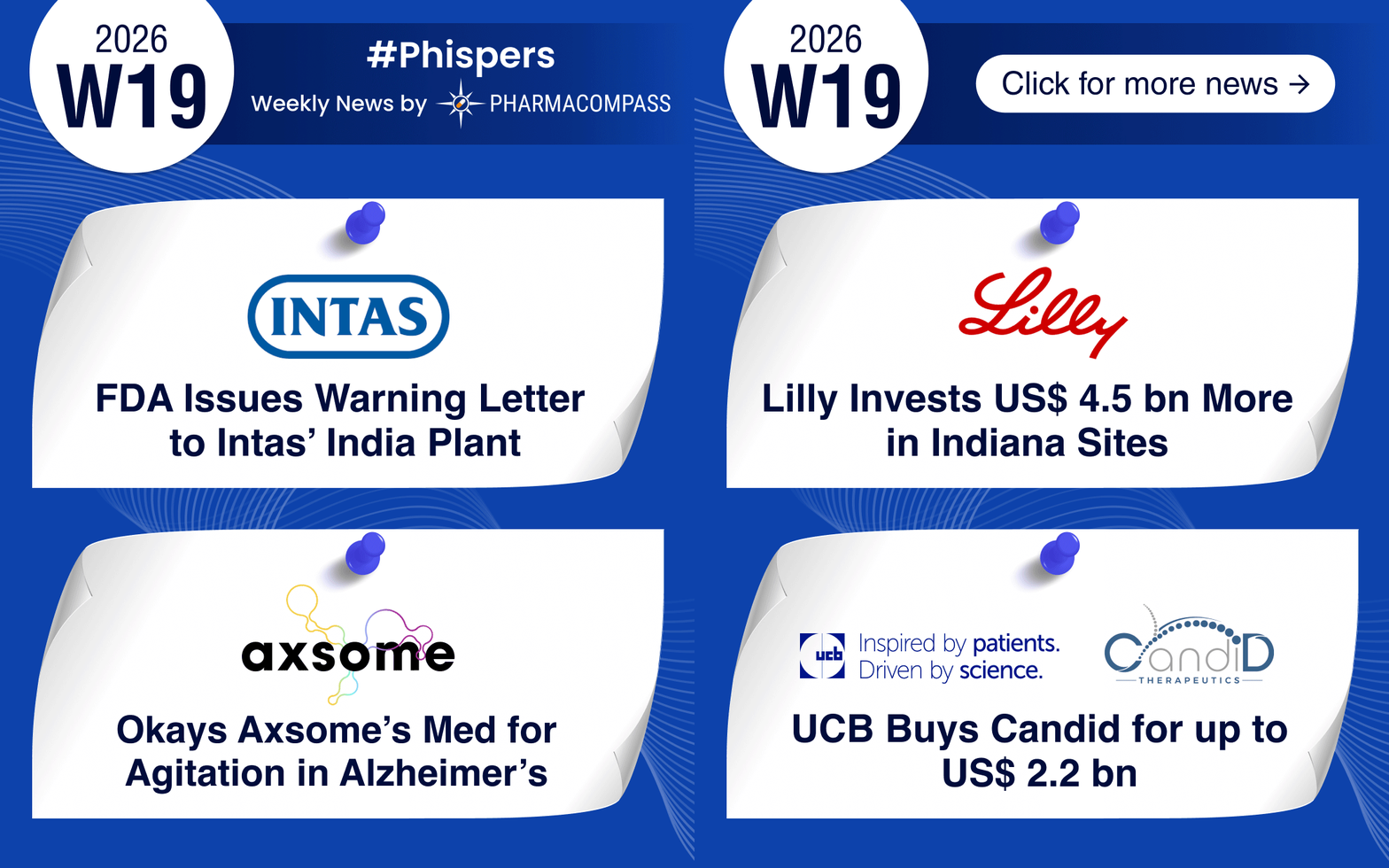
May, Lilly announced an additional US$ 4.5 billion investment across two of its manufacturing sites in
Lebanon, Indiana, bringing its total commitments in this American
state to more than US$ 21 billion since 2020. Last week, Lilly announced agreements to acquire three vaccine companies — Curevo Inc, LimmaTech Biologics, and Vaccine Company — in deals worth up to US$ 3.8 billion. Access the Pipeline Prospector Dashboard for May 2026 Newsmakers (Free Excel)FDA approves Astra’s new hypertension treatment; okays AbbVie’s rare blood cancer drugIn May, the US Food and Drug
Administration (FDA) approved AstraZeneca’s Baxfendy (baxdrostat), a first-in-class treatment for hypertension to be used in combination with other antihypertensive medications.Additionally, FDA granted two new approvals to AstraZeneca and Daiichi Sankyo’s Enhertu (trastuzumab deruxtecan) for treating early-stage
HER2-positive breast cancer. The drug has now been approved for use before
surgery (to shrink tumors) and after surgery (to reduce the risk
of recurrence). Enhertu is already approved for treating advanced breast
cancer.The agency approved Arvinas and Pfizer’s Veppanu (vepdegestrant) for
the treatment of an advanced type of breast cancer known as estrogen
receptor-positive/human epidermal growth factor receptor 2-negative, estrogen receptor 1-mutated advanced or metastatic
breast cancer. The agency also approved AbbVie’s Decnupaz (pivekimab sunirine-pvzy) for the treatment of adult patients
with blastic plasmacytoid dendritic cell neoplasm, an aggressive and ultra-rare blood cancer.In
April, FDA granted accelerated approval to Regeneron Pharmaceuticals’ Otarmeni (lunsotogene parvec-cwha) for the treatment of a rare genetic form of
hearing loss caused by a faulty gene. The agency also approved
Merck’s Idyvnso, a new, two-drug single-tablet regimen of doravirine and islatravir, for treating HIV-1 infections in
adults. Access the Pipeline Prospector Dashboard for May 2026 Newsmakers (Free Excel)Sun Pharma acquires Organon
for ~US$ 11.8 bn; Gilead buys Tubulis for up to US$ 5 bnApril and May saw several big and mid-size M&A deals. Sun Pharmaceutical Industries made the largest overseas acquisition by an Indian drugmaker in April,
as it acquired New Jersey-based Organon in an all-cash deal valued at about
US$ 11.75 billion, including debt.Gilead announced
the acquisition of Germany-based clinical-stage
biotech Tubulis GmbH in early April for up to US$ 5 billion to strengthen its
cancer drugs pipeline. With this acquisition, Gilead will gain access to Tubulis’ next-generation antibody-drug
conjugates (ADCs).In
the first week of May, Rome-based
Angelini Pharma announced the acquisition of American rare-disease drug
maker Catalyst Pharmaceuticals for €3.5 billion (US$ 4.1 billion). Additionally, Neurocrine Biosciences acquired
Soleno Therapeutics for US$ 2.9 billion in cash. The deal gives Neurocrine access to
Vykat XR (diazoxide choline), the first drug approved in the US to treat a rare genetic disorder known as hyperphagia. And Italy’s Chiesi Group announced the
acquisition of US-listed KalVista Pharmaceuticals in an all-cash deal valued at about US$ 1.9 billion. The acquisition will strengthen Chiesi’s rare diseases strategy. Access the Pipeline Prospector Dashboard for May 2026 Newsmakers (Free Excel)China’s Hengrui in up to US$ 15.2 bn deal with BMS, Innovent in oncology tie-up with PfizerLast month, China’s Jiangsu Hengrui Medicine struck global collaboration and licensing deals with BMS that include
an upfront payment of US$ 600 million
and potential milestone payments of up to US$ 15.2 billion. The deal covers four cancer and blood-disease drug candidates from Hengrui, four
immunology candidates from BMS and five additional projects the companies will
work on together.Last
week, Innovent Biologics and Pfizer entered into a
strategic global licensing and collaboration agreement worth up to US$ 10.5 billion
to develop 12 early-stage cancer medicines.In April, Australia’s Telix Pharmaceuticals entered into a collaboration with Regeneron Pharmaceuticals to jointly develop and commercialize next-generation
radiopharmaceutical therapies. Telix will receive US$ 40 million upfront and
earn up to US$ 2.1 billion in milestone payments and royalties. Access the Pipeline Prospector Dashboard for May 2026 Newsmakers (Free Excel)Celcuity’s therapy beats Novartis’ Piqray in breast cancer trial; Moderna’s mRNA flu scores late-stage win US biotech Celcuity announced positive results from a large phase 3 trial testing its
experimental drug gedatolisib in patients with a HR-positive, HER2-negative breast cancer who carry a mutation in the PIK3CA gene and whose cancer had worsened despite earlier treatment.Moderna’s mRNA flu vaccine (mRNA-1010) outperformed the standard flu shot in a phase 3 trial, with the mRNA shot performing about 27 percent better.Merck’s experimental drug sacituzumab
tirumotecan, developed in collaboration with China’s Kelun-Biotech, showed positive results in a late-stage
trial in certain patients with advanced or recurrent endometrial cancer, a type of uterine cancer.In April, there was also news that Novo Nordisk’s experimental
oral drug etavopivat successfully met two co-primary endpoints in a late-stage trial on adults and adolescents with sickle cell disease, a
debilitating, life-threatening disease. And AstraZeneca’s experimental treatment tozorakimab showed benefit in reducing
moderate-to-severe exacerbations of chronic obstructive pulmonary disease
(COPD) in a late-stage trial. Access the Pipeline Prospector Dashboard for May 2026 Newsmakers (Free Excel)Our viewDespite
macroeconomic and geopolitical headwinds, pharmaceutical companies have
continued to expand through acquisitions, deals, and collaborations. AI is
bringing about a structural shift and becoming central to competitive strategy.
Overall, the sector is not only weathering global uncertainty, but actively
reshaping itself for the next phase of growth.













 Share
Share