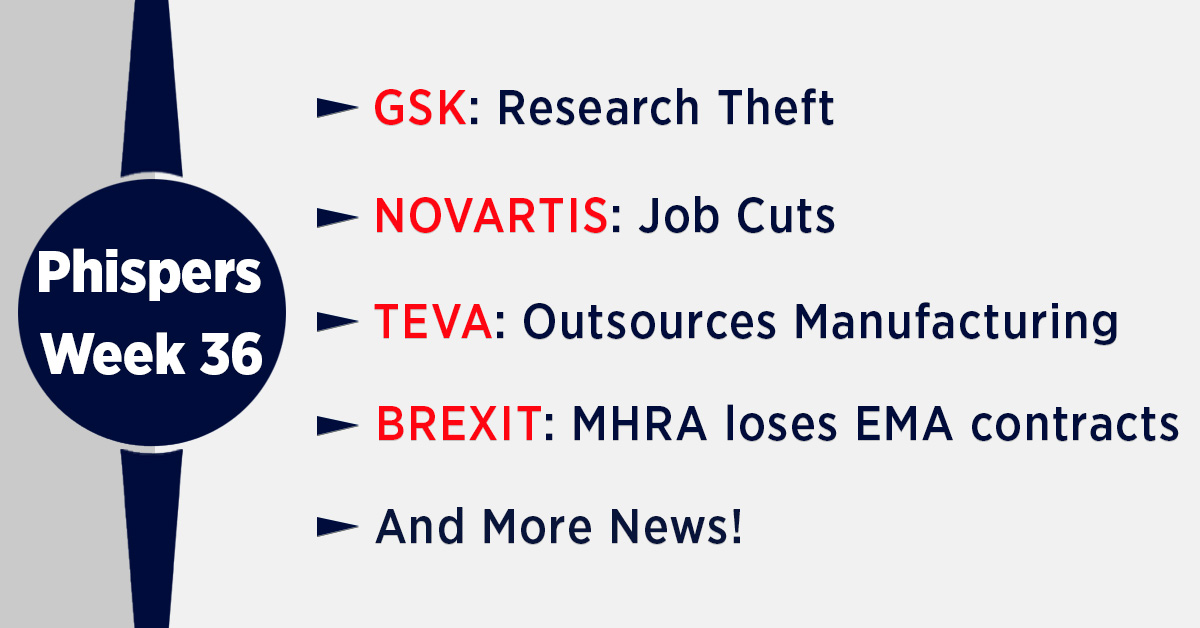
This week,
Phispers brings you details of the scam at GSK, wherein a former cancer
researcher in the US stole trade secrets for the benefit of the companies she
had started. Seven months ahead of the Brexit, Britain begins to feel the heat,
as the EMA decided to cut MHRA out of its contracts. Novartis chairman said it
plans to cut jobs in Switzerland and streamline its worldwide production to
increase its profit margins in light of falling prices of drugs in the US. Teva
began outsourcing manufacturing in Israel. And the USFDA warned doctors and
patients that the new diabetes drugs, known as SGLT2 inhibitors, may cause
flesh-eating, bacterial infection of the genitals.
Former GSK researcher admits conspiring to steal trade
secrets
Last week, Yu Xue, a cancer researcher in the US who was
regarded as one of the top protein biochemists in the world, pleaded guilty to conspiring to steal trade secrets from GlaxoSmithKline (GSK).
In the lawsuit filed by GSK, Yu Xue (48, and a US citizen) was accused of
emailing GSK trade secrets and other confidential information relating to a
dozen or more products and numerous GSK processes from her GSK email account to
her personal email account.
The information was then forwarded to the others accused in
the case (such as Tao Li and Yan Mei) with whom Yu Xue founded a string of
companies called Renopharma, Inc, Nanjing Renopharma and Shanghai Renopharma,
Ltd.
At the time of establishing Renopharma, Yu Xue was working on the development of about US$ 1 billion worth of therapeutics at GSK’s research facility in Upper Merion, Pennsylvania, US.
Yu Xue worked as a research scientist at GSK from June
2006 to January 2016. She has a Ph.D. in Biological Chemistry from the University of
North Carolina.
Tao Li, one of the owners of Renopharma, the corporations which the lawsuit alleged “were established to sell the stolen trade secret and otherwise confidential information”, was the recipient of the emails from Yu Xue. Tao Li’s role included raising funds for Renopharma from various sources, such as private investors, government agencies, and universities. In 2014, Renopharma received millions of yuan in investment from investors and also received Chinese government grants to promote science and technology.
The
theft was discovered in January 2016, when the US Federal Bureau of
Investigation (FBI) arrested Li and seized his computer containing multiple
confidential GSK documents. Yu Xue was fired shortly after charges were brought against her in early 2016.
To
hide the profits accrued from these activities, Yu Xue
titled her interest in Renopharma in the names of family members and other
associates.
Among the documents which Yu Xue sent to her private email account was an internal GSK PowerPoint presentation titled “Anti-HER3 mAb” (monoclonal antibody) which identified a specific GSK antibody under development.
According to media reports, Xue pleaded guilty, but said she did not understand that
the transferred data was considered trade secrets. Xue noted: “A trade secret to me is not publicly available. The patents I sent to them are publicly available.”
Xue is facing up to 10 years in prison and a fine of US$
250,000. She could also be forced to pay restitution for the value of those
secrets, which would be capped at US$ 2 billion.
Novartis to cut jobs in Switzerland; Teva outsources manufacturing to Israel’s Rekah
Despite
falling prices in the United States, Novartis plans to increase its
operating margin. And the Swiss drug major plans to achieve that by streamlining its worldwide production, as also by cutting
jobs, Jörg Reinhardt, the chairman of
Novartis said in an interview with a Swiss newspaper.
Reinhardt
said Novartis wants to streamline its production sites and administration
worldwide.
“This will affect various plants globally and will also have an impact on Switzerland,” Reinhardt said. The impact will be felt not only at
company headquarters in Basel but probably also in the Aargau plant in Stein,
where 2,000 employees still produce many medicines using traditional methods,
according to the newspaper.
Reinhardt
justified the cost reduction plans citing the drop in net prices in the US over
the past year. Proceeds from the sale of drugs in its key US market dropped by 1 to 2
percent last year. This was due to the discounts pharma companies have to grant
large buyers to sell their drugs in the US. Since Novartis generates half of
its profits in the US, this decline is significant.
Meanwhile,
Israeli generic drug giant Teva Pharmaceutical Industries is moving ahead with the reorganization
plan it had announced in December 2017. It would be outsourcing some of its
in-house manufacturing to Israel-based Rekah Pharmaceutical Industry Ltd.
Earlier
this week, Rekah announced the 10-year agreement with Teva in a filing to the
Tel Aviv Stock Exchange.
According
to this filing, Teva will transfer the technical know-how for some of the
products currently manufactured in Ashdod to Vitamed Pharmaceutical Industries
Ltd, a wholly-owned subsidiary of Rekah. The company will manufacture the
products in its Israeli facility, and Teva will continue to sell them
exclusively under its own brand.
Teva’s aggressive reorganization plan announced by CEO
Kåre Schultz last year includes widespread asset divestments and the layoffs of 25 percent of Teva’s employees.
Brexit fallout begins – MHRA loses EMA contracts; Britain’s GDP down 2 percent
Britain
will get no more work from Europe in evaluating new medicines for sale to
patients across the EU. This decision by the European Medicines Agency (EMA),
to cut Britain out of its contracts seven months ahead of
Brexit, is said to be a devastating blow to British drug companies, which are
already reeling from the loss of the EMA headquarters
in London.
All
drugs sold in Europe have to go through a lengthy EMA authorization process
before use by health services. The Medicines & Healthcare products
Regulatory Agency (MHRA) in Britain had built up a leading role in this work.
However, the EMA has awarded MHRA just two contracts this year. The EMA suggested the uncertainty surrounding Brexit has made Britain off limits for new regulatory contracts. The loss of contracts will act as a significant blow to the MHRA, who receive around US$ 18 million (£14 million) each year from the EMA.
Despite
having bid for 36 different contracts this year, the MHRA were only awarded
two, both of which were for drugs in which evaluation had already begun. In
contrast, in both 2015 and 2016, the MHRA was awarded 22 separate contracts.
As
if this was not enough, the EMA has also decided to reallocate existing
contracts with the MHRA to bloc members.
The EMA has already started its move from London to its new headquarters in Amsterdam. It employs 900 people in London, and 84 have already relocated to Amsterdam. Around 300 of EMA’s staff are not expected to relocate.
The
Brexit vote has already cost Britain more than 2 percent of economic output, even before the
nation formally exits the EU, according to analysis by UBS Group AG.
In a note published earlier this week, the bank estimated that UK’s GDP is already lower by 2.1 percent than where it would have been had the UK voted to remain in the EU. Moreover, investment is 4 percent weaker, inflation 1.5 percent higher and consumption is 1.7 percent lower, the note added.
New age SGLT2 diabetes drugs may cause flesh-eating
genital infection
The
US Food and Drug Administration (FDA) has warned doctors and patients that some widely used diabetes drugs may, in some rare cases, cause a flesh-eating bacterial infection of the genitals, known as Fournier’s gangrene.
The
drugs covered by the warning include Johnson & Johnson’s Invokana, AstraZeneca Plc’s Farxiga and Eli Lilly’s Jardiance.
These are
comparatively new drugs, launched between 2013 and 2016. A total of 13 SGLT2
drugs will need this new warning.
The
SGLT2 drugs help the body lower blood-sugar levels via the kidneys, and excess
sugar is excreted through the patient’s urine. Urinary tract infections are a known side effect of these drugs.
A dozen patients developed Fournier’s gangrene shortly after they began taking the medicines between March 2013 and May 2018, the FDA said. The seven men and five women were all hospitalized and underwent surgery for the condition. One patient died.
More
cases may be uncovered once the risk is better understood, the FDA said in a
statement.
In
comparison, the FDA found only six cases of this condition, all in men, in a
review of all other diabetes drug classes that it had examined for the past
three decades.
All SGLT2 drugs have been linked to cases of Fournier’s gangrene, except Merck’s Steglatro (ertugliflozin), which was approved
late last year. But that product will also need to carry the warning, the FDA
said in its announcement.
According to the FDA, diabetics using the drugs should seek immediate medical attention if they develop tenderness, redness or swelling of the genitals, or even if they have mild fever. The symptoms can worsen quickly, so it’s important to get help immediately, the FDA said.
This is not the first time SGLT2 inhibitors have been in news. In May 2015, SGLT2 inhibitors — canagliflozin, dapagliflozin, and
empagliflozin — were served a deadly blow as the FDA issued a safety warning regarding their use, leading to a potential life-threatening
condition.
The FDA warning had said “type 2 diabetes medicines canagliflozin, dapagliflozin, and empagliflozin may lead to ketoacidosis, a serious condition, where the body produces high levels of blood acids called ketones that may require hospitalization”.
Similarly,
in June last year, PharmaCompass had carried news on how Johnson & Johnson's
Invokana decreases the
risk of heart attacks and strokes, but increases the risk of amputation, particularly of toes.
Nearly 2 million patients filled prescriptions for SGLT2 inhibitors in
2017, according to the FDA. And Bloomberg expects these drugs to
generate US$ 7 billion in combined sales by 2020.
















 Share
Share