Please Wait
Applying Filters...
Menu
Xls

Digital Content read-more

Create Content with PharmaCompass, ask us

DATA COMPILATION #PharmaFlow

read-more
read-more
DMF filings rise 4.5% in Q3 2025; China holds lead, India records 20% growth in submissions
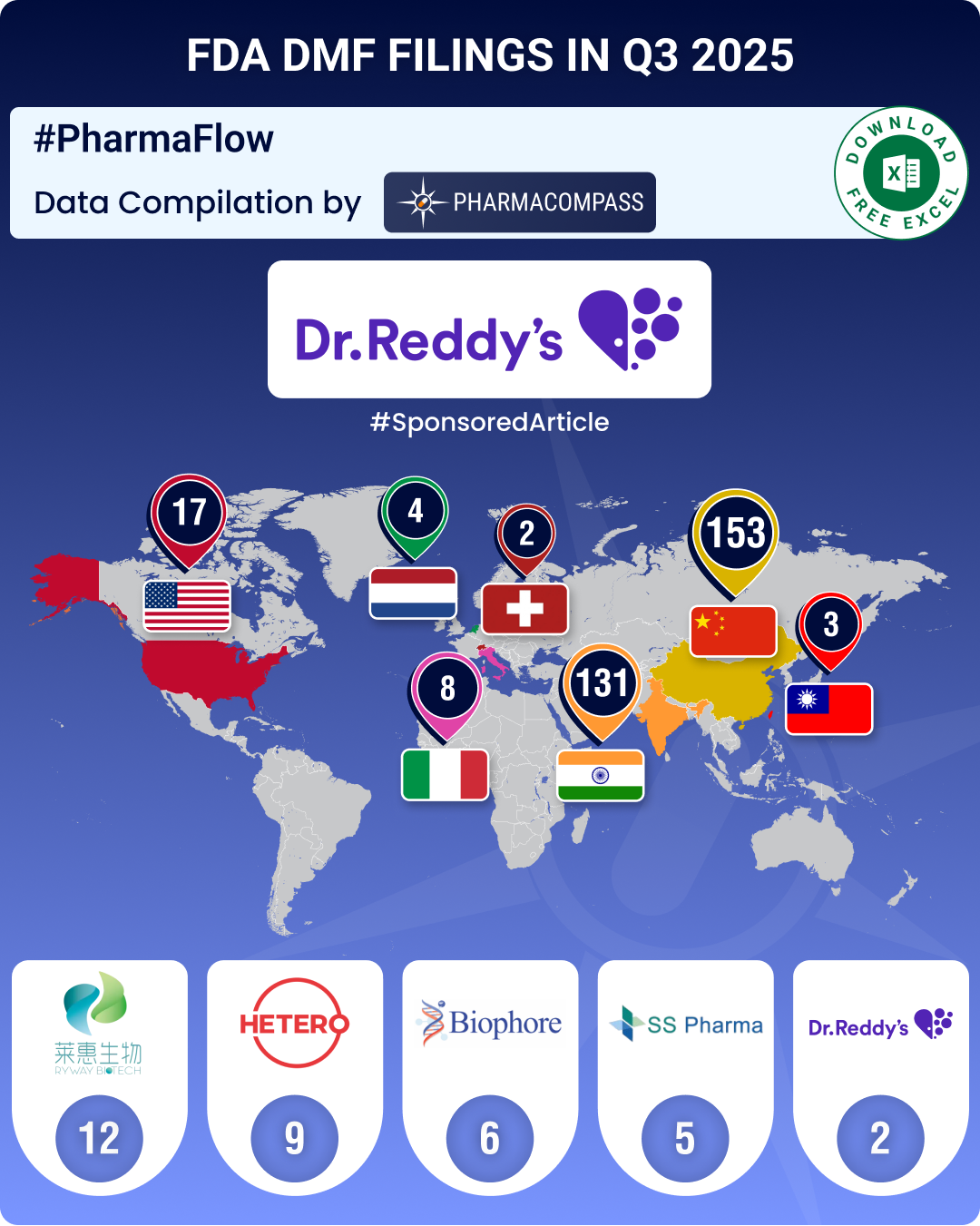
The third quarter (Q3) of 2025 witnessed a steady rise in Drug Master File (DMF) submissions to the US Food and Drug Administration (FDA). DMFs are used to provide confidential, detailed information about facilities, processes, or articles used in the manufacturing, processing, packaging, and storing of human drug productsA total of 323 Type II DMFs were submitted during this period, as opposed to 309 submissions in Q3 2024, marking an increase of 4.53 percent. This is the second highest number since 2018. In Q1 2025, 339 Type II filings were recorded.Across all DMF types (II, III, IV, and V), 479 DMFs were filed in Q3 2025, compared to 394 in Q3 2024, representing a 21.57 percent increase. Out of the 323 Type II DMFs submitted in Q3 2025, 40 had completed their review by the end of Q3, reflecting a processing lag between submission and review completion. View FDA DMF Filings in Q3 2025 (Power BI Dashboard, Free Excel Available)China maintains its lead while India posts double-digit growth in DMF submissions China and India continued to dominate DMF submissions in Q3 2025. China retained the top spot with 153 Type II DMFs, matching its submission count from Q3 2024. India recorded 131 DMFs, marking a 20.18 percent increase over 109 filings during the corresponding period last year.The United States stood a distant third with 17 filings, compared to 13 in Q3 2024. Among European nations, Italy recorded eight DMFs, doubling its 2024 tally. The Netherlands filed four, up from three. Spain submitted only one DMF, as against seven submitted in Q3 2024. Taiwan made three filings, up from one submitted in Q3 2024. Together, India, China and Taiwan accounted for about 88.9 percent of all Type II DMFs filed during the quarter. View FDA DMF Filings in Q3 2025 (Power BI Dashboard, Free Excel Available) China’s Suzhou Ryway Biotech tops corporate tally; India’s Hetero, Biophore followChina’s Suzhou Ryway Biotech led the company-wise tally with 12 DMF submissions in Q3 2025. The company had not filed any DMFs in Q3 2024.India’s Hetero Group followed with nine DMFs, maintaining the same number of filings as Q3 2024. Biophore India Pharmaceuticals ranked third with six DMFs, doubling its count from three last year.Other notable contributors include Sai Sreyas Pharmaceuticals (India) and Shanghai Haoyuan Chemexpress (China), with five DMFs each. Companies such as SNJ Group, Lunan Pharmaceutical, Allsino Pharmaceutical, Shankus Pharma, Jiangxi Xinganjiang Pharmaceutical, Sunpure Extracts, Lee Pharma, Umedica Laboratories, Linhai Tianyu Pharmaceutical and Maithri Drugs filed four DMFs each. View FDA DMF Filings in Q3 2025 (Power BI Dashboard, Free Excel Available) Olaparib, semaglutide lead molecular filings; Dr. Reddy’s files DMF for edoxaban & tucatinibDr. Reddy’s Laboratories also featured among key DMF filers in Q3 2025, submitting two DMFs — for edoxaban tosylate monohydrate and tucatinib copovidone. Edoxaban tosylate monohydrate (marketed as Savaysa by Daiichi Sankyo) is a prescription anticoagulant used to reduce the risk of stroke and to treat deep vein thrombosis and pulmonary embolism. Patent exclusivity for Savaysa extends until October 2026 in the United States, with no generic currently available.In terms of molecules, the highest number of DMFs were filed for olaparib, semaglutide, ruxolitinib phosphate, ferric carboxymaltose, and vismodegib, with three DMFs each in Q3 2025.Olaparib, sold by AstraZeneca under the brand name Lynparza, saw DMFs being filed by BDR Lifesciences and Intas Pharmaceuticals from India, and by ScinoPharm Taiwan during the quarter.Semaglutide, a glucagon-like peptide-1 (GLP-1) receptor agonist developed by Novo Nordisk, continued to draw strong interest from API manufacturers. DMFs for semaglutide were filed by three Chinese companies: Yangzhou Aurisco Pharmaceutical, Zhejiang Peptites Biotech, and Fujian Genohope Biotech.Ruxolitinib phosphate, marketed by Incyte as Jakafi, saw three DMFs. Three Indian companies — Alembic Pharmaceuticals, Valary Labs, and Devi Pharmatech — filed DMFs for this API in Q3 2025. Other molecules that received multiple DMF submissions include ferric carboxymaltose (used to treat iron-deficiency anemia) and vismodegib (an oral therapy for basal-cell carcinoma). View FDA DMF Filings in Q3 2025 (Power BI Dashboard, Free Excel Available) First-time DMF filings span 17 companies; India leads with nine first-time DMFs The quarter saw first-time DMF filings from 17 companies. India took a lead here with nine first-time DMF filings, followed by China (six), and the US (two).The DMF filings in this quarter included inclisiran sodium (filed by Aurisco Pharmaceutical of China), pacritinib citrate (by TAPI Nl B.V. of the Netherlands), and vosoritide (by Apicore LLC of the US).Out of the 19 first-time DMFs filed in Q3 2025, four completed their Generic Drug User Fee Amendments (GDUFA) review process during the quarter. View FDA DMF Filings in Q3 2025 (Power BI Dashboard, Free Excel Available) GDUFA fee for FY 2026: The FDA Generic Drug User Fee Amendments (GDUFA) is a law designed to speed access to safe and effective generic drugs to the public and reduce costs to the industry.Fee rates for fiscal year 2026 were published on July 30, 2025. FDA has revised fees under GDUFA III across all categories. While there is a slight increase in the DMF fee from US$ 95,084 in 2025 to US$ 102,584 in 2026, the ANDA fee has seen a sharp rise: from US$ 321,920 in 2025 to US$ 358,247 in 2026.FY 2025 and FY 2026 User Fee Rates Generic drug fee category Fees rates for FY 2025 Fees rates for FY 2026 Applications:     Abbreviated New Drug Application (ANDA) US$ 3,21,920 US$ 3,58,247 Drug Master File (DMF) US$ 95,084 US$ 1,02,584 Facilities:     Active Pharmaceutical Ingredient (API)—Domestic US$ 41,580 US$ 43,549 API—Foreign US$ 56,580 US$ 58,549 Finished Dosage Form (FDF)—Domestic US$ 2,31,952 US$ 2,38,943 FDF—Foreign US$ 2,46,952 US$ 2,53,943 Contract Manufacturing Organization (CMO)—Domestic US$ 55,668 US$ 57,346 CMO—Foreign US$ 70,668 US$ 72,346 GDUFA Program:     Large size operation generic drug applicant US$ 18,91,664 US$ 19,18,377 Medium size operation generic drug applicant US$ 7,56,666 US$ 7,67,351 Small business generic drug applicant US$ 1,89,166 US$ 1,91,838 Our viewFor several years prior to the pandemic, India had a lead in Type II DMF submissions. In recent years, China has surpassed India in DMF filings. But Q3 2025 numbers indicate that Indian drugmakers are fast catching up. Since DMFs establish trust in APIs from across the world, we feel this healthy competition between drugmakers from the two countries is good for the global pharmaceutical industry. 

Impressions: 4813

https://www.pharmacompass.com/radio-compass-blog/dmf-filings-rise-4-5-in-q3-2025-china-holds-lead-india-records-20-growth-in-submissions

#PharmaFlow by PHARMACOMPASS
13 Nov 2025

WEEKLY NEWS RECAP #Phispers

read-more
read-more
Astra strikes US$ 6.9 billion oncology deal with Daiichi; Cipla, Jubilant, Indoco’s FDA inspection updates
This week, Phispers brings you news about AstraZeneca’s US$ 6.9 billion deal with Japanese drug major Daiichi Sankyo, wherein the two will jointly develop a promising cancer therapy currently in phase III trials. Novartis acquired a portfolio of immunomodulatory medicines through its US$ 310 million buyout of IFM Tre, a subsidiary of IFM Therapeutics LLC.  The USFDA approved two multiple sclerosis drugs from Merck and Novartis. In his last days as the USFDA chief, Scott Gottlieb laid out a vision for replacing opioids. After US, Singapore recalled BP drugs with an API manufactured by India’s Hetero Labs, tainted with a new cancer-causing substance discovered last month. In compliance news, FDA cleared India’s Indoco Remedies’ sterile manufacturing facility that had received a warning letter in March 2017. FDA also classified Jubilant Life Sciences’ API facility in India as an OAI, implying that it needs regulatory action. AstraZeneca bets nearly US$ 7 billion in cancer drug deal with Daiichi Sankyo   Last week, Cambridge-headquartered AstraZeneca struck a deal worth US$ 6.9 billion with Japanese drug major Daiichi Sankyo, which includes an upfront payment of US$ 1.35 billion, to jointly develop and commercialize the antibody drug conjugate cancer therapy trastuzumab deruxtecan. The oncology treatment is currently undergoing two phase III trials for a breast cancer subtype known as HER2-expressing tumors. One in five breast cancer patients have this type of cancer.  The deal comprises payments of US$ 5.6 billion in regulatory, development and sales milestones to Daiichi and hands co-development and commercialization rights to AstraZeneca outside of Japan (where Daiichi has exclusive rights). The deal has the potential to redefine breast cancer treatment. Daiichi has also announced its plans to accelerate trastuzumab deruxtecan’s Biologics License Application (BLA) filing with the US Food and Drug Administration (FDA) to the first half of 2019. Earlier, it had plans for a 2020 filing. AstraZeneca is targeting blockbuster sales of over US$ 1.4 billion from trastuzumab deruxtecan amidst competition from Roche’s Kadcyla. This also marks a bold move under the leadership of Pascal Soriot, AstraZeneca’s CEO, who has charted a mission to emerge as a major force in oncology that can contend with the likes of Merck & Co. Since Soriot took over in 2012, the company has phased out aging treatments and built a war chest for cancer-related research.  Multiple sclerosis battle hots up as FDA approves drugs from Novartis, Merck KGaA   It was a big week for the fight against multiple sclerosis (MS), a chronic, inflammatory, autoimmune disease of the central nervous system that disrupts communications between the brain and other parts of the body. First, Merck KGaA bagged FDA approval for its oral MS treatment Mavenclad (cladribine) as the first and only oral short-course treatment for relapsing-remitting and active secondary progressive forms of the disease. This is particularly significant as the drug returned from the dead after receiving a complete response letter (which determines that the agency will not approve the application or abbreviated application in its present form) from the FDA eight years back. The German drugmaker worked on its clinical progress through these years and has now successfully bounced back into the MS battleground. According to the FDA statement, cladribine is not recommended for MS patients with clinically isolated syndrome – the first episode of neurologic symptoms lasting at least 24 hours caused by inflammation or demyelination in the central nervous system. Merck is yet to announce Mavenclad’s US launch date and pricing details. Second, Novartis bagged a fresh approval for Mayzent (siponimod) last week. Mayzent is approved for various forms of MS, including clinically isolated syndrome. It is expected to be launched in the US as early as this month.  The Swiss drugmaker has announced its list price at US$ 88,500 annually, which according to a BloombergQuint report, is 7.4 percent less than its previously launched MS drug, Gilenya (fingolimod). Novartis’ Gilenya has been leading the MS field with US$ 3.34 billion in annual sales, followed by Roche’s Ocrevus that generated US$ 2.4 billion in 2018 sales. Meanwhile, Celgene is also looking to break ground in this segment with ozanimod for which it refiled its New Drug Application with the FDA last week for the treatment of adults with relapsing forms of MS (RMS). Compliance recap: FDA clears Indoco’s India facility; Jubilant’s valsartan site in trouble   In compliance, there was good news from Indoco Remedies which received clearance from the FDA for its sterile manufacturing facility (plant II) located in Goa, India. The site had received a warning letter in March 2017. The facility manufactures finished dose pharmaceuticals and had been inspected by the FDA between November 14 and 21, 2018. The November inspection led to Indoco receiving two observations, which Indoco Remedies said at the time were “minor” in nature and none of them were a repeat observation.  Several pending abbreviated new drug applications (ANDAs) from this facility will now be approved, the company said. Jubilant’s Nanjangud facility classified as OAI: After a warning letter issued few weeks back to its Roorkee (India) finished dosage form manufacturing facility, there is more bad news for Jubilant Life Sciences. The company’s API facility located at Nanjangud, Mysore, was classified by the USFDA as ‘Official Action Indicated’. An OAI implies that regulatory and/or administrative actions will be recommended, and that the FDA may withhold approval of any pending applications or supplements in which this facility is listed. The company’s API facility in Nanjangud was inspected between December 10 and 18, 2018 and had received a Form 483 with 12 observations.  The inspection of the Nanjangud site, which produces many APIs including valsartan, raised concerns over the failure to identify the root cause of genotoxic and other impurities in their APIs. FDA inspectors found the analytical methods and cleaning procedures followed at the site to be deficient. FDA also raised cross contamination concerns after it uncovered dirty non-dedicated equipment and found that the building and facilities were not adequately maintained.   No data integrity observations found at Cipla’s units: Indian drug major Cipla announced it had received eight good manufacturing practices observations from the US health regulator after inspection of three units at its Kurkumbh plant in Maharashtra from March 11, 2019 to March 20, 2019. In their recently posted BSE filing, Cipla said: “There are no data integrity (DI) observations.” The stock exchange filing also reports that the company received 10 observations pertaining to the pre-approval inspection (PAI) for a novel technology product slated for approval beyond 2024. Cipla stated that these observations are product specific, while GMP observations relate to the manufacturing and quality processes. After US, Singapore recalls BP drugs made with Hetero’s NMBA-tainted losartan    Last month, PharmaCompass had reported on a third cancer-causing substance — N-nitroso-N-methyl-4-aminobutyric acid (NMBA) — the FDA had found in losartan potassium tablets that were made by India’s Hetero Labs and distributed by New Jersey-based Camber Pharmaceuticals. As a result, Camber Pharma had recalled 87 lots of losartan tablets. Last week, there was news that Singapore’s Health Sciences Authority (HSA) is also recalling three brands of high blood pressure medicines containing the active ingredient losartan potassium, manufactured by Hetero Labs, after they were found it to contain higher than acceptable levels of NMBA. Around 137,000 patients in Singapore have been affected by the losartan recall, according to the Singapore government. The current HSA recall includes three brands — Hyperten, Losagen and Losartas. The HSA had tested locally marketed losartan products for the presence of NMBA impurity. The exposure to nitrosamines, beyond permissible levels, over a long-term period may potentially increase the risk of cancer.  Losartan is an angiotensin receptor blocker drug commonly used to treat hypertension and control risks of serious heart ailments such as heart attacks and stroke. In June 2018, cancer-causing impurities were discovered in valsartan API manufactured by Chinese drugmaker Zhejiang Huahai. Since then, drug regulators across the world have stepped up recall of sartans tainted with three cancer-causing impurities. Outgoing FDA chief tells companies to develop pain drugs that replace opioids   Scott Gottlieb, the outgoing commissioner of the US Food and Drug Administration (FDA), who will be handing over the baton to Ned Sharpless (currently the director of the National Cancer Institute) on Friday, has laid out a vision for replacing opioids that have been blamed for sparking an overdose epidemic. In one of his farewell interviews, the revered FDA chief said “companies should have to prove that any new opioids work better or are safer than current painkillers”.  Gottlieb said he wants companies to develop pain drugs that could eventually allow older opioids to be restricted or to come off the market entirely. “Given the public health crisis we face, and that American families are still being destroyed by the opioids epidemic, I believe that the FDA should treat opioids, as a class, differently from other drugs,” Gottlieb told a Senate appropriations subcommittee last week. “More appropriate prescribing can reduce the rate of new addiction and mitigate the serious, and sometimes deadly, risks associated with opioids,” Gottlieb said in a statement. In various interviews, he discussed opioids, pain drugs, electronic cigarettes and his successful tenure at the agency while also reflecting on his job, which he termed as “the best job he could ever have”. Regarding the controversial topic of drug pricing, Gottlieb said he’ll have “more to say” once he leaves the FDA. Novartis pays US$ 310 million upfront to acquire anti-inflammatory drug player IFM Tre   Swiss drug major Novartis has acquired a broad portfolio of immunomodulatory medicines through the acquisition of IFM Tre, a subsidiary of Boston, Massachusetts-based IFM Therapeutics LLC focused on developing anti-inflammatory medicines targeting the NLRP3 inflammasome. Immunomodulators are drugs that normalize the immune system. The acquisition will give Novartis full rights to IFM Tre’s portfolio of anti-inflammatory therapies (NLPR3 antagonists), which consists of one clinical and two pre-clinical programs. IFM will receive US$ 310 million in upfront payments. It will also be eligible for up to US$ 1.265 billion in milestone payments, for a total of US$ 1.575 billion. “IFM Tre’s compounds have demonstrated that they can fine-tune the immune system, offering a potentially potent approach for treating a large variety of diseases associated with inflammation,” Jay Bradner, President of the Novartis Institutes for BioMedical Research (NIBR), said in the statement. The deal has already been approved by IFM’s board of directors and is expected to close in the second quarter of 2019.  

Impressions: 2730

https://www.pharmacompass.com/radio-compass-phisper/astra-strikes-us-6-9-billion-oncology-deal-with-daiichi-cipla-jubilant-indoco-s-fda-inspection-updates

#Phispers by PHARMACOMPASS
04 Apr 2019

NEWS #PharmaBuzz

read-more
read-more

https://www.expresspharma.in/cdsco-approves-trastuzumab-deruxtecan-for-first-line-her2-positive-breast-cancer/

EXPRESSPHARMA
13 Jun 2026

https://www.businesswire.com/news/home/20260521833711/en/Enhertu-Recommended-for-Approval-in-the-EU-by-CHMP-for-Patients-with-Previously-Treated-HER2-Positive-Metastatic-Solid-Tumors

BUSINESSWIRE
22 May 2026

https://www.pharmiweb.com/press-release/2026-04-13/ifinatamab-deruxtecan-granted-priority-review-in-the-us-for-adult-patients-with-previously-treated

PHARMIWEB
14 Apr 2026

https://www.prnewswire.com/news-releases/phrontline-biopharma-presents-preclinical-data-for-tj106-a-biparatopic-her2-dual-payload-adc-at-american-association-for-cancer-research-annual-meeting-2026-302741543.html

PR NEWSWIRE
14 Apr 2026

https://www.pharmiweb.com/press-release/2026-04-13/genialis-supermodel-predicts-patient-response-to-her2-targeted-therapy-enhertu

PHARMIWEB
13 Apr 2026

https://www.globenewswire.com/news-release/2026/03/19/3258838/0/en/Cardiff-Oncology-to-Present-Preclinical-Data-with-Highly-Specific-PLK1-Inhibitor-Onvansertib-at-the-2026-AACR-Annual-Meeting.html

GLOBENEWSWIRE
19 Mar 2026