Please Wait
Applying Filters...
Menu
Xls

Digital Content read-more

Create Content with PharmaCompass, ask us

DATA COMPILATION #PharmaFlow

read-more
read-more
DMF filings surge 44% in Q1 2025; India tops list with 51% rise in year-on-year submissions
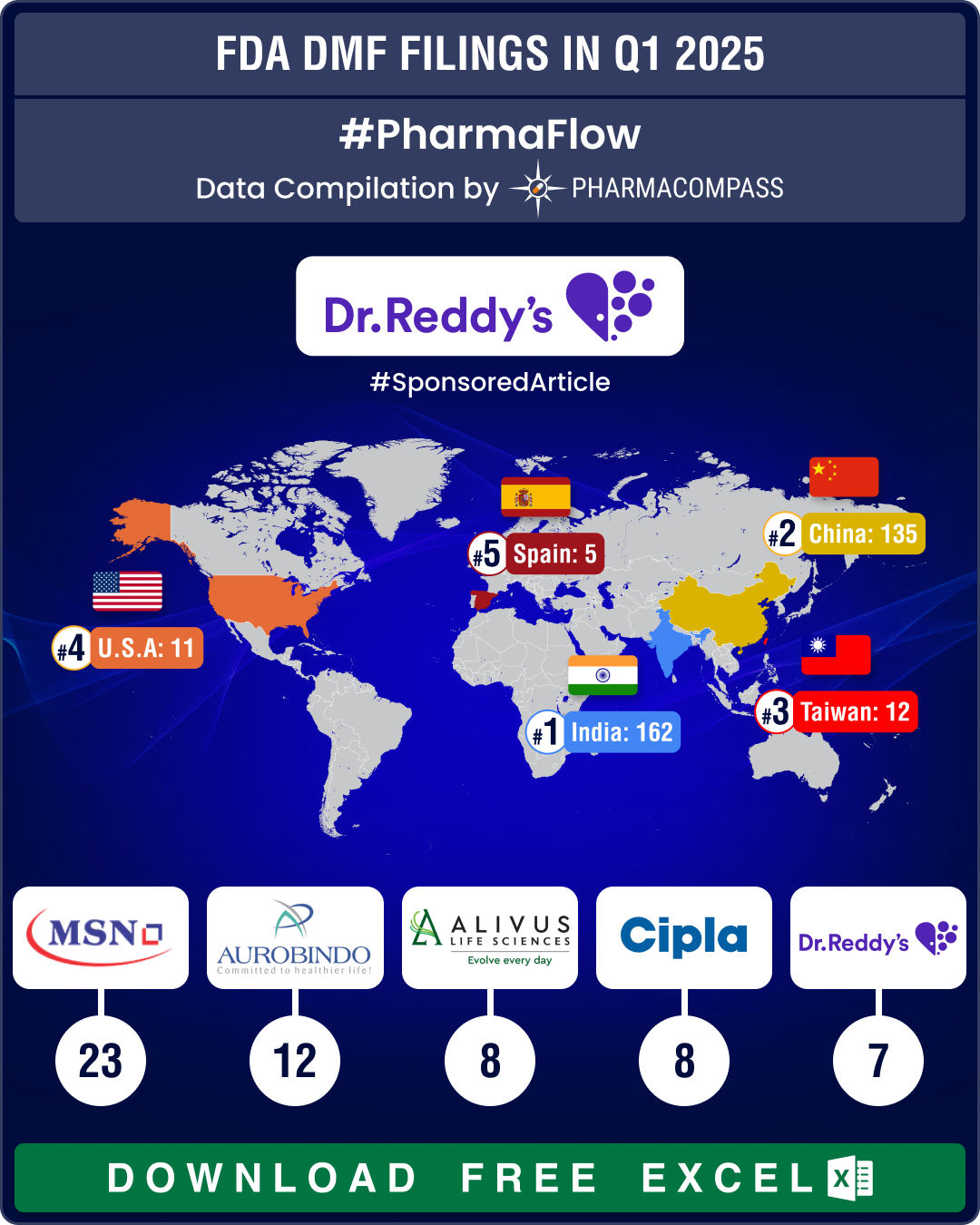
The first quarter (Q1) of 2025 witnessed an impressive surge in Drug Master File (DMF) submissions to the US Food and Drug Administration (FDA), signaling a robust expansion in pharmaceutical development activities, the looming threat of tariffs notwithstanding.A total of 339 Type II DMFs were submitted during this period, as opposed to 235 submissions in Q1 2024, marking an exceptional increase of 44.26 percent. PharmaCompass’ data suggests that this is a record high for any first quarter.Overall, 440 DMFs were submitted across all categories (Types II, III, IV, and V) during Q1 2025, compared to 353 in the same period last year — representing a 24.65 percent increase.India and China continued to dominate the DMF landscape. India led with 162 submissions in Q1 2025, posting a remarkable 51.4 percent increase over 107 submissions recorded in Q1 2024. China followed with 135 submissions, representing a 33.66 percent increase over the 101 filings in Q1 2024.Taiwan sprung a surprise as a distant third. It made 12 DMF submissions in Q1 2025, as opposed to just one in Q1 2024. Western countries like the US, Spain, Germany, and Italy have maintained relatively stable or declining submission rates. Only the Netherlands showed significant growth with four DMF submissions in Q1 2025, up from zero in Q1 2024. View FDA DMF Filings in Q1 2025 (Power BI Dashboard, Free Excel Available)Indian giants MSN, Aurobindo, Cipla, Dr Reddy’s lead record-breaking DMF surgeIndia lived up to its “pharmacy of the world” reputation with the highest DMF submissions. In fact, seven of the top eight companies in the DMF tally were headquartered in India. MSN Group, emerged as the unequivocal leader with 23 submissions in Q1 2025, as against 15 in Q1 2024. Aurobindo Pharma increased its DMF activity from seven submissions in Q1 2024 to 12 in Q1 2025. Alivus Life Sciences, formerly known as Glenmark, made a dramatic leap with eight submissions in Q1 2025, quadrupling its previous year’s count of just two. Cipla more than doubled its DMF submissions — from three in Q1 2024 to eight in Q1 2025.Dr. Reddy’s Laboratories, one of India’s largest generic drugmakers, filed seven DMF submissions. The company’s Q1 2025 DMF portfolio includes high-value molecules like deucravacitinib, finerenone, enzalutamide, niraparib tosylate monohydrate, tucatinib, and tizanidine hydrochloride.Dr. Reddy’s has also indicated that they are open to manufacturing in the US. Meanwhile, Hetero Drugs filed seven submissions while Lee Pharma recorded six in Q1 2025.Chinese manufacturer Jiangsu East-Mab Biomedical Technology also established a significant presence with six DMFs. View FDA DMF Filings in Q1 2025 (Power BI Dashboard, Free Excel Available) Semaglutide, finerenone see most DMF submissions; first-time filings surge 64%Semaglutide and finerenone emerged as the most documented molecules in Q1 2025, each garnering nine DMF submissions. Semaglutide, a glucagon-like peptide-1 (GLP-1) receptor agonist that has revolutionized diabetes management and weight loss treatment, continues to attract significant manufacturer interest. Similarly, finerenone, a non-steroidal drug used in treating chronic kidney disease in type 2 diabetes patients, has garnered attention from manufacturers.Carfilzomib, used in multiple myeloma treatment, secured the third position with five DMF submissions. Deucravacitinib, a novel drug approved for moderate to severe plaque psoriasis, followed with four DMF submissions.There were several molecules with three DMF submissions each. Among them were tapinarof, a novel drug for psoriasis, and tirzepatide, a GLP-1/GIP receptor agonist that has shown remarkable efficacy in diabetes and weight management. During the quarter, 23 molecules received their inaugural DMF submissions. This number has risen by 64 percent since Q1 2024, when only 14 drugs saw their first DMF filings.In Q1 2025, these 23 first-time molecules collectively garnered 30 DMF submissions, with deucravacitinib emerging as the clear leader. Indian companies Dr. Reddy’s Laboratories and Cipla filed DMFs for this plaque psoriasis treatment as did Spain’s Curia and PMC Global.The Q1 2025 roster of first-time DMF filings include retatrutide (another GLP-1 receptor agonist), sotagliflozin, setmelanotide acetate, daridorexant, nusinersen, zavegepant, belzutifan, elacestrant dihydrochloride, selumetinib sulfate, sotorasib, atogepant, omadacycline tosylate, osilodrostat phosphate, ensifentrine, landiolol hydrochloride, maralixibat chloride, maribavir, methyl olivetolate, diazoxide choline, sparsentan, thinnertide, and vismodegib. View FDA DMF Filings in Q1 2025 (Power BI Dashboard, Free Excel Available) Our viewGiven Trump’s rhetoric around tariffs on imported drugs, the record-breaking DMF submissions in Q1 2025 sent out a strong message that the global pharmaceutical industry is willing to take on the complex geopolitical situation with resilience and strategic foresight.On a different note, the rise in DMF filings also indicate increased workload for the FDA staff, as also more inspections by the agency. It seems like more ‘laid off’ FDA employees will be asked to return to work in the coming days.

Impressions: 4945

https://www.pharmacompass.com/radio-compass-blog/dmf-filings-surge-44-in-q1-2025-india-tops-list-with-51-rise-in-year-on-year-submissions

#PharmaFlow by PHARMACOMPASS
15 May 2025

WEEKLY NEWS RECAP #Phispers

read-more
read-more
Trump signs ‘most favored nation’ executive order to slash drug costs; Sanofi, Takeda pledge mega investments in US
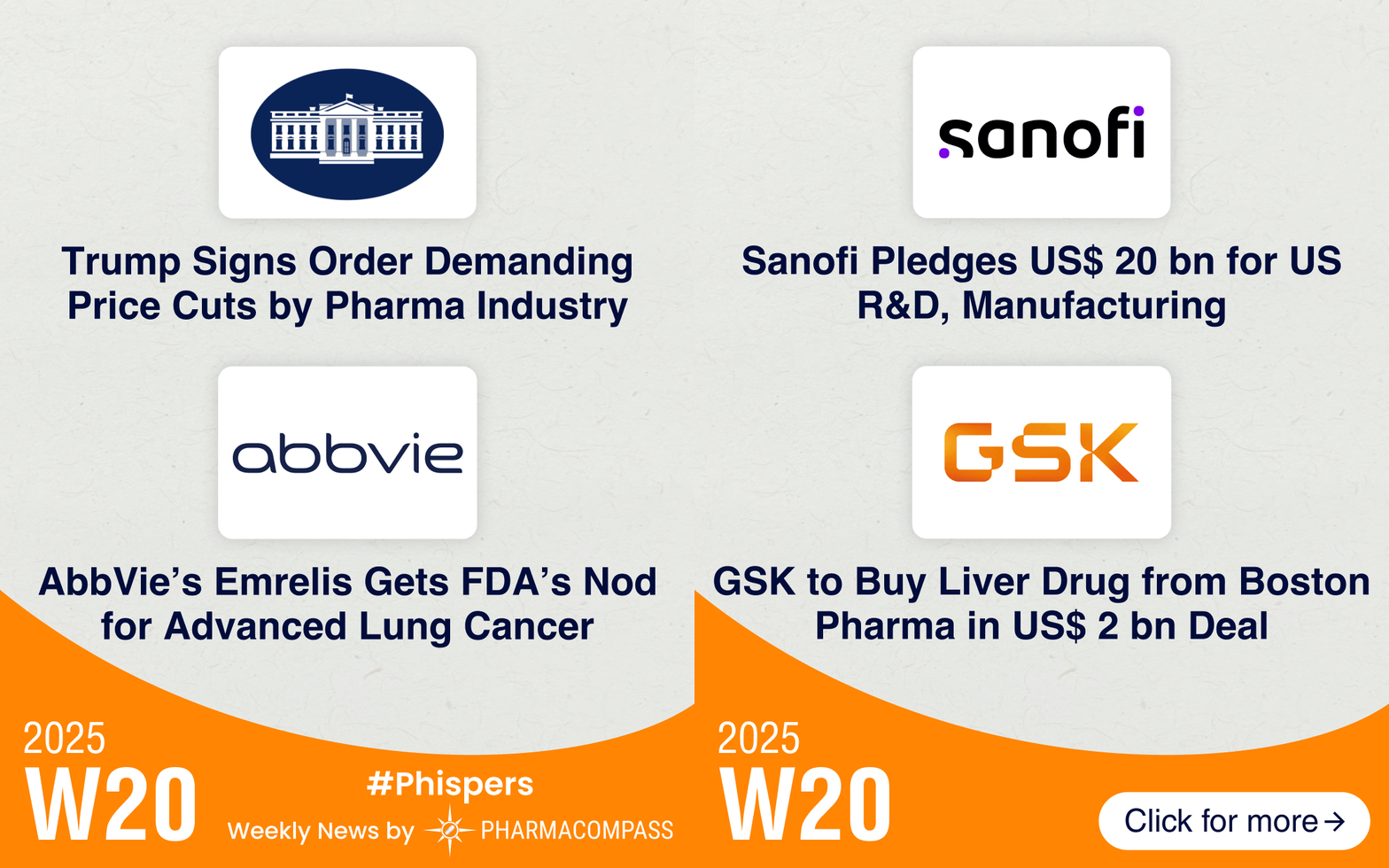
The US President Donald Trump’s dramatic intervention in pharmaceutical pricing took centerstage as the White House unveiled a sweeping “most favored nation” executive order aimed at slashing US prescription drug costs by up to 90 percent. The directive, which links American drug prices to the lowest costs paid in other developed nations, sent ripples through healthcare markets.More drugmakers decided to invest in the US to avoid import tariffs. While Takeda announced the investment of US$ 30 billion in the US over the next five years, Sanofi said it will invest “at least” US$ 20 billion until 2030.In deals, Novo Nordisk signed a potential US$ 2.2 billion collaboration and licensing deal with American biotech Septerna to develop oral small molecule medicines for obesity, type 2 diabetes and other cardio-metabolic diseases. And GSK bought Boston Pharmaceuticals’ late stage investigational liver disease drug for up to US$ 2 billion.In approvals, the US Food and Drug Administration (FDA) approved AbbVie’s drug Emrelis, an antibody-drug conjugate (ADC) that treats a type of lung cancer in patients who have received previous treatment. The agency also okayed Merck’s cancer drug — Welireg — to treat two rare types of adrenal gland tumors, and granted accelerated approval to Verastem’s ovarian cancer med.In trials, Johnson & Johnson’s oral psoriasis drug icotrokinra demonstrated remarkable efficacy, potentially establishing a new standard of care in the category. The week also brought setbacks, as GSK and iTeos Therapeutics abandoned their once-promising US$ 625 million TIGIT cancer immunotherapy program after disappointing clinical results.Trump signs ‘most favored nation’ executive order to slash drug costs by up to 90%Donald Trump signed a sweeping executive order aimed at cutting US prescription drug prices by linking them to the lowest costs paid in other developed nations. The order directs pharmaceutical companies to meet these “most favored nation” (MFN) price targets within 30 days or face federal penalties, including tariffs and import controls.This MFN directive allows drugmakers to directly sell their therapies to patients at lower cost, thereby curbing anti-competitive practices followed by pharmacy benefit managers (PBMs). The news sparked a PBM selloff. White House officials estimate the initiative could cut drug costs by up to 90 percent, saving American patients and taxpayers billions of dollars annually.Experts say more bark than bite: Legal experts caution that an executive order cannot unilaterally override statutes governing Medicare and private-sector contracts, making the plan vulnerable to courtroom challenges reminiscent of earlier attempts struck down by federal judges. PhRMA and other industry groups derided the policy as “socialized medicine,” warning that rushed implementation could disrupt supply chains and stifle innovation.Weight-loss drugs singled out: Trump specifically singled out high-profile weight-loss drugs such as Novo Nordisk’s Wegovy (semaglutide) and Eli Lilly’s Zepbound (tirzepatide), demanding manufacturers slash their prices. During the signing ceremony, Trump recounted a conversation with a “highly neurotic, brilliant businessman” friend who is “seriously overweight”. The said friend apparently told Trump he paid only US$ 88 in London for a “fat drug”, while paying US$ 1,300 in New York.Takeda, Sanofi pledge US$ 30 bn, US$ 20 bn investments respectively in USAfter companies like Johnson & Johnson, Eli Lilly, Novartis, Roche, BMS and Gilead, this week Takeda Pharmaceutical and Sanofi announced billions of dollars in investment in the US to avoid import tariffs. While Takeda said it will invest US$ 30 billion in its US operations over the next five years, Sanofi said it will invest “at least” US$ 20 billion in the country through 2030.Sanofi said its investment includes “a significant increase” in R&D spending and “billions of dollars” allocated for US manufacturing.FDA grants accelerated approval to Verastem’s ovarian cancer drugFDA has granted accelerated approval to Verastem’s Avmapki Fakzynja Co-pack, a dual oral therapy for adults with KRAS‑mutated recurrent low‑grade serous ovarian cancer (LGSOC). This novel regimen combines two inhibitors — avutometinib and defactinib — to disrupt critical signaling pathways that fuel tumor growth.AbbVie’s Emrelis gets FDA’s accelerated nod for advanced lung cancerFDA has okayed AbbVie’s drug — Emrelis (telisotuzumab vedotin-tllv) — to treat adults with a type of lung cancer who have received previous treatment. Emrelis is an ADC — i.e. it belongs to a class of drugs that targets only cancer cells while sparing healthy cells, unlike conventional chemotherapy.Merck’s cancer drug okayed: The agency also approved the expanded use of Merck’s cancer drug — Welireg (belzutifan) — to treat two rare types of adrenal gland tumors. The two tumor types affect the gland that release the adrenaline hormone, which triggers the body’s defense mechanism.Novo ties up with Septerna to develop diabetes, obesity medicinesNovo Nordisk has signed a collaboration and licensing deal with American biotech Septerna to develop oral small molecule medicines for obesity, type 2 diabetes and other cardio-metabolic diseases. The deal could bring in US$ 2.2 billion for Septerna.GSK buys Boston Pharma’s liver disease drug: GSK will acquire efimosfermin, a late-stage investigational drug, from Boston Pharmaceuticals for up to US$ 2 billion. Efimosfermin is a once-monthly subcutaneous injection currently in late-stage clinical trials. It is designed to treat steatotic liver disease (SLD) and metabolic dysfunction-associated steatohepatitis (MASH) — two conditions characterized by fat accumulation and inflammation in the liver.J&J’s oral psoriasis drug helps patients achieve clear skin, beats BMS’ SotyktuJohnson & Johnson’s investigational oral drug, icotrokinra (also known as JNJ-2113), has demonstrated promising results in late-stage clinical trials for moderate-to-severe plaque psoriasis. Icotrokinra is a first-in-class oral peptide that selectively blocks the interleukin-23 (IL-23) receptor, a key driver of inflammation in psoriasis. In head-to-head comparisons, icotrokinra outperformed Bristol Myers Squibb’s oral treatment, Sotyktu (deucravacitinib), in achieving skin clearance and reducing inflammation.GSK, iTeos scrap lung cancer drug trial: GSK and iTeos Therapeutics have announced the discontinuation of the joint development of their experimental lung cancer therapy, belrestotug, in combination with GSK’s anti-PD-1 antibody, dostarlimab. This decision follows the therapy’s failure to demonstrate a significant improvement in progression-free survival in two mid-stage clinical trials targeting non-small cell lung cancer (NSCLC).FDA misses target date for GSK’s Nucala to treat COPD: FDA has missed the May 7, 2025, Prescription Drug User Fee Act (PDUFA) target date for a decision on GSK’s application to expand the use of Nucala (mepolizumab) as an add-on maintenance treatment for chronic obstructive pulmonary disease (COPD) with an eosinophilic phenotype. The FDA has not provided a public update regarding the delay or a revised timeline. 

Impressions: 1024

https://www.pharmacompass.com/radio-compass-phisper/trump-signs-most-favored-nation-executive-order-to-slash-drug-costs-sanofi-takeda-pledge-mega-investments-in-us

#Phispers by PHARMACOMPASS
15 May 2025

NEWS #PharmaBuzz

read-more
read-more

https://www.merck.com/news/fda-approves-keytruda-pembrolizumab-and-keytruda-qlex-pembrolizumab-and-berahyaluronidase-alfa-pmph-each-with-welireg-belzutifan-for-adjuvant-treatment-of-certain-patients/

PRESS RELEASE
15 Jun 2026

https://www.accessdata.fda.gov/scripts/cder/daf/index.cfm?event=overview.process&ApplNo=220866

FDA
01 Jun 2026

https://www.globenewswire.com/news-release/2026/05/21/3299783/0/en/hibercell-to-present-preliminary-results-from-the-phase-1b-trial-of-gcn2-activator-hc-7366-when-combined-with-welireg-belzutifan-for-the-treatment-of-late-line-clear-cell-renal-cel.html

GLOBENEWSWIRE
21 May 2026

https://www.fiercepharma.com/pharma/merck-litespark-shocker-welireg-triplet-misses-mark-first-line-kidney-cancer

FIERCE PHARMA
22 Apr 2026

https://www.fiercepharma.com/pharma/new-standard-merck-welireg-combos-deliver-one-two-punch-kidney-cancer

FIERCE PHARMA
28 Feb 2026

https://www.businesswire.com/news/home/20260228025853/en/KEYTRUDA-pembrolizumab-Plus-WELIREG-belzutifan-Given-as-Adjuvant-Therapy-Reduced-the-Risk-of-Disease-Recurrence-or-Death-by-28-Compared-to-KEYTRUDA-Monotherapy-in-Certain-Patients-With-Earlier-Stage-Renal-Cell-Carcinoma-RCC

BUSINESSWIRE
28 Feb 2026