


NEWS
- Pharma & Biotech News #PharmaBuzz
- Weekly News Recap #Phispers
- Recent Product Approvals #GreenLight
- Quality Compliance Alerts #Warning!
- All News #Library
DRUGS & DEVELOPMENTS
MARKET INTEL by PharmaCompass

Create content with us, ask us
By PharmaCompass
2022-07-14
Impressions: 1,334 Article
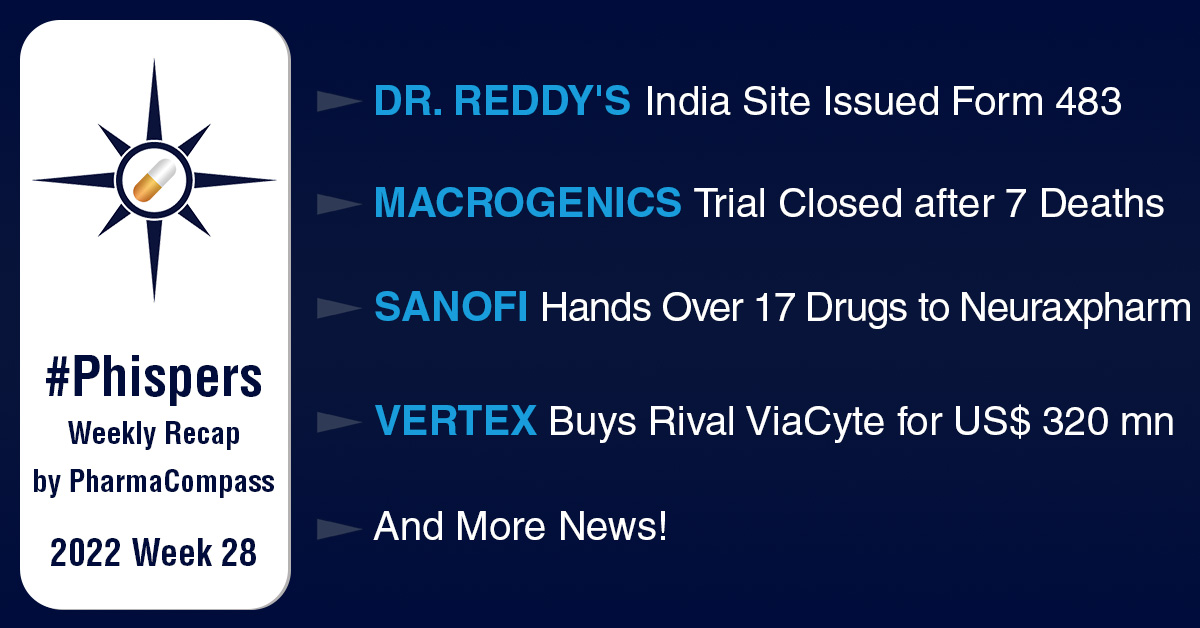
In this week’s Phispers, Sanofi has announced positive results from late-stage trials of two of its investigational hemophilia drugs – fitusiran and efanesoctocog alfa.
In regulatory news, the US Food and Drug Administration (FDA) has issued a Form 483 with two observations to Dr. Reddy’s manufacturing facility at Srikakulam in the state of Andhra Pradesh, India.
Maryland-based biotech MacroGenics has shuttered a phase 2 study of its investigational drug enoblituzumab as part of a combination therapy for head and neck cancer, following the death of seven out of the 62 patients who took part in the trial. The deaths were potentially associated with hemorrhagic events, the company said.
In Covid news, Alnylam has escalated its legal battle with Pfizer and Moderna, accusing the companies in Delaware federal court of infringing a newly obtained patent. The lawsuits said the vaccines’ messenger-RNA delivery systems violate an Alnylam patent on lipid nanoparticle (LNP) technology for delivering genetic material into human cells.
FDA has authorized state-licensed pharmacists to prescribe Pfizer’s Covid-19 pill – Paxlovid – to patients in the US to help improve access to the drug. This has earned the agency criticism from the American Medical Association. Novavax’s Covid vaccine finally bagged FDA authorization, though the CDC still needs to sign off on the use of the vaccine before it can be made available to people.
The United States Patent and Trademark Office (PTO) has said it will work closely with the FDA to scrutinize patenting procedures more carefully. It plans to crack down on patenting of “incremental, obvious changes to existing drugs that do not qualify” for new protections.
In M&A news, Boston-based biotech Vertex Pharmaceuticals said it is acquiring rival biotech ViaCyte for US$ 320 million in an all-cash deal. The two firms have been in a neck-and-neck clinical development race to find a cure for type 1 diabetes. And Sanofi has decided to hand over 17 products to central nervous system (CNS) specialist Neuraxpharm for an undisclosed amount.
Sanofi shares positive data from late-stage trials on two of its hemophilia drugs
Last week, Sanofi presented positive results from late-stage trials of two of its investigational hemophilia drugs. Sanofi’s partner Alnylam Pharmaceuticals has said their experimental drug fitusiran, when dosed once a month, led to a 61 percent decrease in the annualized bleed rate (ABR) over a seven-month period as compared to a previous therapy with either blood clotting factor replacement or bypassing agents (BPAs).




Trial patients who received fitusiran experienced zero treated bleeds compared to 16.9 percent with a prior factor or BPA prophylaxis. Patients on the drug require as little as six injections a year. Fitusiran is an RNA interference (RNAi) therapeutic being developed as a treatment for hemophilia A and B.
Sanofi’s second hemophilia drug, efanesoctocog alfa, protected patients who have severe hemophilia A from bleeds when given once a week. The therapy was tested in patients who have severe disease and had previously received factor VIII replacement therapy – the standard of care used to prevent joint bleeding and halt deterioration of joints. Around 77 percent of the trial patients had zero bleeds once they switched to efanesoctocog alfa as a prophylaxis over a 26-week treatment period.
Novo Nordisk also reported positive phase 3 data for its experimental drug concizumab, an antibody for once-daily prophylactic treatment for all types of hemophilia. The data demonstrated an 86 percent decrease in treated spontaneous and traumatic bleeds, with an estimated mean ABR of 1.7 compared to 11.8 with no prophylaxis.
Dr. Reddy’s facility in south India hit by Form 483 with two observations
The US Food and Drug Administration (FDA) has issued a Form 483 with two observations to Dr. Reddy’s manufacturing facility (FTO 11) at Srikakulam in the state of Andhra Pradesh, India. The agency completed a pre-approval inspection at the company’s manufacturing facility between June 30 and July 7.
The company did not make public the FDA’s observations but said it will address them soon. “We have been issued a Form 483 with two observations, which we will address within the stipulated timeline,” Dr. Reddy’s said in a regulatory filing. Dr. Reddy’s Srikakulam site had received Form 483s in 2014 and 2017. The pharma was hit with eight FDA observations at an oncology drug plant in 2019. It has received 14 Form 483s since 2017.
MacroGenics closes phase 2 cancer study due to deaths of seven trial patients
Maryland-based biotech MacroGenics has shuttered a phase 2 study of its investigational drug enoblituzumab as part of a combination therapy for head and neck cancer following the death of seven (out of 62) trial patients. The biotech said the study was closed following an internal review of the safety data that included the deaths, which were potentially associated with hemorrhagic events.
The clinical trial was evaluating enoblituzumab, a monoclonal antibody, in combination with either of the two anti-PD-1 antibodies — retifanlimab or tebotelimab — as first-line treatment for patients with recurrent or metastatic squamous cell carcinoma of the head and neck (SCCHN).
MacroGenics said it has informed investigators and the FDA about the closure of the study. The company has told investigators that no additional patients in the study are to be enrolled or receive further treatments. Merck’s Keytruda and Bristol Myer Squibb’s Opdivo have been approved in the first line for this type of cancer.
Alnylam escalates its patent tussle over Covid vaccines with Pfizer, Moderna
In March this year, Massachusetts-based Alnylam Pharmaceuticals Inc had sued both Pfizer and Moderna in two separate lawsuits filed in the district court of Delaware. It had claimed that both manufacturers had used Alnylam’s (previously developed) technology to deliver the messenger-RNA in their Covid vaccines safely in the body.
Alnylam has now escalated its legal battle with Pfizer and Moderna, accusing the companies in the Delaware federal court of infringing a newly obtained patent. The lawsuits said the vaccines’ mRNA delivery systems violate an Alnylam patent on lipid nanoparticle (LNP) technology for delivering genetic material into human cells. The US Patent and Trademark Office had issued the patent the same day Alnylam had filed the complaints.
“The Alnylam LNP Technology is foundational to the success of the recently developed messenger RNA (mRNA) based Covid vaccines,” according to the lawsuits filed in Delaware federal court.
Sanofi hands over 17 drugs to Neuraxpharm as part of its ‘play to win’ strategy
Sanofi is set to hand over 17 products to central nervous system (CNS) specialist Neuraxpharm for an undisclosed amount. Of the 17 drugs, 15 are meds for CNS disorders, such as Nozinan, Tranxene, Tiapridal, Dogmatil and Largactil are meant to treat diseases like depression, anxiety, psychosis, alcohol dependence, myasthenia gravis and Parkinson’s disease. There are two pain and vascular meds – Topalgic and Trental.
Neuraxpharm said the deal will help cement its position as one of the top CNS-focused specialty pharmas in Europe. The pharma estimates the drugs from Sanofi to help fetch around €600 million (around US$ 603 million) in yearly sales.
For Sanofi, the sale of the drugs aligns with CEO Paul Hudson’s ‘play to win’ strategy, which aims to focus the company’s efforts on first-in-class drugs. In June, the French pharma had sold the global rights to cancer drug Libtayo to its longtime partner Regeneron for US$ 900 million.
Boston-based Vertex buys rival ViaCyte to boost its type 1 diabetes pipeline
Days after FDA lifted a hold on Vertex Pharmaceuticals’ stem cell therapy for type 1 diabetes, the Boston-based biotech said it is acquiring rival biotech ViaCyte for US$ 320 million in an all-cash deal. The two firms have been in a neck-and-neck clinical development race to find a cure for type 1 diabetes.
Vertex said the ViaCyte deal will provide it “complementary assets, capabilities and technologies” to the ones it picked up three years ago, when it had bought another rival biotech, Semma Therapeutics, for almost US$ 1 billion. The deal will give Vertex access to the San Diego-based firm’s drug candidates, intellectual property and manufacturing facilities that will help it boost development of its existing type 1 diabetes programs, including stem cell-based therapy — VX-880 — currently in human testing. Vertex expects the acquisition to close later this year, provided the deal is approved by antitrust regulators.
US Patent Office to work with FDA to crack down on ‘incremental’ patents
The United States Patent and Trademark Office (PTO) has said it will work closely with the FDA to carefully scrutinize patenting procedures and execute initiatives that are aimed at lowering drug prices. The agency plans to crack down on patenting of “incremental, obvious changes to existing drugs that do not qualify” for new protections. The initiative came after PTO and FDA officials exchanged letters outlining their concerns about pharma patents.
Last year, the then-acting FDA commissioner Janet Woodcock had written to the PTO saying “certain uses of the patent system” lead to a delay in the introduction of generics and biosimilars in the US market. She had cited a study that had found that 78 percent of new drug patents issued between 2005 and 2015 were awarded to existing drugs. The letter asked for a joint mechanism between the two agencies to address the possible misuse of the patent system.
The two agencies are developing policies aimed at “protecting and promoting” innovation and advancing competition with the aim to lower drug prices.
FDA earns ire of American medical body for allowing pharmacists to prescribe Paxlovid
As coronavirus infections rise across the US, the FDA has authorized state-licensed pharmacists to prescribe Pfizer’s Covid-19 pill – Paxlovid – to patients to help improve access to the drug. This measure has earned FDA the ire of the American Medical Association (AMA).
The agency said patients who tested positive for Covid-19 should bring their health records for the pharmacists to review for kidney and liver problems. Pharmacists should refer the patients to a healthcare professional licensed to prescribe drugs if there is not sufficient information to assess kidney or liver function, the agency said.
The AMA has criticized FDA’s
decision saying prescribing decisions should be made by a doctor. AMA president
Jack Resneck said prescribing Paxlovid requires knowledge of a patient’s
medical history, as well as clinical monitoring for side effects and follow-up
care to determine whether a patient is improving.
The FDA, however, clarified that it will not allow state-licensed pharmacists to prescribe Merck’s antiviral Lagevrio (molnupiravir). Covid-19 patients will have to get the drug prescribed by physicians, advanced practice registered nurses and physician assistants, who are licensed or authorized to prescribe Lagevrio. The agency said its decision is based on several factors, including the drug’s side-effect profiles and the need for provider-patient consultation.
Meanwhile, the FDA has granted full approval to Pfizer-BioNTech’s Covid-19 vaccine – Comirnaty – for adolescents between 12 and 15 years. The shot has been available under an emergency use authorization since May 2021 for the same age group.
Moderna’s Omicron booster triggers stronger response against sub-variants: Moderna has said its Omicron-containing bivalent booster vaccine generated higher neutralizing antibodies in participants when compared with the current booster. After a month of getting the shot, trial participants had 1.69 times higher neutralizing antibodies of the BA.4 and BA.5 variants as compared to those who received the original booster. Moderna has shared the data with the regulators. It is working with regulators to advance two bivalent vaccine candidates based on various market preferences.
FDA authorizes Novavax’s Covid vaccine: Finally, Novavax’s Covid-19 vaccine that is based on a more traditional technology has bagged FDA authorization. The US Centers for Disease Control and Prevention (CDC) still needs to sign off on the use of the vaccine before it can be made available to people. More than two-thirds of the US population has been fully vaccinated with shots from Moderna, Pfizer-BioNTech and Johnson & Johnson.
The PharmaCompass Newsletter – Sign Up, Stay Ahead
Feedback, help us to improve. Click here
Image Credit : Phisper Infographic by SCORR MARKETING & PharmaCompass is licensed under CC BY 2.0
“ The article is based on the information available in public and which the author believes to be true. The author is not disseminating any information, which the author believes or knows, is confidential or in conflict with the privacy of any person. The views expressed or information supplied through this article is mere opinion and observation of the author. The author does not intend to defame, insult or, cause loss or damage to anyone, in any manner, through this article.”