


BLOG
MARKET INTEL by PharmaCompass
CONTENT by Suppliers
- Interview #SpeakPharma
- Video #SupplierSpotlight
- Vlog #PharmaReel
- Company Bio #AboutSupplier
- Services Bio #AboutCapabilities
News

Create content with us, ask us
By PharmaCompass
2020-04-16
Impressions: 2150
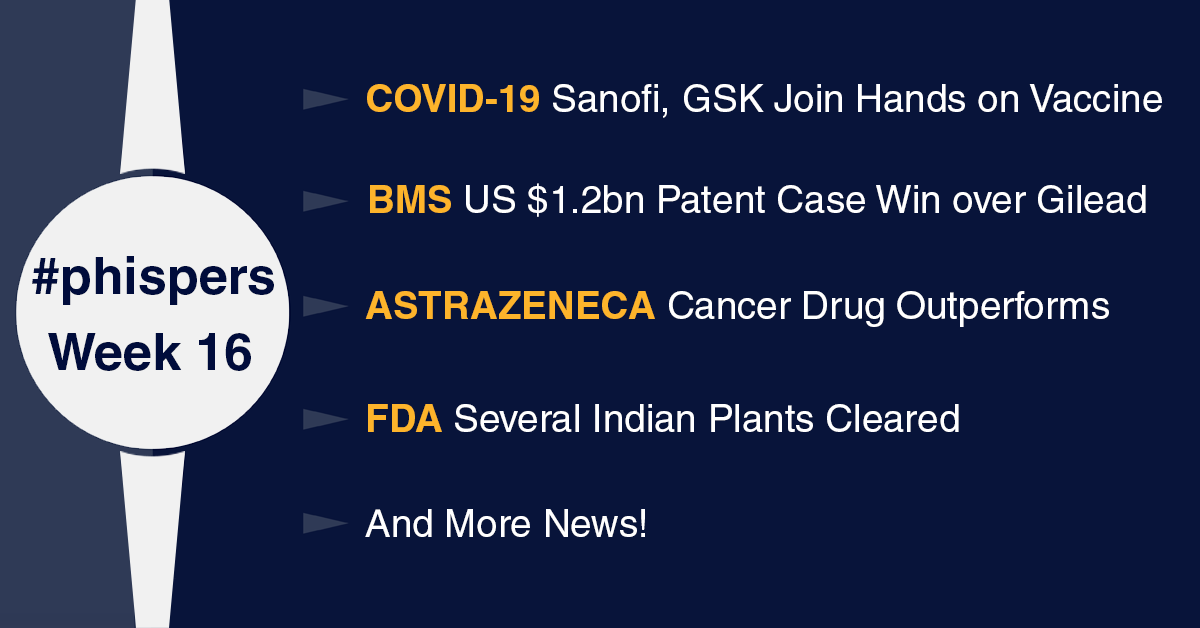
This week, Phispers brings you news about two key competitors in the field of vaccines — Sanofi and GSK — joining hands to develop a vaccine for the novel coronavirus.
Human trials are expected to start later this year. US President Donald Trump said he will stop funding to the WHO post a review of its response to the initial coronavirus outbreak.
Over the last fortnight, FDA has granted approvals and tentative approvals to several Indian firms, including Lupin, Sun Pharma, Biocon, Ajanta Pharma, Strides, Dr Reddy’s, Zydus and Cipla to ensure steady supply of drugs to the US in the face of supply chain disruptions.
Meanwhile, AstraZeneca’s Tagrisso has shown benefit in lung cancer in third phase trials.
AstraZeneca will also start a clinical trial of its cancer drug Calquence to assess its potential to control the exaggerated immune system response associated with Covid-19 infection in severely ill patients.
And Bristol Myers Squibb was awarded US$ 1.2 billion in a major patent case win over Gilead’s Kite Pharma.
Sanofi, GSK join hands to bring out Covid-19 vaccine; to start human trials soon
The Covid-19 pandemic has pushed drugmakers to move faster than before, and is now converting competitors into partners. In a rare move, drug behemoths — Sanofi and GlaxoSmithKline (GSK) — have joined hands to develop a vaccine for the novel coronavirus. The two are collectively worth over US$ 200 billion and are the world’s largest vaccine makers.





The two companies plan to start human trials in the second half of this year, and if things go right, they will file for potential approvals by the second half of 2021.
While Sanofi will contribute its S-protein Covid-19 antigen, which is based on recombinant DNA technology, GSK will contribute its proven pandemic adjuvant technology to the collaboration. The combination of a protein-based antigen together with an adjuvant is well-established and used in a number of vaccines available today.
They also plan to build manufacturing capacity “at risk”. This means they will invest money and resources into scaling up production even before a vaccine proves itself, GSK CEO Emma Walmsley said.
Paul Hudson, CEO Sanofi, said: “As the world faces this unprecedented global health crisis, it is clear that no one company can go it alone. That is why Sanofi is continuing to complement its expertise and resources with our peers, such as GSK, with the goal to create and supply sufficient quantities of vaccines that will help stop this virus.”
Development of the recombinant-based Covid-19 vaccine candidate is being supported through funding and a collaboration with the Biomedical Advanced Research and Development Authority (BARDA) in the US. The companies plan to discuss funding support with other governments and global institutions prioritizing global access.
Massachusetts-based Moderna and Pennsylvania-headquartered Inovio Pharmaceuticals have already advanced their vaccine candidates into human testing.
US to stop funding WHO after reviewing its initial response to virus, says Trump
At the height of the Covid-19 pandemic, the US President Donald Trump announced this week that he is halting funding for the World Health Organization (WHO) pending a review of its response to the initial coronavirus outbreak.
The agency had criticized Trump’s order to temporarily deny most foreign nationals who had recently been to China an entry into the US. The order was issued on January 31, when China was the center of the pandemic.
Trump accused the WHO of “severely mismanaging and covering up” the coronavirus crisis, specifically the initial outbreak in Wuhan, China.
Trump said the WHO was being “China-centric”. The US grants US$ 500 million a year to the WHO and is the largest contributor to the agency out of 196 countries, accounting for roughly 15 percent of the agency's budget. It sent more than US$ 57.8 million earlier this year and also contributes additional money to special projects.
“With the outbreak of the Covid-19 pandemic, we have deep concerns about whether America's generosity has been put to the best use possible,” Trump said. “The reality is that the WHO failed to adequately obtain and share information in a timely and transparent fashion. It could have been contained at its source,” he added.
Halting funding to the WHO has raised several questions about whether it could affect attempts by other countries to curtail Covid-19 cases.
Expectedly, the move has also come under heavy criticism. Congressional Democrats disputed Trump’s authority to unilaterally halt funding to the WHO. Evan Hollander, spokesperson for the House Appropriations Committee, called Trump’s announced move “a desperate attempt to deflect blame.”
“The President does not have the unilateral authority to withhold the United States’ contribution to the World Health Organization,” Hollander said.
Microsoft co-founder Bill Gates tweeted: “Halting funding for the World Health Organization during a world health crisis is as dangerous as it sounds.”
“Their work is slowing the spread of Covid-19 and if that work is stopped no other organization can replace them. The world needs @WHO now more than ever,” Gates said.
“It’s a bizarre decision that would be profoundly detrimental to global public health,” said Gavin Yamey, the director of Duke University’s center for policy impact in global health.
AstraZeneca’s Tagrisso shows benefit in lung cancer in third phase trials
The third phase trial of British drugmaker AstraZeneca Plc’s top-selling cancer drug Tagrisso, aimed at showing the drug’s benefit in lung cancer treatment, will be conducted early after a recommendation from an independent data monitoring committee.
Last year, AstraZeneca had said a late-stage study showed Tagrisso had significantly helped patients with a type of lung cancer live longer. According to Wolfe Research, AstraZeneca’s Tagrisso could hit US$ 8 billion in sales by 2030.
José Baselga, executive vice president, Oncology R&D, said the company was thrilled by the recommendation to unblind the trial much earlier than expected “and are incredibly excited with these unprecedented results in patients with early-stage EGFR-mutated non-small cell lung cancer.”
The adjuvant performance could open up a whole new realm of sales for Tagrisso, which is already AstraZeneca’s bestseller.
AZ tests a cancer drug on Covid-19: AstraZeneca also said it would start a clinical trial of its cancer drug Calquence to assess its potential to control the exaggerated immune system response associated with Covid-19 infection in severely ill patients.
Calquence (acalabrutinib) belongs to a class of drugs called Bruton’s tyrosine kinase (BTK) inhibitors which can suppress autoimmune diseases. The drug, which is currently used to treat certain types of blood cancers, has already been approved for the treatment of adult patients with chronic lymphocytic leukaemia in the US and in several other countries.
Patients with severe symptoms including pneumonia are believed to suffer from an over reaction of the immune system known as cytokine storm and AstraZeneca aims to test whether Calquence, which suppresses certain elements of the immune system, can help control this immune response.
BMS awarded US$ 1.2 billion in major patent case win over Gilead’s Kite Pharma
In a patent infringement case in the US pertaining to the technology for treating cancer, Bristol Myers Squibb managed to persuade a federal judge to increase damages to US$ 1.2 billion against Gilead Sciences Inc’s Kite Pharma unit over revolutionary treatments that use a body’s own immune system to fight cancer.
The two companies are fighting a dispute over the pioneering CAR-T technique in which the T cells of a person’s own immune system are modified to attack cancer cells.
In August 2017, Gilead Sciences had acquired Kite Pharma for US$ 11.9 billion for its most advanced CAR-T therapy candidate — Yescarta (axicabtagene ciloleucel).
Kite makes Yescarta for the treatment of certain types of large B-cell lymphoma, a blood cancer. Yescarta brought in sales of US$ 456 million in 2019, a Bloomberg report said.
The damages of US$ 1.2 billion includes US$ 778 million awarded by a federal jury in December along with enhanced damages of US$ 389 million and a pre-judgment interest on the jury’s verdict of US$ 32.8 million.
A jury in Los Angeles had awarded damages in December after finding that Yescarta, a treatment sold by Kite Pharma, infringed on a patent exclusively licensed by Bristol Myers’ Juno Therapeutics division.
Bristol Myers was seeking as much as US$ 1.5 billion in a fight that began in 2017. Gilead plans to appeal against the ruling, a company spokesperson said.
FDA clears several Indian plants, grants multiple generic drug approvals
At a time when the world is under lockdown and supply chain disruptions are causing drug shortages the world over, the US Food and Drug Administration (FDA) is granting approvals and tentative approvals to Indian drug companies at a feverish pace.
Over the last one year, Indian pharma companies had faced several regulatory hurdles in the US that had led to revenue erosion. But with the Covid-19 pandemic and the anti-China rhetoric, it seems like things are beginning to change for Indian generic drug manufacturers.
Last week, the agency cleared Bengaluru-based Strides Pharma’s largest manufacturing facility after an inspection in March. This plant in Bengaluru has capabilities to produce finished dosage formulations including tablets, capsules, ointments, creams and liquids, and complex generics.
And this week, Lupin, the third largest generic drug supplier in the US by prescriptions, and Dr Reddy’s Laboratories received establishment inspection reports (EIRs), indicating closure of investigation by the US regulator of their manufacturing plants. The clearance for Lupin’s manufacturing facility in Nagpur came after an FDA inspection in January this year.
Hyderabad-based Dr Reddy’s said the company got the EIR for its API plant 5 at Miryalaguda in Telangana.
Similarly, Bengaluru-based Biocon got its insulin plant in Malaysia cleared by the FDA.
There were several other approvals that came in over the last fortnight. Zydus, a subsidiary of Ahmedabad-headquartered Cadila Healthcare, received a tentative approval from the FDA for Carbidopa and Levodopa extended-release tablets. These are both diabetes drugs. Besides Zydus, Sun Pharma also got a tentative FDA nod for Dapagliflozin, a diabetes drug.
Apart from this, Zydus received a tentative approval from the FDA to market its generic drug macitentan tablets in the USA. Macitentan is the API of Opsumit, which was developed and marketed by Acelion Pharmaceuticals, which is now a part of Johnson & Johnson. The medication is indicated for the treatment of pulmonary arterial hypertension.
Maharashtra-based Ajanta Pharma received FDA approval for Cholestyramine powder. It is used to lower high levels of cholesterol in the blood.
Cipla has received FDA approval to make the first generic of a commonly used inhaler — Albuterol Sulfate Inhalation Aerosol 90 mcg — to treat breathing difficulties as demand surges amid the coronavirus pandemic.
The agency also gave consent to Alkem Laboratories to market Azathioprine tablets. Azathioprine is a generic drug used to prevent a patient’s body from rejecting a transplanted kidney. Azathioprine is also used to treat symptoms of rheumatoid arthritis.
The FDA also gave its nod to anesthetic drug — Ropivacaine Hydrochloride — made by Caplin Point Laboratories.
Even with companies instituting “social distancing” and governments locking down, Bernstein analyst Ronny Gal predicted that generics supply will remain strong in the coming quarters.
“Even if social distancing is the new normal, the supply chain will function well enough to supply the market, we may see few spot shortages...but nothing too bad.”
However, in a report published last month, Philippe Guerin, director of the Infectious Diseases Data Observatory at University of Oxford, said in the context of the Covid-19 pandemic that the global reliance on Indian generics was likely to become a complex international challenge.
The PharmaCompass Newsletter – Sign Up, Stay Ahead
Feedback, help us to improve. Click here
Image Credit : #Phisper Infographic by SCORR MARKETING & PharmaCompass is licensed under CC BY 2.0
“ The article is based on the information available in public and which the author believes to be true. The author is not disseminating any information, which the author believes or knows, is confidential or in conflict with the privacy of any person. The views expressed or information supplied through this article is mere opinion and observation of the author. The author does not intend to defame, insult or, cause loss or damage to anyone, in any manner, through this article.”