Please Wait
Applying Filters...
Menu
Xls

Digital Content read-more

Create Content with PharmaCompass, ask us

DATA COMPILATION #PharmaFlow

read-more
read-more
DMF filings rise 4.5% in Q3 2025; China holds lead, India records 20% growth in submissions
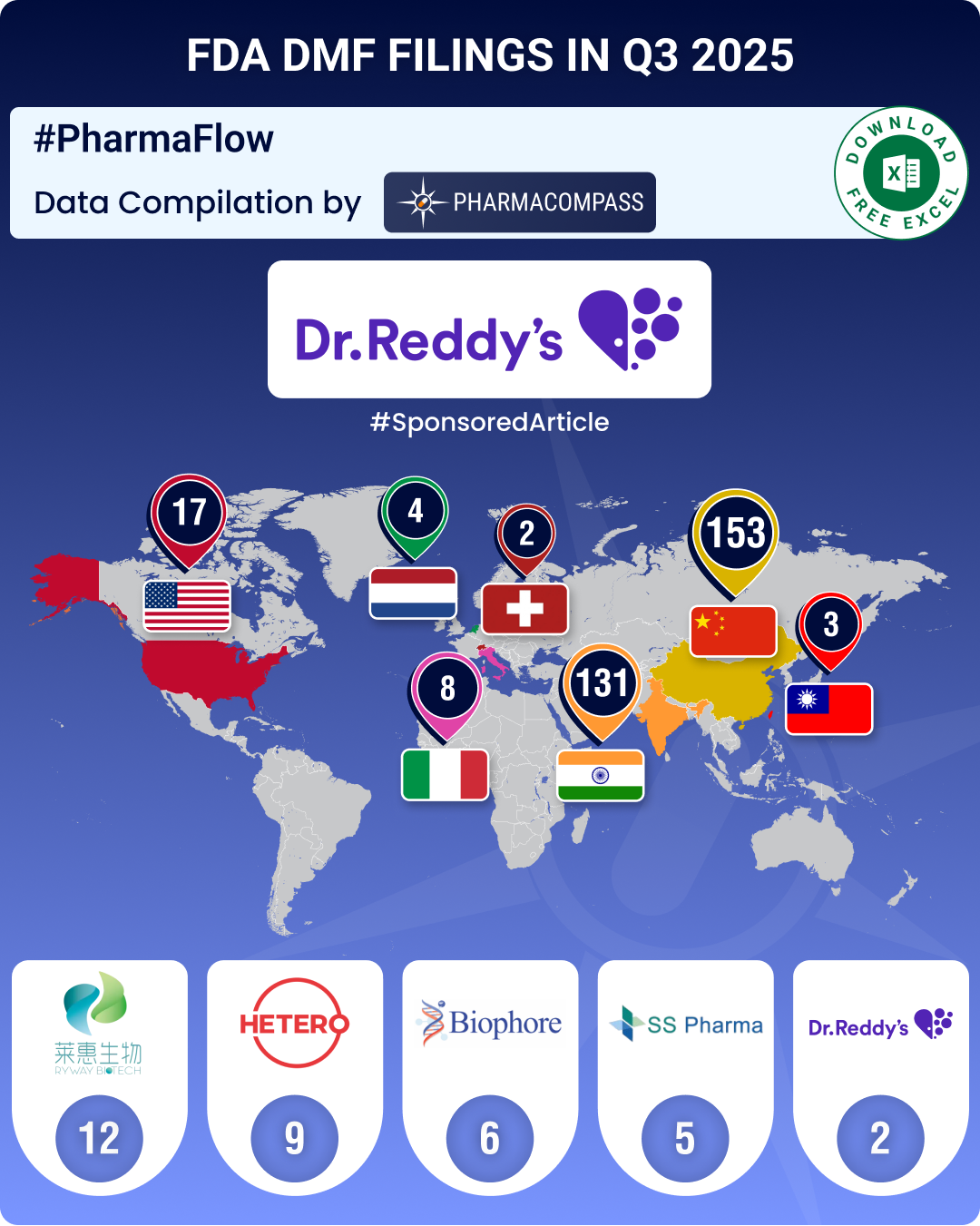
The third quarter (Q3) of 2025 witnessed a steady rise in Drug Master File (DMF) submissions to the US Food and Drug Administration (FDA). DMFs are used to provide confidential, detailed information about facilities, processes, or articles used in the manufacturing, processing, packaging, and storing of human drug productsA total of 323 Type II DMFs were submitted during this period, as opposed to 309 submissions in Q3 2024, marking an increase of 4.53 percent. This is the second highest number since 2018. In Q1 2025, 339 Type II filings were recorded.Across all DMF types (II, III, IV, and V), 479 DMFs were filed in Q3 2025, compared to 394 in Q3 2024, representing a 21.57 percent increase. Out of the 323 Type II DMFs submitted in Q3 2025, 40 had completed their review by the end of Q3, reflecting a processing lag between submission and review completion. View FDA DMF Filings in Q3 2025 (Power BI Dashboard, Free Excel Available)China maintains its lead while India posts double-digit growth in DMF submissions China and India continued to dominate DMF submissions in Q3 2025. China retained the top spot with 153 Type II DMFs, matching its submission count from Q3 2024. India recorded 131 DMFs, marking a 20.18 percent increase over 109 filings during the corresponding period last year.The United States stood a distant third with 17 filings, compared to 13 in Q3 2024. Among European nations, Italy recorded eight DMFs, doubling its 2024 tally. The Netherlands filed four, up from three. Spain submitted only one DMF, as against seven submitted in Q3 2024. Taiwan made three filings, up from one submitted in Q3 2024. Together, India, China and Taiwan accounted for about 88.9 percent of all Type II DMFs filed during the quarter. View FDA DMF Filings in Q3 2025 (Power BI Dashboard, Free Excel Available) China’s Suzhou Ryway Biotech tops corporate tally; India’s Hetero, Biophore followChina’s Suzhou Ryway Biotech led the company-wise tally with 12 DMF submissions in Q3 2025. The company had not filed any DMFs in Q3 2024.India’s Hetero Group followed with nine DMFs, maintaining the same number of filings as Q3 2024. Biophore India Pharmaceuticals ranked third with six DMFs, doubling its count from three last year.Other notable contributors include Sai Sreyas Pharmaceuticals (India) and Shanghai Haoyuan Chemexpress (China), with five DMFs each. Companies such as SNJ Group, Lunan Pharmaceutical, Allsino Pharmaceutical, Shankus Pharma, Jiangxi Xinganjiang Pharmaceutical, Sunpure Extracts, Lee Pharma, Umedica Laboratories, Linhai Tianyu Pharmaceutical and Maithri Drugs filed four DMFs each. View FDA DMF Filings in Q3 2025 (Power BI Dashboard, Free Excel Available) Olaparib, semaglutide lead molecular filings; Dr. Reddy’s files DMF for edoxaban & tucatinibDr. Reddy’s Laboratories also featured among key DMF filers in Q3 2025, submitting two DMFs — for edoxaban tosylate monohydrate and tucatinib copovidone. Edoxaban tosylate monohydrate (marketed as Savaysa by Daiichi Sankyo) is a prescription anticoagulant used to reduce the risk of stroke and to treat deep vein thrombosis and pulmonary embolism. Patent exclusivity for Savaysa extends until October 2026 in the United States, with no generic currently available.In terms of molecules, the highest number of DMFs were filed for olaparib, semaglutide, ruxolitinib phosphate, ferric carboxymaltose, and vismodegib, with three DMFs each in Q3 2025.Olaparib, sold by AstraZeneca under the brand name Lynparza, saw DMFs being filed by BDR Lifesciences and Intas Pharmaceuticals from India, and by ScinoPharm Taiwan during the quarter.Semaglutide, a glucagon-like peptide-1 (GLP-1) receptor agonist developed by Novo Nordisk, continued to draw strong interest from API manufacturers. DMFs for semaglutide were filed by three Chinese companies: Yangzhou Aurisco Pharmaceutical, Zhejiang Peptites Biotech, and Fujian Genohope Biotech.Ruxolitinib phosphate, marketed by Incyte as Jakafi, saw three DMFs. Three Indian companies — Alembic Pharmaceuticals, Valary Labs, and Devi Pharmatech — filed DMFs for this API in Q3 2025. Other molecules that received multiple DMF submissions include ferric carboxymaltose (used to treat iron-deficiency anemia) and vismodegib (an oral therapy for basal-cell carcinoma). View FDA DMF Filings in Q3 2025 (Power BI Dashboard, Free Excel Available) First-time DMF filings span 17 companies; India leads with nine first-time DMFs The quarter saw first-time DMF filings from 17 companies. India took a lead here with nine first-time DMF filings, followed by China (six), and the US (two).The DMF filings in this quarter included inclisiran sodium (filed by Aurisco Pharmaceutical of China), pacritinib citrate (by TAPI Nl B.V. of the Netherlands), and vosoritide (by Apicore LLC of the US).Out of the 19 first-time DMFs filed in Q3 2025, four completed their Generic Drug User Fee Amendments (GDUFA) review process during the quarter. View FDA DMF Filings in Q3 2025 (Power BI Dashboard, Free Excel Available) GDUFA fee for FY 2026: The FDA Generic Drug User Fee Amendments (GDUFA) is a law designed to speed access to safe and effective generic drugs to the public and reduce costs to the industry.Fee rates for fiscal year 2026 were published on July 30, 2025. FDA has revised fees under GDUFA III across all categories. While there is a slight increase in the DMF fee from US$ 95,084 in 2025 to US$ 102,584 in 2026, the ANDA fee has seen a sharp rise: from US$ 321,920 in 2025 to US$ 358,247 in 2026.FY 2025 and FY 2026 User Fee Rates Generic drug fee category Fees rates for FY 2025 Fees rates for FY 2026 Applications:     Abbreviated New Drug Application (ANDA) US$ 3,21,920 US$ 3,58,247 Drug Master File (DMF) US$ 95,084 US$ 1,02,584 Facilities:     Active Pharmaceutical Ingredient (API)—Domestic US$ 41,580 US$ 43,549 API—Foreign US$ 56,580 US$ 58,549 Finished Dosage Form (FDF)—Domestic US$ 2,31,952 US$ 2,38,943 FDF—Foreign US$ 2,46,952 US$ 2,53,943 Contract Manufacturing Organization (CMO)—Domestic US$ 55,668 US$ 57,346 CMO—Foreign US$ 70,668 US$ 72,346 GDUFA Program:     Large size operation generic drug applicant US$ 18,91,664 US$ 19,18,377 Medium size operation generic drug applicant US$ 7,56,666 US$ 7,67,351 Small business generic drug applicant US$ 1,89,166 US$ 1,91,838 Our viewFor several years prior to the pandemic, India had a lead in Type II DMF submissions. In recent years, China has surpassed India in DMF filings. But Q3 2025 numbers indicate that Indian drugmakers are fast catching up. Since DMFs establish trust in APIs from across the world, we feel this healthy competition between drugmakers from the two countries is good for the global pharmaceutical industry. 

Impressions: 4781

https://www.pharmacompass.com/radio-compass-blog/dmf-filings-rise-4-5-in-q3-2025-china-holds-lead-india-records-20-growth-in-submissions

#PharmaFlow by PHARMACOMPASS
13 Nov 2025

WEEKLY NEWS RECAP #Phispers

read-more
read-more
J&J to spin off consumer biz within two years; Biden nominates Califf as FDA chief
After a gap of a week, Phispers is back with reports of some big developments in the world of pharmaceuticals. The biggest news this week was Johnson & Johnson’s announcement that it plans to spin off its consumer health division. Another significant news was the nomination of the US Food and Drug Administration (FDA) commissioner. Ever since January this year, when Stephen M. Hahn resigned as the FDA commissioner, Janet Woodcock has been the acting commissioner of the agency. After ten months, the Biden administration named Robert Califf, who served as the head of the agency during the Obama administration, as the new FDA chief. Pfizer has submitted its application for emergency use authorization (EUA) of its antiviral Covid-19 pill — Paxlovid — with the FDA. The company is also allowing generic versions of the drug in 95 countries and has signed an agreement with MPP. In other news pertaining to new drugs, AstraZeneca and Moderna’s experimental mRNA-based heart drug has shown positive results in heart failure patients. Similarly, Bristol Myers Squibb’s targeted heart drug mavacamten has shown promising results when used with traditional beta blocker therapies. With encouraging new data on Jardiance, Eli Lilly and Boehringer Ingelheim plan to expand into acute heart failure for their SGLT2 inhibitor. And results from the largest study of psilocybin found the drug to be highly efficacious as a therapy for treatment-resistant depression. In regulatory news, the first company to come into public spotlight in the nitrosamine impurities case — Zhejiang Huahai Pharmaceutical — finally saw a closure of a warning letter issued to it by the FDA in 2018. J&J to spin off consumer products business; to focus on drugs, medical devices Johnson & Johnson (J&J) plans to spin off its consumer health division in order to focus on pharmaceuticals and medical devices. This will be the biggest shake-up in the American company’s 135-year history. In a statement, J&J said it will separate its consumer health business into a new, publicly traded company and is aiming to complete the planned separation in 18 to 24 months. “We think these have evolved as fundamentally different businesses,” J&J’s CEO Alex Gorsky said. In the recent past, there have been similar announcements by conglomerates like Toshiba and General Electric. In pharmaceuticals, GSK is planning to spin off its consumer health business next year. In June this year, Merck had spun off Organon, which has a broad portfolio of women’s health and legacy businesses. And Sanofi spun out its API manufacturing capabilities into its own organization, known as EuroAPI. Novartis too has been mulling sale or spinoff of its generic drugs business Sandoz. Earlier this month, Novartis agreed to sell 53.3 million (approximately 33 percent) Roche bearer shares in a bilateral transaction to Roche for a total consideration of US$ 20.7 billion. Last month, J&J too had spun off its talc liabilities into a separate firm which later filed for Chapter 11 bankruptcy. Meanwhile, J&J’s drugs and medical equipment business, which makes cancer treatments, vaccines and surgical tools, is on track to achieve US$ 80 billion in sales this year while its consumer products business is expected to bring in US$ 15 billion. The new company will be home to J&J’s biggest brands such as OTC drugs Tylenol, Zyrtec and Motrin; skin health and beauty products such as Neutrogena; and essential health and specialty brands like Band-Aid, Johnson’s baby and feminine care products. Alex Gorsky joins Apple’s board: Apple Inc has added Alex Gorsky, the departing CEO of Johnson & Johnson, to its board, thereby reinforcing the technology giant’s push to expand its health and wellness offerings. “Gorsky will bring decades of experience in corporate leadership and health technologies, and a long track record of leading innovative and diverse teams around the world,” an Apple statement said. Biden picks Robert Califf as FDA commissioner; urges Senate to confirm him soon After ten months of Janet Woodcock serving as the acting commissioner of the US Food and Drug Administration (FDA), President Joe Biden said last week that he would nominate Robert Califf for a second stint as commissioner of the agency and has urged the Senate to swiftly confirm his nomination. This means that Woodcock won’t get the permanent job. A cardiologist, Califf served as the FDA chief during former President Barack Obama’s administration (from February 2016 to January 2017). He has spent the last two years at Google’s life sciences-focused sister outfit — Verily — as its head of clinical policy and strategy. “Dr. Robert Califf is one of the most experienced clinical trialists in the country, and has the experience and expertise to lead the Food and Drug Administration during a critical time in our nation’s fight to put an end to the coronavirus pandemic,” Biden said in a statement issued by the White House. Pfizer files for US authorization of its promising Covid-19 antiviral pill — Paxlovid Last week, there was news that a large study of Pfizer’s experimental antiviral pill — Paxlovid — found that the drug can cut hospitalizations and deaths from Covid significantly. The encouraging results from an interim analysis of a phase 2/3 study of non-hospitalized adult patients with Covid-19 who were at high risk of progressing to severe illness showed an 89 percent reduction in risk of Covid-19-related hospitalization or death from any cause compared to placebo in patients treated within three days of symptom onset, Pfizer said in a statement. In the overall study population through day 28, no deaths were reported in patients who received Paxlovid, compared to 10 deaths in patients who received placebo, it added. This week, there is news that Pfizer is seeking US authorization of Paxlovid. Pfizer said it completed submission of its application for emergency use authorization (EUA) of the drug with the FDA, including data from the drugmaker’s clinical trial. Like Merck and Ridgeback Biotherapeutics’ molnupiravir, Paxlovid can also be a promising new weapon in the fight against the pandemic. Both can be taken as an early at-home treatment to help prevent Covid-19 hospitalizations and deaths. Merck and Ridgeback completed their EUA submission for molnupiravir on October 11. Meanwhile, Pfizer has said it will allow generic versions of its Covid drug in 95 countries. Pfizer is already lining up Paxlovid to be manufactured as a generic by countries in need. Under an agreement with the Medicines Patent Pool (MPP), Pfizer will licensePaxlovid to facilitate affordable global access. The deal will allow sub-licensees to supply 95 countries that account for 53 percent of the world’s population, Pfizer said. This agreement is similar to the one Merck and Ridgeback signed with the MPP three weeks ago. Pfizer said it will not receive royalties on sales in low-income countries and will waive royalties in all countries covered by the agreement while Covid-19 remains classified as a public health emergency of international concern by the World Health Organization. Two heart therapies — Astra-Moderna’s mRNA drug, BMS’ mavacamten — show promise There is lots of news this week on new drug development. There was news from AstraZeneca and Moderna who have been working on a messenger RNA drug — AZD8601 — for heart failure. The drug is injected directly into the heart of patients who have experienced heart failure to help repair the organ. In a phase 2 trial dubbed EPICCURE, seven patients were treated with AZD8601, while four were given placebo. After six months of follow-up, investigators concluded the drug met the primary endpoints on safety and tolerability, while the exploratory efficacy analyses support further clinical evaluation. The results underscore mRNA’s ability to “act locally and transiently, while driving dose-dependent protein expression,” Moderna’s CEO Stéphane Bancel said. However, the therapy has a long way to go and more data needs to be collected at different dosages before the partners can claim a true breakthrough. Similarly, Bristol Myers Squibb’s targeted heart drug mavacamten has shown promising results when used with traditional beta blocker therapies, often used to control blood pressure. Over a year ago, BMS had acquired the drug through its US$ 13 billion acquisition of MyoKardia. Mavacamten is being tested in obstructive hypertrophic cardiomyopathy, or HCM, an inherited disorder that causes the muscle walls of the heart to thicken, sometimes to the point at which they can obstruct blood flow. With new Jardiance data, Lilly, BI set sights on acute heart failure: A few months after Eli Lilly and Boehringer Ingelheim broke into the chronic heart failure space with their SGLT2 inhibitor Jardiance, the duo is planning an expansion into acute heart failure. At this year’s American Heart Association conference, Lilly and BI announced that acute heart failure patients were 36 percent more likely to benefit from Jardiance than placebo after 90 days, meeting the primary endpoint in the phase 3 EMPULSE trial. Lilly and BI acknowledged that the study could be limited by a relatively small sample size (530 hospitalized adults). But the partners say they’re confident the drug could make a difference in patients’ lives. Largest trial on psilocybin: Results from the largest study of psilocybin were announced this week. And Compass Pathways, the mental healthcare company manufacturing the drug, revealed that psilocybin was highly efficacious as a therapy for treatment-resistant depression. The phase 2b study is the largest randomized, controlled, double-blind trial of psilocybin, the psychedelic compound in magic mushrooms. The company said it found that patients who were given the highest dose (of 25 milligrams) had a significant decrease in depressive symptoms. The study, which enrolled 233 patients at multiple sites across Europe and North America, is the most rigorous trial on psilocybin for treatment-resistant depression. FDA closes warning letter issued to Zhejiang Huahai over nitrosamine impurities Three years after getting an FDA warning letter, Chinese drugmaker — Zhejiang Huahai Pharmaceutical — finally heard from the agency that it has been closed.  Huahai was the first company to come into public spotlight in 2018, when high levels of a probable carcinogen, known as N-nitrosodimethylamine (NDMA), was found in the active ingredient of the popular heart drug valsartan. The finding led to massive recalls of the drug in the US and Europe, as the company was a major valsartan API supplier with 45 percent market share in the US and Germany. The saga led to serious reputation damages not just for Huahai, but also for China’s drug industry. However, the carcinogen problem was not restricted to Huahai or valsartan. Later recalls included losartan by Novartis’ Sandoz and Teva as well as valsartan by Mylan and Aurobindo Pharma, among others — all out of concerns of carcinogenic impurities. In April 2020, NDMA was also found in heartburn drug Zantac, leading to widespread recalls. Though the warning letter is off Huahai’s back, the company can’t yet start selling its products in the US due to an import ban that affects 29 products, Huahai said.  

Impressions: 1857

https://www.pharmacompass.com/radio-compass-phisper/j-j-to-spin-off-consumer-biz-within-two-years-biden-nominates-califf-as-fda-chief

#Phispers by PHARMACOMPASS
18 Nov 2021

NEWS #PharmaBuzz

read-more
read-more

https://www.accessdata.fda.gov/scripts/cder/daf/index.cfm?event=overview.process&ApplNo=212371

FDA
21 May 2026

https://www.accessdata.fda.gov/scripts/cder/daf/index.cfm?event=overview.process&ApplNo=212336

FDA
07 May 2026

https://octaviuspharma.com/blogs/anti-diabetic-dc-granules-sitagliptin-empagliflozin-dapagliflozin-metformin-formulations/

PRESS RELEASE
04 May 2026

https://www.accessdata.fda.gov/scripts/cder/daf/index.cfm?event=overview.process&ApplNo=220511

FDA
25 Feb 2026

https://www.accessdata.fda.gov/scripts/cder/daf/index.cfm?event=overview.process&ApplNo=212283

FDA
04 Feb 2026

https://www.expresspharma.in/zydus-receives-tentative-approval-from-us-fda-for-empagliflozin-and-linagliptin-tablets/

EXPRESSPHARMA
28 Nov 2025