



NEWS
- Pharma & Biotech News #PharmaBuzz
- Weekly News Recap #Phispers
- Recent Product Approvals #GreenLight
- Quality Compliance Alerts #Warning!
- All News #Library
DRUGS & DEVELOPMENTS
MARKET INTEL by PharmaCompass

Create content with us, ask us

Phispers On Air
Click & Listen
By PharmaCompass
2026-05-28
Impressions: 1,557 Article || 80 Video || 1 Listen
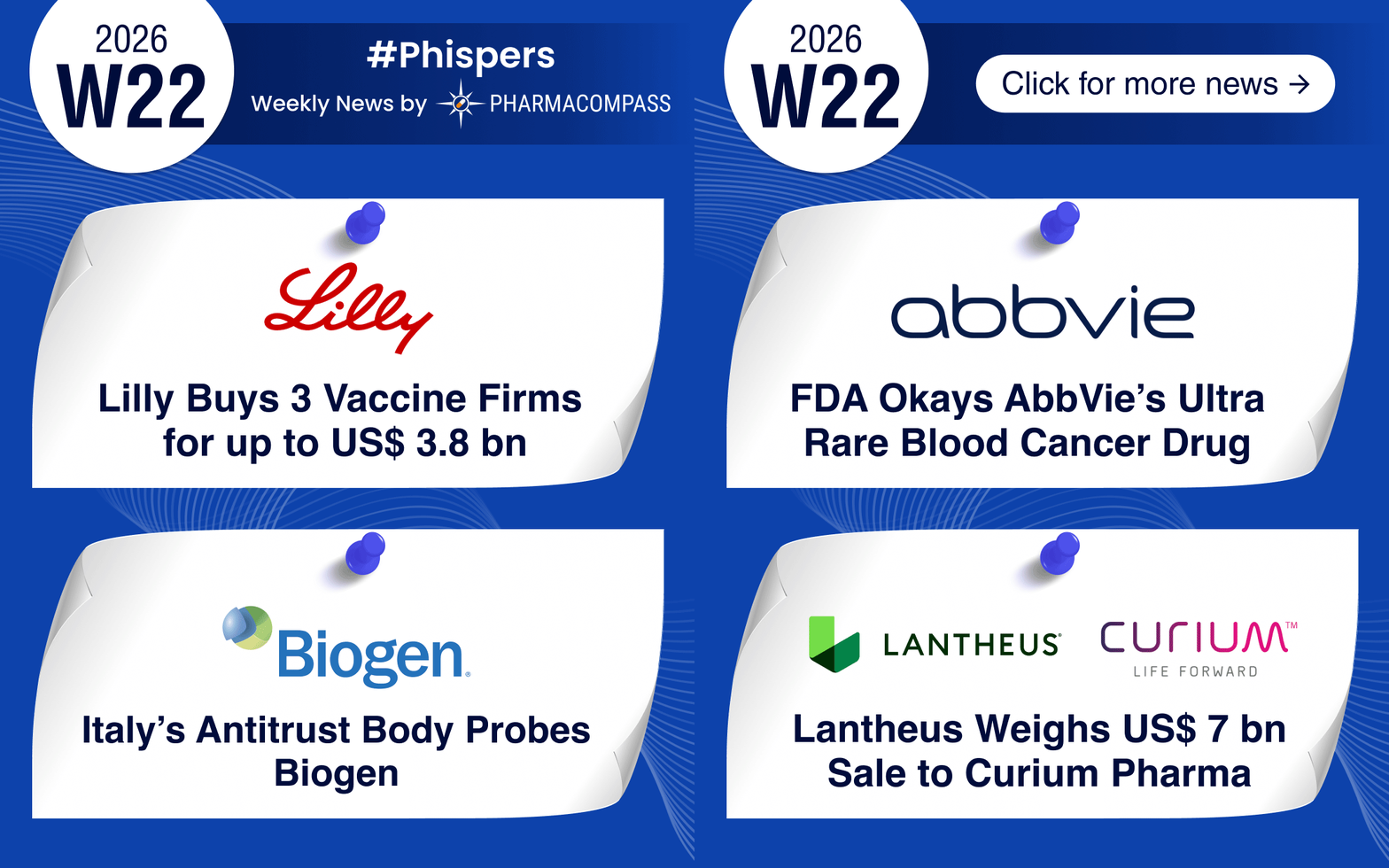
Buoyed by the rising sales of its obesity drug, Eli Lilly has been on an acquisition spree this year. The company announced agreements to acquire three vaccine companies this week, in deals worth up to US$ 3.8 billion.
In drug approvals, the US Food and Drug Administration (FDA) approved Daiichi Sankyo and AstraZeneca’s Datroway (datopotamab deruxtecan-dlnk) for the treatment of adult patients with unresectable or metastatic triple negative breast cancer (TNBC). FDA granted accelerated approval to Gilead Sciences’ Hepcludex (bulevirtide-gmod) injection to treat chronic hepatitis delta virus (HDV). The agency also approved AbbVie’s Decnupaztm (pivekimab sunirine-pvzy) for the treatment of an aggressive and ultra-rare form of blood cancer.
In trials, Sichuan Kelun’s sac-TMT-Keytruda combo improved survival in advanced lung cancer, and Apogee Therapeutics posted favorable results from a mid-stage trial of its experimental eczema drug — zumilokibart. Apogee also secured a financing deal worth up to US$ 1.3 billion with Blackstone Life Sciences.
In regulatory news, Italy’s antitrust authority (AGCM) has opened an investigation into Biogen Italia and its US parent Biogen over allegedly abusing its dominant market position. And FDA issued warning letters to Tokyo-based Sato Pharmaceutical and India’s Alchymars ICM over violations of current good manufacturing practices (CGMPs).
Lilly buys three vaccine drugmakers for US$ 3.8 bn to expand into infectious diseases
Eli Lilly has announced agreements to acquire three vaccine companies in deals worth up to US$ 3.8 billion, signalling a major commitment to the prevention of infectious diseases. The three companies are Curevo Inc, LimmaTech Biologics, and Vaccine Company.
Curevo’s lead candidate, amezosvatein, is an adjuvanted shingles vaccine designed to improve tolerability over GSK’s Shingrix, which generated sales of US$ 4.8 billion in 2025. This deal is worth up to US$ 1.5 billion in cash, including an upfront payment to shareholders and an unspecified milestone payment. Leerink Partners called the deals a “power move into vaccines”.
FDA okays Daiichi-Astra’s Datroway to treat metastatic triple negative breast cancer
FDA has approved Daiichi Sankyo and AstraZeneca’s Datroway (datopotamab deruxtecan-dlnk) for the treatment of adult patients with unresectable or metastatic triple negative breast cancer (TNBC) who are not candidates for PD-1/PD-L1 inhibitor therapy.
The approval follows priority review by the FDA based on results from a phase 3 trial. The two companies said Datroway is currently the only TROP2-directed antibody-drug conjugate (ADC) to prolong overall survival in this treatment setting versus chemotherapy.
Approves AbbVie’s rare blood cancer drug: FDA has approved AbbVie’s Decnupaztm (pivekimab sunirine-pvzy) for the treatment of adult patients with blastic plasmacytoid dendritic cell neoplasm (BPDCN), an aggressive and ultra-rare blood cancer primarily affecting men between the ages of 60 and 70 years. The approval is supported by data from a global study evaluating the safety and efficacy of Decnupaz for BPDCN.
Patients with BPDCN often present with skin lesions, and the disease can rapidly spread to the bone marrow, lymph nodes, and central nervous system. The drug is given through a vein once every three weeks, and carries a boxed warning for hepatotoxicity (chemical-driven liver damage), including hepatic veno-occlusive disease (a life-threatening liver injury).
FDA grants approval to Gilead’s drug to treat chronic hepatitis delta virus infection
FDA has granted accelerated approval to Gilead Sciences’ Hepcludex (bulevirtide-gmod) injection to treat chronic hepatitis delta virus (HDV) infection in adults without cirrhosis (advanced liver scarring) or with compensated cirrhosis. Bulevirtide is the first FDA-approved treatment for chronic HDV infection, a serious and life-threatening condition that can cause rapid development of liver fibrosis (scarring), liver cancer, liver failure, and even death.
Lantheus weighing US$ 7 billion sale to Curium Pharma, reports Bloomberg
Massachusetts-based Lantheus Holdings, a radiopharmaceutical-focused company, is weighing a potential sale after receiving a takeover offer from private-equity backed Curium Pharma that values it at about US $7 billion, Bloomberg News has reported.
While discussions are going on, no final decision has been made and no deal is guaranteed. Curium itself was valued at roughly US$ 7 billion last year. The company is also awaiting a June 29 FDA decision on its diagnostic imaging kit, LNTH-2501.
Sichuan Kelun drug used with Keytruda improves survival in advanced lung cancer
In a late-stage trial, Chinese drugmaker Sichuan Kelun-Biotech Biopharmaceutical’s experimental treatment — sacituzumab tirumotecan (sac-TMT) — in combination with Merck’s Keytruda (pembrolizumab) improved progression-free survival in patients with advanced lung cancer. The trial tested the sac-TMT-Keytruda combo as a first-line treatment for patients with advanced non-small cell lung cancer, against Keytruda alone. The combination significantly improved progression-free survival, reducing the risk of disease progression or death by about 65 percent, thereby meeting the study’s primary goal.
Apogee secures US$ 1.3 bn funding from Blackstone for its eczema drug
Apogee Therapeutics has posted favorable results from a mid-stage trial of its experimental eczema drug — zumilokibart — and secured a financing deal worth up to US$ 1.3 billion with Blackstone Life Sciences. Zumilokibart is being developed to treat moderate-to-severe atopic dermatitis (AD), a chronic skin disease.
The deal will support late-stage development and potential commercialization of zumilokibart. It includes up to US$ 800 million through a royalty agreement and access to up to US$ 500 million in senior debt. If zumilokibart secures FDA approval, Apogee could receive another US$ 400 million in royalty funding. Analysts have said the therapy could hold its own against Eli Lilly’s Ebglyss (lebrikizumab) and Sanofi and Regeneron’s Dupixent, based on cross-trial comparisons.
Italy probes Biogen for allegedly hindering sales of Sandoz’s MS drug
Italy’s antitrust authority (AGCM) has opened an investigation into Biogen Italia and its US parent Biogen over alleged abuse of a dominant position. The two companies allegedly excluded their competitor Sandoz in the market from offering a multiple sclerosis (MS) drug containing the active ingredient natalizumab. In a release, AGCM said Biogen’s actions appear “to be aimed at excluding their competitor Sandoz,” which markets a cheaper biosimilar to Tysabri known as Tyruko.
FDA issues warning letters to Sato, Alchymars ICM: FDA recently issued warning letters to multiple drug manufacturers for current good manufacturing practice (cGMP) violations. Tokyo-based Sato Pharmaceutical received a warning after inspectors found its aseptic filling line “fundamentally unsuitable,” citing at least six media fill failures between 2022 and 2025 and the release of OTC products without adequate microbiological testing. Sato has since halted US exports.
Similarly, India’s Alchymars ICM, an API manufacturer in Tamil Nadu, was issued a warning letter after an unannounced inspection found its equipment in disrepair — including cracked gaskets, rust on product-contact surfaces, and water actively dripping onto manufacturing areas.The PharmaCompass Newsletter – Sign Up, Stay Ahead
Feedback, help us to improve. Click here
Image Credit : Phispers Infographic by PharmaCompass license under CC BY 2.0
“ The article is based on the information available in public and which the author believes to be true. The author is not disseminating any information, which the author believes or knows, is confidential or in conflict with the privacy of any person. The views expressed or information supplied through this article is mere opinion and observation of the author. The author does not intend to defame, insult or, cause loss or damage to anyone, in any manner, through this article.”