


BLOG
MARKET INTEL by PharmaCompass
CONTENT by Suppliers
- Interview #SpeakPharma
- Video #SupplierSpotlight
- Vlog #PharmaReel
- Company Bio #AboutSupplier
- Services Bio #AboutCapabilities
News

Create content with us, ask us
By PharmaCompass
2021-10-28
Impressions: 1534
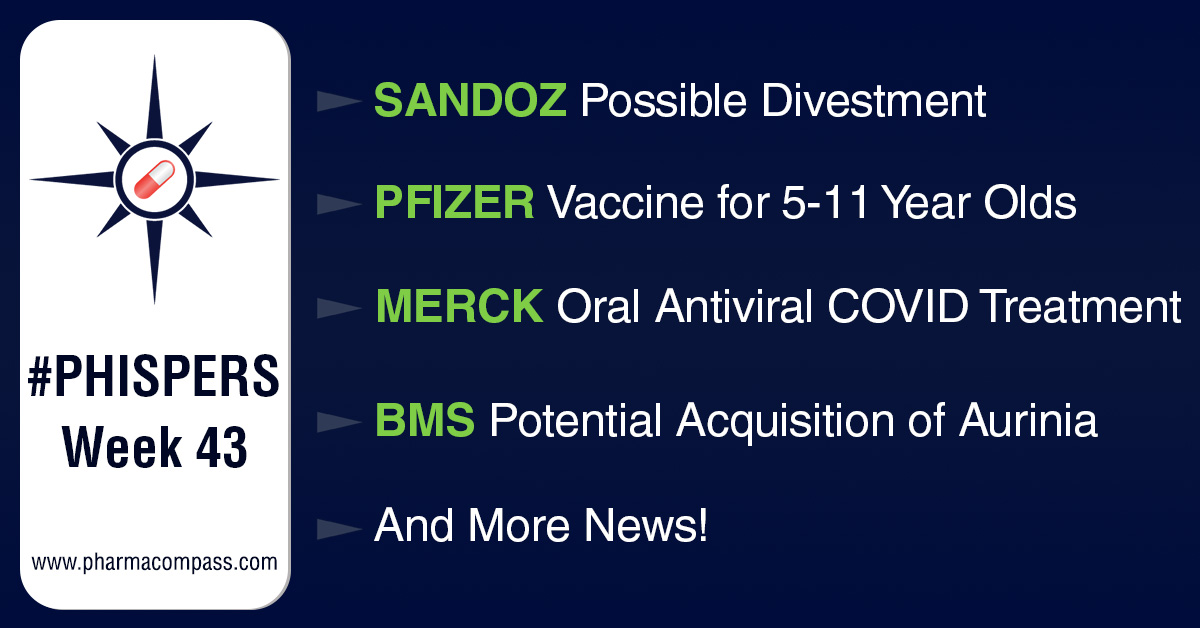
This week, advisors of the US Food and Drug Administration (FDA) voted overwhelmingly in favor of recommending the Pfizer-BioNTech Covid-19 vaccine for the agency’s emergency use authorization (EUA) to inoculate children between the ages of five and 11 years. And Moderna released results from the phase 2/3 KidCOVE study, which showed a half-dose of its vaccine caused strong immune response in six to 11 year old kids.
Merck’s experimental oral antiviral Covid treatment — molnupiravir — has shown a lot of promise in clinical trials by reducing the risk of serious disease and death by half. The company has now signed a licensing agreement with the United Nations-backed Medicines Patent Pool (MPP) to allow more companies to manufacture generic versions of molnupiravir. The royalty-free license would apply to 105 low- and middle-income countries.
In non-Covid news, Bristol-Myers is reportedly looking to acquire a small, rival biopharma firm, Aurinia Pharma, weeks after losing out to Merck in the race to buy Acceleron Pharma.
Novartis may divest its generic drugs unit Sandoz due to mounting price pressures. The Swiss drugmaker has commenced a strategic review of the Sandoz division.
And an academic report brought out by the Coalition for a Prosperous America detailed how a loophole in the Hatch-Waxman Act led to generic drug shortages, offshoring of domestic production of copycat drugs and price gouging in the US.
FDA advisors back Pfizer’s vaccine for five to 11 year olds; say benefits outweigh risks
This week, an expert panel voted overwhelmingly in favor of recommending Pfizer-BioNTech’s Covid-19 vaccine for the US Food and Drug Administration’s emergency use authorization (EUA) for inoculating five- to 11-year-old children. The panel said the benefits of administering the shot to children outweigh the risks.





An advisory panel of the US Centers for Disease Control and Prevention (CDC) will meet on November 2 to discuss the use of Covid-19 vaccines in children aged between five and 11 years. The Pfizer shot was granted FDA’s EUA for 12 to 15 year olds in May and it was cleared for those aged 16 and above in December last year.
Last week, FDA released data showing the Pfizer vaccine is safe and effective in children aged five to 11 as a two-dose regimen. The shot was 90 percent effective in preventing symptomatic Covid-19 in over 2,200 kids who took part in the trial. No cases of the rare heart inflammation condition myocarditis were seen, though researchers said the study size wasn’t large enough to assess a potential risk.
An EUA for five to 11 year olds will be an important regulatory step, paving the way for in-person learning of some 28 million children in the US. The vaccine could be made available to this age group as early as next week.
The vote was 17 in favor, with one abstention. The person who didn’t vote in favor of an EUA — FDA advisor Michael Kurilla — gave his reasons in a statement of abstention. He said the “longest follow-up for a subset of the trial subjects was only three months,” and according to him, children already demonstrate asymptomatic Covid infections about 50 percent of the time (and this increased with younger ages). “Since the trial endpoint only evaluated symptomatic disease, it likely overestimated overall infection prevention,” Kurilla said.
Pfizer and BioNTech are seeking clearance for a lower, 10-microgram dose of the vaccine in young children, versus 30 micrograms for those who are 12 years and older.
Former FDA commissioner Scott Gottlieb said: “The innovation here is that the vaccine is being packaged in units small enough that a lot of pediatrician offices should be able to take the vaccine and distribute it right in the comfort of a doctor’s office.”
Only a few other countries, including China, Cuba and the United Arab Emirates, have so far cleared Covid-19 vaccines for children in this age group and younger.
Pfizer has said it could have data from its clinical trial in even younger children — between the ages of two and four years — by the year end.
Meanwhile, a month after the FDA authorized a booster dose of Pfizer and BioNTech’s Covid-19 shot for certain at-risk individuals, the companies are releasing new data that suggest the extra shot has a 95.6 percent efficacy compared to the two-dose series. The results come from a phase 3 trial that tested a third 30 µg dose of the vaccine given at a median of 11 months, compared to a placebo on top of Pfizer’s two-dose series.
Merck in pact with UN body for generic versions of its oral antiviral Covid treatment
Merck has signed a licensing agreement with the United Nations-backed Medicines Patent Pool (MPP) to allow more companies to manufacture generic versions of its experimental oral antiviral Covid-19 treatment — molnupiravir. The royalty-free license would apply to 105 low- and middle-income countries, Merck said. As per the agreement, MPP will select manufacturers to make generic versions of molnupiravir.
“This is the first transparent, public health-driven voluntary license for a Covid-19 medical technology,” Merck and MPP said in a joint statement.
The antiviral pill has been developed by Merck along with Ridgeback Biotherapeutics. Earlier this month, the two companies submitted an EUA application to the FDA. In a clinical trial, the pill halved the risk of serious disease and death when given early for Covid-19.
Companies will be able to apply for a sub-license from MPP and the license, which also includes technology transfer, will remain royalty-free so long as the World Health Organization classifies the pandemic as a “Public Health Emergency of International Concern,” the statement said.
Medical charity Médecins Sans Frontières (MSF) also known as Doctors Without Borders has expressed disappointment with the limitations of the license as its territory excludes nearly half of the world’s population and upper-middle-income countries with robust manufacturing capacities, such as Brazil and China.
Earlier this year, Merck had signed bilateral licensing deals with eight Indian generic drugmakers — Aurobindo Pharma, Cipla, Dr Reddy’s Labs, Emcure Pharmaceuticals, Hetero Labs, Sun Pharmaceuticals, Torrent Pharmaceuticals and Viatris — for molnupiravir. The agreement with MPP broadens the manufacturing base beyond those companies.
Meanwhile, the Philippines will receive 300,000 courses of molnupiravir as Asian countries race to get early access to the experimental pill amid large demand. Singapore and Malaysia have signed deals to buy the drug, while Indonesia is finalizing a purchase agreement.
Moderna says its Covid vaccine is protective, safe in six to 11 year olds
This week, Moderna announced its Covid-19 vaccine generated a strong immune response in children aged six to 11 years and that it plans to submit the data to global regulators soon.
Moderna said its two-dose vaccine generated virus-neutralizing antibodies in children. The results came from the phase 2/3 KidCOVE study, which enrolled 4,753 participants between the ages of six and 12 years. The children who were given two half-doses of the Moderna jab (50 µg each) showed “strong immune response” a month after the second dose. The interim data is yet to be peer reviewed.
The company statement did not disclose any new information about cases of heart inflammation called myocarditis, a known side effect of mRNA vaccines.
Meanwhile, Moderna’s CEO Stephane Bancel has said the company’s vaccine could be administered to children and teens in the US within weeks. Based on dialogue with the FDA, Bancel said he believes Moderna’s Covid-19 vaccine will be authorized for 12 to 17 year olds in the next few weeks.
The company plans to apply for separate US regulatory clearance in six- to 11-year-old children “very soon,” Bancel said, adding that he is hopeful that this age group could start receiving Moderna's shots by the end of this year.
The Moderna Covid-19 vaccine is authorized for adults over the age of 18 years and is waiting for a response to its June application for 12 to 17 year olds.
Moderna will continue to monitor participants in the KidCOVE trial for a year after their second dose. While the biotech has finished enrolling participants between six and 11 years old, it’s still looking for volunteers between the ages of six months and five years.
After missing out on Acceleron, Bristol Myers eyes Aurinia Pharma
A few weeks back, Bristol Myers Squibb (BMS) was looking to buy Acceleron Pharma, before Merck agreed to acquire the company for US$ 11.5 billion in the biggest biotechnology deal of 2021. BMS has reportedly decided to cash out on its minority stake in Acceleron that is expected to bring in US$ 1.3 billion, while keeping the royalty deals on two of Acceleron’s blood disorder drugs.
After the Acceleron debacle, BMS has its eyes on another target — Aurinia Pharmaceuticals, a rival biopharmaceutical firm. As opposed to Acceleron, Aurinia would represent a much smaller deal.
According to Bloomberg, BMS has approached Aurinia Pharma, which makes oral lupus nephritis treatment Lupkynis, about a potential buyout. Besides Lupkynis, Aurinia has two early-stage candidates to treat autoimmune diseases. However, no final decision has been made between the two companies and BMS could opt against any potential deal, sources told Bloomberg.
Novartis may divest generic drugs unit Sandoz as price pressures mount
After years of revamping its Sandoz division, Swiss drugmaker Novartis has raised the prospect of divesting the business due to mounting price pressures in the off-patent drug sector.
“Novartis has commenced a strategic review of the Sandoz division,” the Swiss-based group said in a statement alongside its quarterly results. “The review will explore all options, ranging from retaining the business to separation, in order to determine how to best maximize value for our shareholders,” it added.
Despite the Sandoz unit generating sales of US$ 9.7 billion last year — approximately 20 percent of the group’s total — Novartis said it expected the division’s operating income to fall faster than previously forecast. Novartis added it would have more to say on the review of Sandoz by the end of next year.
“Given the continued drag on Novartis growth from Sandoz, the announcement of a strategic review is likely to be well received,” JP Morgan analysts said in a research note.
Loophole in Hatch-Waxman Act led to generic drug shortages in US, says report
High drug prices, quality issues and shortages of drugs are just some of the challenges the United States has been dealing with for some years now. An academic report brought out by the Coalition for a Prosperous America (CPA) has detailed how a loophole in the Hatch-Waxman Act led to generic drug shortages in the US.
The report — Generic Drug Shortages and How a Race to the Bottom in Price has Upended 30 years of Hatch-Waxman — outlines how reliance on foreign manufacturers, particularly those in China and India where manufacturing quality and oversight standards are poor, has proven to be a major factor in causing shortages, offshoring of US production, and price gouging by foreign producers.
“For decades, opponents of manufacturing essential generic medicines in the US have falsely claimed that generic competition from foreign manufacturers lowers prices for Americans,” said Rosemary Gibson, author of China Rx and Chairperson of the CPA Healthcare Committee. “This groundbreaking new report from CPA provides clear evidence that purported competition from some foreign manufacturers can increase the price Americans pay for their generic medicines.”
“Authors of the Hatch-Waxman Act intended to create competition, increase innovation, and lower prices for US patients,” continued Gibson. “Instead, a race to the bottom in price triggered offshoring of America’s domestic production of essential generic medicines, widespread illegal price manipulation, shortages of life-saving medicines, and poor quality, unsafe generic drugs. The Covid-19 pandemic revealed that America’s dependence on Chinese and other foreign drug manufacturers is a serious national health security risk that must be addressed.”
The US depends on imports for at least two-thirds of its generic drugs, and nearly 90 percent of generic active pharmaceutical ingredient (API) facilities are overseas. Despite this realization, the FDA has conducted very few inspections in FY2021 and FY2020, compared to previous years, owing to the pandemic.
The PharmaCompass Newsletter – Sign Up, Stay Ahead
Feedback, help us to improve. Click here
Image Credit : Phisper Infographic by SCORR MARKETING & PharmaCompass is licensed under CC BY 2.0
“ The article is based on the information available in public and which the author believes to be true. The author is not disseminating any information, which the author believes or knows, is confidential or in conflict with the privacy of any person. The views expressed or information supplied through this article is mere opinion and observation of the author. The author does not intend to defame, insult or, cause loss or damage to anyone, in any manner, through this article.”