

BLOG
MARKET INTEL by PharmaCompass
CONTENT by Suppliers
- Interview #SpeakPharma
- Video #SupplierSpotlight
- Vlog #PharmaReel
- Company Bio #AboutSupplier
- Services Bio #AboutCapabilities
News

Create content with us, ask us
By PharmaCompass
2021-10-07
Impressions: 2079
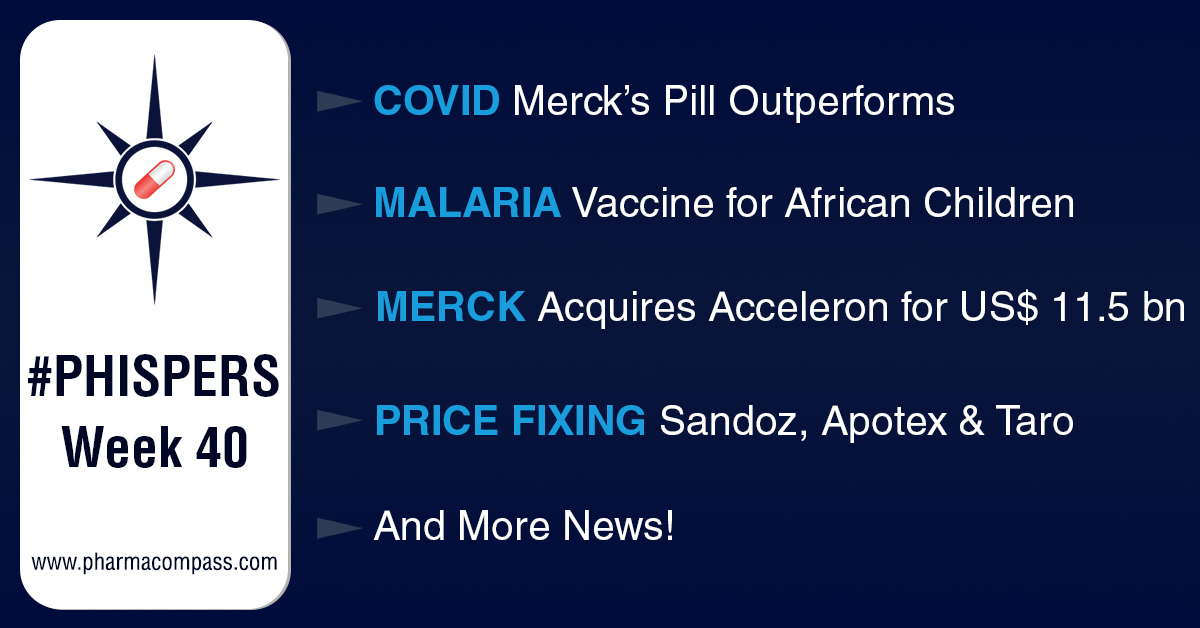
This week, Phispers is packed with news on M&As and deals between drugmakers. The deal of the week was Merck’s acquisition of Acceleron for US$ 11.5 billion. Though Merck hopes to wrap up the acquisition soon, an activist investor that owns 7 percent of Acceleron’s shares has threatened to derail the plan as it finds the price quoted by Merck to be drastically low. Merck was also in news for its experimental Covid drug molnupiravir, which has shown promise by reducing the risk of hospitalization and death by nearly half among high-risk people diagnosed with mild or moderate Covid-19. And then there was news that Merck KGaA and GSK have terminated their US$ 4 billion immunotherapy agreement after the failure of bintrafusp alfa.
In other M&A news, Bayer acquired biotech Vividion Therapeutics for US$ 1.5 billion upfront and US$ 500 million in milestone payments. And AstraZeneca is taking full control of Caelum Biosciences in a deal worth up to US$ 500 million.
Selecta Biosciences entered into a strategic licensing agreement with Takeda to develop next-generation gene therapies; and Danish biotech Gubra tied up with Bayer to find new peptide treatments for kidney and heart disorders.
The week also saw two significant recalls. While Eli Lilly is recalling a diabetes injection kit due to a manufacturing mixup, Bayer is voluntarily recalling some lots of unexpired Lotrimin AF and Tinactin spray products distributed between September 2018 and September 2021 as some samples had benzene in them.
Merck’s experimental Covid-19 drug cuts risk of hospitalization, death by half
Merck announced that in an international clinical trial, its experimental drug to treat Covid-19 — molnupiravir — reduced the risk of hospitalization and death by nearly half among higher-risk people diagnosed with mild or moderate illness.





The clinical trial is being stopped early, and the drugmaker plans to apply for emergency authorization as soon as possible. If authorized by the US Food and Drug Administration, the pill developed by Merck and Ridgeback Biotherapeutics would be the first oral medication to treat the coronavirus.
Analysts from ODDO BHF financial services group say the antiviral will have little impact on Covid vaccines in the short and intermediate term. Even though inoculation rates are low in most lesser developed countries, ODDO says it’s unlikely that countries will shift away from vaccination campaigns to focus primarily on treating high-risk patients with Covid-19.
Australia to buy 300K doses: Australia’s Prime Minister Scott Morrison has said the country will buy 300,000 doses of Merck’s experimental antiviral pill.
“These treatments mean that we are going to be able to live with the virus,” Morrison said. Australia plans to reopen its borders next month for fully vaccinated citizens and permanent residents. The drug is expected to be available in Australia by early next year.
Meanwhile, in India, share of Divi’s Laboratories, which makes the main ingredient of Merck’s experimental antiviral pill, soared 10 per cent on Monday, on reports of positive clinical trial results for molnupiravir. Shares of generic drugmakers Cipla, Sun Pharma, Dr Reddy’s Laboratories and Torrent Pharmaceuticals, which are jointly conducting a clinical trial in India with molnupiravir, also gained between 1.1 per cent and 2.3 per cent.
Moderna jab in younger age groups: Sweden and Denmark are pausing the use of Moderna's Covid-19 vaccine for those born in or after 1991 after reports of possible rare cardiovascular side effects. The Swedish health agency said data pointed to an increase of myocarditis and pericarditis among youths and young adults that had been vaccinated, though the risk is very small. “The connection is especially clear when it comes to Moderna’s vaccine Spikevax, especially after the second dose,” the health agency said.
WHO recommends wide use of GSK’s malaria vaccine in Africa’s children
In a major breakthrough, the World Health Organization (WHO) has recommended that the only approved vaccine against malaria — GlaxoSmithKline’s Mosquirix — should be widely given to children in Africa. This marks a major step in Africa’s fight against malaria, a disease that kills hundreds of thousands of people annually.
According to a WHO estimate, malaria killed 386,000 Africans in 2019, while the continent has reported 212,000 confirmed Covid-19 deaths in the past 18 months. The agency says 94 percent of malaria cases and deaths occur in Africa, a continent of 1.3 billion people, and a majority of those who die of malaria are under the age of five years.
According to Reuters, since 2019, 2.3 million doses of Mosquirix have been administered to infants in Ghana, Kenya and Malawi in a large-scale pilot program coordinated by the WHO. The program followed a decade of clinical trials in seven African countries.
“This is a vaccine developed in Africa by African scientists and we’re very proud,” said WHO director-general Tedros Adhanom Ghebreyesus. “Using this vaccine in addition to existing tools to prevent malaria could save tens of thousands of young lives each year,” he added.
Merck to acquire Acceleron for US$ 11.5 billion; activist investor Avoro slams price
Last week, we had brought you news that Merck was looking to acquire Acceleron. On Thursday, Merck and Acceleron Pharma announced they have entered into a definitive agreement under which Merck, through a subsidiary, will acquire Acceleron for US$ 11.5 billion.
The deal fits well in Merck’s plan to diversify beyond Keytruda, its immuno-oncology blockbuster drug. It will give Merck access to Acceleron’s lead clinical candidate and potential first-in-class pulmonary arterial hypertension (PAH) drug — sotatercept — that is expected to post US$ 2 billion in peak sales.
Given Merck’s existing PAH programs, analysts had anticipated antitrust scrutiny. However, Merck’s CEO Rob Davis dismissed the threat, since sotatercept has a novel mechanism of action.
Merck hopes to wrap up the acquisition by the end of this year. However, revolt from an activist investor — Avoro Capital — threatens to derail that plan. Hours after the announcement, Avoro Capital criticized Merck’s offer, arguing it “drastically undervalues” Acceleron. Avoro owns about 7 percent of Acceleron shares. Avoro said Acceleron should wait for more clinical trial data from sotatercept to get a better price.
Merck KGaA ends US$ 4 billion oncology tie-up with GSK: Two years and multiple trial failures later, Merck KGaA, Darmstadt, Germany and GlaxoSmithKline have terminated a nearly US$ 4 billion development agreement centered on the experimental immunotherapy drug — bintrafusp alfa. In March this year, bintrafusp alfa had failed to hit the mark in a phase 2 clinical trial as a potential second-line treatment for metastatic biliary tract cancer (BTC). This was the second such failure of the drug this year. Merck KGaA and GSK had joined hands to develop the asset in 2019.
The termination of the deal was announced last week after the two companies decided to discontinue the development of bintrafusp alfa as a first-line therapy for patients with stage IV non-small cell lung cancer (NSCLC) and high expression of PD-L1.
Three generic firms shell out US$447 million more to settle price fixing allegations
In the US, three generic pharmaceutical manufacturers — Taro Pharmaceuticals, Sandoz and Apotex Corporation — have agreed to pay US$ 447.2 million to settle allegations of price fixing of various generic drugs under the country’s False Claims Act. The deal follows criminal penalties of over US$ 400 million previously paid by the three companies.
Taro has agreed to pay US$ 213.2 million, Sandoz US$ 185 million and Apotex has agreed to pay US$ 49 million. Each of the companies entered a five-year corporate integrity agreement, which includes internal monitoring and price transparency provisions, among other checks and balances.
The US government alleges that between 2013 and 2015, the trio paid and received compensation prohibited by the Anti-Kickback Statute through arrangements on price, supply and allocation of customers with other manufacturers for certain generic drugs manufactured by the companies. According to the US Department of Justice, these conspiracies allegedly resulted in higher drug prices for federal healthcare programs and beneficiaries.
Deals update: Bayer buys Vividion; Takeda ties up with Selecta Biosciences
The week saw several M&As and agreements being clinched between various drugmakers. German pharma giant Bayer acquired biotech Vividion Therapeutics for US$ 1.5 billion in up-front and US$ 500 million in milestone payments. The deal, first announced in August, gives Vividion the freedom to continue its search for new drugs against disease-causing proteins. And Bayer and Vividion think the deal could become a model for future big pharma acquisitions of local life science companies.
Selecta Biosciences, a biotechnology company that leverages its ImmTOR immune-tolerance platform to overcome immunogenicity, announced it has entered into a strategic licensing agreement with Takeda Pharmaceutical Company to develop targeted, next-generation gene therapies for two indications within the field of lysosomal storage disorders.
Under the terms of the agreement, Selecta will receive an undisclosed upfront payment and up to US$ 1.124 billion in future additional milestone-related payments over the course of the partnership. Selecta is also eligible for tiered royalties on future commercial sales.
Gubra-Bayer deal: Danish biotech Gubra will help Bayer find new peptide treatments for kidney and heart disorders in a deal worth up to US$ 253 million (€216 million). Gubra will provide its machine learning drug discovery platform to Bayer.
Astra’s Alexion buys Caelum: AstraZeneca is taking full control of Caelum Biosciences in a deal worth up to US$ 500 million, thereby sharpening its focus on rare-disease drugs following its US$ 39 billion acquisition of Alexion Pharmaceuticals earlier this year. Alexion had acquired a minority stake in Caelum in 2019. It will now pay US$ 150 million to buy the remaining stake in Caelum and make future payments of up to US$ 350 million, depending on the milestones achieved. New Jersey-based Caelum will become part of AstraZeneca’s Alexion division.
Otsuka-Sunovion deal: Otsuka has set its sight on a new approach to treat schizophrenia, and it is investing close to US$ 1 billion to snap up that candidate and three others from Sunovion, owned by Japan’s Sumitomo Dainippon Pharma. Otsuka is making an upfront payment of US$ 270 million and another US$ 620 million in biobucks for joint development and commercialization rights to four neuropsychiatric compounds from Sunovion.
Recalls update: Lilly recalls diabetes kit due to manufacturing mixup; Bayer recalls sprays
This week, we bring you an update on recalls undertaken by drug companies. While Eli Lilly is recalling a diabetes injection kit after reports that the vial of glucagon was in the form of a liquid instead of powder, Bayer is voluntarily recalling all unexpired Lotrimin AF and Tinactin spray products with lot numbers beginning with TN, CV or NAA, distributed between September 2018 and September 2021, to the consumer level. Some samples of these Bayer products had benzene in them, which is not an ingredient in any of Bayer consumer health products. Bayer says the decision to voluntarily recall these products is a precautionary measure and that the levels detected are not expected to cause adverse health events.
Benzene is classified as a human carcinogen. Depending on duration and level of exposure, it can result in cancers. The affected Lotrimin and Tinactin spray products are over the counter antifungal products, sold individually or in combo packs.
Eli Lilly is recalling lot D239382D to the patient level because of a product complaint that said the vial of glucagon was in liquid form instead of powder form. The firm’s investigation indicates that the liquid in this glucagon vial could be related to the manufacturing process.
“The use of the liquid form of this product may fail to treat severe low blood sugar due to loss of potency,” the US Food and Drug Administration (FDA) has said. This recall marks the seventh drug recall in September alone, according to the FDA.
New House bill to shore up US API production
A new House bill has been introduced in the United States that would create a national stockpile of active pharmaceutical ingredients (APIs) and prevent supply chain shortages. Dubbed the Prepare Act of 2021, the bill was introduced by two republicans — Abigail Spanberger and David McKinley. The bill aims to curb over-reliance of the US on APIs from other countries. Generic drugs make up 90 percent of the prescriptions filled in the US, and 87 percent of API facilities are outside the US, a press release from the Senate said.
The PharmaCompass Newsletter – Sign Up, Stay Ahead
Feedback, help us to improve. Click here
Image Credit : Phisper Infographic by SCORR MARKETING & PharmaCompass is licensed under CC BY 2.0
“ The article is based on the information available in public and which the author believes to be true. The author is not disseminating any information, which the author believes or knows, is confidential or in conflict with the privacy of any person. The views expressed or information supplied through this article is mere opinion and observation of the author. The author does not intend to defame, insult or, cause loss or damage to anyone, in any manner, through this article.”