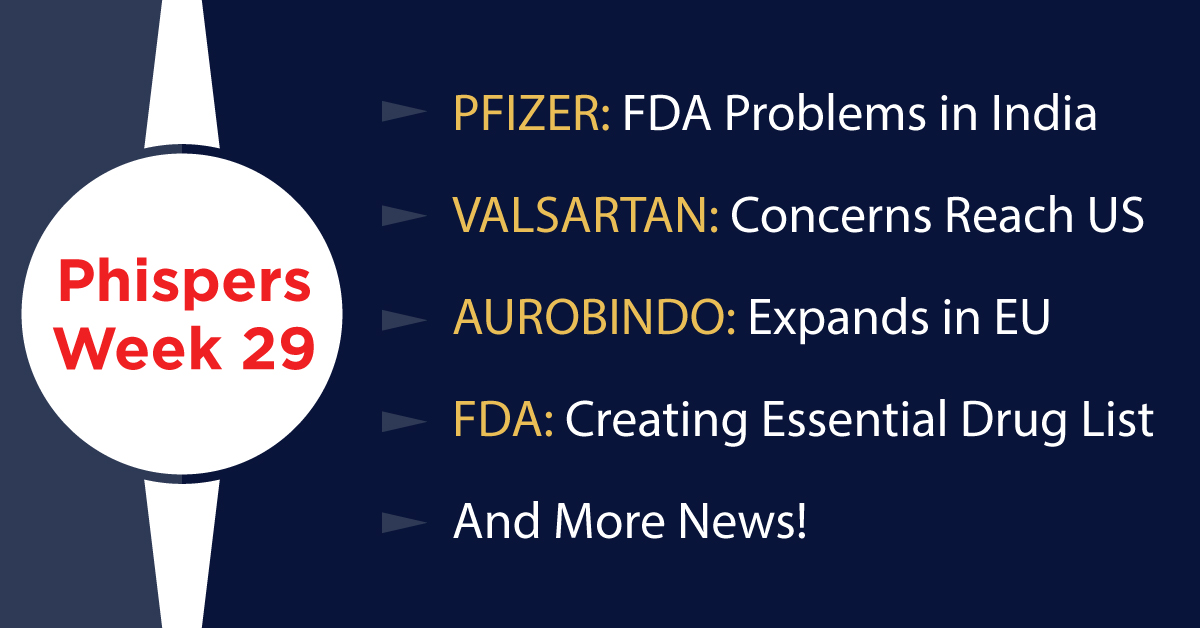
This week, Phispers brings you news on US FDA’s new task force that will look for solutions to perpetual drug shortages. Following EMA’s footsteps, the FDA also recalled several drugs containing the valsartan API, due to detection of a cancer-causing impurity in the products. J&J had a roller-coaster week — while it scored positive results for its diabetes drug Invokana, which had been carrying a black box warning since last year, it was also ordered to pay a record US$ 4.69 billion to 22 women in a talc-based products case. Meanwhile, Novartis exited antibiotics research. Amongst Indian manufacturers, a US district court ruled that Dr. Reddy’s Laboratories likely infringed on Indivior’s patent and blocked its Suboxone generic which had been cleared by the FDA last month. Aurobindo Pharma announced the acquisition of Apotex’s operations in five countries. And Pfizer’s Hospira facility in India got issued a Form 483 by the FDA.
Pfizer’s production woes continue; halts manufacturing post FDA inspection in India
The
ghost of Pfizer’s troubled acquisition of Hospira continues to haunt the
pharma major as an FDA inspection of a sterile manufacturing facility in India
resulted in the issuance of a 32
page Form 483. Pfizer had acquired Hospira in 2015 for US$
15 billion.
In
the week-long inspection that began on March 27, 2018, some of the concerns
raised by the FDA were:
(i) The quality unit failed to
ensure that all production and laboratory control operations were cGMP adopted;
(ii) Laboratory records did not
include complete data derived from all tests. Moreover, the microbiology
laboratory data were unreliable;
(iii) The firm’s quality control (QC) chemistry analysts manipulated test sample weights to obtain passing result;
(iv) The firm failed to complete laboratory and
customer complaint investigations thoroughly;
(v) The review of instrument
method and processing method revealed the test results were processed using
HPLC integration parameters that allows the Empower software to
underestimate the area counts of various impurities;
(vi) There is no assurance that the firm had
adequate in-process controls to prevent critical/major product defects.
A
few months ago, Apotex Corp voluntarily recalled 1.8 million bottles of antibiotics made at Pfizer’s Hospira operation in India.
According to the FDA website, Apotex voluntarily recalled 36 lots of Piperacillin and
Tazobactam for
Injection (USP 3.375 gram/vial and 4.5 gram/vial strengths). The
antibiotic injections were found to contain elevated levels of impurities that
may result in decreased potency.
According to the FDA, the decreased potency, in turn, could
result in worsening of the infection and under extreme circumstances lead to
serious morbidities.
In an emailed statement, Pfizer had mentioned it was “disappointed with the outcome” of the inspection. It had “voluntarily paused production” and had already submitted a comprehensive response to the FDA.
The same facility was issued a warning letter by
the FDA in 2013 and PharmaCompass had previously reported on Pfizer facing supply shortages for products from the legacy Hospira portfolio.
FDA to create a list of essential drugs as a step to address drug shortages
The
US Food and Drug Administration (FDA) is striving hard to address drug
shortages and drug prices. The FDA Commissioner Scott Gottlieb named a task force last week to look for “holistic” solutions to perpetual drug shortages, particularly of sterile injectables.
In
order to address drug shortages, the agency will consider creating a list of “essential drugs”. It will also provide financial incentives to drugmakers
that manufacture them.
The
Drug Shortages Task Force is being led by FDA’s associate commissioner Keagan Lenihan.
Drug
shortages have steadily declined since 2011, when 250 drug shortages were
discovered. However, after five years of decline, drug shortages increased to
39 last year from 26 in the two preceding years. Shortages of critical drug
products is impacting patients.
The task force will also be exploring “manufacturing issues.” The FDA is already taking steps to support new technologies that can improve manufacturing and help reduce the chance that supply disruptions will occur.
Gottlieb said the FDA may want to consider “more significant interventions” than it currently employs. “We want to make sure we aren’t discouraging investment for manufacturing drugs that are more likely to go into shortage, and thus working against our own goals,” he added.
J&J gets positive results for its diabetes drug; to
appeal against US$ 4.69 billion talc verdict
Last
week, there was both good news as well as bad news from Johnson & Johnson’s. First the good news — J&J scored
positive data from its Phase III chronic kidney disease study of the SGLT2
diabetes drug Invokana (canagliflozin). The positive result
possibly indicates a comeback for J&J, which has been witnessing dwindling
sales revenue of Invokana in the face of a safety alert.
Since last year, Invokana has carried a black box warning on it, flagging an increased risk of amputations. As a result, sales of Invokana have been shrinking and competitors have gained due the warning — Invokana brought in US$ 1.1 billion last year, down from US$ 1.4 billion in 2016.
“We are excited about the possibility of bringing forth Invokana (canagliflozin) as the first therapy to treat patients with chronic kidney disease and type 2 diabetes in more than 15 years,” James List, J&J’s head of the cardiovascular and metabolism unit, said in a statement.
The
bad news for J&J came from a Missouri
jury verdict that ordered it to pay a record US$ 4.69 billion to 22 women
who alleged the company's talc-based products, including its baby powder,
contain asbestos and caused them to develop ovarian cancer.
This verdict is the largest to date arising from lawsuits alleging talc-based products like J&J’s baby powder have caused cancer. The jury award includes
US$ 550 million in compensatory damages and US$ 4.14 billion in punitive
damages.
Meanwhile,
J&J has vowed to appeal against this verdict by arguing the plaintiffs’ science was flawed and the case
should not have been heard in Missouri. In a statement, J&J said its
products never contained asbestos and were not carcinogenic.
J&J
is facing 9,000 cases in the US over its talc. “J&J has strong arguments, but unless they get to certify this case to the US Supreme Court, which are very long odds, this decision is likely to stand,” said Lars Noah, a law professor at the University of Florida.
After valsartan case, CFDA uncovers
falsified data at Chinese vaccine manufacturer
A vaccine producer in Northeast China’s Jilin province is being probed for law violations in producing rabies vaccines for human use, China’s drug regulator said.
Changchun
Changsheng Bio-tech Co, in Changchun, was found to have serious irregularities,
including fabricating production records in the manufacture of rabies vaccines
for human use, during an inspection by the State Drug Administration, China FDA
said
in a statement.
After
being tipped off regarding suspected irregularities, the administration
conducted an unannounced inspection of the company. The statement did not
mention when the inspection took place. No products involved in the inspection
were on sale, and all the vaccines involved have been removed, the statement
added.
DRL’s Suboxone generic gets blocked; Sun files lawsuit to protect its derma products
In
June, PharmaCompass had reported that Indian pharma major Dr. Reddy's Laboratories (DRL) had won a US FDA approval
for its generic version of Indivior’s opioid addiction treatment — Suboxone
— and also received a court order that restrained
it from rolling out the copycat drug.
Last week, a US district court ruled that DRL likely infringed on Indivior’s patent.
The district court blocked DRL from re-launching its drug until the patent litigation is over.
The
preliminary injunction came on July 13, days after Indivior issued a profit
warning and said the drug, Suboxone Film, was rapidly losing market share in
the US.
Suboxone Film generates 80 percent of Indivior’s revenue and helps drug users beat their addiction to heroin. It is dissolved under the tongue. Generic rivals in tablet form are already available in the US market, which is grappling with an opioid addiction epidemic that killed 33,000 people in 2015.
Indivior said in June it would consider a potential launch of its own generic product if DRL launched a copycat version. Indivior had filed patent infringement lawsuits against both DRL and Mylan.
Meanwhile, DUSA Pharmaceuticals, Inc, a wholly owned subsidiary of Sun Pharmaceutical Industries, announced that DUSA has filed trade secret misappropriation and tortious interference claims in an ongoing patent
infringement lawsuit against Biofrontera Inc, Biofrontera Bioscience GmbH,
Biofrontera Pharma GmbH, and Biofrontera AG in the US district court of
Massachusetts.
The lawsuit alleges patent infringement of DUSA’s dermatology patents. In its complaint, DUSA also alleged that the Biofrontera defendants misappropriated confidential and trade secret information from DUSA and improperly obtained confidential DUSA information from former DUSA employees to sell and market defendants’ own products.
Valsartan concerns reach the US, FDA recalls batches using Huahai API
Last
week, Phispers had carried a news report on how the European Medicines Agency (EMA) had reviewed medicines containing the active pharmaceutical ingredient (API) valsartan supplied by Zhejiang Huahai Pharmaceuticals, a company in Linhai, China. The reason behind the review was the impurity — nitrosodimethylamine (or NDMA) — detected by the company in their valsartan API. Later, 22
countries had pulled similar affected products from their shelves.
NDMA is classified as a probable human carcinogen. Valsartan
is a common
drug used to treat high blood pressure and heart failure.
The
news this week is that the FDA is also recalling the drug for exactly the same
reason as stated by the EMA.
The
US agency said the recall affects several drugs products containing the
valsartan API, following the detection of an impurity found in the products.
However, not all medications containing the ingredient is affected by the
recall.
The
US recall includes drug products containing a version of valsartan made by
Major Pharmaceuticals, Solco Healthcare, and Teva Pharmaceuticals
Industries. Drug products containing valsartan/hydrochlorothiazide (HCTZ) made by Solco Healthcare and Teva Pharmaceuticals
Industries
are also on the recall list.
Teva Pharmaceuticals USA confirmed the recall and said “29 lots of single and 51 lots of combination valsartan medicines” which were manufactured by Zhejiang Huahai
Pharmaceutical and distributed by the Actavis label, were being recalled due to the detection of NDMA.
Spero inks US defense deal for biodefense threats; Novartis exits
antibiotics research
Antibiotics
maker Spero Therapeutics is joining
hands with the US defense organizations to see if their investigational
antibiotic could be useful against biodefense threats.
Spero
was awarded US$ 15.7 million in funding from the Biomedical Advanced Research
and Development Authority (BARDA), with potential to receive another US$ 28.5
million over the next five years.
The US Army is stepping up to test Spero’s
antibiotic — SPR994 — to see how it works against biodefense threats like anthrax, plague, and melioidosis. These studies will be conducted by the US Army Medical Research Institute of Infectious Diseases.
Meanwhile, Novartis is the next big pharma to
exit antibiotics research. Novartis said its
early-stage research group at Novartis Institutes for BioMedical Research
(NIBR) is dropping antibacterial and antiviral research programs based in
Emeryville, California. This will result in the layoff of around 140 employees.
Novartis is exiting antibiotics research at a time when drug-resistant strains of bacteria are spreading around the world — an issue that once commanded considerable attention at Novartis.
There is more bad
news from Novartis. According to a Wall Street Journal report, Novartis
made misleading statements playing down its 2017 relationship with President Donald Trump’s then-personal lawyer, Michael Cohen.
Quoting a report
prepared by a group of Senate Democrats released last week, a New York Times
report said Cohen was in frequent
contact with top
officials of Novartis as part of a US$ 1.2 million consulting deal, and
Novartis expected him to provide access to policymakers in the Trump
administration.
Aurobindo expands in Europe; acquires Apotex’s operations in five countries
Indian
generic major Aurobindo Pharma announced it had signed a pact to acquire the commercial operations and certain supporting infrastructure of Canadian pharmaceutical firm Apotex International in five European
countries for €74 million (US$ 86.5 million).
The acquisition of Apotex’s operations in Poland, the Czech Republic, the Netherlands, Spain and Belgium includes a portfolio of over 200 prescription drugs and 88 OTC products and an additional pipeline of over 20 products, which are expected to be launched over the next two years.
Through
the acquisition, Aurobindo will also get a manufacturing facility in Leiden in
the Netherlands, with capabilities across manufacturing and packaging and a
capacity of 1.8 billion tablets per annum.
The
acquisition will make Aurobindo one of the top 15 generic drug companies in
Poland and the Czech Republic, a leading OTC company by volume in the
Netherlands, and among the top five brands in retail generics market in
Belgium, the company said in a statement.
The
business had total sales of €133 million (US$ 155 million) in the year ended March 2018 and builds on Aurobindo’s acquisition strategy in Europe, which includes the acquisition of Actavis’ commercial operations in seven Western European countries in 2014 and the acquisition of Generis Farmaceutica in Portugal last year.
The US and Europe are the two largest markets for Aurobindo and account for over 70 percent of the company’s total sales of approximately US$ 2.6 billion.














 Share
Share