Find Riboflavin manufacturers, exporters & distributors on PharmaCompass

PharmaCompass

Synopsis

Related ProductsRelated Products

Synopsis

0INTERMEDIATES

REF. STANDARDS OR IMPURITIES

0

USP

FDF Dossiers

DRUG PRODUCT COMPOSITIONS

432RELATED EXCIPIENT COMPANIES

720EXCIPIENTS BY APPLICATIONS

PATENTS & EXCLUSIVITIES

0

US Patents

0

US Exclusivities

0

Health Canada Patents

GLOBAL SALES INFORMATION

US Medicaid

NA

MARKET PLACE

DIGITAL CONTENT

0

Stock Recap #PipelineProspector

0

Weekly News Recap #Phispers

Chemistry

Click the arrow to open the dropdown
read-moreClick the button for full data set
Also known as: Vitamin b2, Lactoflavin, Riboflavine, 83-88-5, Vitamin g, (-)-riboflavin
Molecular Formula
C17H20N4O6
Molecular Weight
376.4  g/mol
InChI Key
AUNGANRZJHBGPY-SCRDCRAPSA-N
FDA UNII
TLM2976OFR

Riboflavin
Nutritional factor found in milk, eggs, malted barley, liver, kidney, heart, and leafy vegetables. The richest natural source is yeast. It occurs in the free form only in the retina of the eye, in whey, and in urine; its principal forms in tissues and cells are as FLAVIN MONONUCLEOTIDE and FLAVIN-ADENINE DINUCLEOTIDE.
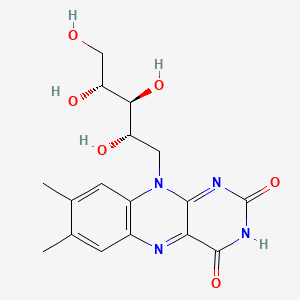
1 2D Structure

Riboflavin

2 Identification
2.1 Computed Descriptors
2.1.1 IUPAC Name
7,8-dimethyl-10-[(2S,3S,4R)-2,3,4,5-tetrahydroxypentyl]benzo[g]pteridine-2,4-dione
2.1.2 InChI
InChI=1S/C17H20N4O6/c1-7-3-9-10(4-8(7)2)21(5-11(23)14(25)12(24)6-22)15-13(18-9)16(26)20-17(27)19-15/h3-4,11-12,14,22-25H,5-6H2,1-2H3,(H,20,26,27)/t11-,12+,14-/m0/s1
2.1.3 InChI Key
AUNGANRZJHBGPY-SCRDCRAPSA-N
2.1.4 Canonical SMILES
CC1=CC2=C(C=C1C)N(C3=NC(=O)NC(=O)C3=N2)CC(C(C(CO)O)O)O
2.1.5 Isomeric SMILES
CC1=CC2=C(C=C1C)N(C3=NC(=O)NC(=O)C3=N2)C[C@@H]([C@@H]([C@@H](CO)O)O)O
2.2 Other Identifiers
2.2.1 UNII
TLM2976OFR
2.3 Synonyms
2.3.1 MeSH Synonyms

1. Vitamin B 2

2. Vitamin B2

3. Vitamin G

2.3.2 Depositor-Supplied Synonyms

1. Vitamin B2

2. Lactoflavin

3. Riboflavine

4. 83-88-5

5. Vitamin G

6. (-)-riboflavin

7. Lactoflavine

8. Flavaxin

9. Beflavin

10. Riboflavinum

11. Riboflavina

12. Russupteridine Yellow Iii

13. Beflavine

14. Bisulase

15. 7,8-dimethyl-10-ribitylisoalloxazine

16. 6,7-dimethyl-9-d-ribitylisoalloxazine

17. Ribocrisina

18. Vitaflavine

19. Flaxain

20. Lactobene

21. Ribipca

22. Riboderm

23. Ribosyn

24. Ribotone

25. Ribovel

26. E101

27. Vitamin Bi

28. Flavin Bb

29. Vitasan B2

30. Hyre

31. Lacto-flavin

32. Riboflavin (vitamin B2)

33. C.i. Food Yellow 15

34. Vitamin-b2

35. Vitamin B-2

36. Riboflavinequinone

37. Chebi:17015

38. 7,8-dimethyl-10-(d-ribo-2,3,4,5-tetrahydroxypentyl)isoalloxazine

39. Ins No.101(iii)

40. Ins-101(iii)

41. 7,8-dimethyl-10-[(2s,3s,4r)-2,3,4,5-tetrahydroxypentyl]benzo[g]pteridine-2,4-dione

42. Vitamin B2 (as Riboflavin)

43. E-101(iii)

44. Tlm2976ofr

45. C.i. 50900

46. Ins No. 101(i)

47. Nsc-33298

48. 1-deoxy-1-(7,8-dimethyl-2,4-dioxo-3,4-dihydrobenzo[g]pteridin-10(2h)-yl)-d-ribitol

49. 7,8-dimethyl-10-((2s,3s,4r)-2,3,4,5-tetrahydroxypentyl)benzo[g]pteridine-2,4(3h,10h)-dione

50. D-ribitol, 1-deoxy-1-(3,4-dihydro-7,8-dimethyl-2,4-dioxobenzo(g)pteridin-10(2h)-yl)-

51. Nci-0033298

52. Mfcd00005022

53. Nsc 33298

54. Dsstox_cid_1777

55. Dsstox_rid_76321

56. Dsstox_gsid_21777

57. Riboflavine [inn-french]

58. Riboflavinum [inn-latin]

59. Riboflavina [inn-spanish]

60. Isoalloxazine, 7,8-dimethyl-10-d-ribityl-

61. Hsdb 817

62. 1-deoxy-1-(7,8-dimethyl-2,4-dioxo-3,4-dihydrobenzo[g]pteridin-10(2h)-yl)pentitol

63. 7,8-dimethyl-10-(d-ribo-2,3,4,5-tetrahydroxypentyl)benzo[g]pteridine-2,4(3h,10h)-dione

64. Ccris 1904

65. Isoalloxazine, 7,8-dimethyl-10-(d-ribo-2,3,4,5-tetrahydroxypentyl)-

66. Riboflavin (vit B2)

67. Einecs 201-507-1

68. Unii-tlm2976ofr

69. Riboflavin [usp:inn:ban]

70. Ai3-14697

71. 1kyv

72. 2ccb

73. 2vxa

74. ()-riboflavin

75. San Yellow B

76. Cas-83-88-5

77. Ncgc00017291-05

78. Bisulase (tn)

79. Food Yellow 15

80. Prestwick_442

81. 2fl5

82. 2vx9

83. 4d1y

84. Riboflavin [ii]

85. Riboflavin [mi]

86. Riboflavin [fcc]

87. Riboflavin [inn]

88. Riboflavin [jan]

89. Vitamin B2; E101

90. Prestwick3_000634

91. Riboflavin [hsdb]

92. Riboflavin [inci]

93. Lactoflavin [inci]

94. Riboflavin [vandf]

95. Epitope Id:161730

96. Riboflavinum [hpus]

97. Riboflavin [mart.]

98. Schembl7706

99. Chembl1534

100. Riboflavin [usp-rs]

101. Riboflavin [who-dd]

102. Riboflavin [who-ip]

103. Vitamin B2 [vandf]

104. Bspbio_000628

105. Mls001066391

106. Bpbio1_000692

107. Gtpl6578

108. Riboflavin (jp17/usp/inn)

109. Riboflavine; Vitamin B2

110. Dtxsid8021777

111. Riboflavin [orange Book]

112. Riboflavin [ep Monograph]

113. Vitamin B2 [green Book]

114. (-)-riboflavin, 97-103%

115. Hms2096p10

116. Riboflavin [usp Monograph]

117. Benzo[g]pteridine Riboflavin Deriv.

118. Hy-b0456

119. Riboflavinum [who-ip Latin]

120. Zinc2036848

121. Tox21_110813

122. Tox21_111714

123. Tox21_201633

124. Tox21_302980

125. 6,7-dimethyl-9-ribitylisoalloxazine

126. Bdbm50362895

127. S2540

128. Riboflavin (b2), Analytical Standard

129. Tox21_111714_1

130. Db00140

131. Ncgc00091288-01

132. Ncgc00091288-02

133. Ncgc00091288-03

134. Ncgc00091288-04

135. Ncgc00091288-05

136. Ncgc00179498-01

137. Ncgc00256408-01

138. Ncgc00259182-01

139. As-15936

140. Smr000112236

141. R0020

142. (-)-riboflavin, Tested According To Ph.eur.

143. C00255

144. D00050

145. (-)-riboflavin, Meets Usp Testing Specifications

146. A840676

147. A934900

148. Q130365

149. (-)-riboflavin, From Eremothecium Ashbyii, >=98%

150. W-104132

151. (-)-riboflavin, Acrylamide Photopolymerization Tested

152. 7,8-dimethyl-10-(1'-d-ribityl)isoalloxazine

153. Riboflavin Sodium Phosphate Impurity D [ep Impurity]

154. Riboflavin, European Pharmacopoeia (ep) Reference Standard

155. Riboflavin, United States Pharmacopeia (usp) Reference Standard

156. Riboflavin, Pharmaceutical Secondary Standard; Certified Reference Material

157. 5-deoxy-5-(7,8-dimethyl-2,4-dioxo-3,4-dihydrobenzo[g]pteridin-10(2h)-yl)-d-ribitol

158. 7,8-dimethyl-10-(d-ribo-2,3,4,5-tetrahydroxypentyl)-benzo[g]pteridine-2,4(3h,10h)-dione

159. Riboflavin For Peak Identification, European Pharmacopoeia (ep) Reference Standard

160. (-)-riboflavin (vitamin B2) Solution, 100 Mug/ml (methanol:0.1% Ammonium Acetate In Water (1:1)), Ampule Of 1 Ml, Analytical Standard

161. (-)-riboflavin, 100 Mug/ml (1% Ammonium Acetate In 50:50 Methanol:water), Certified Reference Material, Ampule Of 1 Ml

162. (-)-riboflavin, Bioreagent, Suitable For Cell Culture, Suitable For Insect Cell Culture, >=98%

163. (-)-riboflavin-13c4,15n2 (vitamin B2-13c4,15n2) Solution, 100 Mug/ml (1% Ammonium Acetate In 50:50 Methanol:water), Certified Reference Material, Ampule Of 1 Ml

164. 7,8-dimethyl-10-[(2s,3s,4r)-2,3,4,5-tetrahydroxypentyl]-2h,3h,4h,10h-benzo[g]pteridine-2,4-dione

165. 7,8-dimethyl-10-[(2s,3s,4r)-2,3,4,5-tetrakis(oxidanyl)pentyl]benzo[g]pteridine-2,4-dione

2.4 Create Date
2005-07-12
3 Chemical and Physical Properties
Molecular Weight 376.4 g/mol
Molecular Formula C17H20N4O6
XLogP3-1.5
Hydrogen Bond Donor Count5
Hydrogen Bond Acceptor Count7
Rotatable Bond Count5
Exact Mass376.13828437 g/mol
Monoisotopic Mass376.13828437 g/mol
Topological Polar Surface Area155 Ų
Heavy Atom Count27
Formal Charge0
Complexity680
Isotope Atom Count0
Defined Atom Stereocenter Count3
Undefined Atom Stereocenter Count0
Defined Bond Stereocenter Count0
Undefined Bond Stereocenter Count0
Covalently Bonded Unit Count1
4 Drug and Medication Information
4.1 Therapeutic Uses

Riboflavin is used to prevent riboflavin deficiency and to treat ariboflavinosis. Whenever possible, poor dietary habits should be corrected, and many clinicians recommend administration of multivitamin preparations containing riboflavin in patients with vitamin deficiencies since poor dietary habits often result in concurrent deficiencies.

American Society of Health System Pharmacists; AHFS Drug Information 2009. Bethesda, MD. (2009)


Riboflavin may be useful in treating microcytic anemia that occurs in patients with a familial metabolic disease associated with splenomegaly and glutathione reductase deficiency.

American Society of Health System Pharmacists; AHFS Drug Information 2009. Bethesda, MD. (2009)


Although riboflavin has not been shown by well-controlled trials to have any therapeutic value, the drug also has been used for the management of acne, congenital methemoglobinemia, muscle cramps, and burning feet syndrome.

American Society of Health System Pharmacists; AHFS Drug Information 2009. Bethesda, MD. (2009)


People undergoing hemodialysis or peritioneal dialysis and those with severe malabsorption are likely to require extra riboflavin. Women who are carrying more than one fetus or breastfeeding more than one infant are also likely to require more riboflavin. It is possible that individuals who are ordinarily extremely physically active may also have increased needs for riboflavin.

Otten JJ, Hellwig JP, Meyers LD, eds; Dietary Reference Intakes: The Essential Guide to Nutrient Requirements, Washington, DC: The National Academies Press, 2006, p. 276


For more Therapeutic Uses (Complete) data for Riboflavin (11 total), please visit the HSDB record page.


4.2 Drug Warning

Riboflavin may cause urine to have a more yellow color than normal, especially if large doses are taken. This is to be expected and is no cause for alarm. Usually, however, riboflavin does not cause any side effects.

Novak, K.M. (ed.). Drug Facts and Comparisons2008 Edition. Wolters Kluwer Health. St. Louis, Missouri 2008., p. 18


No short-term side effects /were observed/ in 49 patients treated with 400 mg/day of riboflavin taken with meals for at least 3 months. One patient receiving riboflavin and aspirin withdrew from the study because of gastric upset. This isolated finding may be an anomaly because no side effects were reported in other patients.

NAS, Food and Nutrition Board, Institute of Medicine; Dietary Reference Intakes for Thiamin, Riboflavin, Niacin, Vitamin B6, Folate, Vitamin B12, Pantothenic Acid, Biotin, and Choline. National Academy Press, Washington, D.C., pg. 115, 1998. Available from, as of March 2, 2010: https://www.nap.edu/catalog/6015.html


Maternal Medication usually Compatible with Breast-Feeding: Riboflavin: Reported Sign or Symptom in Infant or Effect on Lactation: None. /from Table 6/

Report of the American Academy of Pediatrics Committee on Drugs in Pediatrics 93 (1): 141 (1994)


Infants treated for hyperbilirubinemia may also be sensitive to excess riboflavin.

NAS, Food and Nutrition Board, Institute of Medicine; Dietary Reference Intakes for Thiamin, Riboflavin, Niacin, Vitamin B6, Folate, Vitamin B12, Pantothenic Acid, Biotin, and Choline. National Academy Press, Washington, D.C., pg. 116, 1998. Available from, as of March 2, 2010: https://www.nap.edu/catalog/6015.html


For more Drug Warnings (Complete) data for Riboflavin (6 total), please visit the HSDB record page.


4.3 Drug Indication

For the treatment of ariboflavinosis (vitamin B2 deficiency).


5 Pharmacology and Biochemistry
5.1 Pharmacology

Riboflavin or vitamin B2 is an easily absorbed, water-soluble micronutrient with a key role in maintaining human health. Like the other B vitamins, it supports energy production by aiding in the metabolising of fats, carbohydrates, and proteins. Vitamin B2 is also required for red blood cell formation and respiration, antibody production, and for regulating human growth and reproduction. It is essential for healthy skin, nails, hair growth and general good health, including regulating thyroid activity. Riboflavin also helps in the prevention or treatment of many types of eye disorders, including some cases of cataracts.


5.2 MeSH Pharmacological Classification

Photosensitizing Agents

Drugs that are pharmacologically inactive but when exposed to ultraviolet radiation or sunlight are converted to their active metabolite to produce a beneficial reaction affecting the diseased tissue. These compounds can be administered topically or systemically and have been used therapeutically to treat psoriasis and various types of neoplasms. (See all compounds classified as Photosensitizing Agents.)


Vitamin B Complex

A group of water-soluble vitamins, some of which are COENZYMES. (See all compounds classified as Vitamin B Complex.)


5.3 ATC Code

A - Alimentary tract and metabolism

A11 - Vitamins

A11H - Other plain vitamin preparations

A11HA - Other plain vitamin preparations

A11HA04 - Riboflavin (vit B2)


S - Sensory organs

S01 - Ophthalmologicals

S01X - Other ophthalmologicals

S01XA - Other ophthalmologicals

S01XA26 - Riboflavin


5.4 Absorption, Distribution and Excretion

Absorption

Vitamin B2 is readily absorbed from the upper gastrointestinal tract.


Riboflavin is readily absorbed from the upper GI tract; however, absorption of the drug involves active transport mechanisms and the extent of GI absorption is limited by the duration of contact of the drug with the specialized segment of mucosa where absorption occurs. Riboflavin 5-phosphate is rapidly and almost completely dephosphorylated in the GI lumen before absorption occurs. The extent of GI absorption of riboflavin is increased when the drug is administered with food and is decreased in patients with hepatitis, cirrhosis, biliary obstruction, or in those receiving probenecid.

American Society of Health System Pharmacists; AHFS Drug Information 2009. Bethesda, MD. (2009)


Primary absorption of riboflavin occurs in the small intestine via a rapid, saturable transport system. A small amount is absorbed in the large intestine. The rate of absorption is proportional to intake, and it increases when riboflavin is ingested along with other foods and in the presence of bile salts. At low intake levels, most absorption of riboflavin occurs via an active or facilitated transport system. At higher levels of intake, riboflavin can be absorbed by passive diffusion.

Otten JJ, Hellwig JP, Meyers LD, eds; Dietary Reference Intakes: The Essential Guide to Nutrient Requirements, Washington, DC: The National Academies Press, 2006, pp. 275-6


In the plasma, a large portion of riboflavin associates with other proteins, mainly immunoglobulins, for transport. Pregnancy increases the level of carrier proteins available for riboflavin, which results in a higher rate of riboflavin uptake at the maternal surface of the placenta.

Otten JJ, Hellwig JP, Meyers LD, eds; Dietary Reference Intakes: The Essential Guide to Nutrient Requirements, Washington, DC: The National Academies Press, 2006, p. 276


In the stomach, gastric acidification releases most of the coenzyme forms of riboflavin (flavin-adenine dinucleotide (FAD) and flavin mononucleotide (FMN)) from the protein. The noncovalently bound coenzymes are then hydrolyzed to riboflavin by nonspecific pyrophosphatases and phosphatases in the upper gut. Primary absorption of riboflavin occurs in the proximal small intestine via a rapid, saturable transport system. The rate of absorption is proportional to intake, and it increases when riboflavin is ingested along with other foods and in the presence of bile salts. A small amount of riboflavin circulates via the enterohepatic system. At low intake levels most absorption of riboflavin is via an active or facilitated transport system.

NAS, Food and Nutrition Board, Institute of Medicine; Dietary Reference Intakes for Thiamin, Riboflavin, Niacin, Vitamin B6, Folate, Vitamin B12, Pantothenic Acid, Biotin, and Choline. National Academy Press, Washington, D.C., pg. 88, 1998. Available from, as of March 2, 2010: https://www.nap.edu/catalog/6015.html


For more Absorption, Distribution and Excretion (Complete) data for Riboflavin (16 total), please visit the HSDB record page.


5.5 Metabolism/Metabolites

Hepatic.


Free riboflavin is converted in the intestinal mucosa into flavin mononucleotide which is transformed into flavin adenine dinucleotide in the liver.

Evaluations of Drug Interactions. 2nd ed. and supplements. Washington, DC: American Pharmaceutical Assn., 1976, 1978., p. 453


The metabolism of riboflavin is a tightly controlled process that depends on the riboflavin status of the individual. Riboflavin is converted to coenzymes within the cellular cytoplasm of most tissues but mainly in the small intestine, liver, heart, and kidney. The metabolism of riboflavin begins with the adenosine triphosphate (ATP)-dependent phosphorylation of the vitamin to flavin mononucleotide (FMN). Flavokinase, the catalyst for this conversion, is under hormonal control. FMN can then be complexed with specific apoenzymes to form a variety of flavoproteins; however, most is converted to flavin-adenine dinucleotide (FAD) by FAD synthetase. As a result, FAD is the predominant flavocoenzyme in body tissues. Production of FAD is controlled by product inhibition such that an excess of FAD inhibits its further production.

NAS, Food and Nutrition Board, Institute of Medicine; Dietary Reference Intakes for Thiamin, Riboflavin, Niacin, Vitamin B6, Folate, Vitamin B12, Pantothenic Acid, Biotin, and Choline. National Academy Press, Washington, D.C., pg. 89, 1998. Available from, as of March 2, 2010: https://www.nap.edu/catalog/6015.html


The biosynthesis of one riboflavin molecule requires one molecule of GTP and two molecules of ribulose 5-phosphate as substrates. GTP is hydrolytically opened, converted into 5-amino-6-ribitylamino-2,4(1H,3H)-pyrimidinedione by a sequence of deamination, side chain reduction and dephosphorylation. Condensation with 3,4-dihydroxy-2-butanone 4-phosphate obtained from ribulose 5-phosphate leads to 6,7-dimethyl-8-ribityllumazine. The final step in the biosynthesis of the vitamin involves the dismutation of 6,7-dimethyl-8-ribityllumazine catalyzed by riboflavin synthase. The mechanistically unusual reaction involves the transfer of a four-carbon fragment between two identical substrate molecules. The second product, 5-amino-6-ribitylamino-2,4(1H,3H)-pyrimidinedione, is recycled in the biosynthetic pathway by 6,7-dimethyl-8-ribityllumazine synthase. This article will review structures and reaction mechanisms of riboflavin synthases and related proteins up to 2007 and 122 references are cited.

PMID:18298940 Fischer M, Bacher A; Arch Biochem Biophys 474 (2): 252-65 (2008).


5.6 Biological Half-Life

66-84 minutes


The biologic half-life of riboflavin is about 66-84 minutes following oral or IM administration of a single large dose in healthy individuals.

American Society of Health System Pharmacists; AHFS Drug Information 2009. Bethesda, MD. (2009)


5.7 Mechanism of Action

Binds to riboflavin hydrogenase, riboflavin kinase, and riboflavin synthase. Riboflavin is the precursor of flavin mononucleotide (FMN, riboflavin monophosphate) and flavin adenine dinucleotide (FAD). The antioxidant activity of riboflavin is principally derived from its role as a precursor of FAD and the role of this cofactor in the production of the antioxidant reduced glutathione. Reduced glutathione is the cofactor of the selenium-containing glutathione peroxidases among other things. The glutathione peroxidases are major antioxidant enzymes. Reduced glutathione is generated by the FAD-containing enzyme glutathione reductase.


Riboflavin is converted to 2 coenzymes, flavin mononucleotide (FMN) and flavin adenine dinucleotide (FAD), which are necessary for normal tissue respiration. Riboflavin is also required for activation of pyridoxine, conversion of tryptophan to niacin, and may be involved in maintaining erythrocyte integrity.

USP Convention. USPDI-Drug Information for the Health Care Professional. 14th ed. Volume I. Rockville, MD: United States Pharmacopeial Convention, Inc., 1994. (Plus Updates)., p. 2400


Riboflavin functions as the coenzyme for flavin adenine dinucleotide (FAD) and flavin mononucleotide (FMN), which primarily influence hydrogen transport in oxidative enzyme systems (eg, cytochrome C reductase, succinic dehydrogenase, xanthine oxidase).

American Medical Association, Council on Drugs. AMA Drug Evaluations Annual 1994. Chicago, IL: American Medical Association, 1994., p. 2171


Two active forms of riboflavin exist ... coenzyme flavin mononucleotide (FMN) and coenzyme flavin adenine dinucleotide (FAD). They are formed by reaction of riboflavin with 1 and 2 molecules of ATP as follow: riboflavin + ATP = riboflavin-P (FMN) + ADP; FMN + ATP = riboflavin-ADP (FAD) + PP.

Di Palma, J. (ed.). Drill's Pharmacology in Medicine. 4th ed. New York: McGraw Hill Book Co., 1971., p. 1285


Riboflavin is a water-soluble, yellow, fluorescent compound. The primary form of the vitamin is as an integral component of the coenzymes flavin mononucleotide (FMN) and flavin-adenine dinucleotide (FAD). It is in these bound coenzyme forms that riboflavin functions as a catalyst for redox reactions in numerous metabolic pathways and in energy production. ... The redox reactions in which flavocoenzymes participate include flavoprotein-catalyzed dehydrogenations that are both pyridine nucleotide (niacin) dependent and independent, reactions with sulfur-containing compounds, hydroxylations, oxidative decarboxylations (involving thiamin as its pyrophosphate), dioxygenations, and reduction of oxygen to hydrogen peroxide. There are obligatory roles of flavocoenzymes in the formation of some vitamins and their coenzymes. For example, the biosynthesis of two niacin-containing coenzymes from tryptophan occurs via FAD-dependent kynurenine hydroxylase, an FMN-dependent oxidase catalyzes the conversion of the 5'-phosphates of vitamin B6 to coenzymic pyridoxal 5'-phosphate, and an FAD-dependent dehydrogenase reduces 5,10-methylene-tetrahydrofolate to the 5'-methyl product that interfaces with the B12-dependent formation of methionine from homocysteine and thus with sulfur amino acid metabolism.

NAS, Food and Nutrition Board, Institute of Medicine; Dietary Reference Intakes for Thiamin, Riboflavin, Niacin, Vitamin B6, Folate, Vitamin B12, Pantothenic Acid, Biotin, and Choline. National Academy Press, Washington, D.C., pg. 87-88, 1998. Available from, as of March 2, 2010: https://www.nap.edu/catalog/6015.html


For more Mechanism of Action (Complete) data for Riboflavin (7 total), please visit the HSDB record page.


Related Excipient Companies

Upload your portfolio for free, ask us

Excipients by Applications

Click here to find the perfect excipient manufacturers by their capabilities

Fillers, Diluents & Binders

read-more
read-more

Coating Systems & Additives

read-more
read-more

Parenteral

read-more
read-more

Taste Masking

read-more
read-more

Thickeners and Stabilizers

read-more
read-more

Solubilizers

read-more
read-more

Direct Compression

read-more
read-more

Disintegrants & Superdisintegrants

read-more
read-more

Granulation

read-more
read-more

Controlled & Modified Release

read-more
read-more

Topical

read-more
read-more

Film Formers & Plasticizers

read-more
read-more

Lubricants & Glidants

read-more
read-more

Chewable & Orodispersible Aids

read-more
read-more

API Stability Enhancers

read-more
read-more

Emulsifying Agents

read-more
read-more

Co-Processed Excipients

read-more
read-more

Empty Capsules

read-more
read-more

Surfactant & Foaming Agents

read-more
read-more

Rheology Modifiers

read-more
read-more

Vegetarian Capsules

read-more
read-more

Coloring Agents

read-more
read-more

Soft Gelatin

read-more
read-more

Digital Content read-more

Create Content with PharmaCompass, ask us

DATA COMPILATION #PharmaFlow

read-more
read-more

NEWS #PharmaBuzz

read-more
read-more

Global Sales Information

Do you need Business Intel? Ask us

Market Place

Do you need sourcing support? Ask us

REF. STANDARDS & IMPURITIES

Upload your portfolio for free, ask us

ABOUT THIS PAGE

Looking for 83-88-5 / Riboflavin API manufacturers, exporters & distributors?

Riboflavin manufacturers, exporters & distributors 1

95

PharmaCompass offers a list of Riboflavin API manufacturers, exporters & distributors, which can be sorted by GMP, USDMF, JDMF, KDMF, CEP (COS), WC, Price,and more, enabling you to easily find the right Riboflavin manufacturer or Riboflavin supplier for your needs.

Send us enquiries for free, and we will assist you in establishing a direct connection with your preferred Riboflavin manufacturer or Riboflavin supplier.

PharmaCompass also assists you with knowing the Riboflavin API Price utilized in the formulation of products. Riboflavin API Price is not always fixed or binding as the Riboflavin Price is obtained through a variety of data sources. The Riboflavin Price can also vary due to multiple factors, including market conditions, regulatory modifications, or negotiated pricing deals.

API | Excipient name

Riboflavin

Synonyms

Vitamin b2, Lactoflavin, Riboflavine, 83-88-5, Vitamin g, (-)-riboflavin

Cas Number

83-88-5

Unique Ingredient Identifier (UNII)

TLM2976OFR

About Riboflavin

Nutritional factor found in milk, eggs, malted barley, liver, kidney, heart, and leafy vegetables. The richest natural source is yeast. It occurs in the free form only in the retina of the eye, in whey, and in urine; its principal forms in tissues and cells are as FLAVIN MONONUCLEOTIDE and FLAVIN-ADENINE DINUCLEOTIDE.

VibeX Manufacturers

A VibeX manufacturer is defined as any person or entity involved in the manufacture, preparation, processing, compounding or propagation of VibeX, including repackagers and relabelers. The FDA regulates VibeX manufacturers to ensure that their products comply with relevant laws and regulations and are safe and effective to use. VibeX API Manufacturers are required to adhere to Good Manufacturing Practices (GMP) to ensure that their products are consistently manufactured to meet established quality criteria.

click here to find a list of VibeX manufacturers with USDMF, JDMF, KDMF, CEP, GMP, COA and API Price related information on PhamaCompass.

VibeX Suppliers

A VibeX supplier is an individual or a company that provides VibeX active pharmaceutical ingredient (API) or VibeX finished formulations upon request. The VibeX suppliers may include VibeX API manufacturers, exporters, distributors and traders.

click here to find a list of VibeX suppliers with USDMF, JDMF, KDMF, CEP, GMP, COA and API Price related information on PharmaCompass.

VibeX USDMF

A VibeX DMF (Drug Master File) is a document detailing the whole manufacturing process of VibeX active pharmaceutical ingredient (API) in detail. Different forms of VibeX DMFs exist exist since differing nations have different regulations, such as VibeX USDMF, ASMF (EDMF), JDMF, CDMF, etc.

A VibeX DMF submitted to regulatory agencies in the US is known as a USDMF. VibeX USDMF includes data on VibeX's chemical properties, information on the facilities and procedures used, and details about packaging and storage. The VibeX USDMF is kept confidential to protect the manufacturer’s intellectual property.

click here to find a list of VibeX suppliers with USDMF on PharmaCompass.

VibeX JDMF

The Pharmaceuticals and Medical Devices Agency (PMDA) established the Japan Drug Master File (JDMF), also known as the Master File (MF), to permit Japanese and foreign manufacturers of drug substances, intermediates, excipients, raw materials, and packaging materials (‘Products’) to voluntarily register confidential information about the production and management of their products in Japan.

The VibeX Drug Master File in Japan (VibeX JDMF) empowers VibeX API manufacturers to present comprehensive information (e.g., production methods, data, etc.) to the review authority, i.e., PMDA (Pharmaceuticals & Medical Devices Agency).

PMDA reviews the VibeX JDMF during the approval evaluation for pharmaceutical products. At the time of VibeX JDMF registration, PMDA checks if the format is accurate, if the necessary items have been included (application), and if data has been attached.

click here to find a list of VibeX suppliers with JDMF on PharmaCompass.

VibeX KDMF

In Korea, the Ministry of Food and Drug Safety (MFDS) is in charge of regulating pharmaceutical products and services.

Pharmaceutical companies submit a VibeX Drug Master File in Korea (VibeX KDMF) to the MFDS, which includes comprehensive information about the production, processing, facilities, materials, packaging, and testing of VibeX. The MFDS reviews the VibeX KDMF as part of the drug registration process and uses the information provided in the VibeX KDMF to evaluate the safety and efficacy of the drug.

After submitting a VibeX KDMF to the MFDS, the registered manufacturer can provide importers or distributors with the registration number without revealing confidential information to Korean business partners. Applicants seeking to register their VibeX API can apply through the Korea Drug Master File (KDMF).

click here to find a list of VibeX suppliers with KDMF on PharmaCompass.

VibeX CEP

A VibeX CEP of the European Pharmacopoeia monograph is often referred to as a VibeX Certificate of Suitability (COS). The purpose of a VibeX CEP is to show that the European Pharmacopoeia monograph adequately controls the purity of VibeX EP produced by a given manufacturer. Suppliers of raw materials can prove the suitability of VibeX to their clients by showing that a VibeX CEP has been issued for it. The manufacturer submits a VibeX CEP (COS) as part of the market authorization procedure, and it takes on the role of a VibeX CEP holder for the record. Additionally, the data presented in the VibeX CEP (COS) is managed confidentially and offers a centralized system acknowledged by numerous nations, exactly like the VibeX DMF.

A VibeX CEP (COS) is recognised by all 36 nations that make up the European Pharmacopoeia Convention. VibeX CEPs may be accepted in nations that are not members of the Ph. Eur. at the discretion of the authorities there.

click here to find a list of VibeX suppliers with CEP (COS) on PharmaCompass.

VibeX GMP

VibeX Active pharmaceutical ingredient (API) is produced in GMP-certified manufacturing facility.

GMP stands for Good Manufacturing Practices, which is a system used in the pharmaceutical industry to make sure that goods are regularly produced and monitored in accordance with quality standards. The FDA’s current Good Manufacturing Practices requirements are referred to as cGMP or current GMP which indicates that the company follows the most recent GMP specifications. The World Health Organization (WHO) has its own set of GMP guidelines, called the WHO GMP. Different countries can also set their own guidelines for GMP like China (Chinese GMP) or the EU (EU GMP).

PharmaCompass offers a list of VibeX GMP manufacturers, exporters & distributors, which can be sorted by USDMF, JDMF, KDMF, CEP (COS), WC, API price, and more, enabling you to easily find the right VibeX GMP manufacturer or VibeX GMP API supplier for your needs.

VibeX CoA

A VibeX CoA (Certificate of Analysis) is a formal document that attests to VibeX's compliance with VibeX specifications and serves as a tool for batch-level quality control.

VibeX CoA mostly includes findings from lab analyses of a specific batch. For each VibeX CoA document that a company creates, the USFDA specifies specific requirements, such as supplier information, material identification, transportation data, evidence of conformity and signature data.

VibeX may be tested according to a variety of international standards, such as European Pharmacopoeia (VibeX EP), VibeX JP (Japanese Pharmacopeia) and the US Pharmacopoeia (VibeX USP).

Inform the supplier about your product requirements, specifying if you need a product with particular monograph like EP (Ph. Eur.), USP, JP, BP, or any other quality. In addition, clarify whether you need hydrochloride (HCl), anhydricum, base, micronisatum or a specific level of purity. To find reputable suppliers, utilize the filters and select those certified by GMP, FDA, or any other certification as per your requirement.
For your convenience, we have listed synonyms and CAS numbers to help you find the best supplier. The use of synonyms and CAS numbers can be helpful in identifying potential suppliers, but it is crucial to note that they might not always indicate the exact same product. It is important to confirm the product details with the supplier before making a purchase to ensure that it meets your requirements.
Ask Us for Pharmaceutical Supplier and Partner
Ask Us, Find A Supplier / Partner
No Commissions, No Strings Attached, Get Connected for FREE

What are you looking for?

How can we help you?

The request can't be empty

Please read our Privacy Policy carefully

You must agree to the privacy policy

The name can't be empty
The company can't be empty.
The email can't be empty Please enter a valid email.
The mobile can't be empty