

BLOG
MARKET INTEL by PharmaCompass
CONTENT by Suppliers
- Interview #SpeakPharma
- Video #SupplierSpotlight
- Vlog #PharmaReel
- Company Bio #AboutSupplier
- Services Bio #AboutCapabilities
News

Create content with us, ask us
By PharmaCompass
2026-01-01
Impressions: 4359
The year 2025 was an eventful one, marked by increased trade tensions, tariff threats, accelerated adoption of artificial intelligence (AI) in drug development, and an intensified race for next-gen obesity treatments. Major drugmakers pledged substantial investments in the US to mitigate potential tariffs. By the year-end, the Trump Administration announced deals with several drugmakers to lower prices for its Medicaid program and for cash payers.
The year also saw significant changes at the US Food and Drug Administration (FDA), including high-profile leadership changes and workforce reductions. The agency rolled out advanced AI systems — known as agentic AI — to help its staff achieve specific goals.
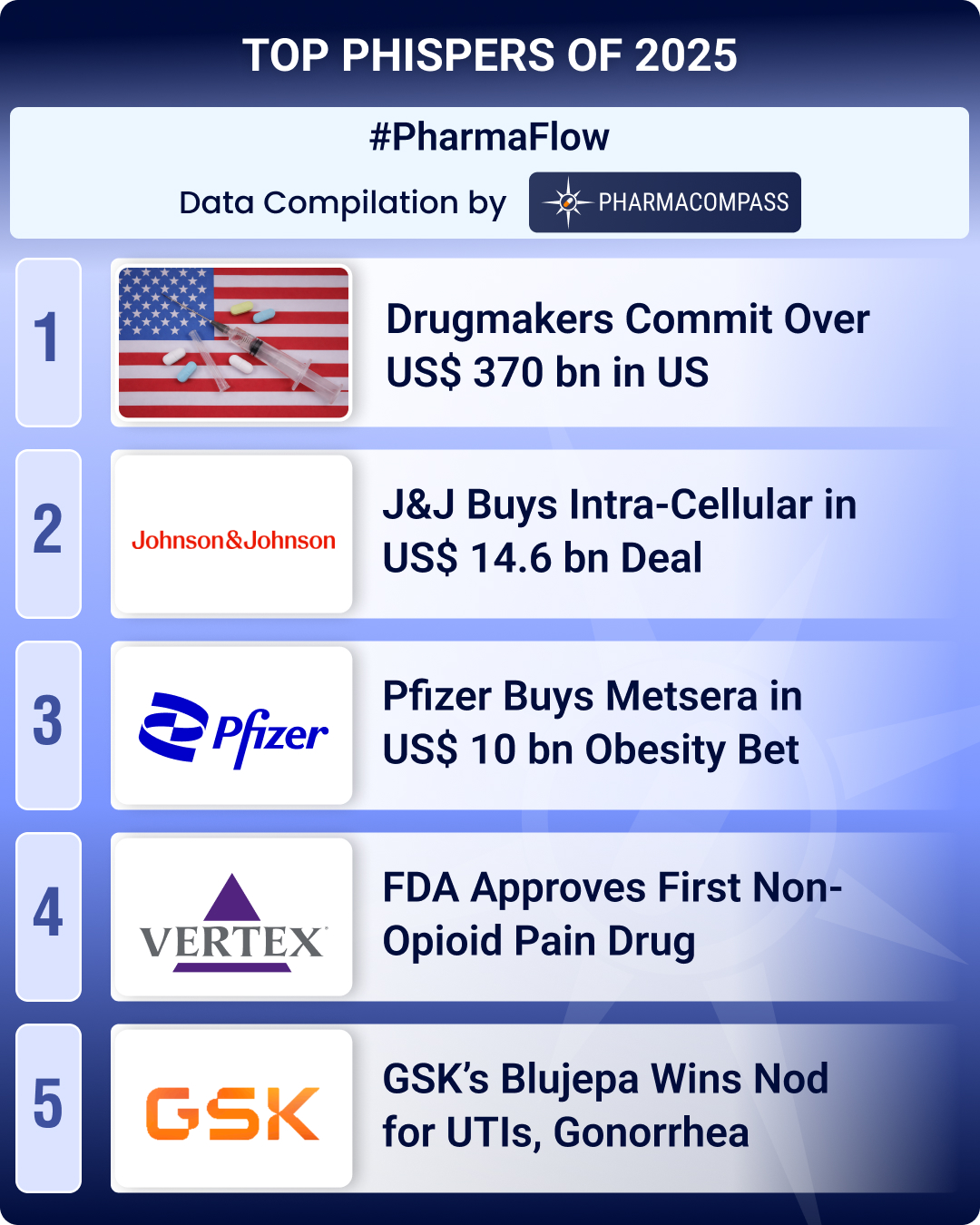
Several large mergers and acquisitions also shaped 2025. Pfizer bought obesity-focused biopharma Metsera for US$ 10 billion and Johnson & Johnson acquired Intra-Cellular for US$ 14.6 billion. Vertex Pharmaceuticals introduced a new, non-opioid painkiller, Journavx (suzetrigine), and GSK launched Blujepa (gepotidacin) which is now approved for treating uncomplicated urinary tract infections (uUTIs) and gonorrhea. Here are the top stories that made it to PharmaCompass’ top 10 Phispers of 2025.
I. Drugmakers pledge over US$ 370 bn in building US capacities; lower Medicaid prices





Eli Lilly has announced a US$ 27 billion investment, followed by Johnson & Johnson (US$ 55 billion), Novartis (US$ 23 billion), Roche (US$ 50 billion), Bristol Myers Squibb (US$ 40 billion), AstraZeneca (US$ 50 billion), and GSK (US$ 30 billion). A Wall Street Journal report dated September 16 states that drugmakers have pledged more than US$ 370 billion in US investments due to tariff threats, while ThinkGlobalHealth estimates this number at over US$ 480 billion.
On September 30, Pfizer struck a US$ 70 billion deal with the US government to lower Medicaid drug prices and expand domestic manufacturing. And in December, US President Donald Trump and nine major drugmakers announced agreements to lower medicine prices for the government’s Medicaid program and for cash payers. These prices will be in line with the lowest prices paid by other developed nations (known as the ‘most-favored-nation’ pricing).
II. Pfizer doubles down on obesity market, buys Metsera for US$ 10 bn, inks deal with YaoPharma
Pfizer aggressively pursued the booming obesity market. In November, Pfizer completed the US$ 10 billion (approximately) acquisition of Metsera, a clinical-stage biopharma focused on drugs for obesity and cardiometabolic diseases, after winning a bidding war against Novo Nordisk. The following month, Pfizer signed a deal worth up to US$ 2.1 billion with China’s YaoPharma, a subsidiary of Shanghai Fosun Pharmaceutical, to develop and commercialize an experimental GLP-1 weight-loss drug — YP05002.
III. FDA approves Vertex’s non-opioid painkiller that blocks acute pain at source
FDA approved Vertex Pharmaceuticals’ non-opioid painkiller, Journavx (suzetrigine), for the treatment of moderate-to-severe acute pain in adults. This represents the first new class of pain medication in over two decades, and offers an alternative to opioid analgesics.
IV. GSK’s Blujepa approved for treating uncomplicated UTIs; also okayed for gonorrhea
In March 2025, FDA approved GSK’s antibiotic, Blujepa (gepotidacin), for the treatment of uncomplicated urinary tract infections (uUTIs) in female patients aged 12 years and older who weigh at least 40 kg. This marked the first approval of a new class of for uUTIs in nearly 30 years. In December, FDA expanded Blujepa’s label to include treatment for gonorrhea, a sexually transmitted disease.
V. J&J acquires neuroscience biotech Intra-Cellular for US$ 14.6 billion
Johnson & Johnson kicked off 2025 with the US$ 14.6 billion acquisition of Intra-Cellular Therapies, strengthening its neuroscience portfolio. Intra-Cellular’s Caplyta (lumateperone) is a once-daily oral therapy approved for treating adults with schizophrenia and depressive episodes associated with bipolar I or II disorder.
VI. Changes at FDA: A year marked by high-profile resignations, rollout of agentic AI
FDA experienced significant organizational changes in 2025, including senior leadership departures, amid the Trump administration’s policy shifts. Approximately 3,500 FDA staff were slated for layoffs beginning in April, raising concerns about the agency's review systems. Health and Human Services (HHS) secretary Robert F Kennedy Jr’s anti-vaccine stance led to internal tensions, controversies and departures of senior vaccine officials.
The agency is transforming itself — in December, it announced the deployment of agentic AI capabilities for all its employees. Agentic AI refers to advanced AI systems designed to achieve specific goals by planning, reasoning, and executing multi-step actions.
VII. Sanofi-Alnylam’s Qfitlia becomes first approved RNAi med for hemophilia A, B
FDA approved Qfitlia (fitusiran) — the first RNA interface (RNAi) therapeutic for treating rare bleeding disorders hemophilia A and B. Developed through a collaboration between Sanofi and Alnylam Pharmaceuticals, Qfitlia is indicated for routine prophylaxis to prevent or reduce bleeding episodes in hemophilia patients aged 12 and older.
VIII. Astra-Daiichi Sankyo’s Datroway bags FDA nod for treating advanced lung, breast cancer
AstraZeneca and Daiichi Sankyo’s precision drug Datroway (datopotamab deruxtecan) won two key approvals in 2025. In January, Datroway received FDA approval for the treatment of adult patients with unresectable or metastatic hormone receptor (HR)-positive, HER2-negative breast cancer. And in June, it bagged accelerated approval for the treatment of an advanced form of non-small cell lung cancer in adults who had received prior treatment.
IX. Novartis continues to forge deals; inks US$ 12 bn deal with Avidity, US$ 2 bn deal with Arrowhead
Novartis also signed a licensing and options deal with China-based Argo Biopharmaceuticals worth up to US$ 5.2 billion for experimental cardiovascular drug candidates, and a US$ 2 billion licensing and collaboration agreement with Arrowhead Pharmaceuticals for its preclinical neurodegenerative disease candidate. Novartis also agreed to buy Anthos Therapeutics, a drug development company majority-owned by investment firm Blackstone, for up to US$ 3.1 billion.
X. Merck acquires Verona for US$ 10 billion; inks US$ 9.2 billion deal to buy Cidara
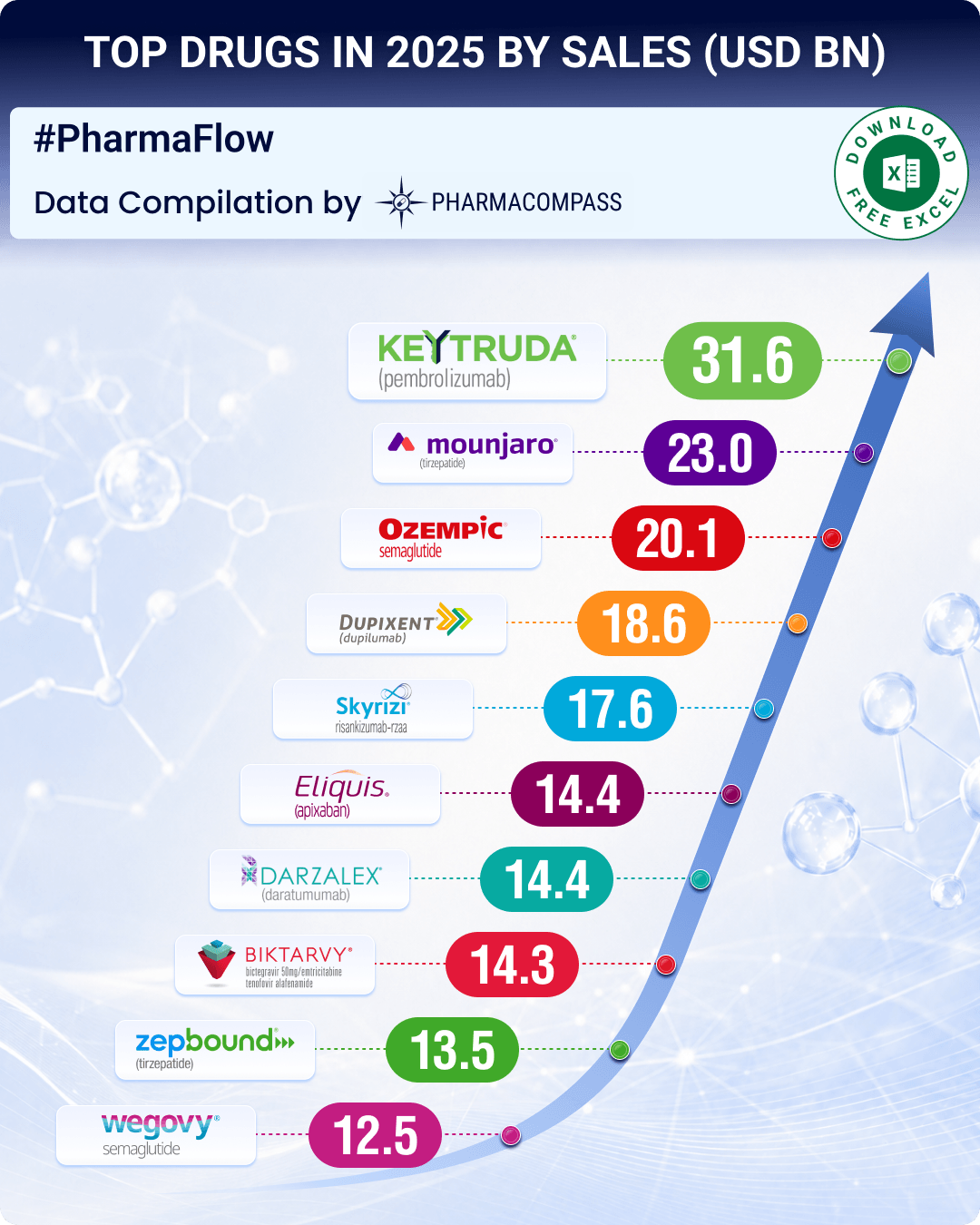
Merck acquired London‑based Verona Pharma for approximately US$ 10 billion as part of its strategy to diversify ahead of the 2028 patent expiration of its cancer blockbuster, Keytruda (pembrolizumab). Merck also agreed to acquire Cidara Therapeutics in a deal valued at approximately US$ 9.2 billion, strengthening its infectious disease portfolio.
The PharmaCompass Newsletter – Sign Up, Stay Ahead
Feedback, help us to improve. Click here
Image Credit : Top news of 2025: Drugmakers invest in US capacities, agree to lower Medicaid prices; Pfizer buys obesity-focused biotech Metsera by PharmaCompass license under CC BY 2.0
“ The article is based on the information available in public and which the author believes to be true. The author is not disseminating any information, which the author believes or knows, is confidential or in conflict with the privacy of any person. The views expressed or information supplied through this article is mere opinion and observation of the author. The author does not intend to defame, insult or, cause loss or damage to anyone, in any manner, through this article.”