
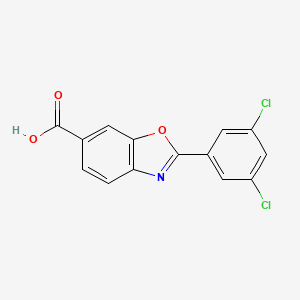
1. Fx006
2. Vyndamax
1. 594839-88-0
2. Vyndamax
3. 2-(3,5-dichlorophenyl)-1,3-benzoxazole-6-carboxylic Acid
4. Fx-1006
5. Tafamidisum
6. 8fg9h9d31j
7. 2-(3,5-dichlorophenyl)benzoxazole-6-carboxylic Acid
8. Chebi:78538
9. Fx1006
10. Fx-1005
11. Dtxsid00208185
12. 6-benzoxazolecarboxylic Acid, 2-(3,5-dichlorophenyl)-
13. Refchem:56085
14. Dtxcid20130676
15. N07xx08
16. 813-715-5
17. Fx006
18. 2-(3,5-dichlorophenyl)-6-benzoxazole Carboxylic Acid
19. 2-(3,5-dichlorophenyl)benzo[d]oxazole-6-carboxylic Acid
20. C14h7cl2no3
21. Mfcd16621109
22. 594839-88-0 (free Acid)
23. Tafamidis [usan]
24. Tafamidis [usan:inn]
25. Unii-8fg9h9d31j
26. 4his
27. Tafamidis-meglumine
28. Vyndamax (tn)
29. 3mi
30. 2-(3,5-dichlorophenyl)-6-benzoxazolecarboxylic Acid
31. Vynmac (tn)
32. Tafamidis;fx 1006
33. Tafamidis [inn]
34. Tafamidis [jan]
35. Tafamidis [mi]
36. Tafamidis [mart.]
37. Tafamidis [who-dd]
38. Tafamidis (jan/usan/inn)
39. Schembl442508
40. Gtpl8378
41. Orb1302753
42. Tafamidis [orange Book]
43. Chembl2103837
44. Pf-06291826(tafamidis)
45. Schembl29361223
46. Pf-06291826(tafamidis)?
47. Glxc-10770
48. Hms3741e09
49. Hms5085b06
50. Ex-a3575
51. Bdbm50197883
52. S6465
53. Akos017550076
54. Db11644
55. Fd27988
56. Vs-0125
57. Ncgc00390731-01
58. 137464-18-7
59. Hy-14852
60. Sy217402
61. Db-072645
62. Ns00072572
63. C75776
64. D09673
65. En300-307185
66. 839d880
67. Q519447
68. Brd-k23728141-001-01-2
69. Z1443584665
70. Tafamidis; 2-(3,5-dichlorophenyl)-6-benzoxazole Carboxylic Acid
| Molecular Weight | 308.1 g/mol |
|---|---|
| Molecular Formula | C14H7Cl2NO3 |
| XLogP3 | 4.2 |
| Hydrogen Bond Donor Count | 1 |
| Hydrogen Bond Acceptor Count | 4 |
| Rotatable Bond Count | 2 |
| Exact Mass | Da |
| Monoisotopic Mass | Da |
| Topological Polar Surface Area | 63.3 |
| Heavy Atom Count | 20 |
| Formal Charge | 0 |
| Complexity | 371 |
| Isotope Atom Count | 0 |
| Defined Atom Stereocenter Count | 0 |
| Undefined Atom Stereocenter Count | 0 |
| Defined Bond Stereocenter Count | 0 |
| Undefined Bond Stereocenter Count | 0 |
| Covalently Bonded Unit Count | 1 |
Tafamidis is indicated to treat cardiomyopathy of wild type or hereditary transthyretin-mediated amyloidosis in adults.
FDA Label
Tafamidis is an innovative drug used to treat certain forms of ATTR amyloidosis (Transthyretin). ATTR amyloidosis is due to transthyretin (prealbumin) misfolding, which becomes unstable and deposits within the extracellular space of mainly cardiac tissue and nerves. It is of two types: the wild or senile type (ATTRwt) and the variant type (ATTRv), also known as hereditary or familial type. ATTRwt amyloidosis presents in elderly males with a predominant cardiac phenotype: Whereas the ATTRv amyloidosis mainly presents as sensorimotor peripheral neuropathy, specifically in patients with V30M mutation.
Anti-Inflammatory Agents
Substances that reduce or suppress INFLAMMATION.
Glucocorticoids
A group of CORTICOSTEROIDS that affect carbohydrate metabolism (GLUCONEOGENESIS, liver glycogen deposition, elevation of BLOOD SUGAR), inhibit ADRENOCORTICOTROPIC HORMONE secretion, and possess pronounced anti-inflammatory activity. They also play a role in fat and protein metabolism, maintenance of arterial blood pressure, alteration of the connective tissue response to injury, reduction in the number of circulating lymphocytes, and functioning of the central nervous system.
Immunosuppressive Agents
Agents that suppress immune function by one of several mechanisms of action. Classical cytotoxic immunosuppressants act by inhibiting DNA synthesis. Others may act through activation of T-CELLS or by inhibiting the activation of HELPER CELLS. While immunosuppression has been brought about in the past primarily to prevent rejection of transplanted organs, new applications involving mediation of the effects of INTERLEUKINS and other CYTOKINES are emerging.
N07XX08
S76 | LUXPHARMA | Pharmaceuticals Marketed in Luxembourg | Pharmaceuticals marketed in Luxembourg, as published by d'Gesondheetskeess (CNS, la caisse nationale de sante, www.cns.lu), mapped by name to structures using CompTox by R. Singh et al. (2021) DOI:10.1021/acsenvironau.1c00008. List downloaded from https://cns.public.lu/en/legislations/textes-coordonnes/liste-med-comm.html. Dataset DOI:10.5281/zenodo.4587355
N - Nervous system
N07 - Other nervous system drugs
N07X - Other nervous system drugs
N07XX - Other nervous system drugs
N07XX08 - Tafamidis
ATCvet Code
QN - Nervous system
QN07 - Other nervous system drugs
QN07X - Other nervous system drugs
QN07XX - Other nervous system drugs
QN07XX08 - Tafamidis
Absorption
Tafamidis reaches a Cmax of 1430.93ng/mL with a Tmax of 1.75h fasted and 4h fed. The AUC of tafamidis is 47,864.31ng\*h/mL.
Route of Elimination
A 20mg oral dose of tafamidis is approximately 59% recovered in the feces, largely as unchanged drug. Approximately 22% of a 20mg oral dose is recovered in the urine, mostly as the glucuronide metabolite.
Volume of Distribution
The apparent volume of distribution at steady state is 18.5L.
Clearance
The oral clearance of tafamidis is 0.263L/h. The apparent total clearance is 0.44L/h.
Tafamidis is largely not subject to first pass or oxidative metabolism, being 90% unchanged after in in vitro experiments. Preclinical data suggest tafamidis is mainly metabolized through glucuronidation and excreted in bile.
The half life of tafamidis is 49h.
Genetic mutations or natural misfolding of transthyretin destabalizes transthyretin tetramers, leading to their dissociation and aggregation in tissues, and disrupting the normal function of these tissues. Tafamidis binds to transthyretin tetramers at the thyroxin binding sites, stabilizing the tetramer, reducing the availability of monomers for amyloidogenesis.
BUILDING BLOCK