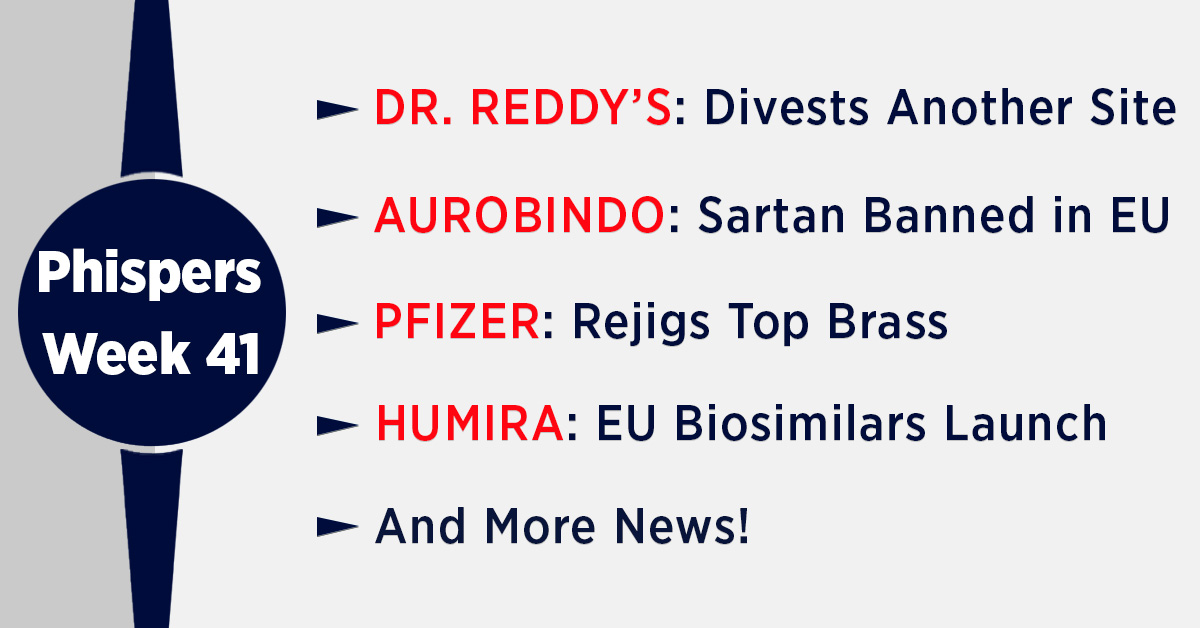
This week, Phispers brings you news from Dr. Reddy’s Laboratories in India which is divesting its API plant in Hyderabad in order to optimize its cost structure.
J&J and Bayer’s blood thinner Xarelto was found to reduce cardiovascular risks in heart patients.
Following the footsteps of GSK and Novartis, Pfizer too got a chief digital office on board, as it revamped its top brass a fortnight after announcing a new CEO.
Meanwhile a third sartan was found to be contaminated with low levels of NDEA and the EU has taken action against its manufacturer — India’s Aurobindo Pharma — by suspending its CEP.
FDA released a method to detect NDMA and NDEA impurities in valsartan drug products.
And generic versions of the world’s biggest selling drug — AbbVie’s Humira — went on sale in Europe.
However, in the US, AbbVie has staved off all Humira knockoffs until 2023.
Dr. Reddy’s cost cutting measures gain momentum; divests API manufacturing site
Earlier this month, Dr. Reddy's Laboratories (DRL) had announced the sale of its antibiotic
manufacturing site and its related assets in Bristol, Tennessee, to Neopharma Inc, a wholly owned subsidiary of the UAE’s largest drug manufacturer headquartered in Abu Dhabi.
The Indian drug major’s cost cutting measures have gathered momentum. This week, DRL announced it is selling its API manufacturing unit located in Jeedimetla, Hyderabad, to Therapiva Private Limited.
In a regulatory filing, DRL said it has entered into a definitive agreement for
the sale of this unit to Therapiva, a joint venture between Omnicare Drugs
India (a wholly owned subsidiary of Neopharma LLC, Abu
Dhabi) and Laxai Life Sciences.
This divestiture is being done by way of slump sale (as a
going concern) and includes all related fixed assets (land and building),
current assets, current liabilities, and its employees, the company statement
said.
“The divestiture of our API manufacturing business unit is a step towards streamlining our manufacturing operations and optimizing our cost structures,” Sanjay Sharma, Executive Vice
President and Head, Global Manufacturing Operations of DRL said. “We are confident that we have found in Therapiva, a buyer-partner who fully understands and appreciates the business unit and its people as a powerful strategic asset,” he added. However, the company did not disclose any financial details.
PharmaCompass reviewed the Written Confirmation, issued by India’s drug regulator, to the site and found that the site manufactures Sumatriptan Succinate, Topiramate, Montelukast Sodium, Olanzapine, Doxazosin, Ondansetron, Donepezil and Escitalopram.
The
Written Confirmation is a certificate issued to certify compliance with
standards of good manufacturing practices (GMP) for a manufacturing site are at
least equivalent to the GMP of the European Union.
After Huahai’s valsartan, Aurobindo stopped from supplying irbesartan into Europe
The detection of impurities – N-nitrosodimethylamine (NDMA) and
N-nitrosodiethylamine (NDEA) – in valsartan from Zhejiang Huahai Pharmaceuticals over the last few months has led to an EU-wide review of all valsartan medicines. The
review was subsequently extended to other ‘sartan’ medicines when
very low levels of NDEA were found in losartan made by Hetero Labs in India.
European regulators say they have found the same impurity
discovered in valsartan in both losartan made by Hetero Labs and now irbesartan
manufactured by Aurobindo Pharma.
Irbesartan is the third sartan to be found with low levels
of NDEA. On October 8, 2018, the European Directorate for the Quality of Medicines & HealthCare (EDQM) suspended Aurobindo Pharma’s CEP (Certificate of Suitability), effectively stopping the supply in the EU of medicines containing irbesartan from this company.
National authorities in the EU are also considering whether to recall medicines containing Aurobindo Pharma’s irbesartan from
pharmacies as a precaution.
“The review into the presence of impurities in sartans and their potential effects in patients is ongoing. EMA will continue working with national authorities, international partners and EDQM and will provide updates as more information becomes available,” an EMA statement said.
FDA releases method to detect NDMA and NDEA; issues
clarification on import alert
This week, the US drug regulator posted a redeveloped
combined gas chromatography-mass spectrometry (GC/MS) headspace method for detecting the
presence of impurities NDMA and NDEA in valsartan drug products.
Previously, the FDA had
posted a GC/MS method for detection of NDMA in valsartan products. Upon
detection of NDEA in valsartan products manufactured by Zhejiang Huahai, FDA
redeveloped the testing method so that it can be used to detect and quantify
levels of both NDMA and NDEA. In their announcement the FDA stated that the
method should be validated by users if the resulting data are used to support a
required quality assessment of the API or drug product, or if the results are
used in a regulatory submission.
The agency is also working on
a GC/MS direct injection method for detection of NDMA and NDEA. PharmaCompass
will post the method when it is available. This
will provide an additional option before regulators and the industry to detect
the two impurities.
Meanwhile, the FDA clarified that it’s just one site of Zhejiang Huahai on which the import ban has been slapped.
On September 28, the FDA had announced it had imposed an import alert banning “all” APIs made by Huahai and finished drug products made using Huahai’s APIs from entering the US. But the actual import alert on the FDA website appeared to be directed only to the Chinese pharma’s Chuannan site in the city of Taizhou, China. FDA corrected this mistake recently.
In an alert, Health Canada said it had found the Chuannan
manufacturing site of Huahai to be non-compliant with requirements of good manufacturing practices for the
manufacture of APIs.
It also listed the products manufactured at the Chuannan site. These are — “candesartan, irbesartan, losartan, olmesartan, telmisartan, and valsartan, which are
used in the manufacture of a class of drugs known as angiotension receptor
blockers (drugs that are used to treat high blood pressure and heart failure); levetiracetam, which is
used in the manufacture of an anti-epileptic drug; nevirapine, which is
used in the manufacture of an antiviral drug; and repaglinide, which is used in the manufacture of an anti-diabetic drug,” Health Canada said.
J&J gets key label expansion for its blood thinner
Xarelto
Johnson & Johnson and Bayer’s Xarelto, which has been
gradually losing market share to Pfizer and Bristol-Myers Squibb’s Eliquis, just won
a much-needed new indication. According to analysts, this new indication can
bring in US$ 1.5 billion for Xarelto from the US alone.
The US Food and Drug Administration (FDA) approved Xarelto as a drug that can reduce cardiovascular (CV) risks in
patients with coronary artery disease (CAD) or peripheral artery disease (PAD),
a J&J statement said. That makes it the first novel oral anticoagulant (NOAC)
approved for that market, ahead of Eliquis and Boehringer Ingelheim’s Pradaxa.
The drug is the first and only Factor Xa inhibitor (a class
of anticoagulant drugs that act directly upon Factor X in the coagulation
cascade, without using antithrombin as a mediator) approved to reduce the risk
of major CV events in people with CAD or PAD.
This decision of the FDA is based on data from the Phase 3
COMPASS trial, which showed Xarelto with aspirin reduced stroke by 42 percent, cardiovascular death by 22
percent and heart attack by 14 percent compared with aspirin alone in this
patient group.
In August this year, Bayer
had
gained approval for Xarelto in Europe for this indication. The first launch is
planned for Germany.
There are currently four NOACs on the market: Xarelto
(rivaroxaban) from J&J and Bayer; Eliquis (apixaban)
from Pfizer and Bristol-Myers Squibb; Pradaxa (dabigatran) from Boehringer
Ingelheim; and Savaysa (edoxaban)
from Daiichi Sankyo.
So far, Xarelto is the only one to have picked up this
indication.
Earlier this year, results from the MARINER and COMMANDER
HF trials on Xarelto failed to show expected benefits and risk reductions,
including in patients at risk of venous thromboembolism.
This new approval provides Xarelto with a differentiator against market leader Eliquis. In the second quarter, Xarelto’s US sales were US$ 679 million, nearly 6 percent higher than the same
quarter in 2017. Meanwhile, Eliquis’ US sales were US$ 979 million, up 39 percent year over year.
Pfizer rejigs top brass, gets chief digital officer on
board
A fortnight back, Phispers had reported how Ian Read
is to step down as CEO of Pfizer,
handing over the baton to the chief operating officer Albert Bourla. Following
the change of leadership, Pfizer is also revamping its executive team.
As part of a boardroom shake-up, and owing
to the growing importance of digital
technology, the American pharmaceutical behemoth has appointed Lidia Fonseca as
its chief digital officer in R&D and business process.
Pfizer is following the example of GlaxoSmithKline and Novartis, two big
pharma companies that have already appointed chief digital officers to
transform R&D and relationships with customers.
Fonseca will be in charge of creating and implementing a “strategy that accelerates and improves the company’s digital capabilities.” At present, she is the chief information officer at Quest Diagnostics and will join Pfizer’s executive leadership team in January.
Other changes at Pfizer include Mikael Dolsten, who will assume oversight of the chief medical officer’s role. Angela Hwang will become group president of Pfizer’s innovative business, responsible for the entire portfolio of innovative medicines. Freda Lewis-Hall will assume a new role as Pfizer’s chief patient officer, advocating on behalf of all patients who rely on Pfizer’s new drugs.
John Young — presently Pfizer’s president of Innovative Health — will assume responsibility for “strategy, business development, portfolio management and valuation activities; business analytics; global commercial operations; and Patient and Health Impact,” among other areas, Pfizer said. Young will also head Pfizer’s consumer healthcare business.
Biosimilars of world’s best-selling drug Humira go on sale this week in Europe
Generic versions of AbbVie’s Humira, the world’s biggest-selling drug, go on sale in Europe this week. However, in the US, Illinois-headquartered AbbVie has extended the drug’s shelf life by staving off Humira knockoffs to 2023. Humira is used to treat rheumatoid arthritis, Crohn’s disease, ulcerative colitis and psoriasis.
The deal this time is with Novartis’ generic arm, Sandoz,
which has agreed to launch its biosimilar in the US later (in 2023) than other
competitors. As per the current agreement, Amgen
will launch its copycat version on January 31, 2023, Samsung Bioepis
and Merck
on June 30, 2023, Mylan
on July 31, 2023, while Sandoz will launch it on September 30, 2023.
For AbbVie, the stakes are indeed high — last year, Humira brought in US$ 18 billion for the drug maker, and the sales are expected to increase by US$ 3 billion in 2020, driven by annual price hikes. On its part, AbbVie now has five years to get new drugs lined up to replace Humira.
In the EU though, Sandoz rolled out its
biosimilar of Humira, branded as Amgevita,
on October 16. Novartis said its Sandoz unit is launching its product Hyrimoz
initially in Britain, with other markets set to follow.












 Share
Share