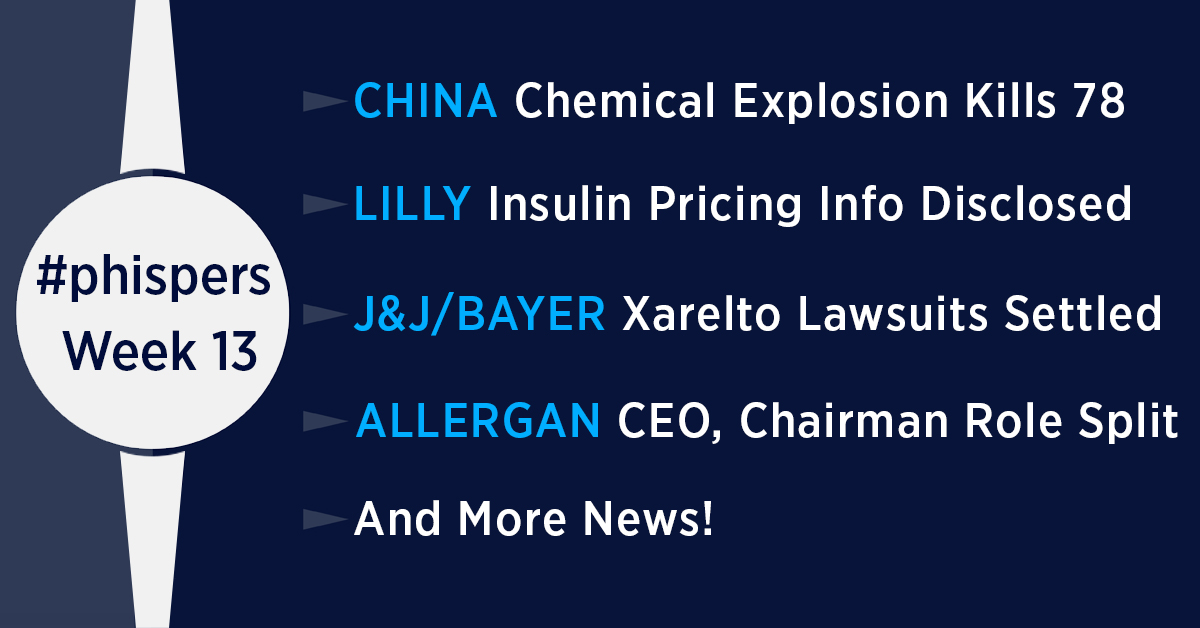
This week, Phispers brings news that
J&J and Bayer have settled more than 25,000 lawsuits in the US against
their blood thinner Xarelto. Similarly, Purdue Pharma and the State of Oklahoma
in the US began their crackdown on the opioid crisis through a US$ 270 million
out-of-court settlement.
In drug development news, Biogen Inc and its partner Eisai said they are ending two late-stage trials of their experimental Alzheimer’s disease drug — aducanumab.
Similarly, FDA warned of death risk from AbbVie and Roche’s Venclexta for multiple myeloma. And Pfizer and Merck scrapped another Bavencio trial, this time for ovarian cancer.
Meanwhile, Novartis said it will be
listing Alcon
on SIX Swiss Exchange and the New York Stock Exchange on April 9.
Allergan gave into pressure from hedge fund Appaloosa LP, and said it will split the role of
the CEO and chairman in the next leadership transition. And China experienced
another massive explosion at a chemical plant in Xiangshui County that killed
78 people.
Another massive explosion in a chemical
plant rocks China, kills 78
China witnessed yet another massive explosion at a chemical plant last week that killed 78 people and critically injured 13 others. The plant was run by Tianjiayi Chemical Company Limited in eastern China. The explosion created an enormous fireball, and also an earthquake, 2.2 in magnitude.
The factory located
in an industrial park in Xiangshui County has raised concerns about exposure to
benzene, a known carcinogen that allegedly caused the explosion.
According to public government records, in January 2018, a local inspection
group found 13 safety risks at Tianjiayi Chemical, including insufficient
operating rules for benzene storage.
After the blast, the concentration of sulfur dioxide in the air was 57 times higher than the Chinese safe standards, and the concentration of nitrogen oxide was 348 times higher, according to the
Jiangsu environment bureau.
This is the latest in
a string of explosions at chemical plants in China.
In July 2018, a chemical plant in south-west Sichuan province had left 19 dead
and 12 injured. In November 2018, a gas leak at a plant in the northern city of
Zhangjiakou (which was among the host locations for the 2022 Winter Olympics)
had killed 24 people. In December 2018, a laboratory blast had taken place at
Beijing University, killing three students. And in 2015, a giant chemical blast
at a container storage facility had killed at least 165 people in the northern
port city of Tianjin.
Lilly discloses drug pricing data for
insulin amidst mounting federal scrutiny
In the US, insulin makers Eli Lilly, Sanofi and Novo Nordisk have been in the eye of a storm since
2017, battling pricing lawsuits, and more recently a class action suit that accuses the players of fraudulently inflating the prices
of insulin.
Due to the increased scrutiny, Eli Lilly released data that indicates the amount the company received for
its popular insulin injection — Humalog — which declined 8.1 percent over the past five years. The net price for Humalog — which factors in the rebates and other incentives Lilly provides to customers — fell to US$ 135 in 2018 from US$ 147 in 2014.
While the net price has declined, the list price has risen 52 percent to US$ 594. The last time the company raised the list price for Humalog was in 2017, it said. Lilly’s list prices for Humalog and what most patients are charged after insurance company rebates and other discounts highlights the disparity in prices between uninsured and insured patients.
Lilly cited increased negotiating power of pharmaceutical benefit managers (PBMs) as one of the reasons for the decline, warning that “changes in insurance design and the trend toward greater consumer cost sharing” could mean more patients are forced to pay the full retail price.
Novartis’ Alcon to be listed on SIX Swiss Exchange and NYSE on April 9
In July last year, PharmaCompass had reported that Novartis would be spinning off Alcon — its eye-care division — and buyback up to US$ 5 billion in stocks.
Last week, the Swiss pharma major announced that Alcon obtained approval for listing
on SIX Swiss Exchange and the New York Stock Exchange (NYSE). Alcon would enter the SMI, Switzerland’s blue-chip stock index, on its first day of trading, Novartis said. Shares in Alcon are expected to start trading on April 9 on the Swiss market and the NYSE.
Alcon had secured debt financing of US$
3.5 billion. Bank of America, Merrill Lynch and UBS were advising Novartis on
the transaction. Under the distribution, each Novartis shareholder will receive
one Alcon share for every five Novartis shares or American depositary receipts
they hold at the close of business on April 8.
Novartis had acquired Alcon for over US$
50 billion in 2011. The completion of the spin-off would mark exactly eight
years of its full ownership.
Allergan gives in to Appaloosa’s demand, agrees to split CEO, chairman roles
Hedge fund Appaloosa LP has been putting pressure on Allergan to split the roles of its chairman and
CEO. Both the positions are currently held by CEO Brent Saunders. Appaloosa has
also suggested the Botox maker consider a sale or breakup of the company.
On March 22, Allergan disclosed in a US
Securities and Exchange Commission filing that it has agreed to split the roles of the CEO and chairman in the
next leadership transition, in accordance with Appaloosa’s request.
The company also stated that it had slashed the pay handed out to Saunders, to US$ 6.6
million for 2018, which is less than one-fourth of the US$ 32.8 million he
received in 2017.
However, it seems that Appaloosa is not impressed. In a statement, Appaloosa said: “Typical of this Board, Allergan has done everything except what needs to be done to fix the company. Unless the Board intends to make a CEO transition in the very near-term, these measures are no more than a meaningless series of gestures intended to preserve the current system of lax oversight and further entrench management.”
The company said
splitting the roles now, as hedge fund Appaloosa has requested, “could impede the board’s effectiveness by creating a crisis of confidence in Saunders at a time when leadership stability and effectiveness is critical.”
Once-daily male contraceptive pill passes
initial human safety tests
So far, men have had little birth-control
choices other than using condoms or going in for a vasectomy. Researchers have
been exploring new options, such as an injection and a topical gel.
But now, it seems that a birth control pill for men may find its way into the market over the next decade or so. The pill — 11-beta-MNTDC — has passed initial human safety tests, carried by the
University of Washington and the Los Angeles Biomedical Research Institute (LA
BioMed), an independent biomedical research organization.
The once-daily pill suppresses levels of
hormones that drive the production of sperm and testosterone in the testes. A month-long study on the
pill has shown that the capsule appeared to work as a male contraceptive with
no significant side-effects.
Forty healthy men (between the age of 18
and 50) enrolled for this phase one safety trial. Ten volunteers received a
placebo capsule; the rest were assigned a 200mg or 400mg dose of 11-beta-MNTDC.
All took one capsule daily with food for 28 days. The levels of hormones
required for sperm production fell in men who took the daily capsule,
suggesting their sperm counts had been significantly reduced.
The drug contains a form of progesterone that blocks the production of hormones called luteinizing hormone (LH) and follicle-stimulating hormone (FSH) that are needed to make sperm. However, researchers say it could be a decade before a male pill is on the market, even as they believe there is strong demand for such a pill.
J&J and Bayer settle over 25,000 Xarelto lawsuits in US for US$ 775 million
Pharmaceutical giants Johnson & Johnson and Bayer AG have agreed to settle more than 25,000 lawsuits in the US wherein the plaintiffs alleged injuries and death due to taking
prescription blood thinner Xarelto. The drug had been jointly developed by the two companies.
Bayer and J&J have agreed to settle with plaintiffs for a total of US$ 775 million.
Under the terms of the agreement, the
companies do not admit liability. The plaintiffs said Bayer and J&J had
failed to give adequate
warnings about risks associated with taking the anti-coagulant drug. The plaintiffs had alleged that patients
taking Xarelto experienced unstoppable bleeding, which led to other severe
conditions including fatalities. The lawsuits claimed that adequate information
regarding the use of the drug would have prevented these incidents.
The pharma giants say these claims are without merit. In a statement, Bayer said the “settlement allows the company to avoid the distraction and significant cost of continued litigation.” Some of Bayer’s settlement costs will be offset by product liability insurance.
Xarelto is Bayer’s highest earning drug, generating US$ 4.07 billion (Euro 3.6 billion) in 2018 revenues. J&J reported Xarelto sales of US$ 2.47 billion in 2018.
Purdue Pharma, Oklahoma crackdown on
opioid crisis via out-of-court settlement
In the US, the State of Oklahoma and OxyContin maker Purdue Pharma began their crackdown on the opioid crisis this week when the
two agreed to a US$ 270 million out-of-court settlement.
Purdue and dozens of other drug companies face more than 1,600 other lawsuits filed by cities, counties, states and native American tribes that allege culpability in the nation’s opioid epidemic. Thirty-five other states have sued drug companies in their own court systems. As of now, there is little understanding on how this settlement will affect other cases and whether it will send legal dominoes
falling all across the US or not.
Under the terms of the Oklahoma
settlement, Purdue will immediately contribute US$ 102.5 million to establish
a new foundation for addiction treatment and research at the Oklahoma State
University. Members of the Sackler family, who own Purdue Pharma but were not
defendants in the case, will pay an additional US$ 75 million in personal
funds over five years. Purdue will also provide US$ 20 million worth of
treatment drugs, pay US$ 12 million to cities and towns and cover about
US$ 60 million in litigation costs.
Oklahoma will continue to press its case against the two other defendants — Johnson & Johnson, and Teva Pharmaceutical Industries.
Nearly 400,000 people in the United States
died of opioid overdoses between 1999 and 2017, according to the Centers for
Disease Control and Prevention, including a record 47,600 in 2017. Purdue is
more closely associated with the opioid crisis, as it introduced the powerful
opioid OxyContin to the market in 1996.
FDA warns of death risk from AbbVie’s Venclexta; Pfizer, Merck scrap another Bavencio trial
After halting enrollment of patients in
multiple myeloma trials due to incidents of patient deaths, the United States Food and Drug
Administration (FDA) issued a warning against the use of AbbVie and Roche’s Venclexta for multiple myeloma.
FDA informed it had reviewed data from the BELLINI clinical trial
whose interim results showed an increased risk of death for patients receiving
Venclexta as compared to the control group. Data from the trial showed
Venclexta increased the relative risk of death by about twofold compared to a
placebo.
In an interim survival analysis, 41 of
194 (21.1 percent) patients in the experimental arm had died, versus 11 of 97
patients (11.3 percent) in the placebo group.
Venclexta (venetoclax) is currently under clinical trials for several blood cancer indications
including myelodysplastic syndrome and mantle cell lymphoma. It generated US$ 344 million for AbbVie in 2018 revenues.
FDA has asked healthcare professionals and
patients to report any Venclexta side effects to its MedWatch Adverse Event
Reporting program, even as it considers the drug to be a safe and an effective
treatment for its approved indications, such as chronic lymphocytic
leukemia and acute myeloid leukemia.
Another drug that suffered a trial setback is Pfizer and Merck KGaA’s Bavencio (avelumab), a drug competing with blockbusters
like Keytruda and Opdivo. In a joint statement, the companies announced they would be
discontinuing a phase III trial that evaluates a combination therapy of
Bavencio-chemotherapy followed by a Bavencio-Talzenna treatment.
The trial included patients with
untreated advanced ovarian cancer in stage III or stage IV of the disease. This
comes few months after the companies suffered a blow as Bavencio
failed a first-line study,
in patients with certain forms of ovarian cancer.
Biogen, Eisai scrap two late-stage trials of its Alzheimer’s drug
Biogen Inc. and its partner Eisai Co., Ltd. announced last week that they are ending two late-stage trials of their experimental Alzheimer’s disease drug — aducanumab.
The decision came
after a futility analysis conducted by an independent monitoring
committee concluded the trials had very low chances of success.
Ironically, a day later, the companies announced they have decided to start an Alzheimer’s disease study of BAN2401 — a monoclonal antibody targeting
beta-amyloid much like aducanumab.
“We still believe that amyloid beta hypothesis is potentially the right approach for the treatment of Alzheimer’s disease,” an Eisai spokesman told Reuters.
Alzheimer’s has been the holy grail for pharma companies, with no cure and only five FDA-approved prescription drugs to treat its symptoms. In the
past, pharma biggies such as Janssen Pharmaceutical, Boehringer Ingelheim and Merck have also had to end their mid-stage or late-stage trials on experimental Alzheimer’s treatments due to uncertainties in trial results.











 Share
Share