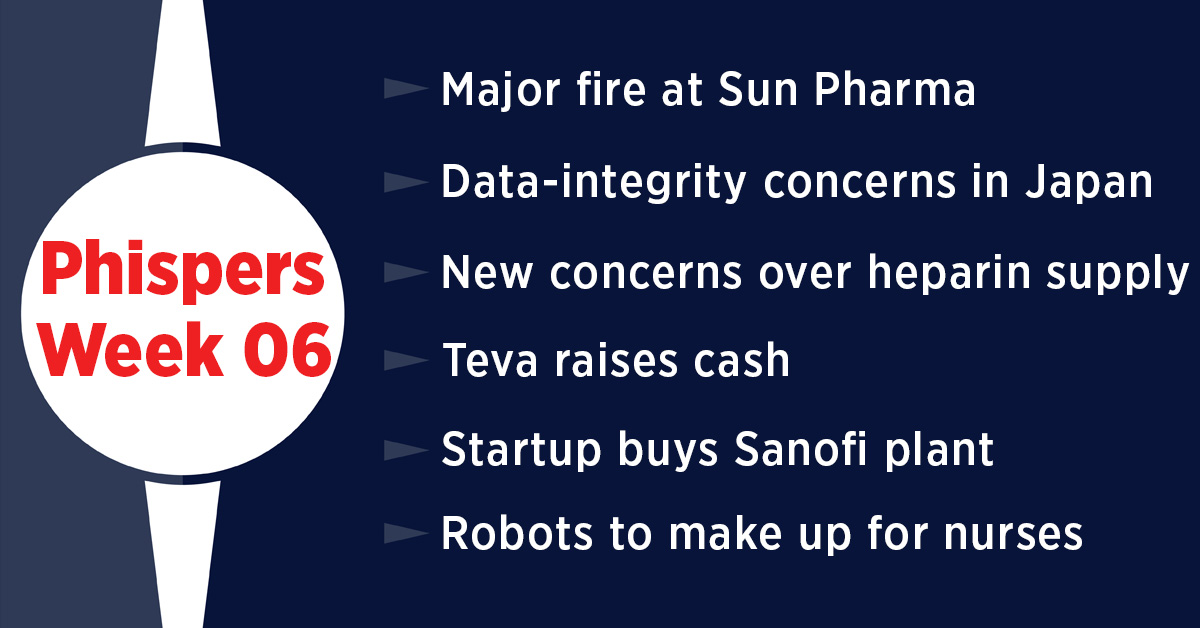
This week, Phispers brings you a compliance recap, wherein we look at the various data integrity concerns raised by the USFDA at companies in Japan, South Korea, Taiwan and China. Cash-strapped Teva managed to raise some cash by selling its women’s health portfolio, and by settling a dispute with deal partner Allergan. The US Congress has raised concerns over the supply chain for heparin. There is news of a fortnight-old startup buying a manufacturing plant from Sanofi. And we look at how Japan’s aging population is being asked to get ready for robots, as the country faces shortage of nursing manpower.
Major fire at Sun Pharma’s API manufacturing facility in India; no one injured
India’s largest pharmaceutical company Sun Pharmaceutical’s intermediate and active pharmaceutical
ingredient (API) manufacturing site in Ankleshwar (Gujarat) saw a major fire break out in the
early hours of February 4.
The company said the fire was put off by the site’s firefighting team with the support of fire tenders. According to the company spokesperson, no one was injured during this incident.
There was no
direct loss of production because of this incident. A detailed investigation is
under progress, the company said. Sun Pharma had a similar fire accident at
Ahmednagar in December 2016 that killed two people and injured two others.
Compliance
recap: FDA raises data-integrity concerns in Japan, warning letters for companies in Taiwan,
China, Korea
Recent warning
letters issued by the USFDA highlight compliance concerns at pharmaceutical
companies in Japan, South Korea,
Taiwan and China.
— Data integrity concerns at Japanese API
manufacturer: The USFDA uncovered data-integrity concerns at
Japanese API manufacturer Daito Kasei Kogyo. During the inspection, the FDA
investigators found that the company had released numerous drugs to the market without completing all required tests. The investigators reviewed certificates of analysis (COA) for batches of API manufactured and released between June 2011 and February 2016. Although the company’s quality control unit signed these COA, the firm had “falsified the COA” issued to its customers as these COAs had been signed without conducting all tests reported on these COA.
— In Taiwan, OTC drug released without testing: Failure
to complete all necessary tests was also found at the finished pharmaceuticals
facility of Polaroisin International, Taiwan. The USFDA found that the firm had released finished over-the-counter
(OTC) drug product without testing for the identity and strength of the active
ingredient. In addition, the company did not have stability data demonstrating
that the OTC drug product manufactured met all established specifications, such
as active ingredient content, throughout its labelled shelf life.
— In China,
company fails to locate production batch: In the case of Hunan Norchem Pharmaceutical, the USFDA found significant deviations from current Good Manufacturing Practices (cGMPs) at its API manufacturing facility in Hunan China. The agency found that the company’s quality unit had failed to retain and locate
production batch records as well as the analytical raw data for batches which
were shipped to the United States.
— Warning letter issued to South Korea’s Celltrion: A year ago, PharmaCompass had shared that aseptic fill/finish may
become a leading cause of concern with regulators. As Korea emerges as a force
to reckon with in the emerging world of biosimilars, the USFDA’s warning letter
to Celltrion, a major manufacturer of biosimilars
that has also partnered with Pfizer for commercialization in the United States, comes as a
major setback.
In an inspection
conducted by the FDA from May 22 to June 2, 2017, the investigators raised
concerns over multiple poor aseptic practices during the set-up and filling
operations. The warning letter highlights an example where during the aseptic
filling of vials, an operator used restricted access barrier system (RABS) to
remove a jammed stopper by reaching over exposed sterile stoppers in the
stopper bowl. The RABS disrupted the unidirectional airflow over the stopper
bowl, creating a risk for microbial contamination. After the operator removed
the jammed stopper, the filling line was restarted, but the affected stoppers
were not cleared.
PharmaCompass has also been highlighting how
inadequate investigations into deviations has become a major cause of concern
for investigators. At Celltrion, the FDA raised concern over 140 complaints received between October 2015 to May 2017 which were identified to have occurred because of vial stoppers. Celltrion’s stock took a beating at the
bourses due to the warning letter.
— Form 483 to South Korea’s Daewoong Pharma to delay botox knockoff: The Celltrion
warning letter follows an announcement by the US-based Evolus that a USFDA pre-approval inspection of Daewoong Pharmaceutical’s plant in South Korea, where a botox biosimilar is being produced, resulted in 10 observations. Back in 2013, Daewoong had inked a contract with Evolus to
export DWP-450 (a botulinum neurotoxin candidate), which was expected to be
released in the US market around 2017-18.
While Daewoong said that it expects “no significant further actions”, Evolus’ SEC filing highlights “any failure to adequately resolve the FDA’s observations at the Daewoong facility would likely cause FDA approval of DWP-450 to be delayed or denied”. Therefore, Evolus’ ability to generate revenues from DWP-450 could be materially and adversely affected. “Our reputation and ability to continue as a going concern could be seriously harmed,” Evolus said in the SEC filing.
Meanwhile, the
Danish Medicines Agency has issued a notice of non-compliance to Kadam
Exports in Gujarat (India). The letter to the API manufacturer says there
was a “general lack of ability to adhere to the principles of good manufacturing practices for production facilities, laboratory facilities and storage of reference and retention samples.”
The inspection
found the facilities were not appropriate for GMP use and there was a big risk
of contamination of products.
US Congress
raises new concerns over heparin supply chain
The US has raised
a new set of concerns
over the supply chain for life saving drug heparin. Last week, leaders of the House Energy and Commerce Committee sent a letter to US Food and Drug Administration (USFDA) Commissioner Scott Gottlieb calling on the agency to look into conflicting data on America’s supply of heparin. The FDA had recently added heparin to
its list of drug shortages. Heparin is an anticoagulant used to decrease blood
clotting, leaders also requested a contingency plan in the event of a heparin
shortage.
The letter — signed by Energy and Commerce Committee chairman Greg Walden, vice chairman Joe Barton, Health Subcommittee chairman Michael C. Burgess, and Oversight and Investigations Subcommittee chairman Gregg Harper — raises concerns over the
fluctuations in the heparin market.
“The areas of concern relate to the following: (1) whether the Chinese heparin supply is in fact shrinking or increasing, which could affect the risks of a heparin shortage in the US and could raise the risk of economically-motivated adulteration; (2) whether Chinese customs data accurately reflect Chinese heparin export and import activity; and (3) whether the recent emergence of significant US heparin imports to China is further constraining the US domestic supply of heparin,” the letter said.
The Congressmen have also raised concerns over the public dismissal by a Chinese heparin manufacturer of Chinese customs data that showed questionable surging exports to Thailand and Hong Kong, and the discovery of Chinese industry’s use of frozen pig intestines to make heparin, suggestive of internal supply pressures in China that raises risks of fraud and adulteration.
Chinese heparin
exports to Thailand and Hong Kong shot up to 40,000 kilograms and 28,000
kilograms, respectively, in 2016. Though the Congressmen have not spelt it out,
it seems they are suspecting China to be exporting heparin to countries like
Thailand to overcome scrutiny.
Despite the United States’ reliance on China’s heparin supply, the US is also curiously the largest exporter of the drug to China. The committee leaders touched on the interesting dynamic between the two countries’ imports and exports of heparin, noting the recent growth of US exports to China.
Concerns over the
quality standards for heparin have continued post the 2008 Chinese heparin
adulteration crisis, which had led to the deaths of more than 100 Americans and
had prompted an investigation by the FDA that led to dozens of Chinese heparin
suppliers being placed on import alert.
Teva raises cash by settling case with Allergan, selling women’s health portfolio
Israel’s beleaguered generic drug giant Teva Pharmaceutical Industries has managed to raise some cash by
putting aside its differences with Allergan and by selling a portfolio of products in its global women’s health business.
In November 2017,
Teva had said the final cash consideration from its US$ 40.5 billion buyout of Allergan’s generics unit required some tweaking.
Before heading into arbitration, Teva suggested Allergan hand over US$ 1.4 billion.
Last week, the former deal partners signed an agreement to settle a dispute over the amount of working capital that changed hands when Teva took over Allergan’s generics unit. As per the agreement, Allergan will fork over US$ 700 million, and Teva will use that money to repay some of the debt it incurred when it had bought Allergan’s generic business for US$ 40.5 billion, a deal that sent Teva’s fortunes in a downward spiral.
Teva is selling its portfolio of products within its global women’s health business across contraception, fertility, menopause and osteoporosis for US$ 703 million in cash. The portfolio, which is marketed and sold outside of the US, includes Ovaleap, Zoely, Seasonique, Colpotrophine, Actonel and additional products. The business will be known as ‘Theramex’.
Michael McClellan,
executive vice president and chief financial officer (CFO) at Teva said: “Teva is very pleased to complete the sale of our global women’s health portfolio today, which brings a significant influx of cash needed to further progress our ability to repay term loan debt. With the completion of today’s transaction, Teva has generated total proceeds of US$ 2.48 billion from the women’s health divestitures, higher than the previously announced US$ 2.3 billion expected proceeds.”
Allergan gets new CFO: Allergan
appointed Matthew Walsh as its
executive vice president and CFO. Walsh currently serves as the executive vice
president and CFO at Catalent, a role he assumed in 2008. According to
a Reuters report, Walsh’s offer letter provides for an annual salary base of US$ 800,000. Walsh would also receive
a sign-on bonus of US$ 1.4 million.
Partner
Therapeutics, a startup, buys Sanofi plant that manufactures leukemia drug
Boston-based
startup Partner Therapeutics (PTx) recently announced it has raised US$ 60 million and bought a drug and
US manufacturing plant from French drug major Sanofi. In a statement, the startup said it had acquired Leukine
(sargramostim), a Sanofi drug used to help acute myeloid leukemia patients
fight infections after bone marrow transplants. Terms of the deal were not
disclosed.
What is
interesting about this acquisition is that PTx did not exist a fortnight back.
The company came into existence on January 25, 2018, as a
cancer-focused company.
Back in 2009, Sanofi’s Genzyme had acquired Leukine from Bayer Healthcare as part of a three-drug deal, just ahead of Genzyme’s buyout by Sanofi.
As part of the
deal with Sanofi, PTx also gets a Seattle-area manufacturing plant dedicated to
making Leukine, for which Genzyme had paid about US$ 100 million. PTx said
the biologics plant in Lynnwood, Washington, was certified for commercial
production in 2012. PTx said it plans to trial Leukine in other diseases, like
melanoma and radiation poisoning.
Japan focuses
on increasing acceptance of robots to make up for nursing shortages
Japan’s aging society is estimated to face a shortfall of 370,000 caregivers by 2025. And the Japanese government is telling the elderly to accept and get used to being looked after by robots.
Developers in
Japan have focused on producing simple robotic devices that help frail persons
get out of bed and into a wheelchair, or that can ease senior citizens into
bathtubs.
In fact, the government of Japan is going a step further — it recently revised its list of priorities to include robots that can predict when patients might need to use the toilet.
The idea is to ease the burden on the nursing staff and boost the autonomy of people still living at home, Dr Hirohisa Hirukawa, director of robot innovation research at Japan’s National Institute of Advanced Industrial Science and Technology, said.
“In Japan we already have motor-supported bicycles so it is like a version of an assist for walking,” Hirukawa added. According to Japan’s robot strategy, the government hopes that four in five care recipients accept having some support provided by robots by 2020.
Japan is home to the world’s fastest-aging population — more than a quarter of the population is over 65, a figure set to rise to 40 percent by 2050. According to a report published in the Washington Post last month, lonely deaths of the
elderly are becoming quite common in Japan. This has given rise to the lonely-death-cleanup industry. Several companies offer this kind of service, and insurance firms are coming out with policies to protect landlords if their tenants die inside their properties. The insurance plans cover the cost of cleaning the apartment and also compensate for the lost rent.


















 Share
Share