Please Wait
Applying Filters...
Menu
Xls

Digital Content read-more

Create Content with PharmaCompass, ask us

DATA COMPILATION #PharmaFlow

read-more
read-more
DMF filings rise 4.5% in Q3 2025; China holds lead, India records 20% growth in submissions
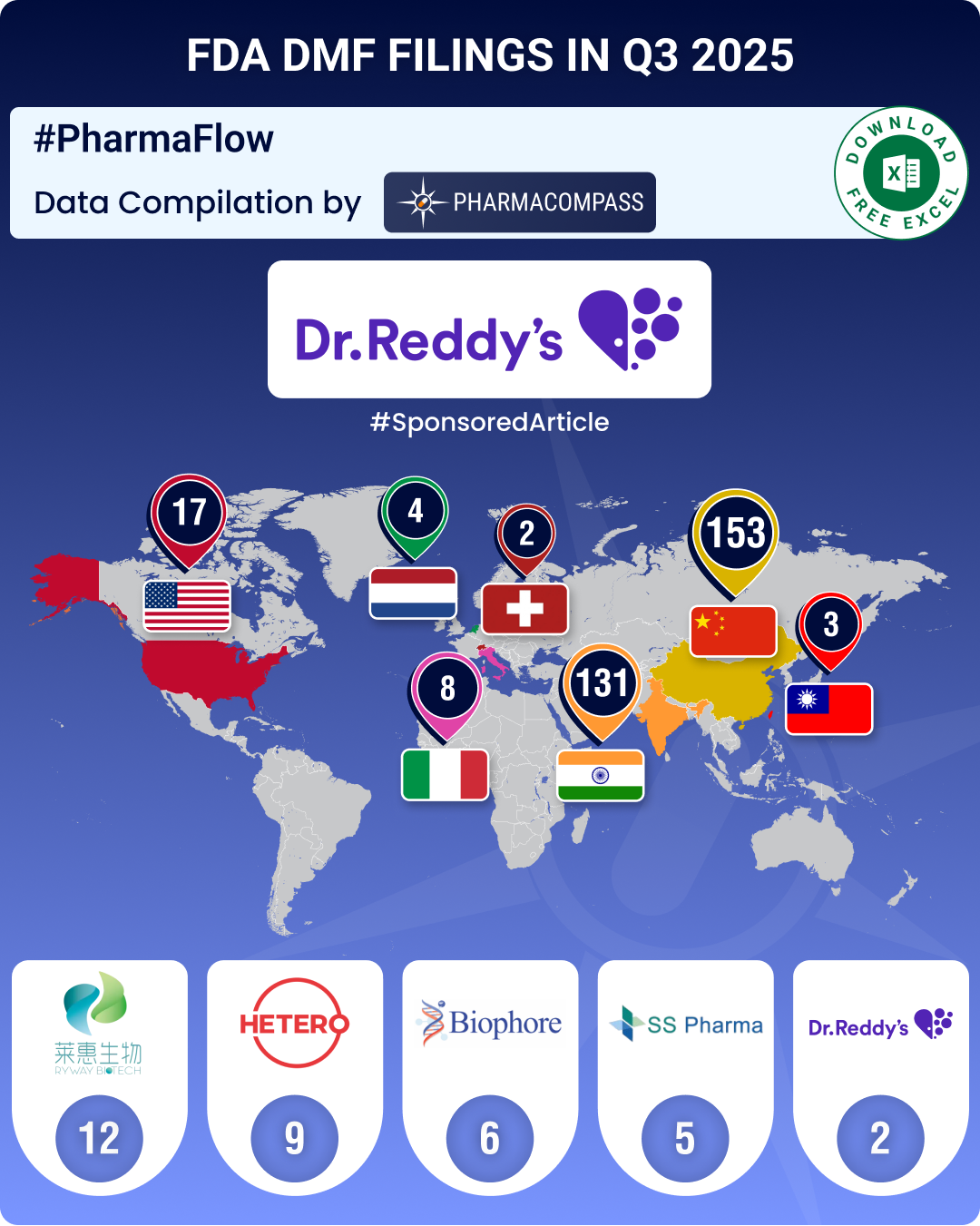
The third quarter (Q3) of 2025 witnessed a steady rise in Drug Master File (DMF) submissions to the US Food and Drug Administration (FDA). DMFs are used to provide confidential, detailed information about facilities, processes, or articles used in the manufacturing, processing, packaging, and storing of human drug productsA total of 323 Type II DMFs were submitted during this period, as opposed to 309 submissions in Q3 2024, marking an increase of 4.53 percent. This is the second highest number since 2018. In Q1 2025, 339 Type II filings were recorded.Across all DMF types (II, III, IV, and V), 479 DMFs were filed in Q3 2025, compared to 394 in Q3 2024, representing a 21.57 percent increase. Out of the 323 Type II DMFs submitted in Q3 2025, 40 had completed their review by the end of Q3, reflecting a processing lag between submission and review completion. View FDA DMF Filings in Q3 2025 (Power BI Dashboard, Free Excel Available)China maintains its lead while India posts double-digit growth in DMF submissions China and India continued to dominate DMF submissions in Q3 2025. China retained the top spot with 153 Type II DMFs, matching its submission count from Q3 2024. India recorded 131 DMFs, marking a 20.18 percent increase over 109 filings during the corresponding period last year.The United States stood a distant third with 17 filings, compared to 13 in Q3 2024. Among European nations, Italy recorded eight DMFs, doubling its 2024 tally. The Netherlands filed four, up from three. Spain submitted only one DMF, as against seven submitted in Q3 2024. Taiwan made three filings, up from one submitted in Q3 2024. Together, India, China and Taiwan accounted for about 88.9 percent of all Type II DMFs filed during the quarter. View FDA DMF Filings in Q3 2025 (Power BI Dashboard, Free Excel Available) China’s Suzhou Ryway Biotech tops corporate tally; India’s Hetero, Biophore followChina’s Suzhou Ryway Biotech led the company-wise tally with 12 DMF submissions in Q3 2025. The company had not filed any DMFs in Q3 2024.India’s Hetero Group followed with nine DMFs, maintaining the same number of filings as Q3 2024. Biophore India Pharmaceuticals ranked third with six DMFs, doubling its count from three last year.Other notable contributors include Sai Sreyas Pharmaceuticals (India) and Shanghai Haoyuan Chemexpress (China), with five DMFs each. Companies such as SNJ Group, Lunan Pharmaceutical, Allsino Pharmaceutical, Shankus Pharma, Jiangxi Xinganjiang Pharmaceutical, Sunpure Extracts, Lee Pharma, Umedica Laboratories, Linhai Tianyu Pharmaceutical and Maithri Drugs filed four DMFs each. View FDA DMF Filings in Q3 2025 (Power BI Dashboard, Free Excel Available) Olaparib, semaglutide lead molecular filings; Dr. Reddy’s files DMF for edoxaban & tucatinibDr. Reddy’s Laboratories also featured among key DMF filers in Q3 2025, submitting two DMFs — for edoxaban tosylate monohydrate and tucatinib copovidone. Edoxaban tosylate monohydrate (marketed as Savaysa by Daiichi Sankyo) is a prescription anticoagulant used to reduce the risk of stroke and to treat deep vein thrombosis and pulmonary embolism. Patent exclusivity for Savaysa extends until October 2026 in the United States, with no generic currently available.In terms of molecules, the highest number of DMFs were filed for olaparib, semaglutide, ruxolitinib phosphate, ferric carboxymaltose, and vismodegib, with three DMFs each in Q3 2025.Olaparib, sold by AstraZeneca under the brand name Lynparza, saw DMFs being filed by BDR Lifesciences and Intas Pharmaceuticals from India, and by ScinoPharm Taiwan during the quarter.Semaglutide, a glucagon-like peptide-1 (GLP-1) receptor agonist developed by Novo Nordisk, continued to draw strong interest from API manufacturers. DMFs for semaglutide were filed by three Chinese companies: Yangzhou Aurisco Pharmaceutical, Zhejiang Peptites Biotech, and Fujian Genohope Biotech.Ruxolitinib phosphate, marketed by Incyte as Jakafi, saw three DMFs. Three Indian companies — Alembic Pharmaceuticals, Valary Labs, and Devi Pharmatech — filed DMFs for this API in Q3 2025. Other molecules that received multiple DMF submissions include ferric carboxymaltose (used to treat iron-deficiency anemia) and vismodegib (an oral therapy for basal-cell carcinoma). View FDA DMF Filings in Q3 2025 (Power BI Dashboard, Free Excel Available) First-time DMF filings span 17 companies; India leads with nine first-time DMFs The quarter saw first-time DMF filings from 17 companies. India took a lead here with nine first-time DMF filings, followed by China (six), and the US (two).The DMF filings in this quarter included inclisiran sodium (filed by Aurisco Pharmaceutical of China), pacritinib citrate (by TAPI Nl B.V. of the Netherlands), and vosoritide (by Apicore LLC of the US).Out of the 19 first-time DMFs filed in Q3 2025, four completed their Generic Drug User Fee Amendments (GDUFA) review process during the quarter. View FDA DMF Filings in Q3 2025 (Power BI Dashboard, Free Excel Available) GDUFA fee for FY 2026: The FDA Generic Drug User Fee Amendments (GDUFA) is a law designed to speed access to safe and effective generic drugs to the public and reduce costs to the industry.Fee rates for fiscal year 2026 were published on July 30, 2025. FDA has revised fees under GDUFA III across all categories. While there is a slight increase in the DMF fee from US$ 95,084 in 2025 to US$ 102,584 in 2026, the ANDA fee has seen a sharp rise: from US$ 321,920 in 2025 to US$ 358,247 in 2026.FY 2025 and FY 2026 User Fee Rates Generic drug fee category Fees rates for FY 2025 Fees rates for FY 2026 Applications:     Abbreviated New Drug Application (ANDA) US$ 3,21,920 US$ 3,58,247 Drug Master File (DMF) US$ 95,084 US$ 1,02,584 Facilities:     Active Pharmaceutical Ingredient (API)—Domestic US$ 41,580 US$ 43,549 API—Foreign US$ 56,580 US$ 58,549 Finished Dosage Form (FDF)—Domestic US$ 2,31,952 US$ 2,38,943 FDF—Foreign US$ 2,46,952 US$ 2,53,943 Contract Manufacturing Organization (CMO)—Domestic US$ 55,668 US$ 57,346 CMO—Foreign US$ 70,668 US$ 72,346 GDUFA Program:     Large size operation generic drug applicant US$ 18,91,664 US$ 19,18,377 Medium size operation generic drug applicant US$ 7,56,666 US$ 7,67,351 Small business generic drug applicant US$ 1,89,166 US$ 1,91,838 Our viewFor several years prior to the pandemic, India had a lead in Type II DMF submissions. In recent years, China has surpassed India in DMF filings. But Q3 2025 numbers indicate that Indian drugmakers are fast catching up. Since DMFs establish trust in APIs from across the world, we feel this healthy competition between drugmakers from the two countries is good for the global pharmaceutical industry. 

Impressions: 4796

https://www.pharmacompass.com/radio-compass-blog/dmf-filings-rise-4-5-in-q3-2025-china-holds-lead-india-records-20-growth-in-submissions

#PharmaFlow by PHARMACOMPASS
13 Nov 2025

WEEKLY NEWS RECAP #Phispers

read-more
read-more
US Senator seeks “unannounced” FDA inspections; Nektar reports manufacturing issues with lead project
This week in Phispers, we bring you news about Nektar Therapeutics which disclosed declining efficacy of its lead project due to manufacturing problems. In Congo, two experimental drugs showed survival rates of nearly 90 percent in patients suffering from the deadly Ebola fever. US Senator Chuck Grassley has sought unannounced FDA inspections of drug manufacturing facilities overseas. Bayer announced it would fully acquire biotechnology firm BlueRock, while CDMO Cambrex was bought out by private equity firm Permira Funds. Amgen won a key Enbrel patent case against Sandoz’s biosimilar.  Two AstraZeneca cancer drugs — Tagrisso and Lynparza — posted promising results for new indications. And Canada announced final regulations to reduce price of patented drugs — the biggest reform to its drug price regime since 1987. US Senator seeks “unannounced” FDA inspections of plants overseas In a letter sent to Alex Azar, secretary, Department of Health and Human Services (HHS), and Norman Sharpless, acting commissioner, US Food and Drug Administration (FDA), Chuck Grassley, chairman of the US Senate Committee on Finance, highlighted that the committee has an obligation to ensure that FDA upholds its responsibility to protect public health by properly overseeing the nation’s drug supply and ensuring that the drugs Americans use are safe and effective. Referencing the valsartan drug safety issues that made headlines in the past year and an interview with ex-FDA investigator Motammed Masoud who “had tried to sound the alarm on what he flagged as potential systemic problems at two facilities in China and India that produce the API in generic valsartan and other blood pressure medications”, the letter also highlights that the “FDA only inspected one in five registered human drug manufacturing facilities abroad last year.” As the Trump administration is pushing for drug imports from overseas in an effort to lower drug prices in the US, the letter states “the FDA does not track in its databases whether a foreign inspection was subject to an announced or unannounced visit.” Further, Grassley said he has learned that the FDA generally does not perform unannounced visits of drug manufacturing facilities in foreign countries but does perform unannounced visits at facilities based in the US. The letter  goes on to mention that in 2013 the FDA created a pilot program in India that eliminated advanced notice and instead used short notice or unannounced visits. In 2015, the pilot program was shut down without explanation. It is unclear why the Obama administration shut the pilot program. However, because of its reported successes, Grassley said he would strongly encourage the administration’s demonstration projects to include unannounced inspections in foreign manufacturing facilities to determine “if they meet the required API and drug quality and safety standards to include sufficient record-keeping, testing, and protections against counterfeiting”. Meanwhile, following data accuracy issues with Novartis’ recently approved gene therapy — Zolgensma, Grassley has asked Novartis to provide details on data manipulation related to its US$ 2 million gene therapy. Grassley wants Novartis to submit additional details, including the date when it came to know that it issued manipulated data to the FDA as well as the number of employees whose services were terminated due to this issue. Novartis said it has received the Senator’s letter and was reviewing the request. After Novartis, Nektar reports manufacturing issues with lead project   Last week, we had carried an article on the data accuracy issues with Novartis’ recently approved gene therapy — Zolgensma. This week too, compliance continues to dominate news headlines. Shares of Nektar Therapeutics plummeted after the company disclosed declining efficacy of its lead project — NKTR-214 (bempegaldesleukin). During an analyst call, Nektar Therapeutics said new assays had revealed two of its earliest production batches differed from others. And these two batches correlated with the study subjects who yielded relatively low response rates to NKTR-214. The study subjects had received “suboptimal” product batches. The “single suboptimal batch of in-process intermediate” led to two lots of 22 being ineffectively produced.  In February 2018, Bristol-Myers Squibb and Nektar Therapeutics had announced a global development and commercialization collaboration for Nektar’s NKTR-214. Bristol-Myers Squibb had inked a US$ 1.85 billion partnership with Nektar to evaluate the full-potential of NKTR-214 given along with BMS’ flagship immune-oncology treatment Opdivo (nivolumab) across numerous tumors. The broad joint clinical development plan combining NKTR-214 with Opdivo and Opdivo plus Yervoy (ipilimumab) targeted registration-enabling trials in more than 20 indications across nine tumors. During the analyst call, Nektar executives also announced that Bristol-Myers had cut back its commitment to the bempegaldesleukin partnership to just five or six trials aimed at regulatory approval. Another company which hit headlines was Sarepta Therapeutics. An adverse event report was submitted to the FDA regarding an ongoing study of the company’s gene therapy for Duchenne muscular dystrophy (DMD). When the news broke, shares of the company plunged by as much as 19 percent. A notice from the FDA showed a patient in the study reportedly developing a serious illness. However Sarepta’s own investigation indicated the report was not submitted by its employee or the study’s principal investigator. The FDA told Reuters that it was looking into the matter. Experimental drugs show 90 percent survival rates for Ebola patients   The deadly Ebola hemorrhagic fever is not incurable anymore. Scientists are a step closer to being able to cure the deadly Ebola fever after two experimental drugs showed survival rates of nearly 90 percent in a clinical trial in the Democratic Republic of Congo (DRC). Two experimental drugs — REGN-EB3 developed by Regeneron and a monoclonal antibody called mAb114 — will now be offered to all patients infected with the viral disease. Ebola has been spreading in eastern Congo since August 2018, with the outbreak killing at least 1,800 people.  The drugs showed “clearly better” results, according to the US National Institute of Allergy and Infectious Diseases (NIAID), in a trial of four potential treatments being conducted during the second-largest Ebola outbreak in history, now entering its second year in DRC. The drugs improved survival rates from the disease more than the two other treatments being tested — ZMapp (manufactured by Mapp Biopharmaceutical) and Remdesivir (made by Gilead Sciences). The agency said 49 percent of the patients on ZMapp and 53 percent on Remdesivir died in the study. In comparison, 29 percent of the patients on REGN-EB3 and 34 percent on mAb114 died. ZMapp and Remdevisir will now be dropped. Jean-Jacques Muyembe, director general of Congo’s Institut National de Recherche Biomédicale in DRC, who co-led the trial, said: “From now on, we will no longer say that Ebola is incurable…these advances will help save thousands of lives.” Bayer to fully acquire BlueRock; CDMO Cambrex maybe bought out; Perrigo split put on hold   In M&A news, Bayer AG and BlueRock Therapeutics announced an agreement wherein Bayer will fully acquire BlueRock Therapeutics. BlueRock is a privately held, US-headquartered biotechnology company focused on developing engineered cell therapies in the fields of neurology, cardiology and immunology. Following a 2016 joint venture with Versant Ventures to establish BlueRock Therapeutics, Bayer will acquire the remaining stake for approximately US$ 240 million in cash. With Bayer currently holding 40.8 percent stake, the investment corresponds to a total company value of US$ 1 billion estimated for BlueRock Therapeutics. The closing of the transaction is expected during the third quarter of 2019. Meanwhile, there are reports that Elanco, an Eli Lilly spin off, maybe interested in buying Bayer’s animal health business. A year ago, there were rumors that Bayer might be planning to exit the animal-health business. According to news reports, Elanco and Bayer could announce an agreement to merge as soon as next week. Cambrex now a target for buyout: Contract developer and manufacturer (CDMO) Cambrex, which is known for its aggressive acquisitions, is now the target of a buyout bid. The bid is to the tune of US$ 2 billion. The firm is being bought out by private equity firm Permira Funds. If shareholders and regulators give their nod, the transaction is expected to close in the fourth quarter. Cambrex, which makes small-molecule APIs, has built itself into a top-tier CDMO after two major acquisitions last year. Perrigo postpones spinoff of its prescription business: Last year, Perrigo Company Plc had announced its board has approved a plan to separate its prescription pharmaceuticals business following the company’s previously announced strategic portfolio review.  A year on, there is news that Perrigo will postpone the spinoff of its prescription generics business after a steady sales quarter and the fizzle of its consumer health business. The plan, which Perrigo once said could lead to a sale or merger, was originally expected to go into action by the end of 2019 or early 2020, but that deadline is now indefinite, Perrigo said. In a second-quarter earnings call with investors last week, president and CEO Murray Kessler said Perrigo remained committed to a sale or spinoff but felt less pressure now, since the drugmaker’s prescription drugs were showing promising growth. Amgen wins key Enbrel patent case against Sandoz’s biosimilar   Last week, a US judge upheld two patents related to Amgen Inc’s blockbuster rheumatoid arthritis drug — Enbrel — denying a challenge posed by Novartis AG, which is seeking to launch its biosimilar version through its Sandoz unit. The judge rejected arguments by Novartis’ Sandoz unit that the patents covering Enbrel’s API until 2029 should not have been granted because their concepts were already contained in previous patents. Enbrel has been on the US market since 1998. It was developed by Immunex, which Amgen acquired in 2002. “This is a key overhang removed,” Jefferies analyst Michael Yee said in a research note. “While an (expedited) appeal is in place and expected, we believe the worst-case fear is now gone.” Novartis said it would appeal the ruling to the US Court of Appeals for the Federal Circuit. “Sandoz respectfully disagrees with the Court’s ruling, which prevents us from launching an additional treatment option for patients with autoimmune and inflammatory diseases,” said Carol Lynch, president of Sandoz US and head of North America. Two AstraZeneca cancer drugs — Tagrisso and Lynparza — post promising results   British drugmaker AstraZeneca Plc had positive news to share about two of its drugs — Tagrisso (osimertinib) and Lynparza (Olaparib). While Tagrisso is currently approved in 74 countries, including the US, Japan and the EU, for first-line epidermal growth factor receptor (EGFR)-mutated metastatic non-small cell lung cancer, Lynparza (which is being jointly developed with Merck) is already approved for advanced ovarian cancer and metastatic breast cancer. AstraZeneca said Lynparza was successful in helping patients with metastatic prostate cancer and certain genetic mutations live longer without the disease worsening. EGFR is a transmembrane protein, and more than 60 percent of non-small cell lung carcinomas (NSCLCs) express EGFR. A new late-stage study showed that Tagrisso had significantly helped patients with this type of lung cancer live longer without the disease worsening. “Tagrisso was the only medicine that had shown statistically significant overall survival benefit in this type of disease setting,” AstraZeneca said. On Lynparza, the company said the treatment met the main goal in a late-stage study of patients with metastatic castration-resistant prostate cancer and BRCA1/2 or ATM gene mutations. Patients were previously treated with hormonal anticancer therapies. BRCA and ATM genes are responsible for producing proteins that repair damaged DNA, but can cause cancer growth if the genes mutate. “This will be a big extension to Lynparza’s market potential and will be seen as good news. After good phase II data this trial was expected to work,” Liberum analysts said in a note. Prostate cancer is the second-most common cancer in men, with an estimated 1.3 million new cases diagnosed worldwide in 2018, AstraZeneca said. The company has moved deeper into cancer therapy through wide-ranging deals, including those for immunotherapy and targeted therapy. Sales from AstraZeneca’s oncology unit had soared 57 percent to US$ 2.17 billion in the second quarter, accounting for 38 percent of total product sales, with revenue from Tagrisso nearly doubling to US$ 784 million. Canada unveils biggest reform to drug price regime since 1987 Last week, the Canadian government announced final regulations that should save nearly US$ 10 billion for Canadians over a decade in terms of their spend on patented drugs. Drug companies have been opposing this move and may eventually challenge the new rules in court. This is the biggest reform to Canada’s drug price regime since 1987. The rules will save money for patients, employers and insurers, including the government, at the expense of the profits of drug companies. They could also eventually cut the earnings of drugmakers in the US, the world’s largest pharmaceutical market. The new rules were largely in line with a December 2017 draft. “We are taking the biggest step in a generation to lower the price of drugs in Canada by moving forward with these regulations,” minister of health Ginette Petitpas Taylor said. Petitpas Taylor said the rules would lay the foundation for a new national drug program. Prime Minister Justin Trudeau’s government is expected to announce a program to cover the cost of prescription drugs for some or all Canadians, but the program’s scope is not yet clear.  

Impressions: 2695

https://www.pharmacompass.com/radio-compass-phisper/us-senator-seeks-unannounced-fda-inspections-nektar-reports-manufacturing-issues-with-lead-project

#Phispers by PHARMACOMPASS
15 Aug 2019

NEWS #PharmaBuzz

read-more
read-more

https://www.globenewswire.com/news-release/2026/04/14/3273519/15459/en/Myriad-Genetics-Expands-Access-for-MyChoice-Test-to-Prostate-Cancer-Patients-in-Japan.html

GLOBENEWSWIRE
14 Apr 2026

https://www.globenewswire.com/news-release/2025/12/22/3209045/0/en/Biosplice-Therapeutics-Announces-First-Patient-Dosed-in-Investigator-Initiated-Phase-1-Clinical-Trial-of-Cirtuvivint-and-Olaparib-in-BRCA-HRD-Platinum-Resistant-Ovarian-Cancer.html

GLOBENEWSWIRE
22 Dec 2025

https://www.accessdata.fda.gov/scripts/cder/daf/index.cfm?event=overview.process&ApplNo=219893

FDA
06 Nov 2025

https://www.globenewswire.com/news-release/2025/10/13/3165395/0/en/Artios-to-Announce-First-Phase-1-2a-Data-for-DNA-Polymerase-Theta-Pol%CE%B8-Inhibitor-ART6043-in-Advanced-Solid-Tumors-in-Oral-Presentation-at-ESMO.html

GLOBENEWSWIRE
13 Oct 2025

https://www.businesswire.com/news/home/20250715020079/en/Lantern-Pharma-Unveils-Groundbreaking-AI-Powered-Module-to-Predict-Activity-and-Efficacy-of-Combination-Regimens-in-Clinical-Cancer-Treatment

BUSINESSWIRE
15 Jul 2025

https://www.expresspharma.in/steerlife-announces-its-solvent-free-melt-fusion-technology/

EXPRESSPHARMA
15 May 2025