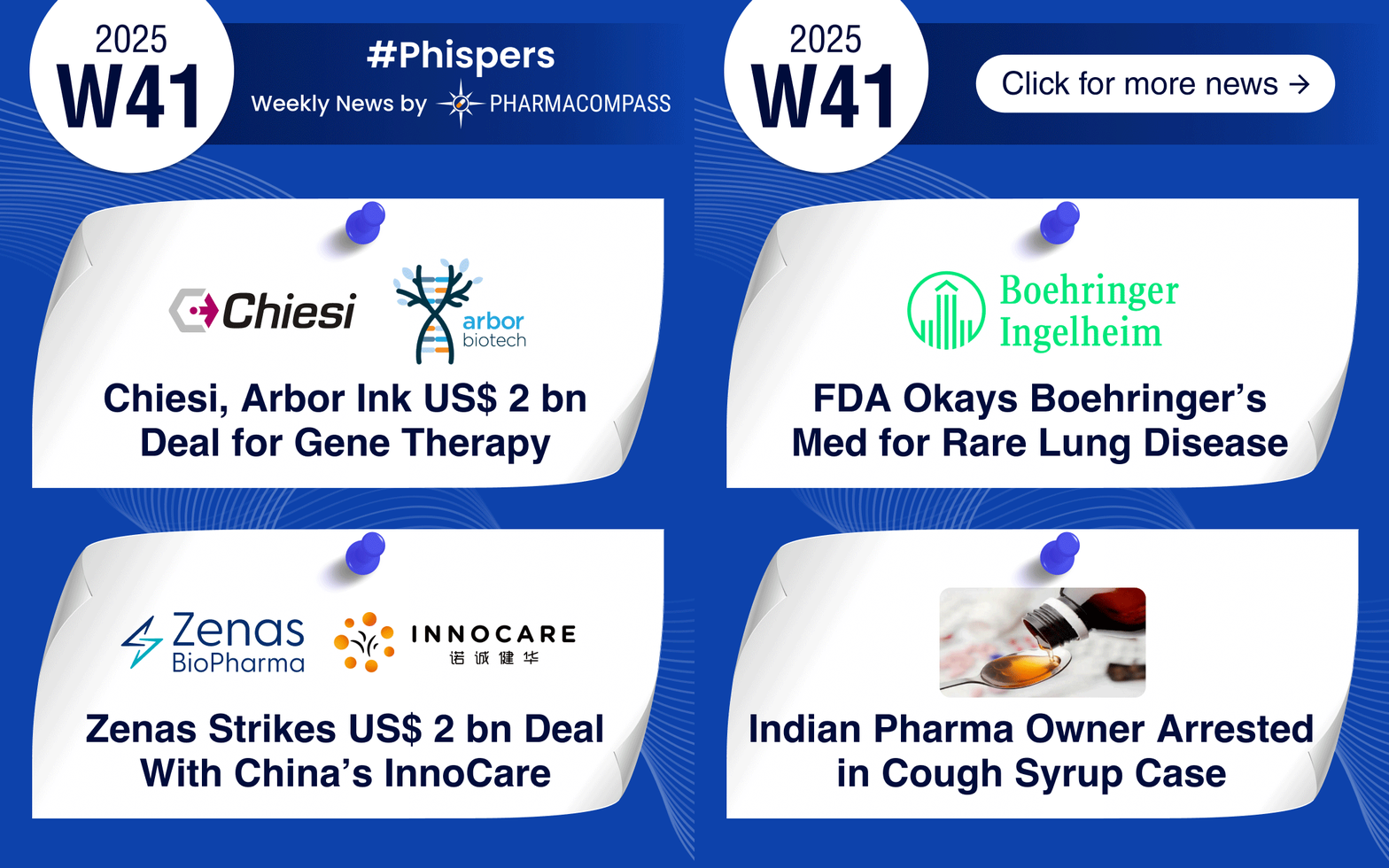
In news this week, Italy’s Chiesi Group announced a deal worth up to US$ 2 billion with US-based Arbor Biotechnologies to advance a one-time gene therapy for an ultra-rare inherited kidney disorder. Massachusetts-based Zenas BioPharma also signed a deal worth over US$ 2 billion with China’s InnoCare Pharma to develop a new treatment for multiple sclerosis. And Eli Lilly announced an investment of over US$ 1 billion in India to expand drug manufacturing through local contract partners.
In drug approvals, the US Food and Drug Administration (FDA) has okayed Boehringer Ingelheim’s Jascayd (nerandomilast) for idiopathic pulmonary fibrosis (IPF) — a deadly lung disease that makes breathing increasingly difficult. The agency also approved a second generic version of the abortion pill mifepristone, cleared Jazz Pharmaceuticals and Roche’s drug combo for use as the first maintenance therapy for an aggressive type of lung cancer, and launched a pilot program to fast-track review of generics made entirely in the US. It also expanded the use of Regeneron’s Libtayo (cemiplimab-rwlc) to treat cutaneous squamous cell carcinoma (CSCC) — a common type of skin cancer.
Meanwhile, the owner of India’s Sresan Pharma, manufacturer of the toxic cough syrup that led to the deaths of at least 17 children, has been arrested.
And in news from clinical trials, AstraZeneca and Daiichi Sankyo’s breast cancer drug showed survival benefit over chemotherapy, while AstraZeneca’s new hypertension drug cut blood pressure in hard-to-treat patients.
Chiesi, Arbor ink US$ 2 bn gene therapy deal to treat rare kidney disease
Arbor
Biotechnologies has signed
a collaboration-cum-license agreement worth up to US$
2 billion with Chiesi
Group to advance its one-time liver-directed gene editing
treatment for primary hyperoxaluria type 1 (PH1). PH1 is an ultra-rare inherited disorder that causes recurrent kidney stones and may lead to kidney failure. Current treatments — such as Alnylam’s
Oxlumo (lumasiran) and Novo Nordisk’s Rivfloza (nedosiran) — require regular injections.
Zenas in US$ 2 bn deal with China’s InnoCare for its multiple sclerosis drug
Massachusetts-based
Zenas
BioPharma has signed
a deal worth over US$
2 billion with China’s InnoCare
Pharma to develop orelabrutinib — a new treatment for multiple sclerosis (a chronic disease in which the
immune system attacks the brain and spinal cord, leading to muscle weakness,
vision problems, and difficulty in walking). This
experimental oral drug aims to slow disease progression and
disability, an area where current treatments fall short. The agreement also
gives Zenas rights to develop two new autoimmune drug candidates that are
expected to enter human trials next year.
Lilly to invest over US$ 1 bn in
India to boost drug manufacturing
Eli
Lilly will invest more than US$
1 billion in India over the next few years to expand manufacturing
and supply through local contract
drugmakers. The American drugmaker aims to strengthen global
production of key medicines for obesity, diabetes, Alzheimer’s disease, cancer, and autoimmune diseases.
Meanwhile,
Peter Marks, former
head of the FDA’s Center for Biologics Evaluation and Research (CBER), has joined Lilly as senior vice president of
molecule discovery and head of infectious diseases. Marks resigned
from the FDA earlier this year after
clashing with the US Health Secretary Robert F Kennedy Jr's team.
FDA clears Boehringer’s med for idiopathic pulmonary fibrosis
FDA
has approved Boehringer Ingelheim’s Jascayd (nerandomilast) for
treating idiopathic pulmonary fibrosis (IPF) — a rare and
deadly lung disease that makes breathing
increasingly difficult. The twice-daily oral
pill is the first new IPF therapy approved in over a decade. Boehringer said it will make Jascayd available “within days” and has also filed for approvals in Europe, China, and Japan.
Expands use of Regeneron’s Libtayo: FDA has
approved Libtayo (cemiplimab-rwlc), Regeneron’s
immunotherapy infusion for treating
adults with cutaneous squamous cell carcinoma (CSCC) — a common type of skin cancer that can return even after surgery and radiation. The treatment
is the first immunotherapy approved to prevent a relapse in high-risk
patients. Libtayo is already approved in the US for various kinds of cancer.
FDA okays Jazz-Roche’s drug combo as maintenance therapy in lung cancer
FDA
has approved Jazz
Pharmaceuticals’ Zepzelca (lurbinectedin) in
combination with Roche’s
Tecentriq (atezolizumab) as
a maintenance
therapy for adults with extensive-stage small cell lung cancer
(ES-SCLC) whose disease has not worsened after
initial chemotherapy. ES-SCLC is an aggressive form
of lung
cancer that can rapidly spread to different parts
of the body. This is the first approved combination
for first-line maintenance in ES-SCLC. Zepzelca is already cleared as a
second-line treatment for ES-SCLC.
Okays second mifepristone generic: FDA has
approved a second generic version of mifepristone, a
pill used along with misoprostol to
end early pregnancies. The new generic is manufactured by Evita Solutions. The approval
comes less than two weeks after RFK Jr told Republican state attorneys general in a letter that the FDA would review mifepristone’s safety. The drug approval has been condemned by anti-abortion
groups.
Pilot program for US-made generics: FDA
has launched a pilot
program to speed up the review of generic
drugs that are entirely made and tested in the US. The initiative aims
to attract investment in domestic drug manufacturing.
AstraZeneca-Daiichi’s Datroway shows promise in aggressive breast cancer
AstraZeneca and Daiichi Sankyo’s Datroway (datopotamab deruxtecan) has become the first
drug to show a significant overall survival
benefit compared
to chemotherapy in metastatic triple-negative
breast cancer (TNBC) patients who cannot receive immunotherapy. In the phase 3
trial, Datroway also improved progression-free survival. TNBC is an aggressive
type of breast cancer that often affects younger women.
Baxdrostat shows gain in phase 3
trial: AstraZeneca’s experimental drug baxdrostat
significantly lowered blood
pressure in patients with treatment-resistant hypertension in a late-stage
trial. AstraZeneca plans to seek regulatory approval by the end
of the year.
Owner of India’s Sresan Pharma arrested in toxic cough syrup case
G. Ranganathan, owner of India’s Sresan Pharma that was manufacturing
Coldrif cough syrup containing diethylene glycol, has been arrested in Chennai. Tests found the
syrup contained 46.28 percent diethylene glycol, against the permissible limit
of 0.1 percent. The toxic cough syrup led to the deaths of at least 17
children in the Indian state of Madhya Pradesh. India’s health ministry said the contaminated
batch was sold only domestically. However, the World Health Organization has urged caution, and has said it is possible that some exports took place unofficially.

















 Share
Share