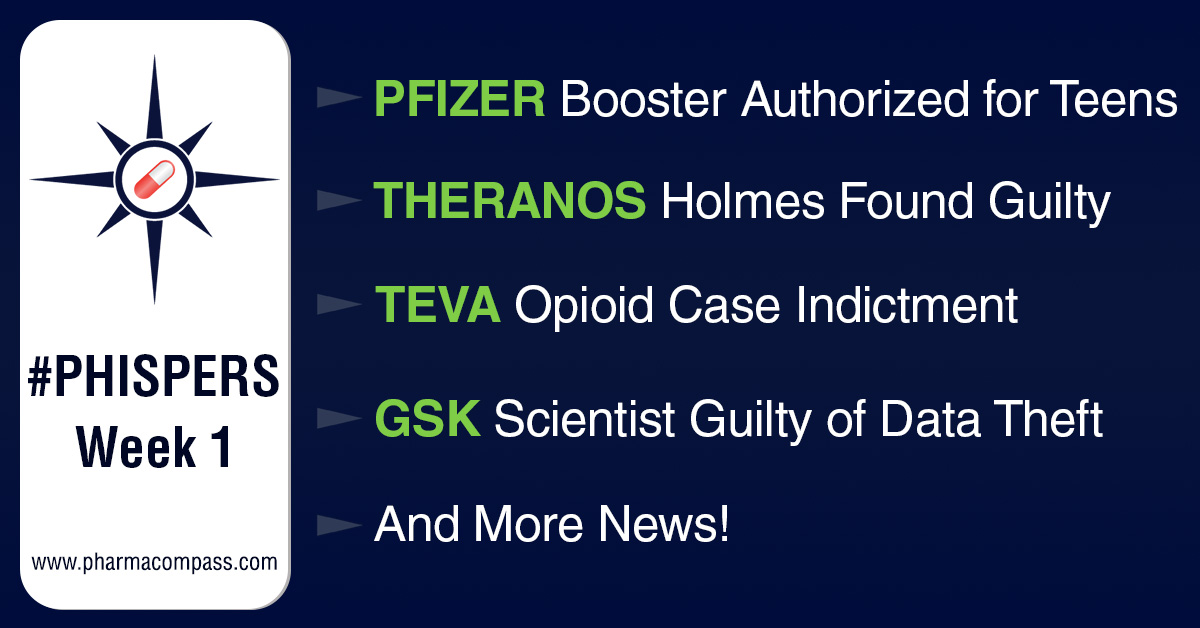
In this first Phispers of 2022, we bring you several
updates on court cases involving pharmaceutical companies such as Teva,
Theranos and GSK. There are also updates on Covid-19 drugs and vaccines,
along with some regulatory news.
A New York jury has found generic drugmaker Teva guilty of
fueling the opioid crisis in the state, including pushing drugs for off-label
use. Unlike AbbVie and Johnson & Johnson, Teva had not entered into an
out-of-court settlement with the state over the opioid lawsuit.
In another court case, Theranos founder Elizabeth Holmes
was found guilty of defrauding investors and raising money for her
blood-testing startup. And, in the ongoing trade-secrets case involving GSK, a
third former scientist working at the British drugmaker has pleaded guilty. The
scientists were stealing trade secrets from GSK to benefit Renopharma, a
company in China.
With the US witnessing a surge in Covid-19 cases due to the
fast-spreading Omicron variant, the FDA authorized Pfizer’s booster shot for children between the ages of 12 and 15
years while reducing the time interval for the third dose to five months from
the existing six months. On Wednesday, the CDC signed off on that
recommendation.
In regulatory news, the FDA has paused all domestic,
non-mission-critical inspections due to the surge in Covid-19 cases. This pause
is likely to increase the agency’s
existing backlog of inspections worldwide. And, the International Council for
Harmonization (ICH) has revised the Q9 guideline with the aim to provide more
scientific and robust applications of quality risk management principles (QRM),
leading to “fewer quality defects and recalls” and reduced costs for the pharmaceutical industry.
Teva indicted for fueling opioid addiction in New York
The year 2021 could not have ended on a sorer note for
Israeli generic drugmaker Teva. Last year, when AbbVie and Johnson & Johnson inked out-of-court settlements with the New York State to resolve their
portion of the state's opioid lawsuit, Teva chose to wait for the trial to close.
Last week, a New York jury ruled that the drugmaker and its
affiliates contributed to the opioid addiction in the state. The court will now hold
another trial to determine how much the drugmaker should pay as compensation.
The ruling could hurt Teva hard. In December 2017, Teva had
embarked on an ambitious restructuring plan to improve its business
performance. Though the company had reduced its net debt by around US$ 10
billion (to US$ 23.8 billion) by 2020, it continues to be in the red.
The verdict followed a six-month trial
in a case brought by the New York state and two of its counties in 2019,
accusing Teva of engaging in misleading marketing practices that fueled the
opioid addiction, including pushing drugs for off-label use. The case focused
on Actiq and Fentora, two cancer pain drugs made by Cephalon, a company acquired by Teva in 2011, along with other
generic opioids sold by Teva.
In June, Johnson & Johnson had reached a deal worth up to US$ 230 million to resolve the charges. AbbVie’s Allergan had inked a
US$ 200 million settlement last month, leaving Teva as the lone manufacturer
defendant in the case. Teva’s compensation will be on top of the US$ 1.5 billion that
the New York Attorney General Letitia James has already negotiated with
other defendants.
Teva, which is facing thousands
of other opioid-related lawsuits around the US, said it will appeal against the
outcome.
Blood-testing startup founder Elizabeth Holmes convicted
for defrauding investors
A US jury has found Theranos founder Elizabeth Holmes
guilty of defrauding investors, convicting her on four counts, each carrying
a fine of up to US$ 250,000 plus restitution and a maximum sentence of 20 years
in prison.
All the four convictions were for misleading Theranos’ investors, who poured millions of dollars into the blood-testing startup based on Holmes’ promise of revolutionizing the healthcare industry with a machine that could detect conditions such as cancer and diabetes with only a few drops of blood.
Holmes founded Theranos as a teenager in 2003, when she was
a student at Stanford. She raised over US$ 900 million from investors, such as
media magnate Rupert Murdoch and tech mogul Larry Ellison. This helped Theranos
reach a valuation of US$ 9 billion. However, a Wall Street
Journal investigation in 2015 found that the blood-testing technology did not work, and the company was using third-party technology to run
most of its tests. Theranos closed down in 2018.
Testifying in her own defense, Holmes acknowledged mistakes in Theranos’ operation, but maintained that she never meant to deceive anyone, adding that Theranos’ lab directors were in charge of test quality. Holmes’ sentencing date will reportedly be scheduled next week when the court reconvenes to address the deadlocked charges. She is likely to appeal
the guilty verdicts.
Third former GSK scientist pleads guilty of stealing
company trade secrets
Back in 2016, the US had filed an indictment against some
scientists working at GlaxoSmithKline (GSK), alleging that they had stolen the British drug behemoth’s trade secrets to benefit a company in China. The conspiracy had come to light post an FBI probe.
In 2018, two former GSK scientists, Yu Xue and Tao Li, had admitted guilt along with Xue’s twin sister, Tian Xue. And this week, a third former GSK scientist — Lucy Xi — who was caught in a conspiracy to steal secret from the company to benefit Renopharma (a company in China), has pleaded guilty to the conspiracy.
Xi’s former husband Yan Mei had established Renopharma in 2012 along with Yu Xue and Tao Li, supposedly to research and develop anti-cancer drugs. In reality, the company was used as a repository of information stolen from GSK. Renopharma had received financial support and subsidies from the government of China.
Xi used to work on developing antibody drugs at GSK’s facility in Upper Merion, Pennsylvania, between July 2008 and November 2015. In January 2015, she had sent a document to Mei containing confidential information and a summary of GSK’s research into monoclonal antibodies for his work at Renopharma.
Covid-19 update: Pfizer’s booster to be administered to 12- to 15-year-olds in US
As the Omicron variant of the coronavirus pushed Covid-19
cases in the US to record highs, the US Food and Drug Administration (FDA) authorized the use of a third dose of the Pfizer- BioNTech vaccine in children between 12 and 15 years of age. It
also reduced the interval between the second dose and the booster dose from six
to five months.
On Wednesday, the US Centers for Disease Control and
Prevention (CDC) expanded the eligibility
of Pfizer-BioNTech’s booster doses to 12-15 year old children, so that the shots can be administered.
The agency also authorized a third shot for immunocompromised
children between five and 11 years of age, but decided to keep
the interval between the second dose of Moderna’s vaccine and a booster dose unchanged at six months.
“Based on the FDA’s assessment of currently available data, a booster dose of the currently authorized vaccines may help provide better protection against both the Delta and Omicron variants,” said Peter Marks, director of the FDA’s Center for
Biologics Evaluation and Research.
Britain approves Paxlovid: The UK, which is also witnessing a massive surge in
Omicron cases, has approved Pfizer’s anti-viral drug Paxlovid for high-risk adults with mild to moderate infection. According to the UK’s Medicines and Healthcare products Regulatory Agency (MHRA), Paxlovid is most effective when taken during the early stages of Covid-19. MHRA is also working with Pfizer to track Paxlovid’s effectiveness against Omicron.
Meanwhile, the US doubled its order
for Paxlovid from 10 million courses to 20 million, while asking the drugmaker
to speed up the delivery of those treatments. The first batch of 10 million
courses are set for delivery by June end, while the remaining 10 million
courses are pegged for delivery by September, Pfizer said.
Study finds J&J booster shot 84
percent effective against Omicron:
Researchers have found a booster dose of Johnson & Johnson’s Covid-19 vaccine
to be 84 percent effective at preventing hospitalization among South African
healthcare workers infected with the Omicron variant. The real-world study,
which is yet to be peer-reviewed, was based on a second dose of the vaccine
administered to around 69,000 workers in November and December.
Novavax to file
for FDA’s EUA this month: Novavax has said it will submit
a request to the FDA to authorize its Covid-19 vaccine this month. Earlier, it
had planned to submit the request by 2021-end. The announcement came after the
company submitted its final data regarding the vaccine’s manufacturing processes to the US drug regulator — a prerequisite for an emergency use authorization (EUA) application. Earlier, Novavax had to delay its US submission multiple times due to development and manufacturing setbacks.
FDA pauses domestic, non-mission critical inspections again
due to spread of Omicron
The US Food and Drug Administration (FDA) has paused all domestic, non-mission-critical inspections. The pause is likely to increase the agency’s existing backlog of inspections worldwide.
This pause in inspections has reportedly been brought into force to
ensure the safety of FDA employees and the companies it regulates, in light of the rise in Covid-19 cases due to the highly
contagious Omicron variant. The US has been reporting an average of over half a
million cases a day for the last one week.
“Through January 19, the agency intends to continue mission-critical work but has temporarily postponed certain inspectional activities with the hopes of restarting these activities as soon as possible,” the FDA said in a statement.
The agency had returned to relatively normal domestic
inspections in July 2021, after inspections had been paused due to the pandemic
in early 2020. In November, the agency had said 52 new drug applications were
delayed as a result of the inspection backlog created by that long pause.
Foreign inspections have been even slower. Between April
and September 2021, the FDA said it completed just 37 foreign drug inspections,
compared to over 1,200 in 2019. The agency said it will continue conducting
mission-critical foreign and domestic inspections.
ICH releases revised Q9 guideline to improve risk
assessments
The International Council for Harmonization (ICH) has
revised the Q9 guideline
with the aim to provide more scientific and robust applications of quality risk
management principles (QRM), leading to “fewer quality defects and recalls” and reduced costs for the pharmaceutical industry. The body brings together regulatory authorities and the pharmaceutical industry to discuss scientific and technical aspects of drugs and develop ICH guidelines.
The guideline was published on the European Medicines Agency (EMA) website last month
and will replace the current 16-year-old guideline.
The revision plans to address four shortcomings of the original ICH Q9 guideline — high levels of subjectivity in risk assessments and in QRM outputs, failure to adequately manage supply chain and product availability risks, lack of understanding as to what constitutes formality in QRM work and lack of clarity on risk-based decision making.
EMA will accept comments until March 15, 2022, and the
agency plans to adopt the ICH harmonized guideline sometime in June.













 Share
Share