Please Wait
Applying Filters...
Menu
Xls

Digital Content read-more

Create Content with PharmaCompass, ask us

DATA COMPILATION #PharmaFlow

read-more
read-more
FDA approvals drop 24% in H1 2025; GSK’s UTI med, Vertex’s non-opioid painkiller lead pack of first-in-class meds
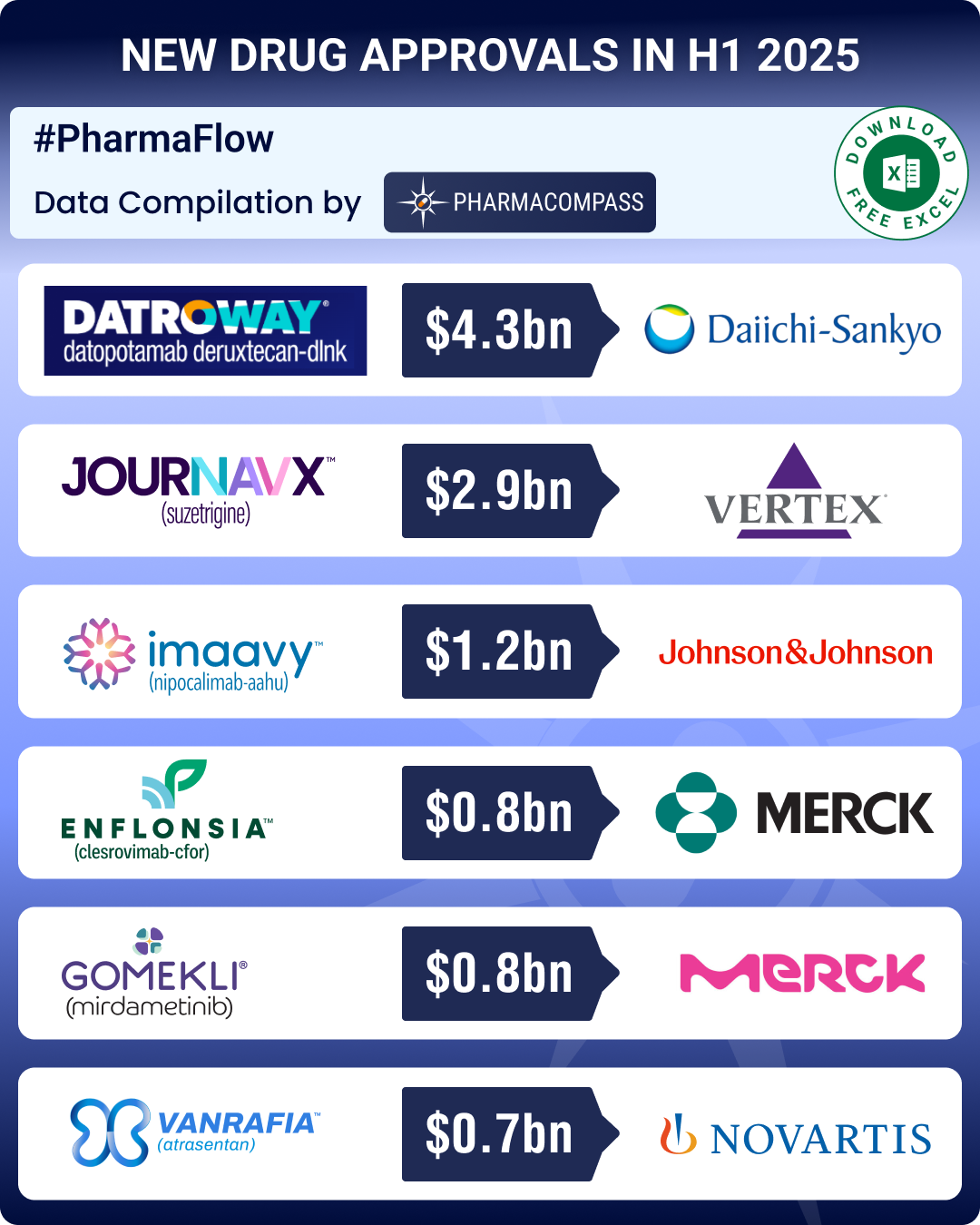
It has been a turbulent year for the US Food and Drug Administration (FDA), marked by reductions in both staff and budget, shake-ups at the top and a reduction in inspections. This upheaval has clearly impacted the functioning of the agency, with reports of missed deadlines and reduced responsiveness. This disruption resulted in a slowdown in new drug approvals in the first half of 2025 (H1 2025), as opposed to the same period last year. Incidentally, drug approvals in H1 2024 were also down by 19 percent compared to H1 2023. FDA’s Center for Drug Evaluation and Research (CDER) approved 16 novel drugs in H1 2025, down from 21 in H1 2024, a decline of nearly 24 percent. Of these, nine were small molecules and seven were biologics. The period saw eight first-in-class therapies get CDER’s approval, as opposed to 17 in H1 2024. FDA’s Center for Biologics Evaluation and Research (CBER) approved seven biologics in H1 2025, compared to eight in the same period last year. In comparison, both Health Canada and the European Medicines Agency (EMA) reported a strong rebound in approvals and authorizations, respectively. Health Canada approved 20 drugs in H1 2025, as opposed to 10 in H1 2024. Similarly, EMA authorized 19 new therapies in H1 2025, compared to 15 in H1 2024. Notably, EMA’s pending decisions increased to 25 in H1 2025, from 14 in the same period last year, while conditional authorizations remained static at five. This underscores EMA’s active regulatory pipeline, suggesting that more drugs could be approved in Europe soon.   View New Drug Approvals in H1 2025 with Estimated Sales (Free Excel Available) Vertex’s non-opioid painkiller, GSK’s antibiotic for UTI, Merck’s RSV antibody bag FDA nods Oncology remained the single largest category in H1 2025 with seven new drugs being approved by the FDA, followed by four rare diseases and disorders and as many infections and infective diseases.  The eight drugs that were designated first-in-class in H1 2025 are: Journavx (Suzetrigine), Imaavy (nipocalimab), Emrelis (telisotuzumab vedotin), Blujepa (gepotidacin mesylate), Qfitlia (fitusiran), Avmapki Fakzynja Co-Pack (avutometinib potassium/defactinib hydrochloride), Tryptyr (acoltremon), and Andembry (garadacimab). In January, a new class of non-opioid pain therapy made a debut — FDA approved Vertex Pharmaceuticals’ Journavx (suzetrigine). This first-in-class oral analgesic could bring in US$ 2.9 billion in sales for Vertex by 2030. The half year also saw a new oral antibiotic — GSK’s Blujepa (gepotidacin) — for treating uncomplicated urinary tract infections (uUTIs) bag FDA approval. This is the first new antibiotic for uUTIs in nearly three decades. It treats infections caused by resistant pathogens such as E. coli and K. pneumoniae. In June, Merck’s Enflonsia (clesrovimab), a long-acting monoclonal antibody, won FDA approval to prevent respiratory syncytial virus (RSV) lower respiratory tract disease in neonates and infants entering their first RSV season. A single 105 mg dose provides protection for about five months, the length of a typical RSV season. Enflonsia could bring in US$844 million in annual sales by 2030.   View New Drug Approvals in H1 2025 with Estimated Sales (Free Excel Available)  FDA approves four meds for rare diseases, including SpringWorks’ Gomekli, Novartis’ Vanrafia In H1 2024, rare genetic diseases had witnessed some significant approvals. The trend continued in H1 2025. In February, Gomekli (mirdametinib), developed by SpringWorks Therapeutics, became the first approved therapy for neurofibromatosis type 1 (a genetic disorder that causes tumors to grow on nerve tissues) in adult and pediatric patients who have symptomatic plexiform neurofibromas (benign, complex nerve tumors) not amenable to complete resection. Analysts expect peak sales of around US$ 0.8 billion by 2030. Post this approval, SpringWorks got acquired by Merck KGaA for approximately US$ 3.9 billion. The same month, Ono Pharma-owned Deciphera’s Romvimza (vimseltinib) became the first oral therapy approved for another rare disease known as symptomatic tenosynovial giant cell tumor. This is a benign but aggressive growth that can be painful. This new drug offers patients an option beyond surgery. In March, Sanofi’s Qfitlia (fitusiran) was approved for routine prophylaxis in hemophilia A or B, with or without inhibitors. And in April, Novartis’ Vanrafia (atrasentan) was granted accelerated approval for IgA nephropathy (a chronic autoimmune kidney disease), which is at the risk of rapid progression. Vanrafia could bring in sales of over US$ 735 million by 2030. Johnson & Johnson secured approval for Imaavy (nipocalimab-aahu) for generalized myasthenia gravis (a chronic autoimmune disease that causes muscle weakness) in adults and adolescents. Imaavy’s sales could cross US$1.17 billion by 2030. Rare diseases continue to attract regulatory attention, with the trend carrying into the current quarter. July witnessed two noteworthy rare-disease approvals — Ekterly (garadacimab), CSL’s once-monthly prophylactic treatment for hereditary angioedema (a genetic disorder that causes recurrent episodes of swellings), and Sephience (pegvaliase-abcx), BioMarin’s new therapy for phenylketonuria (a rare metabolic disorder).   View New Drug Approvals in H1 2025 with Estimated Sales (Free Excel Available)  FDA greenlights new oncology therapies, including Astra’s Datroway, AbbVie’s Emrelis The field of oncology saw some notable new drug approvals. In January, Datroway (datopotamab deruxtecan), an antibody-drug conjugate (ADC) developed by AstraZeneca and Daiichi Sankyo, was granted approval for adults with unresectable or metastatic, hormone receptor-positive, HER2-negative breast cancer. Later, in June, the FDA granted accelerated approval  to AstraZeneca;s Datroway for adults with locally advanced or metastatic, EGFR-mutated non-small cell lung cancer. The drug’s peak annual sales are projected at about US$ 4.2 billion by 2030. In May, Emrelis (telisotuzumab vedotin-tllv), AbbVie’s ADC was granted FDA’s accelerated approval. Emrelis treats locally advanced or metastatic non-squamous non-small cell lung cancer (NSCLC) characterized by significantly increased levels of the c-Met protein in cancer cells. FDA also approved a companion diagnostic test — Roche's Ventana — in May to determine the c-Met protein biomarker status in order to identify patients eligible for Emrelis.  The same month, FDA also granted accelerated approval to Verastem’s Avmapki Fakzynja Co-pack, a dual oral therapy for adults with KRAS‑mutated recurrent low‑grade serous ovarian cancer (LGSOC). This novel regimen combines two inhibitors — avutometinib and defactinib — to disrupt critical signaling pathways that fuel tumor growth. In ophthalmology, Alcon re-entered the prescription pharmaceutical market with Tryptry (acoltremon), a first-in-class TRPM8 agonist for dry eye disease, which stimulates corneal nerves to increase tear production.   View New Drug Approvals in H1 2025 with Estimated Sales (Free Excel Available)  Our view The changes in the FDA are clearly having a far-reaching impact on the global pharmaceutical industry. There have been reports of drugmakers losing confidence in the FDA, which has been a gold standard for drug regulation. Some American biotechs are shifting early trials outside of the US. With EMA and Health Canada authorizing/approving a larger number of drugs in H1 2025, we do see some changes underway that may eventually reshape drug development.  

Impressions: 6408

https://www.pharmacompass.com/radio-compass-blog/fda-approvals-drop-24-in-h1-2025-gsk-s-uti-med-vertex-s-non-opioid-painkiller-lead-pack-of-first-in-class-meds

#PharmaFlow by PHARMACOMPASS
28 Aug 2025

STOCK RECAP #PipelineProspector

read-more
read-more
Pipeline Prospector Oct 2024: Lundbeck acquires Longboard for US$ 2.6 bn; molecular glue degrader tech witnesses dealmaking
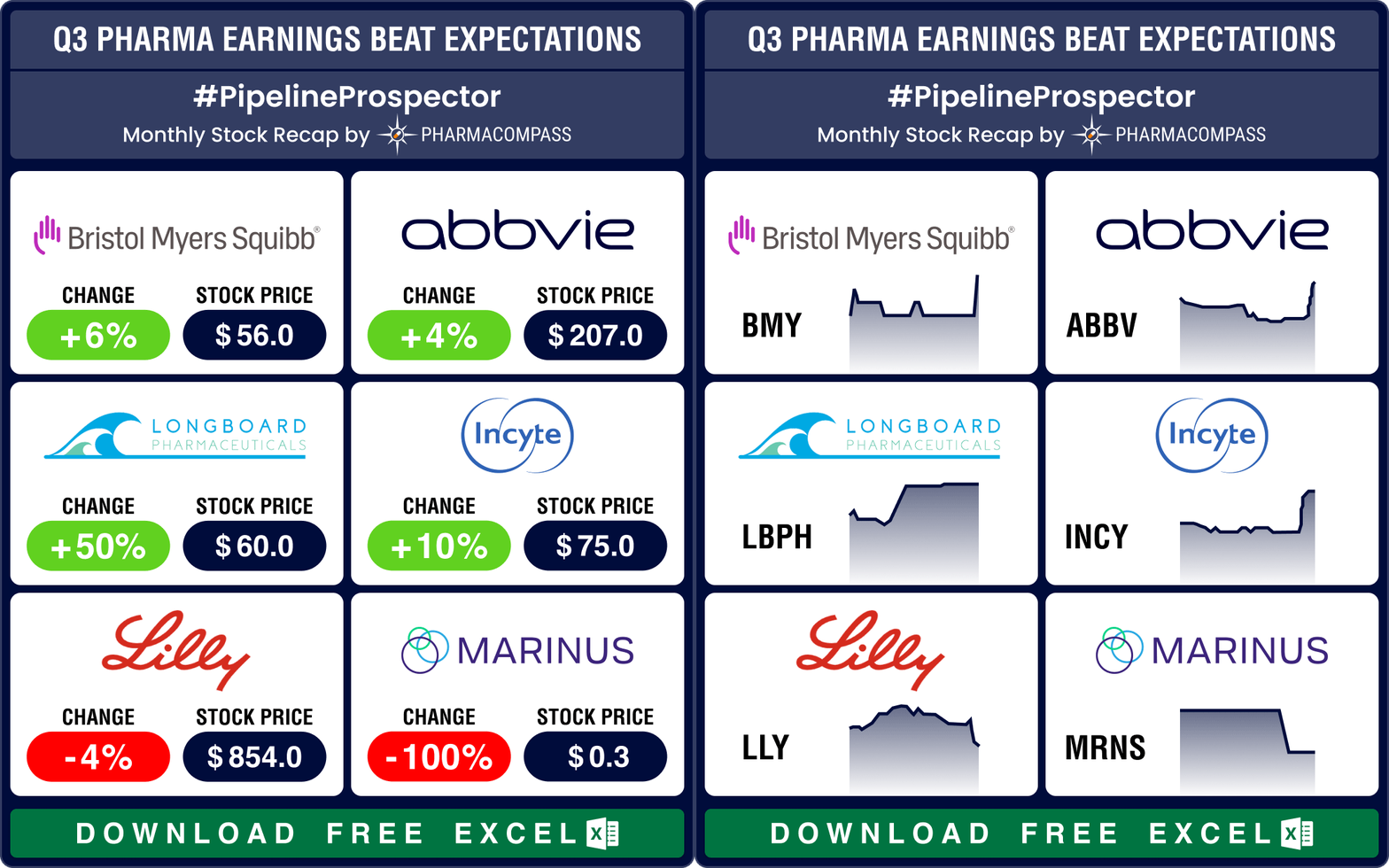
In October, several pharma companies posted their third quarter (Q3) results. Drugmakers like Pfizer, BMS, Roche, Novartis, Sanofi, Merck and Incyte reported higher-than-expected Q3 earnings, beating analyst expectations. Despite these healthy results, pharma indices continued on their downward journey that had begun in September. The Nasdaq Biotechnology Index (NBI) dropped 2.6 percent from 4,771.85 to 4,650.07. The SPDR S&P Biotech ETF (XBI) fell 1.6 percent from 98.61 to 97.03, and the S&P Biotechnology Select Industry Index (SPSIBI) decreased 1.9 percent from 7,707.4 to 7,561.29.  Access the Pipeline Prospector Dashboard for October 2024 Newsmakers (Free Excel) Lundbeck buys Longboard, AbbVie picks up Aliada, Merck acquires Modifi in US$ 1 bn+ deals In mergers and acquisitions, Denmark’s Lundbeck agreed to buy California-based Longboard Pharmaceuticals for US$ 2.6 billion. The acquisition centers around bexicaserin, a promising phase 3 candidate for rare epilepsies including Dravet syndrome and Lennox-Gastaut syndrome, with Lundbeck projecting potential peak sales of US$ 1.5 billion to US$ 2 billion for this asset.  AbbVie acquired Boston-based Aliada Therapeutics for US$ 1.4 billion after reportedly outbidding at least three other drugmakers. The acquisition brings innovative blood-brain barrier technology to AbbVie’s portfolio, along with ALIA-1758, a phase 1 compound showing potential as a best-in-class therapy for Alzheimer’s disease. AbbVie also partnered with EvolveImmune Therapeutics in a potential US$ 1.4 billion deal (plus US$ 65 million upfront) to develop next-generation cancer biotherapeutics. The collaboration will leverage EvolveImmune’s innovative T-cell engager platform to create multispecific biologics targeting various oncology indications. Merck bolstered its oncology pipeline through the acquisition of Modifi Biosciences in a deal valued up to US$ 1.3 billion. The acquisition targets novel DNA modification therapeutics for challenging brain tumors, particularly glioblastomas. Merck  also entered into a potential US$ 1.9 billion deal with Mestag Therapeutics to explore fibroblast therapies for inflammatory diseases, leveraging Mestag’s innovative platform.  Access the Pipeline Prospector Dashboard for October 2024 Newsmakers (Free Excel) Pfizer, Novartis, Biogen sign molecular glue degrader deals; Astra in US$ 2 bn pact with CSPC There were at least three deals signed in October in the molecular glue degrader technology space. These degraders represent a novel therapeutic approach by facilitating the degradation of disease-causing proteins that are otherwise difficult to target with conventional drugs. First, Pfizer partnered Triana Biomedicines in a deal potentially exceeding US$ 1.5 billion, focusing on cancer applications. Second, Novartis committed US$ 150 million upfront to Monte Rosa Therapeutics in a deal worth up to US$ 2.25 billion. And Biogen tied up with Neomorph, pledging up to US$ 1.45 billion for neurological and immunological applications. Among other deals, AstraZeneca entered into a US$ 2 billion licensing agreement with CSPC Pharmaceutical Group for a novel lipid-lowering therapy, while Recordati acquired global rights to Sanofi’s Enjaymo for US$ 825 million upfront, with additional milestone payments of up to US$ 250 million. The Recordati-Sanofi deal focuses on cold agglutinin disease (CAD), a rare autoimmune disorder, and includes rights to sutimlimab, the first and only targeted therapy for CAD patients. Roche demonstrated its commitment to gene therapy advancement by expanding its collaboration with Dyno Therapeutics, committing over US$ 1 billion for adeno-associated virus (AAV) vector development, with an upfront payment of US$ 50 million. This expanded partnership builds on their initial 2020 collaboration and aims to accelerate the development of innovative gene therapies for neurological diseases.  Access the Pipeline Prospector Dashboard for October 2024 Newsmakers (Free Excel) AbbVie wins FDA nod for subcutaneous Parkinson’s drug; Roche med okayed for breast cancer October marked significant advances in the treatment of several major diseases. FDA approved AbbVie’s Vyalev for advanced Parkinson’s disease. This innovative therapy, utilizing foscarbidopa and foslevodopa prodrugs, delivers round-the-clock symptom control through subcutaneous infusion. The treatment represents a major advancement in managing motor fluctuations in late-stage patients, with market analysts projecting peak sales exceeding US$ 2 billion. In the oncology space, a historic milestone was reached with FDA’s approval of Vyloy, the world’s first therapy targeting CLDN18.2 proteins in gastric cancer. Developed by Astellas, the drug was approved for use in combination with chemotherapy for treating advanced gastric or gastroesophageal junction adenocarcinoma in adults with HER2-negative, CLDN18.2-positive tumors. This approval validates Astellas’ strategic US$ 1.4 billion acquisition of Ganymed Pharmaceuticals in 2016. Roche strengthened its position in breast cancer treatment with the approval of Itovebi, an oral PI3K inhibitor for first-line treatment of advanced hormone receptor-positive, HER2-negative breast cancer with PIK3CA mutation. This approval positions Itovebi as a strong competitor to existing treatments like Novartis' Piqray and AstraZeneca's Truqap, with Roche projecting annual peak sales of US$ 2.3 billion. Novartis expanded the reach of its leukemia treatment Scemblix through an accelerated approval for newly diagnosed Philadelphia chromosome-positive chronic myeloid leukemia in chronic phase. This expansion significantly increases the eligible patient population by approximately four times, building on its existing approval as a third-line treatment. Pfizer expanded its presence in the respiratory syncytial virus (RSV) market as FDA broadened the approval of Abrysvo to include at risk adults aged 18 to 50 years, making it the first and only RSV vaccine authorized for this population. In hematology, Pfizer secured approval for Hympavzi marking its second hemophilia approval in six months. This approval follows the earlier authorization of Pfizer’s one-time gene therapy Beqvez for hemophilia B in April. Iterum Therapeutics received FDA approval for its new oral antibiotic, Orlynvah, designed to treat uncomplicated urinary tract infections (uUTIs) in adult women who have limited or no alternative oral antibacterial treatment options. This marks the first US approval for an oral penem antibiotic.  Access the Pipeline Prospector Dashboard for October 2024 Newsmakers (Free Excel)  Gilead withdraws Trodelvy, J&J discontinues late-stage study of its bladder cancer candidate In a notable development for bladder cancer treatment, Gilead Sciences announced the withdrawal of Trodelvy from the US market after the targeted therapy, which received accelerated FDA approval in 2021 for metastatic urothelial cancer, failed to demonstrate survival benefits in a crucial confirmatory study.  Johnson & Johnson decided to discontinue the late-stage study of TAR-200, their investigational bladder cancer therapy, after interim analysis showed no superior benefits compared to standard chemo-radiation therapy. In neurology, Marinus Pharmaceuticals faced disappointment when their phase 3 trial of oral ganaxolone (Ztalmy) failed to meet its primary endpoint in reducing seizures associated with tuberous sclerosis complex (a genetic disorder). Marinus’ stock fell nearly 100 percent in October.  Access the Pipeline Prospector Dashboard for October 2024 Newsmakers (Free Excel)  Our view The last quarter was a good one for several drugmakers. Pfizer saw a surge in sales of its Covid drug Paxlovid to US$ 2.7 billion, encouraging it to up its guidance for Covid-related sales from US$ 8.5 billion to US$ 10.5 billion. For BMS, blockbusters like blood thinner Eliquis and cancer treatment Revlimid continued to bring in revenue. Merck’s growth was driven by the world’s top-selling drug, Keytruda, which saw revenue jump 17 percent compared to Q3 2023, beating analysts’ estimates. In a nutshell, the robust Q3 earnings of major pharma companies signals strong industry fundamentals, the volatility in pharma indices notwithstanding.  Access the Pipeline Prospector Dashboard for October 2024 Newsmakers (Free Excel)

Impressions: 3906

https://www.pharmacompass.com/pipeline-prospector-blog/pipeline-prospector-oct-2024-lundbeck-acquires-longboard-for-us-2-6-bn-molecular-glue-degrader-tech-witnesses-dealmaking

#PharmaFlow by PHARMACOMPASS
07 Nov 2024

NEWS #PharmaBuzz

read-more
read-more

https://www.globenewswire.com/news-release/2025/07/23/3119972/0/en/European-Commission-approves-Roche-s-Itovebi-for-people-with-ER-positive-HER2-negative-advanced-breast-cancer-with-a-PIK3CA-mutation.html

GLOBENEWSWIRE
23 Jul 2025

https://www.businesswire.com/news/home/20250531316801/en/New-Data-Show-Genentechs-Itovebi-Significantly-Extended-Survival-in-a-Certain-Type-of-HR-positive-Advanced-Breast-Cancer

BUSINESSWIRE
31 May 2025

https://www.globenewswire.com/news-release/2025/05/23/3087480/0/en/CHMP-recommends-EU-approval-of-Roche-s-Itovebi-for-PIK3CA-mutated-ER-positive-HER2-negative-advanced-breast-cancer.html

GLOBENEWSWIRE
23 May 2025

https://www.fiercepharma.com/pharma/asco-roches-itovebi-cuts-risk-death-33-certain-breast-cancer-patients-further-backing

FIERCE PHARMA
22 May 2025

https://www.businesswire.com/news/home/20250127792428/en

BUSINESSWIRE
27 Jan 2025

https://www.globenewswire.com/news-release/2024/11/11/2978601/0/en/Onco360-Has-Been-Selected-as-a-National-Specialty-Pharmacy-Partner-for-Itovebi-inavolisib.html

GLOBENEWSWIRE
11 Nov 2024