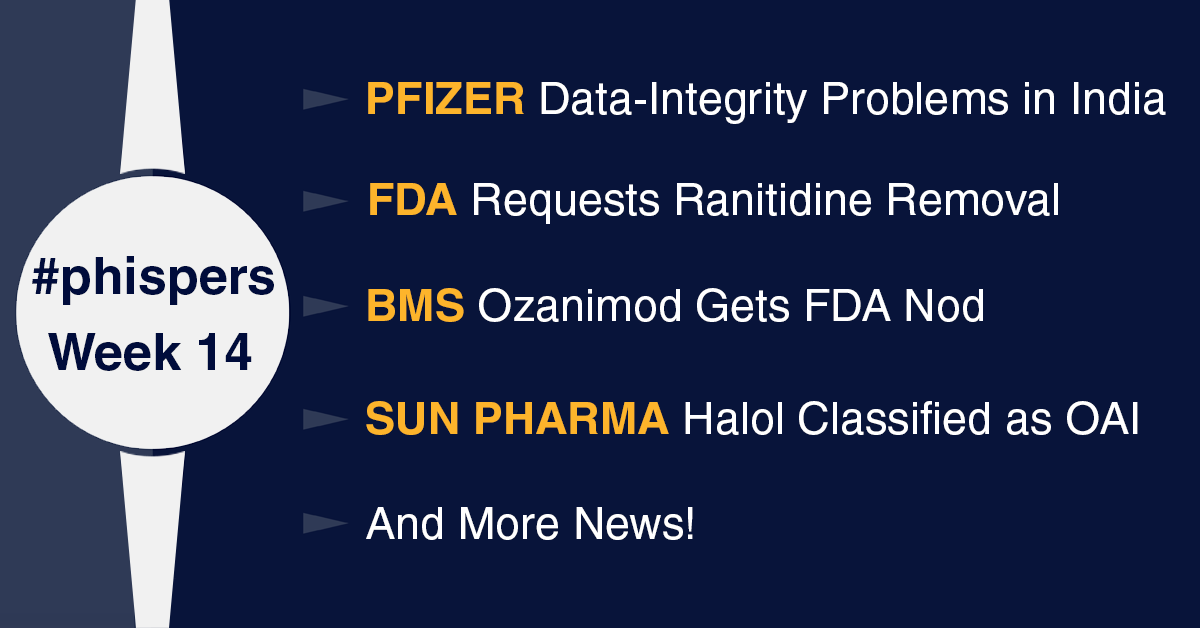
This week, N-nitrosodimethylamine (NDMA) is back in news as the FDA requests manufacturers to withdraw ranitidine from the market immediately due to the presence of the cancer-causing impurity.
Bristol Myers bagged FDA approval for its multiple sclerosis treatment Zeposia. However, its launch would be delayed due to the ongoing Covid-19 pandemic.
In an unusual turn of events, Chinese officials have suspended the import of Bristol Myers’ cancer drug Abraxane, post inspection of the company’s facility in the US.
Meanwhile, the FDA found data integrity concerns at Pfizer’s site in Visakhapatnam (India) and issued it a warning letter.
The merger of Mylan with Upjohn (Pfizer’s off-patent branded and generic business) has been postponed until the second half of 2020 due to Covid-19.
And Indian drugmaker Sun Pharma’s plant in Halol (Gujarat) got classified as OAI by the FDA.
FDA highlights data-integrity concerns at Pfizer’s India unit; Mylan-Upjohn merger delayed
Last year, when the mega-merger of Mylan with Upjohn (Pfizer’s off-patent branded and generic established medicines
business) was announced, PharmaCompass had highlighted how compliance would play a key role in determining the
merger’s success.
This week, Pfizer’s sterile manufacturing operations in India received a warning letter from the US Food and
Drug Administration (FDA). The site, located in Visakhapatnam
(Andhra Pradesh, India),
was inspected from August 29 to September 6, 2019.
The warning letter highlights that Pfizer’s
operations failed to conduct adequate investigations, including timely
implementation of effective corrective action and preventive action (CAPA)
plans. There was a failure to adequately investigate serious deficiencies in
microbiology laboratory conditions and practices as microbial results were
invalidated without adequate scientific justification. Laboratory data accuracy
deficiencies were also cited by the FDA in a previous September 2018
inspection.
As a result, the FDA recommended data-integrity
remediation plans as it believed the site’s quality system did not adequately ensure the accuracy and
integrity of data to support the safety, effectiveness and quality of the drugs
that were being manufactured.
The
Visakhapatnam operation was acquired by Pfizer in February 2015, as part of its
US$ 17 billion acquisition of Hospira. When the deal was
struck, Pfizer was aware of Hospira’s manufacturing record as the company was issued FDA warning letters in four out of seven continents (Europe, North America, Asia and Australia).
The executives of Pfizer had assured investors and
regulators that they would quickly resolve issues at the plants.
In January 2019, Pfizer went on to
announce that two manufacturing sites in India, which were part of the Hospira
acquisition, will cease manufacturing operations. At the
time of the announcement, the sites located near Chennai (Irungattukottai) and
Aurangabad employed 1,700 people.
The FDA warning letter for the operations at the Irungattukottai site stated that the
agency had found the site’s
microbiology laboratory was inaccurately reporting test results.
Pfizer-Mylan merger delayed: The merger of Pfizer’s Upjohn unit and Mylan has been postponed until the
second half of 2020.
With
the ongoing novel coronavirus pandemic, US regulators have warned that major
corporate transaction reviews could be held up.
In a statement, Mylan said the merger has been delayed due to “unprecedented circumstances surrounding the Covid-19 pandemic, including associated delays in the regulatory review process.”
“The two companies remain highly confident in the benefits of the pending transaction to their respective shareholders and other stakeholders,” the statement added.
The
Upjohn-Mylan deal delay is the first instance of pharma pushing merger
deadlines in response to the ongoing novel coronavirus pandemic.
End of ranitidine? FDA requests removal of all product from
market
Cancer-causing
impurity N-nitrosodimethylamine (NDMA) is back in the news. In a
statement issued this week, the US Food and Drug Administration (FDA) said it had
found levels of the cancer-causing impurity NDMA in ranitidine increase over
time. And when stored at higher room temperatures, it may result in consumer
exposure to unacceptable levels of this impurity.
As a
result of this finding, the FDA has requested manufacturers to withdraw all
prescription and over-the-counter (OTC) ranitidine drugs from the market
immediately.
Ranitidine
is a widely used heartburn medication and is commonly known by the brand name
Zantac. The drug is currently sold by French drugmaker Sanofi in the US and Canada after it acquired
the drug from Boehringer in 2016.
The
trigger for the NDMA concerns in ranitidine was a citizen petition filed on behalf of an online pharmacy — Valisure — on September 9, 2019. The petition stated that while the FDA had established a permissible daily intake limit for the probable human carcinogen — NDMA — of 96 nanograms (ng), Valisure had detected NDMA in excess of 3,000,000 ng per tablet when it analyzed ranitidine products, likely due to an inherent instability of the ranitidine molecule. The molecule contains both a nitrite and a dimethylamine (“DMA”) group, which is known to combine to
form NDMA.
Post
the Valisure finding, many leading brand and generic manufacturers recalled
their ranitidine drug products globally.
The FDA
tested numerous ranitidine tablets on the market over the past few months and
released a summary of the results on November 1, 2019. The agency had indicated
that if the NDMA levels were found to be above acceptable limits (96 ng per day
or 0.32 ppm), they would ask companies to recall Ranitidine products
voluntarily.
There
were companies like Strides Pharma Science in India that
went on to re-launch their ranitidine tablets in
the US as they stated that the level of NDMA in their product was found to be
within acceptable limits.
Valisure’s petition also tested other commonly
used antacids for NDMA levels and detected elevated levels in another antacid
containing nizatidine (sold under the brand
name Axid).
In order to provide patients with other treatment options, the FDA stated that
to date, the FDA’s
testing has not found NDMA in famotidine (Pepcid), cimetidine (Tagamet), esomeprazole (Nexium), lansoprazole (Prevacid) or omeprazole (Prilosec).
Bristol Myers’ ozanimod bags FDA nod for MS, though Covid-19 delays its launch
Covid-19
is delaying drug launches. Last week, Bristol-Myers Squibb (BMS) said the US Food and
Drug Administration (FDA) has approved its multiple sclerosis (MS) treatment — Zeposia (ozanimod). However, the launch
of the drug would be delayed due to the coronavirus outbreak.
The drug was added to BMS’s portfolio through its US$ 74 billion acquisition of Celgene last year. Its approval was
one of the three conditions set for a potentially higher payout for Celgene
investors.
Despite
the expectant delay, the approval brings the company into a highly lucrative MS
market where rivals have recorded blockbuster sales. For instance, Novartis AG’s Gilenya brought in sales of over US$
2 billion in 2019. Novartis’ new MS treatment, Mayzent, recorded sales of US$ 17
million in the first quarter of its launch.
The FDA nod comes at a time when sales of BMS’s blockbuster cancer drug Opdivo have slowed under pressure from Merck’s
Keytruda.
“With
the FDA approval of Zeposia, appropriate patients with relapsing forms of
multiple sclerosis will have another oral treatment option with meaningful
efficacy to help address the disease’s hallmark relapses and brain lesions,” said Samit Hirawat, chief medical officer, BMS.
Analysts
have high hopes from ozanimod. Its average peak sales for 2024 have been predicted to be at US$ 1.62 billion by Cortellis, though the Covid-19 pandemic
may weigh in there as well.
Chinese regulator suspends import of Bristol Myers’ blockbuster product
from US
It’s usually the US Food and Drug Administration (FDA) or the European Medicines Agency (EMA) that cites irregularities with drug companies overseas. In a rare event, Beijing-headquartered biopharmaceutical company BeiGene said it is being forced by
Chinese officials to halt imports of the cancer drug Abraxane.
According
to BeiGene, the China National Medical Products Administration (NMPA) has ordered the
halt following an inspection of one of Bristol Myers Squibb’s (BMS) facilities in the US that is used
to manufacture the drug.
The
details of the inspection and the lapses on part of BMS are not known. However,
BeiGene said it is trying to find another supplier for the drug, which it
licensed from Celgene, as they try to resolve the issues raised by Chinese
inspectors.
Over
the recent past, we have seen the US-China relations plummet with the US President
Donald Trump putting pressure on China to make some fundamental changes in the
way they handle exports to the US.
“A recent inspection of the Chinese governmental body at a third-party manufacturing site that produces Abraxane for the China market identified opportunities for improvement. We are working closely with the Chinese health authorities and the manufacturing site to implement corrective actions and preventive measures to address their findings,” a BMS spokesperson said.
Celgene, which is now a BMS company,
entered into an exclusive license and supply agreement with BeiGene for
Abraxane and two other cancer medicines in China in 2017 as part of a broader
strategic collaboration. The drug had brought in
sales of US$ 1.2 billion for BMS in 2019.
“As the marketing agent for Abraxane in China, we are extremely disappointed by this interruption in drug supply,” John V Oyler, chairman, co-founder and CEO of BeiGene said.
Sun Pharma’s Halol facility gets classified as OAI
The
US Food and Drug Administration (FDA) has classified Indian drugmaker Sun Pharmaceutical’s Halol facility in Gujarat as Official Action Indicated (OAI). Sun Pharma is the world’s fourth largest specialty generic pharmaceutical company and India’s largest drug firm.
OAI
implies that pending product approval from the facility could be
withheld by the regulator. Earlier in December, the plant had been issued a Form 483 by the FDA with eight observations. This
has escalated into an OAI classification.
According
to Sun Pharma, the OAI classification implies that
the FDA may withhold approval of any pending product applications or
supplements filed from this facility till the outstanding observations are
resolved.
There
are 19 abbreviated new drug applications (ANDAs) and two new drug applications
(NDAs), which were filed from the Halol facility, currently awaiting approval
for the US market.
The
company continues to manufacture and distribute existing products for the US
market. Therefore, it is not likely to have any adverse impact on the current
business from the facility. As of now, US supplies from Halol contribute
approximately three to four percent of the company's consolidated revenues.
In
December, the company had said that it had been issued a Form 483 by the FDA with eight observations, post an
inspection conducted by the agency at its Halol facility from December 3 to 13,
2019.
The Form 483 had
highlighted that Sun “failed to establish and implement controls which ensure data integrity” in the use of the environmental monitoring computerized system used in its microbiology laboratory for all samples including those that are used to establish a sterile manufacturing environment.
Sun
Pharma has said it continues to cooperate with the FDA and will undertake all
necessary steps to resolve these issues and to ensure that the regulator is
completely satisfied with its remedial action.
















 Share
Share