November saw several big ticket
acquisitions across the consumer health and biopharma space, including the US$
48.7 billion acquisition of Johnson & Johnson’s consumer health unit
Kenvue by Kimberly-Clark and Pfizer’s up to US$ 10 billion
acquisition of obesity-focused biotech Metsera. Additionally, the
trend of companies announcing capacity expansions continued unabated.The month saw several key drug approvals
by the US Food and Drug Administration (FDA), including Kura Oncology-Kyowa Kirin’s Komzifti (ziftomenib) for treating adults
with relapsed or refractory acute myeloid leukemia (AML) with an NPM1 mutation.The indices rose substantially during the month. The Nasdaq Biotechnology Index (NBI) rose 8.85 percent, from 5,344.91 at the end of October to 5,818.03 by November-end. The SPDR S&P Biotech ETF (XBI) gained 10.97 percent from 110.98 to 123.16. The S&P Biotechnology Select Industry Index (SPSIBI) also advanced 9.08 percent — from 8,789.93 to 9,588.09. Access the Pipeline Prospector Dashboard for November 2025 Newsmakers (Free Excel)Pfizer clinches up to US$ 10
bn deal for Metsera; Merck to buy Cidara for US$ 9.2 bnPfizer inked an agreement
worth up to US$ 10 billion to acquire obesity-focused biotech Metsera. The deal ended a
competitive bidding process between Pfizer and Novo Nordisk. Pfizer had filed lawsuits, alleging that Metsera breached an earlier merger agreement. Metsera accepted Pfizer’s revised offer after raising concerns about potential antitrust risks associated with Novo’s competing bid. In early November, Kimberly-Clark announced
the acquisition of Johnson & Johnson’s consumer health unit — Kenvue — in a cash-and-stock deal valued at US$ 48.7 billion. The merger will
create a consumer health company with expected annual revenue of about US$ 32 billion and a portfolio of highly-valued
brands, including Tylenol (paracetamol), Neutrogena,
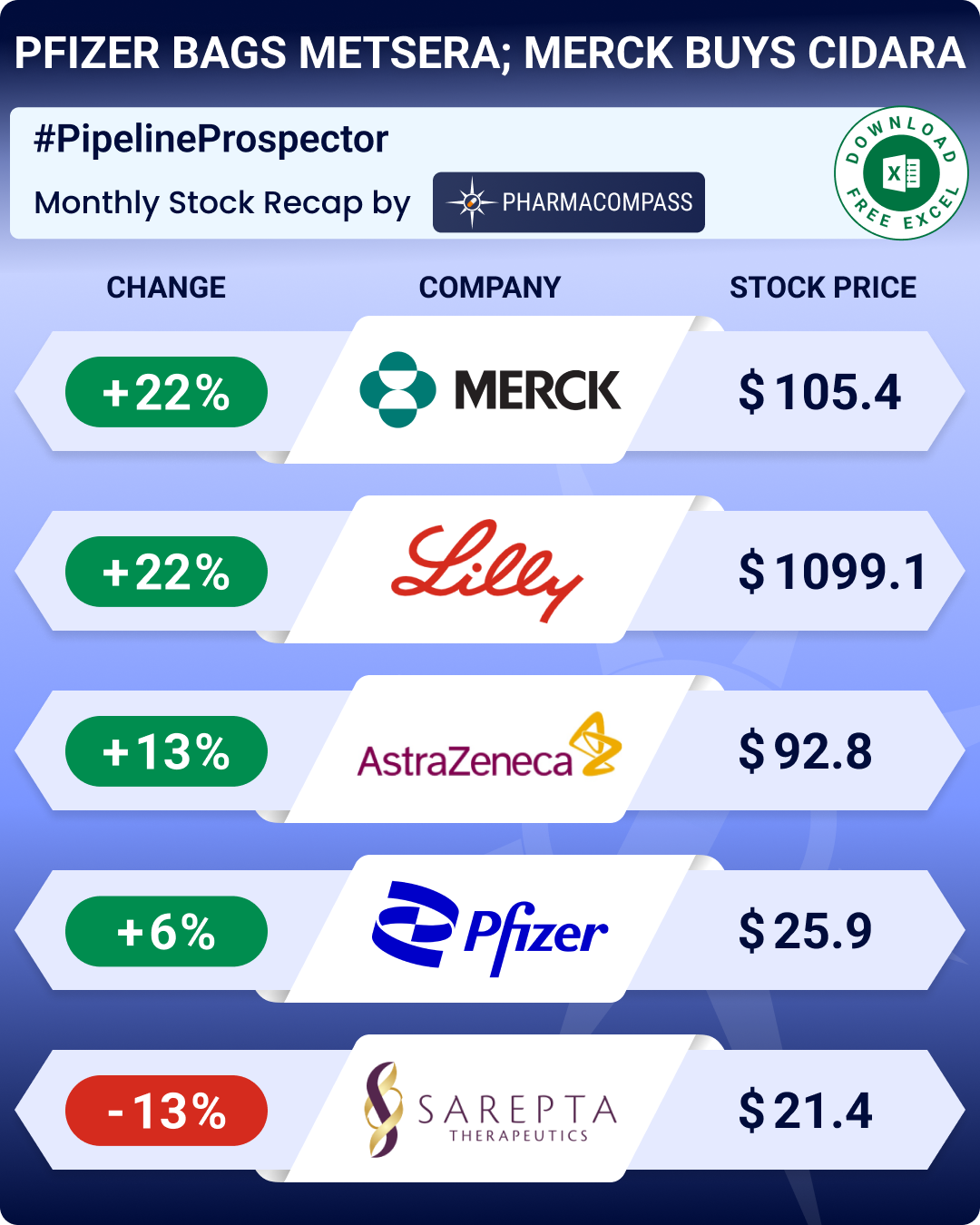
Aveeno, and Listerine.Merck announced the acquisition of Cidara Therapeutics in a deal valued at US$ 9.2 billion. The acquisition gives Merck access
to an experimental influenza antiviral designed to provide season-long
protection with a single dose. Its stock rose 22 percent in November.Johnson & Johnson is buying Halda Therapeutics for US$ 3.05 billion in cash. Halda, a Connecticut-based biotech, adds early-stage cancer programs to J&J’s pipeline, including a lead candidate in prostate cancer.Like Pfizer and Novo Nordisk, Lundbeck and Alkermes were also embroiled in a bidding war for Avadel Pharmaceuticals. Lundbeck later withdrew from the race, clearing the way for Alkermes, which eventually agreed to acquire Avadel for US$ 2.37 billion.Drugmakers continued to announce plans to
expand capacities. Eli Lilly (whose stock rose 22
percent in November) announced plans to invest US$ 3 billion to build an oral
medicines manufacturing site in the Netherlands to support its experimental
GLP-1 pill, orforglipron. It will also invest
more than US$ 1.2 billion to expand its
facility in Puerto Rico.AstraZeneca said it will invest US$ 2 billion to expand its manufacturing capacity in Maryland (US).
And Novartis said it will set up
a flagship manufacturing hub in North Carolina,
post a trade agreement that lowers US
tariff rates on Swiss imports. Access the Pipeline Prospector Dashboard for November 2025 Newsmakers (Free Excel) FDA approves Komzifti for leukemia; Bayer’s Hyrnuo wins accelerated approval for lung cancerFDA approved Komzifti (ziftomenib), a once-daily pill from Kura Oncology and Japan’s Kyowa Kirin, for adults with relapsed or refractory acute myeloid leukemia (AML) with an NPM1
mutation.The agency also expanded the approval of
Epkinly (epcoritamab), developed by AbbVie and Genmab, for use as a second-line treatment of relapsed or
refractory follicular lymphoma.The agency also granted accelerated approval to Bayer’s Hyrnuo (sevabertinib) for people with non-squamous
non-small cell lung cancer (NSCLC) that has recurred or spread and carries a
specific HER2 mutation.Moreover, FDA approved UCB’s Kygevvi (doxecitine
and doxribtimine), the first treatment for thymidine kinase
2 deficiency (TK2d), a rare inherited mitochondrial disorder that leads to progressive muscle weakness and respiratory complications.Further, FDA approved Redemplo (plozasiran
sodium), Arrowhead Pharmaceuticals’ first marketed drug for adults with familial chylomicronemia syndrome (FCS), a rare genetic disorder that causes extremely high levels of triglycerides in the blood that can cause acute pancreatitis. During the month, Arrowhead’s stock price went up by 31 percent.FDA also granted accelerated approval to Otsuka’s Voyxact
(sibeprenlimab-szsi) to help reduce excess urinary
protein in adults with IgA nephropathy, a chronic kidney disease.Separately, FDA approved Novartis’ gene-replacement therapy Itvisma (onasemnogene abeparvovec-brve) for patients aged two years and older
with spinal muscular atrophy (SMA) caused by an SMN1 mutation. Itvisma uses the
same active ingredient as Zolgensma and is the first approved gene therapy for a
broader SMA population.Other than these, the regulator approved the Padcev
(enfortumab vedotin) and Keytruda (pembrolizumab) regimen for people with muscle-invasive
bladder cancer who cannot
receive cisplatin-based chemotherapy. The combination is the first and only approved regimen
that can be used before and after surgery. Access the Pipeline Prospector Dashboard for November 2025 Newsmakers (Free Excel) Bayer’s asundexian shows benefit in strokes; Novo’s Rybelsus fails Alzheimer’s trialsThe month saw several trial wins. For
instance, Bayer reported positive phase 3 results for asundexian, an experimental
blood thinner that lowered the risk of repeated strokes without increasing major bleeding. In another phase 3 trial, Amgen’s Repatha (evolocumab) reduced major
cardiovascular events in adults without prior heart attack or stroke when added to statins or other therapies.Cogent Biosciences (stock up 146
percent in November) reported strong phase 3 results for bezuclastinib in combination with
sunitinib in patients with gastrointestinal stromal tumor (GIST) whose disease had progressed after earlier treatment.In trial failures, Novo Nordisk’s oral semaglutide pill, Rybelsus, failed to slow Alzheimer’s disease progression in two large phase 3
trials. The studies showed no benefit over placebo in more
than 3,800 people with early-stage disease.The agency also paused two phase 3 studies of Intellia’s gene-editing therapy
nexiguran ziclumeran after a patient developed severe liver problems. The share price of
the company fell by 33 percent over the month.November wasn’t a good month for Sarepta (its stock was down
13 percent). The company said its late-stage trial of casimersen and
golodirsen for Duchenne muscular dystrophy did not meet its main goal.
Moreover, FDA added a boxed warning to Sarepta’s gene therapy Elevidys (delandistrogene moxeparvovec-rokl) following the deaths of two non-ambulatory children from acute liver failure. Access the Pipeline Prospector Dashboard for November 2025 Newsmakers (Free Excel) Our viewAfter a few difficult years marked by stock-market volatility and disruptions in global supply chains, the pharmaceutical sector is finally showing signs of sustained growth and stability. The uptick in big-ticket M&A activity is a clear indicator of the industry’s confidence. These are all huge positives as we move closer to 2026. Access the Pipeline Prospector Dashboard for November 2025 Newsmakers (Free Excel)

















 Share
Share