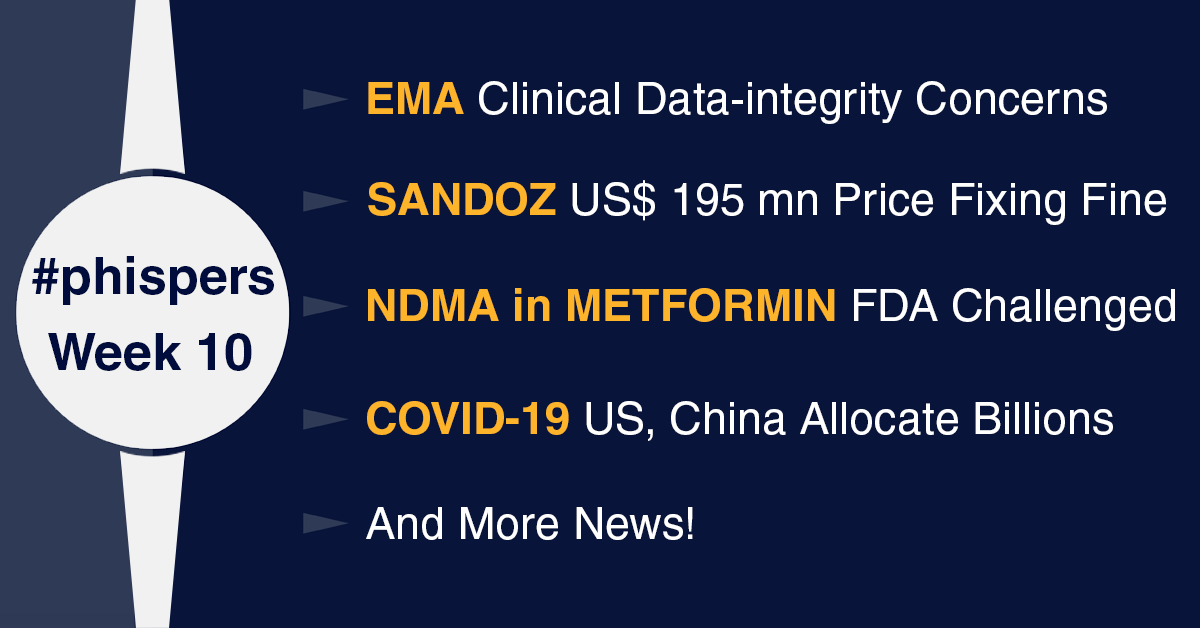
This week, Phispers has more updates on Covid-19.
While US lawmakers approved an emergency bill of US$ 8.3 billion to fund the government’s response to the coronavirus outbreak, China had allocated US$ 15.58 billion in special funds by March 2 to prevent the spread of the disease. The week also saw several M&A deals.
While Thermo Fisher is acquiring Qiagen, a Dutch maker of tests for diseases including Covid-19 and cancer, for US$ 10 billion, Gilead is acquiring cancer biotech Forty Seven for US$ 4.9 billion.
Japanese drugmaker Takeda sold off its old headquarter in Chicago suburbs to Horizon Therapeutics and its Latin American brands to Brazil’s Hypera Pharma.
And GSK and AstraZeneca are selling their non-core businesses to focus on oncology.
Even though FDA cleared diabetes drug metformin of concerns that it carried high levels of NDMA impurity, testing laboratory Valisure has challenged those findings.
Meanwhile, Sandoz has agreed to pay a criminal penalty of US$ 195 million to settle price fixing allegations.
EMA raised data-integrity concerns at an Indian CRO in Mumbai.
And FDA approved Biohaven’s migraine drug, Esperion’s cholesterol drugs and Acacia Pharma’s post-operative nausea drug.
Sandoz
to pay record US$ 195 million fine to settle price fixing allegations
Sandoz Inc, a generic
pharmaceutical company headquartered in New Jersey which is a part of Swiss
drugmaker Novartis AG, was charged for
conspiring to allocate customers, rig bids, and fix prices for generic drugs,
the US Department of Justice (DOJ) said.
This
represents the third pharmaceutical company to (after Heritage Pharmaceuticals and Rising Pharmaceuticals) admit to criminal
antitrust charges in the Antitrust Division’s ongoing investigation. The charged conspiracies took
place between 2013 and 2015. Charges against Heritage Pharmaceuticals and
Rising Pharmaceuticals were also resolved with criminal penalties and deferred
prosecution agreements.
The
Antitrust Division also announced a deferred prosecution agreement under which
Sandoz agreed to pay a US$ 195 million criminal penalty to
resolve criminal charges of conspiring to fix prices and rig bids to stifle
competition for generic drugs. This is the largest fine the department had
levied in a domestic antitrust case.
Sandoz
also admitted that the price-fixing affected more than US$ 500 million in its
generic drug sales. Under the deferred prosecution agreement, Sandoz has
agreed to cooperate fully with the Antitrust Division’s ongoing criminal investigation.
Officials
said the company conspired between 2013 and 2015 with other drug manufacturers
and their executives to raise prices for critical medications, hurting
vulnerable consumers such as the elderly.
EMA
raises clinical data-integrity concerns at Indian CRO in Mumbai
Over the last four years, we have seen multiple contract research organizations (CROs) face flak from regulators. In what was reminiscent of the Semler Research Center and the Micro Therapeutics Research Labs episodes in 2016 and 2017, last week the European Medicines Agency (EMA) started a review of medicines for which studies had
been conducted by Panexcell Clinical Laboratories Private Limited at its site
in Mumbai, India.
This
exercise by the European regulator follows a good clinical practice (GCP)
inspection which raised concerns about the study data used to support marketing
authorization applications of some medicines in the EU. The inspection was
carried out jointly by Austrian and German authorities in October 2019.
Having
considered the inspection findings, the German medicines agency (BfArM)
requested EMA to assess the impact of these findings on the benefits and risks
of medicines that have been authorized in the EU on the basis of studies
performed by Panexcell at its site in Mumbai.
EMA
has also been requested to look at the impact of the findings on medicines
currently being evaluated for authorization. EMA will now review the available
data to determine if any action is necessary to protect public health.
In
April 2016, the FDA had come down heavily on Semler Research Center over
issues of data manipulation. The FDA had told drug firms that their
applications seeking approvals on the basis of studies done by Semler will not
be accepted.
And
in late-2016, EMA had raised data-integrity concerns over another CRO in India — Chennai-based, Micro Therapeutics Research Labs. The concerns had regulators reviewing the data of over 300 generic
medicines being sold across Europe.
After
FDA clears metformin of NDMA risk, online pharmacy challenges results
Last
month, the FDA had said its testing of type 2 diabetes drug metformin did not find any samples with unacceptably high
levels of N-Nitrosodimethylamine (NDMA). But testing
laboratory Valisure has challenged those findings in a petition, saying it
discovered problems in 42 percent of the batches it checked.
Valisure
said it tested 38 batches of diabetes medicine metformin from 22 companies and
found 16 batches from 11 companies had the suspected carcinogen NDMA exceeding
the FDA’s acceptable daily level of 96 mg. In fact, the petition says it found
several batches contained levels that were 10 times the daily acceptable intake
limit.
It
also found “significant variability from batch to batch, even within a single company,” which it says in its petition underscores the need for expanded testing of some drugs at the batch level. Valisure also got another testing lab, Emergy Pharma, to check its findings and Emergy came to the same conclusions. Valisure has asked FDA to recall the batches in which it found issues.
“This certainly underscores the prevalence of existing pharma quality problems, which may end up becoming even worse as coronavirus continues to derail Chinese drug manufacturing, where the majority of US drugs originate from,” Valisure CEO David Light said.
Covid-19
impact: US approves emergency bill of US$ 8.3 billion; China allocates US$
15.58 billion
In
its effort to confront a growing public health threat, the US legislature resoundingly approved US$ 8.3 billion in
emergency aid on Wednesday to combat the novel coronavirus.
The
bipartisan package, which includes nearly US$ 7.8 billion for agencies dealing
with the virus, was put together after days of intensive negotiations. It is
substantially larger than what the White House had proposed in late February.
It also authorizes roughly US$ 500 million to allow Medicare providers to
administer telehealth services so that more elderly patients, who are at
greater risk from the virus, can receive care at home.
Representative
Nita M. Lowey, Democrat of New York and chairwoman of the House Appropriations
Committee said: “Strong funding in this legislation is a critical first step to enable a strategic, coordinated and whole-of-government response to the coronavirus.”
There
is growing fear that the rapid spread of the virus will impact the US economy and will lead to significant disruption in people’s everyday lives.
“When it comes to
Americans’ health and safety, there is no reason to be penny-wise and pound-foolish,” top Senate Democrat Chuck Schumer said.
Meanwhile, Chinese governments of every level had allocated a total of
108.75 billion yuan (US$ 15.58 billion) in special funds by March 2 to prevent
the spread of the coronavirus epidemic.
Fu Jinling, head of the social insurance division of the
Ministry of Finance, also said China had provided enterprises with 1 trillion
yuan (US$ 144 billion) in social insurance payment relief this year to support
the resumption of production.
He said China is aiming to cut the total tax burden on
enterprises by 510 billion yuan (US$ 73.51 billion) this year, and was also
allowing firms in the virus-stricken province of Hubei to waive insurance
payments for five months.
Thermo
Fisher to buy diagnostic company for US$ 10.1 billion
After a slow start in 2020, M&A deals have gathered
momentum in the pharmaceutical industry. US laboratory equipment maker Thermo Fisher Scientific Inc agreed to buy Qiagen NV, a Dutch maker of tests for diseases
including cancer and the new coronavirus, for about US$ 10
billion (Euro 9 billion) in the biggest healthcare acquisition so far this
year.
This is the largest purchase by Thermo Fisher after the company’s US$
13.6 billion acquisition of Life Technologies in
2014. Qiagen employs approximately 5,100 people at 35 locations in more than 25 countries.
The deal is expected to close in the first half of 2021.
Thermo Fisher expects synergies of US$ 200 million in the third year after
completion of the acquisition.
“We are excited to bring together our complementary offerings to advance our
customers’ important work, from discovery to diagnostics,” Marc N. Casper, chairman, president and chief executive officer of Thermo Fisher Scientific, said.
Thermo Fisher will assume US$ 1.4 billion (Euro 1.26
billion) in net debt, and will finance the purchase through cash, bridge
financing and new debt.
When a new coronavirus emerged out of China, Qiagen got to
work on a test to detect the virus in bodily fluids. The test is now being
evaluated at four hospitals in China and one in France. The diagnostic gives
results in about one hour.
Gilead buys cancer biotech for US$ 4.9 billion; Takeda, GSK, Astra to sell assets
This
week, Gilead Sciences Inc said it would buy cancer biotech Forty Seven Inc for US$ 4.9 billion
in cash. This acquisition adds another experimental treatment that targets blood cancer to Gilead’s portfolio of oncology drugs.
Through
the acquisition, Gilead will have access to Forty Seven’s lead drug, magrolimab, that targets CD47, a molecule often known as the “don’t eat me signal”. Cancer cells use that signal to avoid the immune system. The biotech has shown a 50 percent response rate from its lead drug magrolimab in Myelodysplastic syndrome and a 40 percent complete response rate in acute myeloid leukemia in small trials. Forty Seven also has programs in lymphoma and bladder, colorectal and ovarian cancers.
The
deal is Gilead’s largest acquisition since the company acquired Kite Pharma for US$ 11.9 billion
in 2017. The deal is expected to
complement the portfolio of Kite Pharma, and comes at a time when sales of
Gilead’s hepatitis C drugs have seen a steep fall. Gilead’s Yescarta, a CAR-T
therapy added through the acquisition of Kite, has gained market share as a
treatment for certain types of diffuse large B-cell lymphoma.
Takeda sells HQ to
Horizon, Latin American brands to Hypera: In a bid to lower its debts incurred due to the massive buy
of Shire Plc, Japanese drugmaker Takeda sold off its US headquarters in Chicago suburbs to Horizon Therapeutics for US$ 115 million. Takeda’s old campus is situated in Deerfield, Illinois as the Japanese drugmaker relocated its US operations out of the Chicago suburbs to join Shire in the Greater Boston region.
The drug company is
also offloading some of its non-core Latin American brands to Brazil’s Hypera Pharma. Under the agreement, Takeda will sell 18 branded prescriptions and consumer health drugs in Latin America to Brazil’s Hypera
Pharma for US$ 825 million, the company said.
GSK may sell antibiotics business: GlaxoSmithKline Plc (GSK) is rekindling efforts to sell part of its antibiotics
business. The British drugmaker is also pruning its
portfolio to focus more on areas such as cancer, a Bloomberg
report said.
According
to sources quoted in the report, GSK is working with financial advisers on the
potential divestment of its business making antibiotics called cephalosporins,
including the Zinnat and Fortum brands. The portfolio could fetch several hundred million US dollars.
The
drugs generate about US$ 200 million in annual revenue and GSK has started
sounding out potential buyers including other antiobiotic makers as well as
investment funds.
Emma Walmsley, CEO of GSK, is known to be betting big
on oncology and is divesting older treatments in a bid to strengthen the
company’s drug business.
Astra
to sell non-core assets: Another company that plans to increase its focus on
oncology by selling its non-core and underperforming assets is
British-drugmaker AstraZeneca. The company has sold commercial rights for its hypertension drugs.
AstraZeneca
said it has sold global commercial rights for hypertension drugs Inderal, Tenormin, Tenoretic, Zestril and Zestoretic to Atnahs Pharma to the tune
of US$ 350 million and future milestone payments.
The
future payments are sales contingent, AstraZeneca said, and could add up
to US$ 40 million between 2020 and 2022.
The
move comes a week after it divested most of its global rights for gastrointestinal
drug Movantik to RedHill Pharma for US$ 68 million.
In October,
AstraZeneca opted to sell most of its global commercial rights for Losec (omeprazole)
for US$ 243 million
to German pharma Cheplapharm Arzneimittel GmbH. The deal included sales-contingent
milestone payments of up to US$ 33 million in 2021 and 2022, AstraZeneca said.
FDA approves Biohaven’s migraine drug, Esperion’s cholesterol drug
Last
week, the FDA approved Biohaven Pharmaceutical Holding Company Limited’s oral pill — Nurtec ODT — for relieving pain after the onset of migraine headaches.
Chemically
known as rimegepant, Nurtec ODT belongs
to an emerging class of migraine treatments called calcitonin gene-related peptide
(CGRP) inhibitors. It directly competes with Allergan Plc’s Ubrelvy, which became the
first oral CGRP to be approved for acute migraine in December.
A
single oral dose of the 75 mg tablet can provide fast pain relief, return
patients to normal function within an hour, and remain effective for up to 48
hours in the case of many patients, the company said. Biohaven said 86 percent
of patients treated with a single dose of the pill did not use a migraine
rescue medication within 24 hours.
Esperion’s cholesterol buster: Esperion has been aiming to reconfigure the cholesterol-lowering market for
sometime. Last week, it bagged its first FDA approval for its Nexletol (bempedoic acid) as a monotherapy for cholesterol. And this week, it won the FDA nod for a combination product — Nexlizet (bempedoic acid-ezetimibe) — that lowers LDL cholesterol in patients with high cholesterol or established atherosclerotic cardiovascular disease.
Despite
both drugs sharing an active ingredient, Nexlizet boasts of more impressive
data on its label as a phase 3 clinical study showed the drug lowered LDL
cholesterol by 38 percent over a placebo. Nexletol, by contrast, posted
an 18 percent reduction in its clinical program. Both drugs were approved
for patients who have reached their maximum statin tolerance, the company said.
Nexletol
and Nexlizet will be sold at a wholesale acquisition cost of US$ 10 per day.
Acacia’s post-operative nausea drug: Acacia Pharma
has
bagged FDA nod for its post-operative nausea and vomiting (PONV) drug Barhemsys (amisulpride injection).
“The approval of our first product represents a significant milestone in Acacia Pharma’s evolution into an integrated hospital pharmaceutical company with strong development and commercialization capabilities,” commented Mike Bolinder, Acacia Pharma’s CEO. Acacia intends
to launch the drug with its own direct sales force in the second half of 2020.












 Share
Share