Please Wait
Applying Filters...
Menu
Xls

Digital Content read-more

Create Content with PharmaCompass, ask us

DATA COMPILATION #PharmaFlow

read-more
read-more
DMF filings rise 4.5% in Q3 2025; China holds lead, India records 20% growth in submissions
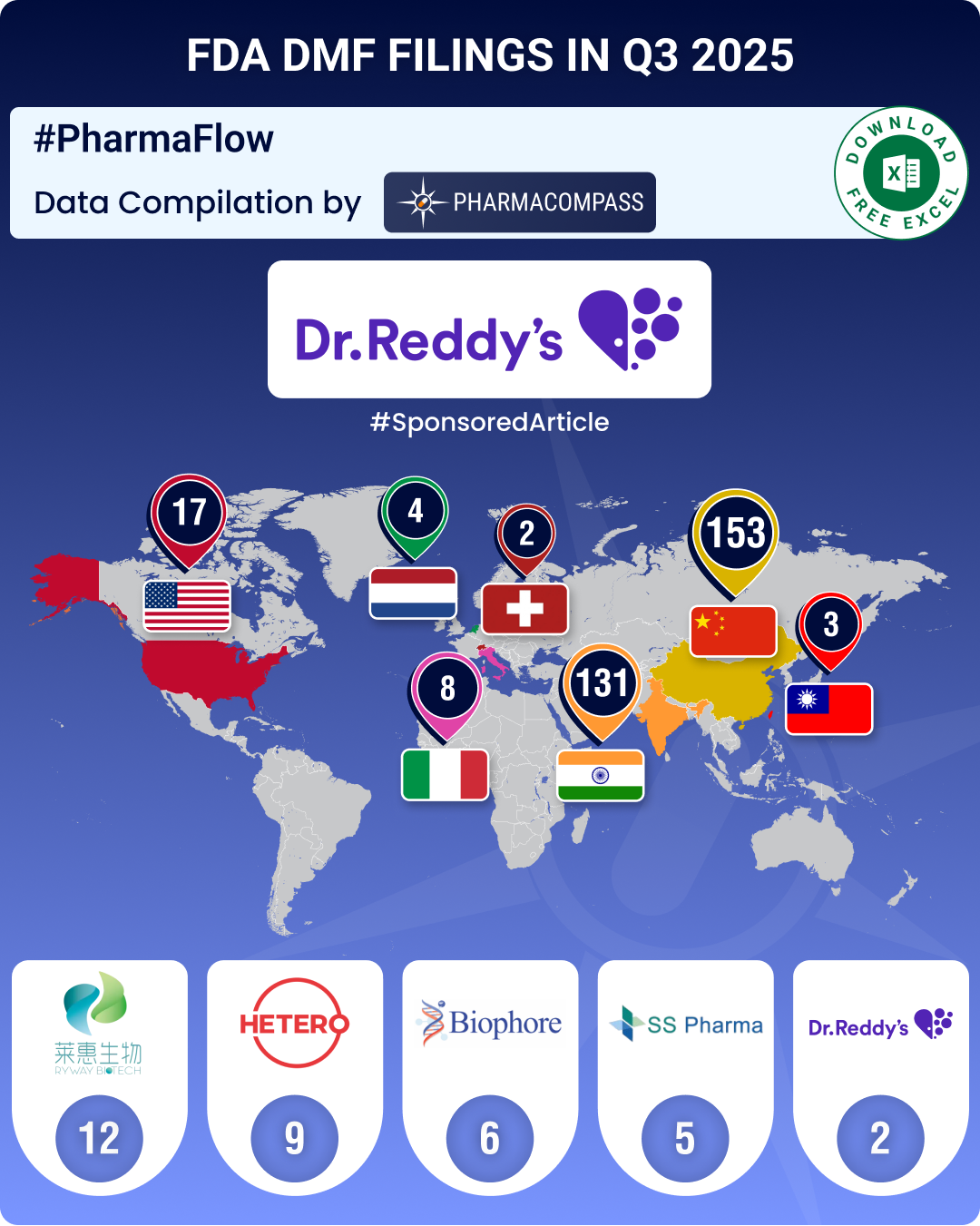
The third quarter (Q3) of 2025 witnessed a steady rise in Drug Master File (DMF) submissions to the US Food and Drug Administration (FDA). DMFs are used to provide confidential, detailed information about facilities, processes, or articles used in the manufacturing, processing, packaging, and storing of human drug productsA total of 323 Type II DMFs were submitted during this period, as opposed to 309 submissions in Q3 2024, marking an increase of 4.53 percent. This is the second highest number since 2018. In Q1 2025, 339 Type II filings were recorded.Across all DMF types (II, III, IV, and V), 479 DMFs were filed in Q3 2025, compared to 394 in Q3 2024, representing a 21.57 percent increase. Out of the 323 Type II DMFs submitted in Q3 2025, 40 had completed their review by the end of Q3, reflecting a processing lag between submission and review completion. View FDA DMF Filings in Q3 2025 (Power BI Dashboard, Free Excel Available)China maintains its lead while India posts double-digit growth in DMF submissions China and India continued to dominate DMF submissions in Q3 2025. China retained the top spot with 153 Type II DMFs, matching its submission count from Q3 2024. India recorded 131 DMFs, marking a 20.18 percent increase over 109 filings during the corresponding period last year.The United States stood a distant third with 17 filings, compared to 13 in Q3 2024. Among European nations, Italy recorded eight DMFs, doubling its 2024 tally. The Netherlands filed four, up from three. Spain submitted only one DMF, as against seven submitted in Q3 2024. Taiwan made three filings, up from one submitted in Q3 2024. Together, India, China and Taiwan accounted for about 88.9 percent of all Type II DMFs filed during the quarter. View FDA DMF Filings in Q3 2025 (Power BI Dashboard, Free Excel Available) China’s Suzhou Ryway Biotech tops corporate tally; India’s Hetero, Biophore followChina’s Suzhou Ryway Biotech led the company-wise tally with 12 DMF submissions in Q3 2025. The company had not filed any DMFs in Q3 2024.India’s Hetero Group followed with nine DMFs, maintaining the same number of filings as Q3 2024. Biophore India Pharmaceuticals ranked third with six DMFs, doubling its count from three last year.Other notable contributors include Sai Sreyas Pharmaceuticals (India) and Shanghai Haoyuan Chemexpress (China), with five DMFs each. Companies such as SNJ Group, Lunan Pharmaceutical, Allsino Pharmaceutical, Shankus Pharma, Jiangxi Xinganjiang Pharmaceutical, Sunpure Extracts, Lee Pharma, Umedica Laboratories, Linhai Tianyu Pharmaceutical and Maithri Drugs filed four DMFs each. View FDA DMF Filings in Q3 2025 (Power BI Dashboard, Free Excel Available) Olaparib, semaglutide lead molecular filings; Dr. Reddy’s files DMF for edoxaban & tucatinibDr. Reddy’s Laboratories also featured among key DMF filers in Q3 2025, submitting two DMFs — for edoxaban tosylate monohydrate and tucatinib copovidone. Edoxaban tosylate monohydrate (marketed as Savaysa by Daiichi Sankyo) is a prescription anticoagulant used to reduce the risk of stroke and to treat deep vein thrombosis and pulmonary embolism. Patent exclusivity for Savaysa extends until October 2026 in the United States, with no generic currently available.In terms of molecules, the highest number of DMFs were filed for olaparib, semaglutide, ruxolitinib phosphate, ferric carboxymaltose, and vismodegib, with three DMFs each in Q3 2025.Olaparib, sold by AstraZeneca under the brand name Lynparza, saw DMFs being filed by BDR Lifesciences and Intas Pharmaceuticals from India, and by ScinoPharm Taiwan during the quarter.Semaglutide, a glucagon-like peptide-1 (GLP-1) receptor agonist developed by Novo Nordisk, continued to draw strong interest from API manufacturers. DMFs for semaglutide were filed by three Chinese companies: Yangzhou Aurisco Pharmaceutical, Zhejiang Peptites Biotech, and Fujian Genohope Biotech.Ruxolitinib phosphate, marketed by Incyte as Jakafi, saw three DMFs. Three Indian companies — Alembic Pharmaceuticals, Valary Labs, and Devi Pharmatech — filed DMFs for this API in Q3 2025. Other molecules that received multiple DMF submissions include ferric carboxymaltose (used to treat iron-deficiency anemia) and vismodegib (an oral therapy for basal-cell carcinoma). View FDA DMF Filings in Q3 2025 (Power BI Dashboard, Free Excel Available) First-time DMF filings span 17 companies; India leads with nine first-time DMFs The quarter saw first-time DMF filings from 17 companies. India took a lead here with nine first-time DMF filings, followed by China (six), and the US (two).The DMF filings in this quarter included inclisiran sodium (filed by Aurisco Pharmaceutical of China), pacritinib citrate (by TAPI Nl B.V. of the Netherlands), and vosoritide (by Apicore LLC of the US).Out of the 19 first-time DMFs filed in Q3 2025, four completed their Generic Drug User Fee Amendments (GDUFA) review process during the quarter. View FDA DMF Filings in Q3 2025 (Power BI Dashboard, Free Excel Available) GDUFA fee for FY 2026: The FDA Generic Drug User Fee Amendments (GDUFA) is a law designed to speed access to safe and effective generic drugs to the public and reduce costs to the industry.Fee rates for fiscal year 2026 were published on July 30, 2025. FDA has revised fees under GDUFA III across all categories. While there is a slight increase in the DMF fee from US$ 95,084 in 2025 to US$ 102,584 in 2026, the ANDA fee has seen a sharp rise: from US$ 321,920 in 2025 to US$ 358,247 in 2026.FY 2025 and FY 2026 User Fee Rates Generic drug fee category Fees rates for FY 2025 Fees rates for FY 2026 Applications:     Abbreviated New Drug Application (ANDA) US$ 3,21,920 US$ 3,58,247 Drug Master File (DMF) US$ 95,084 US$ 1,02,584 Facilities:     Active Pharmaceutical Ingredient (API)—Domestic US$ 41,580 US$ 43,549 API—Foreign US$ 56,580 US$ 58,549 Finished Dosage Form (FDF)—Domestic US$ 2,31,952 US$ 2,38,943 FDF—Foreign US$ 2,46,952 US$ 2,53,943 Contract Manufacturing Organization (CMO)—Domestic US$ 55,668 US$ 57,346 CMO—Foreign US$ 70,668 US$ 72,346 GDUFA Program:     Large size operation generic drug applicant US$ 18,91,664 US$ 19,18,377 Medium size operation generic drug applicant US$ 7,56,666 US$ 7,67,351 Small business generic drug applicant US$ 1,89,166 US$ 1,91,838 Our viewFor several years prior to the pandemic, India had a lead in Type II DMF submissions. In recent years, China has surpassed India in DMF filings. But Q3 2025 numbers indicate that Indian drugmakers are fast catching up. Since DMFs establish trust in APIs from across the world, we feel this healthy competition between drugmakers from the two countries is good for the global pharmaceutical industry. 

Impressions: 4782

https://www.pharmacompass.com/radio-compass-blog/dmf-filings-rise-4-5-in-q3-2025-china-holds-lead-india-records-20-growth-in-submissions

#PharmaFlow by PHARMACOMPASS
13 Nov 2025

WEEKLY NEWS RECAP #Phispers

read-more
read-more
FDA chief Gottlieb resigns; BMS-Celgene deal may get derailed due to shareholder opposition
This week, Phispers brings you news about the sudden and unexpected resignation of the USFDA commissioner Scott Gottlieb, a day after his crackdown on retailers selling tobacco to young people. The other big news came from BMS and Celgene — their US$ 74 billion mega merger may get derailed as influential financial investors expressed opposition to the merger. In the sartan impurities case, the USFDA found a third cancer-causing impurity in the losartan potassium tablets made by India’s Hetero Labs. A troubled Mylan faced more flak over raising its CEO Heather Bresch’s salary amid dismal forecasts and falling revenues.  Opioid drugmaker Purdue Pharma may dodge 2,000 lawsuits by filing for bankruptcy. In Philippines, the department of justice has found reasons to indict Sanofi officials over deaths related to its dengue vaccine — Dengvaxia. And Biogen announced it will acquire Nightstar Therapeutics for US$ 800 million. FDA chief resigns a day after taking ‘forceful actions’ against tobacco retailers   The biggest news that shook the world of pharmaceuticals this week was the unexpected resignation of the US Food and Drug Administration (FDA) Commissioner Scott Gottlieb. Gottlieb was the 23rd commissioner of the agency and had been nominated by President Trump. He took charge on May 2017, and his resignation would become effective in a month. Only two months back, he had said in a tweet that he was not leaving, and was looking forward to sharing his 2019 strategic roadmap. Gottlieb cited personal reasons for his resignation, particularly his weekly commute from Washington to his home in Connecticut. His resignation has come at a time when Gottlieb’s signature issue – youth vaping – is being reviewed by the White House Office of Management and Budget. On Monday, the FDA had announced a renewed effort to hold retailers accountable for selling tobacco and e-cigarettes to the youth. An eminent public health advocate, Gottlieb had been at the forefront of FDA’s efforts to speed up drug approvals and accomplished the task of approving a record 62 new drugs in 2018. “All of us at HHS are proud of the remarkable work Commissioner Gottlieb has done at the FDA. He has been an exemplary public health leader, aggressive advocate for American patients, and passionate promoter of innovation,” the Health and Human Services (HHS) Secretary Alex Azar said. Unlike his predecessors, who believed drug pricing didn’t fall under the purview of the FDA, the 46-year-old physician and former venture capitalist intensified the debate around the high cost of medicines in the US and had the agency actively look for possible solutions. BMS-Celgene’s US$ 74 billion mega merger may get derailed due to investor opposition   The New Year opened to the news of a definitive merger agreement between Bristol-Myers Squibb (BMS) and Celgene Corporation, with the former acquiring the latter for US$ 74 billion. Two months on, there is news that BMS could have its plans derailed by some influential financial advisers. In February, activist investor Starboard Value bought stake in BMS and speculation arose about the Starboard’s rising opposition to the deal. Later, BMS’ biggest institutional investor —Wellington Management — came out publicly against the merger, and Starboard followed with its own arguments against it. Their opposition to the merger has left investors baffled, as they are wondering whether the takeover is in trouble or not. Analysts too are divided on its outcome. According to reports, Credit Suisse’s Vamil Divan is of the view that there is plenty of overlap between the shareholder bases of BMS and Celgene. And this should work in the deal’s favor. UBS’s Navin Jacob, on the other hand, worries what the new ‘merged entity’ will look like. According to him, it may face a “double digit earnings compound annual growth rate decline between 2025 and 2030.” Meanwhile, Celgene announced that the FDA has accepted the New Drug Application (NDA) for Fedratinib, a drug for myelofibrosis and that it expects to submit the Biologics License Application (BLA) for Luspatercept  in April. These drugs are part of the six new launches scheduled for 2019, and Celgene and BMS expect to earn more than US$ 15 billion in peak annual sales from these new drugs. Amid a turbulent year and falling revenues, Mylan faces more flak for raising CEO’s salary   Mylan NV has been facing a tumultuous year — in November 2018, the US Food and Drug Administration (FDA) issued a warning letter to its manufacturing site in Morgantown, West Virginia (US), and the EU suspended its valsartan certificate of suitability to the monograph of the European Pharmacopeia (CEP) for Mylan’s facility in Hyderabad, India. This is after it faced much flak for raising the price of its life-saving epinephrine auto-injector EpiPen in 2016. Last week, the generic drug major faced even more criticism — this time for giving a raise to its CEO Heather Bresch. This information was known once Mylan announced disappointing results for yet another quarter, along with a rather dismal forecast for the year ahead.  Mylan increased Bresch’s salary by more than 15 percent to US$ 1.5 million and extended her contract through April 21, 2024, according to a document filed with the Securities and Exchange Commission last week. She’s also eligible for a target annual bonus of US$ 2.25 million. The company has been grappling with a turbulent generic-drug market, wherein prices have been falling amid regulatory pressure to bring more competing products on the US market. With the introduction of generics, North American sales of EpiPen continue to slide. President Rajiv Malik, who faces civil lawsuits accusing him of taking part in an alleged price-fixing scheme, saw his base salary increase 15 percent to US$ 1.15 million and his contract extended through 2022. Generic drug makers are facing headwinds as the FDA has also expedited its drug approval process, thereby impacting the prices of existing drugs. Mylan’s total revenue of US$ 3.1 billion was down 5 percent year-on-year (YoY). Similarly, Teva experienced a fourth quarter revenue decline of 16 percent YoY. Meanwhile, Mylan’s EpiPen manufacturing partner — Pfizer — received a request from the US Attorney for Southern District of New York to provide documents as part of a probe into quality control issues at Meridian Medical Technologies for a failure to investigate “serious” problems associated with an unspecified number of patient deaths. In 2017, Pfizer’s Meridian unit (that manufactures EpiPens for Mylan) had received a warning letter from the FDA, in which the agency said Meridian had failed to thoroughly investigate product failures, including EpiPen products that were associated with patient deaths and severe illnesses. Opioid drugmaker Purdue Pharma explores bankruptcy to dodge lawsuit liabilities   Purdue Pharma, the opioid drugmaker built by Richard Sackler that reaped billions in profits through its painkiller OxyContin, said this week it is considering options to file for bankruptcy in an effort to address the significant liabilities arising out of lawsuits that allege its role in the deadly opioid epidemic. Purdue Pharma has been battling roughly 2,000 lawsuits at federal and state courts. The lawsuits accuse opioid manufacturers such as Purdue of using deceptive practices to push addictive drugs that led to fatal overdoses. One of the publicly discussed lawsuit launched by the Massachusetts attorney general against the drugmaker alleges that the company “seeded the state’s opioid crisis by misleading the public and prescribers about its drugs’ risk of addiction and overdose.”  If Purdue files for bankruptcy, it comes under the purview of Chapter 11 protection under the Bankruptcy Code of the US, which would in turn halt the lawsuits and allow Purdue to negotiate legal claims with plaintiffs under the supervision of a bankruptcy judge. Endo International Plc and Insys Therapeutics Inc are two other companies that have been cited in lawsuits related to the US opioid crisis. In 2017, US reported 47,600 deaths — a six-fold increase from 1999 — caused due to an overdose of opioids, including prescription painkillers, heroin and fentanyl, according to the US Centers for Disease Control and Prevention. Philippines DOJ prepares charges to indict Sanofi officials over dengue vaccine mess   In December 2015, Sanofi Pasteur, the vaccines division of the French drugmaker, had bagged the marketing approval of Dengvaxia in the Philippines, making it the first vaccine to be licensed for the prevention of dengue in Asia. In December 2017, the vaccine ran into trouble as the Philippines government suspended it amid widespread fears about its safety. Over 830,000 school children had already been given the vaccine. The government then began investigations into Sanofi’s immunization program, which came under fire for discounting early signs that it could put some people at heightened risk of a severe form of the disease. Last week, the Philippines Department of Justice said it had found reason to indict Sanofi officials and Philippine health officials over 10 deaths that it said were linked to the use of the dengue vaccine. The prosecutors said six Sanofi officials, mostly country representatives of the firm, and 14 current and former Philippine health officials should be charged, including former health minister Janette Garin. Sanofi rejected the justice department’s findings and reiterated that Dengvaxia is safe and effective. The company said it “strongly disagrees” with the findings made against Sanofi and some of its employees”. The drugmaker said it will vigorously defend its employees.  A week back, the government of Philippines had permanently revoked the Certificates of Product Registration (CPR) of the dengue vaccine, citing the continued failure of Sanofi Pasteur to submit post-approval commitment documents. Third cancer-causing toxin found in Hetero’s losartan; Torrent issues fresh recalls   Nitrosamine impurities continue to worry the US drug supply chain — last week, the FDA found a third cancer-causing substance in losartan potassium tablets made by India’s Hetero Labs and distributed by New Jersey-based Camber Pharmaceuticals.  Known as N-Nitroso N-Methyl 4-amino butyric acid (NMBA), trace amounts of this new impurity were detected in the active pharmaceutical ingredient (API) manufactured by Hetero Labs’ Unit-1 situated in Telangana (India). Hetero Labs issued a fresh recall of 87 lots of losartan potassium tablets up to the consumer level due to the detection of this third nitrosamine impurity. The FDA said this recall is “the first ARB (angiotensin II receptor blocker) recall resulting from the presence of NMBA”. The FDA’s evaluation suggests that the nitrosamines found in ARBs may be generated when specific chemicals and reaction conditions are present in the manufacturing process of the drug’s API, and may also result from the reuse of materials, such as solvents. Meanwhile, Torrent Pharmaceuticals Limited has expanded its recall to include 114 additional lots of losartan potassium and losartan potassium/hydrochlorothiazide tablets due to the presence of NMBA in the losartan API manufactured by Hetero Labs.  Biogen to acquire Nightstar Therapeutics in US$ 800 million cash deal   Earlier this week, Biogen said it will acquire Nightstar Therapeutics for US$ 800 million in cash, as “the company looks to tap into a potentially lucrative gene therapy market.” London-based gene therapy company Nightstar is focused on adeno-associated virus (AAV) treatments for inherited retinal disorders. Nightstar’s lead candidate–NSR-REP1–is currently in Phase III development for choroideremia, a progressive vision loss condition mostly affecting men. However, Biogen will only be acquiring the technical and clinical expertise of Nightstar. It won't be taking on the manufacturing capabilities with its proposed acquisition. Interestingly, the deal comes just a week after Roche announced its plans to acquire Spark Therapeutics for US$ 4.8 billion in an all-cash transaction. Spark Therapeutics is currently leading in the gene therapies for inherited retinal diseases space with its breakthrough approval of Luxturna both in the US and Europe.  

Impressions: 3396

https://www.pharmacompass.com/radio-compass-phisper/fda-chief-gottlieb-resigns-bms-celgene-deal-may-get-derailed-due-to-shareholder-opposition

#Phispers by PHARMACOMPASS
07 Mar 2019

NEWS #PharmaBuzz

read-more
read-more

https://www.accessdata.fda.gov/scripts/cder/daf/index.cfm?event=overview.process&ApplNo=219869

FDA
27 May 2026

https://www.accessdata.fda.gov/scripts/cder/daf/index.cfm?event=overview.process&ApplNo=204687

FDA
23 Apr 2026

https://www.accessdata.fda.gov/scripts/cder/daf/index.cfm?event=overview.process&ApplNo=206371

FDA
13 Apr 2026

https://www.prnewswire.com/news-releases/accord-healthcare-us-reintroduces-hydrochlorothiazide-tablets-expanding-access-across-all-three-strengths-302730673.html

PR NEWSWIRE
01 Apr 2026

https://www.accessdata.fda.gov/scripts/cder/daf/index.cfm?event=overview.process&ApplNo=219489

FDA
24 Mar 2026

https://www.pharmacompass.com/pdf/news/enforcement-report-week-of-february-11-2026-78301.pdf

FDA
11 Feb 2026