
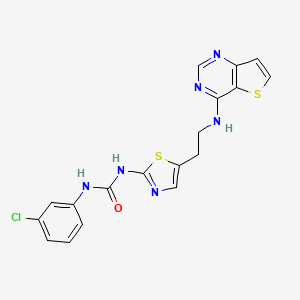
1. Sns 314
2. Sns314
1. 1057249-41-8
2. Sns 314
3. Sns314
4. N-(3-chlorophenyl)-n'-[5-[2-(thieno[3,2-d]pyrimidin-4-ylamino)ethyl]-2-thiazolyl]urea
5. 1-(3-chlorophenyl)-3-[5-[2-(thieno[3,2-d]pyrimidin-4-ylamino)ethyl]-1,3-thiazol-2-yl]urea
6. 802ifj0z8x
7. 1-(3-chlorophenyl)-3-{5-[2-(thieno[3,2-d]pyrimidin-4-ylamino)ethyl]-1,3-thiazol-2-yl}urea
8. 1057249-41-8 (free Base)
9. 1-(3-chlorophenyl)-3-[5-(2-{thieno[3,2-d]pyrimidin-4-ylamino}ethyl)-1,3-thiazol-2-yl]urea
10. N-(3-chlorophenyl)-n'-[5-[2-(thieno[3,2-d]pyrimidin-4-ylamino)ethyl]-2-thiazolyl]urea.
11. Urea, N-(3-chlorophenyl)-n'-(5-(2-(thieno(3,2-d)pyrimidin-4-ylamino)ethyl)-2-thiazolyl)-
12. Kinome_3712
13. Unii-802ifj0z8x
14. Sn-314
15. Chembl482767
16. Gtpl9397
17. Schembl3415843
18. Sns 314 [who-dd]
19. Bdbm26326
20. Chebi:94720
21. Dtxsid20147269
22. Ex-a181
23. Hms3244o17
24. Hms3244o18
25. Hms3244p17
26. Amy24207
27. Bcp01773
28. Nsc758250
29. Nsc800886
30. S8699
31. Zinc40393428
32. Ccg-269017
33. Db06134
34. Db07361
35. Nsc-758250
36. Nsc-800886
37. Sb16660
38. Compound 21 [pmid: 18678489]
39. Ncgc00242482-01
40. Ncgc00242482-11
41. Ak2
42. As-16236
43. Db-059388
44. Hy-108344
45. Cs-0028416
46. Ft-0717912
47. 249c418
48. J-503125
49. Brd-k71512533-001-01-7
50. Q27096584
| Molecular Weight | 430.9 g/mol |
|---|---|
| Molecular Formula | C18H15ClN6OS2 |
| XLogP3 | 4.2 |
| Hydrogen Bond Donor Count | 3 |
| Hydrogen Bond Acceptor Count | 7 |
| Rotatable Bond Count | 6 |
| Exact Mass | 430.0437292 g/mol |
| Monoisotopic Mass | 430.0437292 g/mol |
| Topological Polar Surface Area | 148 Ų |
| Heavy Atom Count | 28 |
| Formal Charge | 0 |
| Complexity | 532 |
| Isotope Atom Count | 0 |
| Defined Atom Stereocenter Count | 0 |
| Undefined Atom Stereocenter Count | 0 |
| Defined Bond Stereocenter Count | 0 |
| Undefined Bond Stereocenter Count | 0 |
| Covalently Bonded Unit Count | 1 |
Investigated for use/treatment in solid tumors.
SNS-314 inhibits Aurora kinases A, B, and C. Stopping Aurora kinases halts cellular division at the mitotoic phase of the cell cycle and proliferation in tumor cells that overexpress Aurora kinases.
The process of cell division, or mitosis, plays a critical role in the uncontrolled proliferation that is a hallmark of cancer. During mitosis, a cell aligns duplicate copies of its DNA along a mitotic spindle and subdivides itself through a process called cytokinesis, creating two identical daughter cells. This process is often poorly regulated in cancer, leading to rapid proliferation and tissue growth. Aurora kinases (A, B, and C) play important, though differentiated, roles in mitosis. Aurora A controls the formation of the spindle assembly, while Aurora B ensures that the DNA is appropriately aligned and that cytokinesis proceeds successfully. Less is known about Aurora C, though it is thought to serve many of the same functions as Aurora B. Elevated expression of Aurora A has been detected in a high percentage of colon, breast, ovarian, gastric, and pancreatic tumors. Aurora B and C are also expressed at high levels in primary tumors. Given the central roles of all three Aurora kinases in regulating mitosis and the association between their overexpression and tumorigenesis, they are being evaluated as potential targets in cancer therapy. SNS-314 is a potent inhibitor of all 3 Aurora kinases. Cells treated with SNS-314 make additional copies of their DNA, but are unable to create functional spindle assemblies or replicate. As a result, these cells are unable to progress, and ultimately die by a variety of mechanisms. Since most normal cells are not undergoing mitosis in their normal settings, SNS-314 is expected to affect only highly proliferating tissues, particularly tumor tissues. SNS-314 is being tested in a Phase 1 trial in patients with advanced solid tumor malignancies.