Find Ranitidine manufacturers, exporters & distributors on PharmaCompass

PharmaCompass

Synopsis

Synopsis

ACTIVE PHARMA INGREDIENTS

0

CEP/COS

0

JDMF

0

KDMF

0

NDC API

0

VMF

0INTERMEDIATES

REF. STANDARDS OR IMPURITIES

0

EDQM

0

USP

0

JP

FDF Dossiers

DRUG PRODUCT COMPOSITIONS

158RELATED EXCIPIENT COMPANIES

242EXCIPIENTS BY APPLICATIONS

PATENTS & EXCLUSIVITIES

0

US Patents

0

US Exclusivities

0

Health Canada Patents

GLOBAL SALES INFORMATION

US Medicaid

NA

Annual Reports

NA

MARKET PLACE

DIGITAL CONTENT

0

Data Compilation #PharmaFlow

0

Stock Recap #PipelineProspector
0

Weekly News Recap #Phispers

Chemistry

Click the arrow to open the dropdown
read-moreClick the button for full data set
Also known as: 66357-35-5, Ranitidine base, Raticina, Ratic, Ranitidina, Ranitidinum
Molecular Formula
C13H22N4O3S
Molecular Weight
314.41  g/mol
InChI Key
VMXUWOKSQNHOCA-UKTHLTGXSA-N

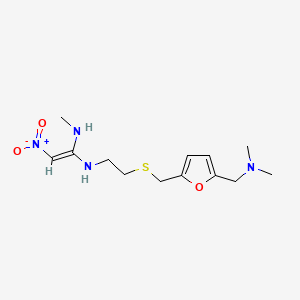
Ranitidine
A non-imidazole blocker of those histamine receptors that mediate gastric secretion (H2 receptors). It is used to treat gastrointestinal ulcers.
1 2D Structure

Ranitidine

2 Identification
2.1 Computed Descriptors
2.1.1 IUPAC Name
(E)-1-N'-[2-[[5-[(dimethylamino)methyl]furan-2-yl]methylsulfanyl]ethyl]-1-N-methyl-2-nitroethene-1,1-diamine
2.1.2 InChI
InChI=1S/C13H22N4O3S/c1-14-13(9-17(18)19)15-6-7-21-10-12-5-4-11(20-12)8-16(2)3/h4-5,9,14-15H,6-8,10H2,1-3H3/b13-9+
2.1.3 InChI Key
VMXUWOKSQNHOCA-UKTHLTGXSA-N
2.1.4 Canonical SMILES
CNC(=C[N+](=O)[O-])NCCSCC1=CC=C(O1)CN(C)C
2.1.5 Isomeric SMILES
CN/C(=C\[N+](=O)[O-])/NCCSCC1=CC=C(O1)CN(C)C
2.2 Synonyms
2.2.1 MeSH Synonyms

1. Ah 19065

2. Ah-19065

3. Ah19065

4. Biotidin

5. Hydrochloride, Ranitidine

6. N (2-(((5-((dimethylamino)methyl)-2-furanyl)methyl)thio)ethyl)-n'-methyl-2-nitro-1,1-ethenediamine

7. Ranisen

8. Ranitidin

9. Ranitidine Hydrochloride

10. Sostril

11. Zantac

12. Zantic

2.2.2 Depositor-Supplied Synonyms

1. 66357-35-5

2. Ranitidine Base

3. Raticina

4. Ratic

5. Ranitidina

6. Ranitidinum

7. Coralen

8. Gastrial

9. Quantor

10. Rantidine

11. Zantac

12. Gastrosedol

13. Microtid

14. Ptinolin

15. Ranidine

16. Raniogas

17. Ranisen

18. Ranitiget

19. Rantacid

20. Taural

21. Duractin

22. Ulceranin

23. Weichilin

24. Xanidine

25. Zantadin

26. Achedos

27. Acidex

28. Atural

29. Axoban

30. Ezopta

31. Istomar

32. Logast

33. Mauran

34. Quicran

35. Radinat

36. Randin

37. Raniter

38. Sampep

39. Urantac

40. Verlost

41. Vesyca

42. Vizerul

43. Weidos

44. Zantab

45. Ranin

46. Ul-pep

47. Ranitidine Free Base

48. Chebi:8776

49. Ranitidine Impurity J

50. 1,1-ethenediamine, N-(2-(((5-((dimethylamino)methyl)-2-furanyl)methyl)thio)ethyl)-n'-methyl-2-nitro-

51. Ranitidinum [inn-latin]

52. Ranitidina [inn-spanish]

53. Zantac (tn)

54. Chembl512

55. 1,1-ethenediamine, N-[2-[[[5-[(dimethylamino)methyl]-2-furanyl]methyl]thio]ethyl]-n'-methyl-2-nitro-

56. 66357-35-5 (free Base)

57. Ncgc00015876-07

58. Dsstox_cid_25191

59. Dsstox_rid_80738

60. Dsstox_gsid_45191

61. Ranitidine [usan:ban:inn]

62. Rnd

63. Ranitidine (tn)

64. {2-[({5-[(dimethylamino)methyl]furan-2-yl}methyl)sulfanyl]ethyl}[(e)-1-(methylamino)-2-nitroethenyl]amine

65. Dimethyl[(5-{[(2-{[(e)-1-(methylamino)-2-nitroethenyl]amino}ethyl)sulfanyl]methyl}furan-2-yl)methyl]amine

66. Cas-66357-35-5

67. (e)-n-(2-(((5-((dimethylamino)methyl)furan-2-yl)methyl)thio)ethyl)-n-methyl-2-nitroethene-1,1-diamine

68. 71130-06-8

69. Ranitidine (usan/inn)

70. Gavilast

71. Sr-01000075288

72. (e)-ranitidine

73. Tocris-1967

74. Lopac-r-101

75. Prestwick2_000201

76. Spectrum5_001189

77. Epitope Id:127515

78. Ranitidine Hcl 1/2 Type

79. Lopac0_001073

80. N'-[2-[[5-(dimethylaminomethyl)-2-furyl]methylsulfanyl]ethyl]-n-methyl-2-nitro-ethene-1,1-diamine Hydrochloride

81. Bidd:gt0179

82. Spectrum1501151

83. Gtpl1234

84. Bdbm22893

85. Chebi:92246

86. Hms501f22

87. N-[2-[[5-[(dimethylamino)methyl]furfuryl]thio]ethyl]-n'-methyl-2-nitro-1,1-ethenediamine

88. Bdbm237183

89. Dtxsid101112063

90. Hms1921l07

91. Hms2092h15

92. Hms3886a16

93. Pharmakon1600-01501151

94. Ranitidine (form I And Form Ii)

95. Bcp21325

96. Hy-b0693

97. Zinc1530728

98. Tox21_110250

99. Tox21_302372

100. Ccg-39025

101. Mfcd00081180

102. Nsc757851

103. S5662

104. Stk619092

105. Akos005552967

106. Tox21_110250_1

107. Ks-5230

108. Sdccgsbi-0051043.p004

109. Idi1_000440

110. Ncgc00015876-01

111. Ncgc00015876-02

112. Ncgc00015876-03

113. Ncgc00015876-04

114. Ncgc00015876-05

115. Ncgc00015876-06

116. Ncgc00015876-08

117. Ncgc00015876-09

118. Ncgc00015876-11

119. Ncgc00015876-16

120. Ncgc00018108-01

121. Ncgc00018108-02

122. Ncgc00018108-03

123. Ncgc00024387-02

124. Ncgc00094913-01

125. Ncgc00094913-02

126. Ncgc00094913-03

127. Ncgc00094913-04

128. Ncgc00094913-05

129. Ncgc00256269-01

130. ({5-[(2-{[(1e)-1-(methylamino)-2-nitrovinyl]amino}ethylthio)methyl](2-furyl)}m Ethyl)dimethylamine

131. (e)-n-{2-[({5-[(dimethylamino)methyl]-2-furyl}methyl)sulfanyl]ethyl}-n'-methyl-2-nitroethene-1,1-diamine

132. (e)-n-{2-[({5-[(dimethylamino)methyl]furan-2-yl}methyl)sulfanyl]ethyl}-n'-methyl-2-nitroethene-1,1-diamine

133. 82530-72-1

134. Ac-12712

135. Br166204

136. Sbi-0051043.p003

137. Cas-66357-59-3

138. Cs-0009591

139. D00422

140. D97790

141. Ab00052223-10

142. Ab00052223_11

143. Ab00052223_12

144. 357r355

145. A835434

146. A899862

147. L000504

148. Sr-01000075288-3

149. Brd-k70505054-001-02-9

150. Q21971328

151. N-[2-[[5-[(dimethylamino)methyl]furfuryl]thio]ethyl]-n'-methyl-2-nitro-1,1-ethylenediamine

152. (1e)-n-[2-[[[5-[(dimethylamino)methyl]-2-furanyl]methyl]thio]ethyl]-n'-methyl-2-nitro-1,1-ethenediamine

153. (e)-1-n'-[2-[[5-[(dimethylamino)methyl]furan-2-yl]methylsulfanyl]ethyl]-1-n-methyl-2-nitroethene-1,1-diamine

154. (e)-n-(2-((5-((dimethylamino)methyl)furan-2-yl)methylthio)ethyl)-n-methyl-2-nitroethene-1,1-diamine

155. (e)-n1'-[2-[[5-(dimethylaminomethyl)-2-furyl]methylsulfanyl]ethyl]-n1-methyl-2-nitro-ethene-1,1-diamine

156. (e)-n1'-[2-[[5-[(dimethylamino)methyl]-2-furyl]methylsulfanyl]ethyl]-n1-methyl-2-nitro-ethene-1,1-diamine;ranitidine Base

157. 1,1-ethenediamine, N-[2-[[[5-[(dimethylamino)methyl]-2-furanyl]methyl]thio]ethyl]-n'-methyl-2-nitro-, (e)-

158. N-[(e)-1-(methylamino)-2-nitroethenyl]-2-[[[2-[(dimethylamino)methyl]-5-furanyl]methyl]thio]ethanamine

159. N-[2-[[[5-[(dimethylamino)methyl]-2 -furanyl]methyl]thio]ethyl]-n'-methyl-2-nitro-1,1-ethanediamine

160. N-[2-[[[5-[(dimethylamino)methyl]-2-furanyl]methyl]thio]ethyl]-n'-methyl-2-nitro-1,1-ethenediamine

161. N-[2-[[5-(dimethylaminomethyl)furan-2-yl]methylsulfanyl]ethyl]-n'-methyl-2-nitroethene-1,1-diamine

162. N-[2-[[5-[(dimethylamino)methyl]furfuryl]thio]ethyl]-n'-methyl-2-nitrovinylidenediamine Monohydrochloride;ranitidine Hcl

163. N1'-[2-[[5-[(dimethylamino)methyl]-2-furanyl]methylthio]ethyl]-n1-methyl-2-nitroethene-1,1-diamine

2.3 Create Date
2005-03-27
3 Chemical and Physical Properties
Molecular Weight 314.41 g/mol
Molecular Formula C13H22N4O3S
XLogP30.3
Hydrogen Bond Donor Count2
Hydrogen Bond Acceptor Count7
Rotatable Bond Count9
Exact Mass314.14126175 g/mol
Monoisotopic Mass314.14126175 g/mol
Topological Polar Surface Area112 Ų
Heavy Atom Count21
Formal Charge0
Complexity347
Isotope Atom Count0
Defined Atom Stereocenter Count0
Undefined Atom Stereocenter Count0
Defined Bond Stereocenter Count1
Undefined Bond Stereocenter Count0
Covalently Bonded Unit Count1
4 Drug and Medication Information
4.1 Drug Information
1 of 4  
Drug NameRanitidine
PubMed HealthRanitidine
Drug ClassesAntiulcer, Gastric Acid Secretion Inhibitor
Drug LabelThe active ingredient in ZANTAC 150 Tablets, ZANTAC 300 Tablets, and ZANTAC Syrup is ranitidine hydrochloride (HCl), USP, a histamine H2-receptor antagonist. Chemically it is N[2-[[[5-[(dimethylamino)methyl]-2-furanyl]methyl]thio]ethyl]-N-methyl-2...
Active IngredientRanitidine
Dosage FormSolution
Routeoral
Strength15mg/ml
Market StatusTentative Approval
CompanyActavis Elizabeth

2 of 4  
Drug NameZantac
PubMed HealthRanitidine (Injection)
Drug ClassesAntiulcer, Gastric Acid Secretion Inhibitor
Drug LabelThe active ingredient in ZANTAC 150 Tablets, ZANTAC 300 Tablets, and ZANTAC Syrup is ranitidine hydrochloride (HCl), USP, a histamine H2-receptor antagonist. Chemically it is N[2-[[[5-[(dimethylamino)methyl]-2-furanyl]methyl]thio]ethyl]-N-methyl-2...
Active IngredientRanitidine hydrochloride
Dosage FormSyrup; Injectable
RouteInjection; Oral
Strengtheq 15mg base/ml; eq 25mg base/ml
Market StatusPrescription
CompanyCovis Injectables; Glaxo Grp

3 of 4  
Drug NameRanitidine
PubMed HealthRanitidine
Drug ClassesAntiulcer, Gastric Acid Secretion Inhibitor
Drug LabelThe active ingredient in ZANTAC 150 Tablets, ZANTAC 300 Tablets, and ZANTAC Syrup is ranitidine hydrochloride (HCl), USP, a histamine H2-receptor antagonist. Chemically it is N[2-[[[5-[(dimethylamino)methyl]-2-furanyl]methyl]thio]ethyl]-N-methyl-2...
Active IngredientRanitidine
Dosage FormSolution
Routeoral
Strength15mg/ml
Market StatusTentative Approval
CompanyActavis Elizabeth

4 of 4  
Drug NameZantac
PubMed HealthRanitidine (Injection)
Drug ClassesAntiulcer, Gastric Acid Secretion Inhibitor
Drug LabelThe active ingredient in ZANTAC 150 Tablets, ZANTAC 300 Tablets, and ZANTAC Syrup is ranitidine hydrochloride (HCl), USP, a histamine H2-receptor antagonist. Chemically it is N[2-[[[5-[(dimethylamino)methyl]-2-furanyl]methyl]thio]ethyl]-N-methyl-2...
Active IngredientRanitidine hydrochloride
Dosage FormSyrup; Injectable
RouteInjection; Oral
Strengtheq 15mg base/ml; eq 25mg base/ml
Market StatusPrescription
CompanyCovis Injectables; Glaxo Grp

4.2 Therapeutic Uses

Anti-Ulcer Agents; Histamine H2 Antagonists

National Library of Medicine's Medical Subject Headings online file (MeSH, 1999)


Ranitidine is effective for the treatment of duodenal or gastric ulcer and relieves symptoms of reflux esophagitis. It heals some NSAID-induced ulcers but does not appear to prevent their initial occurrence. ... Investigationally, this drug prevented aspiration pneumonitis during surgery, and it appears to be useful for the prophylaxis of bleeding due to stress ulcers.

American Medical Association, Council on Drugs. AMA Drug Evaluations Annual 1994. Chicago, IL: American Medical Association, 1994., p. 901


Studies show that ranitidine can adequately inhibit acid secretion in patients with gastric hypersecretory disorders, is safe at high doses, does not cause the antiandrogen side effects frequently seen with high doses of cimetidine, & is threefold more potent than cimetidine. Patients relatively resistant to cimetidine will have proportional resistance to ranitidine.

PMID:6318628 Collen MJ et al; Ann Intern Med 100 (1): 52-8 (1984)


Ranitidine and a placebo were evaluated in the 28 day treatment of duodenal ulcer through an open randomized study performed in 120 patients. At the end of the treatment, ranitidine demonstrated a significantly higher efficacy on ulcer healing as well as on symptom relief in comparison with placebo (P less than 0.05).

Giacosa A et al; Scand J Gastroenterol (Suppl) 17 (72): 215-9 (1982)


For more Therapeutic Uses (Complete) data for RANITIDINE (30 total), please visit the HSDB record page.


4.3 Drug Warning

Minor adverse effects occur infrequently (incidence less than 3%) and include headache and rashes that usually subside with continued therapy, malaise, nausea, constipation, dizziness, and abdominal pain. ... Usual doses of ranitidine only rarely produce confusion, gynecomastia, hyperprolactinemia, sexual dysfunction, bradycardia, blood dyscrasias, or hepatitis.

American Medical Association, Council on Drugs. AMA Drug Evaluations Annual 1994. Chicago, IL: American Medical Association, 1994., p. 901


Reversible blurred vision suggestive of a change in accommodation has occurred rarely. Exacerbation of ocular pain and blurred vision assoc with increased intraocular pressure and chronic glaucoma have been reported in at least one patient during ranitidine therapy. Loss of color vision, which recurred following rechallenge, has also occurred in at least one patient.

McEvoy G.K. (ed.). American Hospital Formulary Service-Drug Information 96. Bethesda, MD: American Society of Health-System Pharmacists, Inc. 1996 (Plus Supplements)., p. 2182


Side effects of /ranitidine and cimetidine/ that are hard to explain are headache, dizziness, malaise, myalgia, nausea, vomiting, diarrhea, and constipation.

Haddad, L.M., Clinical Management of Poisoning and Drug Overdose. 2nd ed. Philadelphia, PA: W.B. Saunders Co., 1990., p. 824


Sexual impotence has occurred in at least one male during ranitidine therapy, but disappeared following discontinuance of the drug; impotence recurred upon rechallenge. Painful gynecomastia also has occurred during oral admin of ranitidine, but disappeared gradually following discontinuance of the drug; gynecomastia reappeared upon rechallenge.

McEvoy G.K. (ed.). American Hospital Formulary Service-Drug Information 96. Bethesda, MD: American Society of Health-System Pharmacists, Inc. 1996 (Plus Supplements)., p. 2182


For more Drug Warnings (Complete) data for RANITIDINE (19 total), please visit the HSDB record page.


5 Pharmacology and Biochemistry
5.1 MeSH Pharmacological Classification

Anti-Ulcer Agents

Various agents with different action mechanisms used to treat or ameliorate PEPTIC ULCER or irritation of the gastrointestinal tract. This has included ANTIBIOTICS to treat HELICOBACTER INFECTIONS; HISTAMINE H2 ANTAGONISTS to reduce GASTRIC ACID secretion; and ANTACIDS for symptomatic relief. (See all compounds classified as Anti-Ulcer Agents.)


Histamine H2 Antagonists

Drugs that selectively bind to but do not activate histamine H2 receptors, thereby blocking the actions of histamine. Their clinically most important action is the inhibition of acid secretion in the treatment of gastrointestinal ulcers. Smooth muscle may also be affected. Some drugs in this class have strong effects in the central nervous system, but these actions are not well understood. (See all compounds classified as Histamine H2 Antagonists.)


5.2 FDA Pharmacological Classification
5.2.1 Pharmacological Classes
Histamine-2 Receptor Antagonist [EPC]; Histamine H2 Receptor Antagonists [MoA]
5.3 ATC Code

A02BA02

S66 | EAWAGTPS | Parent-Transformation Product Pairs from Eawag | DOI:10.5281/zenodo.3754448


A02BA02

S66 | EAWAGTPS | Parent-Transformation Product Pairs from Eawag | DOI:10.5281/zenodo.3754448


A02BA02

S66 | EAWAGTPS | Parent-Transformation Product Pairs from Eawag | DOI:10.5281/zenodo.3754448


A02BA02

S66 | EAWAGTPS | Parent-Transformation Product Pairs from Eawag | DOI:10.5281/zenodo.3754448


A - Alimentary tract and metabolism

A02 - Drugs for acid related disorders

A02B - Drugs for peptic ulcer and gastro-oesophageal reflux disease (gord)

A02BA - H2-receptor antagonists

A02BA02 - Ranitidine


5.4 Absorption, Distribution and Excretion

Twelve normal male subjects received 20, 40, or 80 mg of ranitidine orally 90 min before starting a 3-hr continuous infusion of pentagastrin, 2 ug/kg/hr. Ranitidine reduced hydrogen ion output by 29%, 50% and 70% & secretion volume by 21%, 37%, and 47%. Pepsin activity was reduced by 8%, 50% & 49% by the same doses. Peak serum concn was correlated positively with percent reduction in hydrogen ion output (r= 0.81, P= less than 0.001) & volume (r= 0.71, P less than 0.01) over a 2-hr period. A 50% inhibition of hydrogen ion output was associated with a peak ranitidine serum concn of 165 ug/l and subjects reached peak serum concn 60 to 120 min after oral dosing.

PMID:6269788 Lebert PA et al; Clin Pharmacol Ther 30 (4): 539-44 (1981)


Ranitidine is rapidly absorbed from the GI tract following oral admin and from parenteral sites following IM injection; however, following oral admin, the drug undergoes extensive first-pass metabolism. ... The absolute bioavailability of orally admin ranitidine has been reported to be about 50%; similar oral bioavailability of the drug has been reported in children 3.5-16 yr of age. Following oral admin, area under the plasma conc-time curve may be substantially increased in geriatric individuals compared with younger adults. Following IM admin, the absolute bioavailability of ranitidine is 90-100%.

McEvoy G.K. (ed.). American Hospital Formulary Service-Drug Information 96. Bethesda, MD: American Society of Health-System Pharmacists, Inc. 1996 (Plus Supplements)., p. 2180


Following oral admin of 150 mg doses, mean peak serum ranitidine conc of 372-545 ng/ml occur within 2-3 hr and may be positively correlated with age in adults. Following oral admin of single doses of the drug in one study, peak serum conc were biphasic in some individuals with an initial peak occurring @ 0.5-1.5 hr after admin and a second peak occurring about 3 hr after admin. Following IM admin of a single 50-mg dose of the drug, mean peak serum ranitidine conc of 576 ng/ml occur within 15 min.

McEvoy G.K. (ed.). American Hospital Formulary Service-Drug Information 96. Bethesda, MD: American Society of Health-System Pharmacists, Inc. 1996 (Plus Supplements)., p. 2180


Ranitidine is widely distributed throughout the body and is 10-19% protein bound. The apparent volume of distribution of ranitidine is reported to be 1.2-1.9 l/kg. The apparent volume of distribution in children 3.5-16 yr of age is reported to be 2.3-2.5 l/kg (range: 1.1-3.7 l/kg).

McEvoy G.K. (ed.). American Hospital Formulary Service-Drug Information 96. Bethesda, MD: American Society of Health-System Pharmacists, Inc. 1996 (Plus Supplements)., p. 2180


For more Absorption, Distribution and Excretion (Complete) data for RANITIDINE (32 total), please visit the HSDB record page.


5.5 Metabolism/Metabolites

Ranitidine undergoes significant first-pass metabolism after oral admin. It is metabolized in the liver to the pharmacologically inactive desmethylranitidine, ranitidine-N-oxide, and ranitidine-S-oxide.

American Medical Association, Council on Drugs. AMA Drug Evaluations Annual 1994. Chicago, IL: American Medical Association, 1994., p. 902


Less than 10% of an iv or oral dose is excreted as metabolites; 68% to 79% of an iv dose and 30% of an oral dose appear in the urine as unchanged drug.

American Medical Association, Council on Drugs. AMA Drug Evaluations Annual 1994. Chicago, IL: American Medical Association, 1994., p. 902


The chromatographic behavior of putative N-oxide metabolites relative to the parent amino compounds with the aim of predicting retention data for N-oxides is described. Model compounds were evaluated by reversed phase HPLC and standard TLC systems and the data generated to predict retention values for ranitidine N-oxide and tamoxifen N-oxide based upon those of the parent compounds. The deviation between actual and predicted values was larger than expected.

PMID:2100636 Ballard P, Law B; J Pharm Biomed Anal 8 (8-12): 877-80 (1990)


Ranitidine has known human metabolites that include Desmethylranitidine.

S73 | METXBIODB | Metabolite Reaction Database from BioTransformer | DOI:10.5281/zenodo.4056560


5.6 Biological Half-Life

The elimination half-life of ranitidine in adults averages 1.7-3.2 hr and may be positively correlated with age in adults. The elimination half-life is prolonged in patients with renal impairment. In children 3.5-16 yr of age, the elimination half-life averages 1.8-2 hr (range: 1.4-2.9 hr).

McEvoy G.K. (ed.). American Hospital Formulary Service-Drug Information 96. Bethesda, MD: American Society of Health-System Pharmacists, Inc. 1996 (Plus Supplements)., p. 2180


In one study following oral admin of a single 150-mg dose of ranitidine in patients with creatinine clearances averaging 27.2 ml/min, the terminal elimination half-life of ranitidine was 8.7 hr; a correlation between the degree of impairment and the elimination half-life of the drug was not apparent. However, in another study in patients with GFRs ... ranging from 3-69 ml/min per 1.73 sq m, ranitidine clearance was shown to correlate with GFR and elimination half-life of ranitidine was correlated with degree of renal impairment. In a study in patients with creatinine clearances of 0.5-34 ml/min, the elimination half-life ranged from 3-10 hr following IV admin of a single 50-mg dose.

McEvoy G.K. (ed.). American Hospital Formulary Service-Drug Information 96. Bethesda, MD: American Society of Health-System Pharmacists, Inc. 1996 (Plus Supplements)., p. 2180


The half-life of ranitidine reportedly is prolonged to about 6 hr in geriatric individuals following oral admin of a 100 mg dose of the drug.

McEvoy G.K. (ed.). American Hospital Formulary Service-Drug Information 96. Bethesda, MD: American Society of Health-System Pharmacists, Inc. 1996 (Plus Supplements)., p. 2180


5.7 Mechanism of Action

H2 antagonists inhibit gastric acid secretion elicited by histamine and other H2 agonists in a dose dependent, competitive manner; the degree of inhibition parallels the concentration of the drug in plasma over a wide range. The H2 antagonists also inhibit acid secretion elicited by gastrin and, to a lesser extent, by muscarinic agonists. Importantly, these drugs inhibit basal (fasting) and nocturnal acid secretion and that stimulated by food, sham feeding, fundic distention, and various pharmacological agents; this property reflects the vital role of histamine in mediating the effects of diverse stimuli. /H2 Receptor Antagonists/

Gilman, A.G., T.W. Rall, A.S. Nies and P. Taylor (eds.). Goodman and Gilman's The Pharmacological Basis of Therapeutics. 8th ed. New York, NY. Pergamon Press, 1990., p. 899


... /H2 Antagonists/ measurably inhibit effects on the cardiovascular and other systems that are elicited through H2 receptors by exogenous or endogenous histamine. /H2 Receptor Antagonists/

Gilman, A.G., T.W. Rall, A.S. Nies and P. Taylor (eds.). Goodman and Gilman's The Pharmacological Basis of Therapeutics. 8th ed. New York, NY. Pergamon Press, 1990., p. 899


...IS A COMPETITIVE ANTAGONIST OF HISTAMINE-INDUCED GASTRIC ACID SECRETION... INHIBITS BOTH THE VOLUME AND CONCENTRATION OF GASTRIC ACID INDUCED NOCTURNALLY AND BY FOOD BUT DOES NOT AFFECT GASTRIC MUCUS OR ITS PRODUCTION. ...DOES NOT AFFECT LOWER ESOPHAGEAL SPHINCTER PRESSURE...

American Medical Association, Council on Drugs. AMA Drug Evaluations Annual 1994. Chicago, IL: American Medical Association, 1994., p. 901


Related Excipient Companies

Upload your portfolio for free, ask us

Excipients by Applications

Click here to find the perfect excipient manufacturers by their capabilities

Fillers, Diluents & Binders

read-more
read-more

Coating Systems & Additives

read-more
read-more

Direct Compression

read-more
read-more

Controlled & Modified Release

read-more
read-more

Film Formers & Plasticizers

read-more
read-more

Taste Masking

read-more
read-more

Granulation

read-more
read-more

Co-Processed Excipients

read-more
read-more

Thickeners and Stabilizers

read-more
read-more

Chewable & Orodispersible Aids

read-more
read-more

Lubricants & Glidants

read-more
read-more

Parenteral

read-more
read-more

Disintegrants & Superdisintegrants

read-more
read-more

Empty Capsules

read-more
read-more

Vegetarian Capsules

read-more
read-more

API Stability Enhancers

read-more
read-more

Emulsifying Agents

read-more
read-more

Coloring Agents

read-more
read-more

Rheology Modifiers

read-more
read-more

Solubilizers

read-more
read-more

Topical

read-more
read-more

Soft Gelatin

read-more
read-more

Surfactant & Foaming Agents

read-more
read-more

Digital Content read-more

Create Content with PharmaCompass, ask us

NEWS #PharmaBuzz

read-more
read-more

Global Sales Information

Do you need Business Intel? Ask us

Market Place

Do you need sourcing support? Ask us

REF. STANDARDS & IMPURITIES

Upload your portfolio for free, ask us

ANALYTICAL

Upload your methods for free, ask us

ABOUT THIS PAGE

Looking for 82530-72-1 / Ranitidine API manufacturers, exporters & distributors?

Ranitidine manufacturers, exporters & distributors 1

34

PharmaCompass offers a list of Ranitidine API manufacturers, exporters & distributors, which can be sorted by GMP, USDMF, JDMF, KDMF, CEP (COS), WC, Price,and more, enabling you to easily find the right Ranitidine manufacturer or Ranitidine supplier for your needs.

Send us enquiries for free, and we will assist you in establishing a direct connection with your preferred Ranitidine manufacturer or Ranitidine supplier.

PharmaCompass also assists you with knowing the Ranitidine API Price utilized in the formulation of products. Ranitidine API Price is not always fixed or binding as the Ranitidine Price is obtained through a variety of data sources. The Ranitidine Price can also vary due to multiple factors, including market conditions, regulatory modifications, or negotiated pricing deals.

API | Excipient name

Ranitidine

Synonyms

66357-35-5, Ranitidine base, Raticina, Ratic, Ranitidina, Ranitidinum

Cas Number

82530-72-1

About Ranitidine

A non-imidazole blocker of those histamine receptors that mediate gastric secretion (H2 receptors). It is used to treat gastrointestinal ulcers.

Vizerul Manufacturers

A Vizerul manufacturer is defined as any person or entity involved in the manufacture, preparation, processing, compounding or propagation of Vizerul, including repackagers and relabelers. The FDA regulates Vizerul manufacturers to ensure that their products comply with relevant laws and regulations and are safe and effective to use. Vizerul API Manufacturers are required to adhere to Good Manufacturing Practices (GMP) to ensure that their products are consistently manufactured to meet established quality criteria.

click here to find a list of Vizerul manufacturers with USDMF, JDMF, KDMF, CEP, GMP, COA and API Price related information on PhamaCompass.

Vizerul Suppliers

A Vizerul supplier is an individual or a company that provides Vizerul active pharmaceutical ingredient (API) or Vizerul finished formulations upon request. The Vizerul suppliers may include Vizerul API manufacturers, exporters, distributors and traders.

click here to find a list of Vizerul suppliers with USDMF, JDMF, KDMF, CEP, GMP, COA and API Price related information on PharmaCompass.

Vizerul USDMF

A Vizerul DMF (Drug Master File) is a document detailing the whole manufacturing process of Vizerul active pharmaceutical ingredient (API) in detail. Different forms of Vizerul DMFs exist exist since differing nations have different regulations, such as Vizerul USDMF, ASMF (EDMF), JDMF, CDMF, etc.

A Vizerul DMF submitted to regulatory agencies in the US is known as a USDMF. Vizerul USDMF includes data on Vizerul's chemical properties, information on the facilities and procedures used, and details about packaging and storage. The Vizerul USDMF is kept confidential to protect the manufacturer’s intellectual property.

click here to find a list of Vizerul suppliers with USDMF on PharmaCompass.

Vizerul WC

A Vizerul written confirmation (Vizerul WC) is an official document issued by a regulatory agency to a Vizerul manufacturer, verifying that the manufacturing facility of a Vizerul active pharmaceutical ingredient (API) adheres to the Good Manufacturing Practices (GMP) regulations of the importing country. When exporting Vizerul APIs or Vizerul finished pharmaceutical products to another nation, regulatory agencies frequently require a Vizerul WC (written confirmation) as part of the regulatory process.

click here to find a list of Vizerul suppliers with Written Confirmation (WC) on PharmaCompass.

Vizerul GMP

Vizerul Active pharmaceutical ingredient (API) is produced in GMP-certified manufacturing facility.

GMP stands for Good Manufacturing Practices, which is a system used in the pharmaceutical industry to make sure that goods are regularly produced and monitored in accordance with quality standards. The FDA’s current Good Manufacturing Practices requirements are referred to as cGMP or current GMP which indicates that the company follows the most recent GMP specifications. The World Health Organization (WHO) has its own set of GMP guidelines, called the WHO GMP. Different countries can also set their own guidelines for GMP like China (Chinese GMP) or the EU (EU GMP).

PharmaCompass offers a list of Vizerul GMP manufacturers, exporters & distributors, which can be sorted by USDMF, JDMF, KDMF, CEP (COS), WC, API price, and more, enabling you to easily find the right Vizerul GMP manufacturer or Vizerul GMP API supplier for your needs.

Vizerul CoA

A Vizerul CoA (Certificate of Analysis) is a formal document that attests to Vizerul's compliance with Vizerul specifications and serves as a tool for batch-level quality control.

Vizerul CoA mostly includes findings from lab analyses of a specific batch. For each Vizerul CoA document that a company creates, the USFDA specifies specific requirements, such as supplier information, material identification, transportation data, evidence of conformity and signature data.

Vizerul may be tested according to a variety of international standards, such as European Pharmacopoeia (Vizerul EP), Vizerul JP (Japanese Pharmacopeia) and the US Pharmacopoeia (Vizerul USP).


Inform the supplier about your product requirements, specifying if you need a product with particular monograph like EP (Ph. Eur.), USP, JP, BP, or any other quality. In addition, clarify whether you need hydrochloride (HCl), anhydricum, base, micronisatum or a specific level of purity. To find reputable suppliers, utilize the filters and select those certified by GMP, FDA, or any other certification as per your requirement.
For your convenience, we have listed synonyms and CAS numbers to help you find the best supplier. The use of synonyms and CAS numbers can be helpful in identifying potential suppliers, but it is crucial to note that they might not always indicate the exact same product. It is important to confirm the product details with the supplier before making a purchase to ensure that it meets your requirements.
Ask Us for Pharmaceutical Supplier and Partner
Ask Us, Find A Supplier / Partner
No Commissions, No Strings Attached, Get Connected for FREE

What are you looking for?

How can we help you?

The request can't be empty

Please read our Privacy Policy carefully

You must agree to the privacy policy

The name can't be empty
The company can't be empty.
The email can't be empty Please enter a valid email.
The mobile can't be empty