Find Phenobarbital manufacturers, exporters & distributors on PharmaCompass

PharmaCompass

Synopsis

Synopsis

0INTERMEDIATES

REF. STANDARDS OR IMPURITIES

0

USP

0

JP

FDF Dossiers

DRUG PRODUCT COMPOSITIONS

154RELATED EXCIPIENT COMPANIES

230EXCIPIENTS BY APPLICATIONS

PATENTS & EXCLUSIVITIES

0

US Patents

0

US Exclusivities

0

Health Canada Patents

GLOBAL SALES INFORMATION

Annual Reports

NA

MARKET PLACE

DIGITAL CONTENT

0

Data Compilation #PharmaFlow

0

Stock Recap #PipelineProspector

0

Weekly News Recap #Phispers
Chemistry

Click the arrow to open the dropdown
read-moreClick the button for full data set
Also known as: Phenobarbitone, Luminal, Phenobarbitol, 50-06-6, Phenylethylbarbiturate, Phenobarbituric acid
Molecular Formula
C12H12N2O3
Molecular Weight
232.23  g/mol
InChI Key
DDBREPKUVSBGFI-UHFFFAOYSA-N
FDA UNII
YQE403BP4D

Phenobarbital
A barbituric acid derivative that acts as a nonselective central nervous system depressant. It potentiates GAMMA-AMINOBUTYRIC ACID action on GABA-A RECEPTORS, and modulates chloride currents through receptor channels. It also inhibits glutamate induced depolarizations.
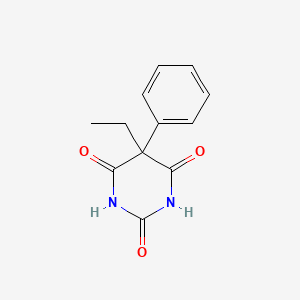
1 2D Structure

Phenobarbital

2 Identification
2.1 Computed Descriptors
2.1.1 IUPAC Name
5-ethyl-5-phenyl-1,3-diazinane-2,4,6-trione
2.1.2 InChI
InChI=1S/C12H12N2O3/c1-2-12(8-6-4-3-5-7-8)9(15)13-11(17)14-10(12)16/h3-7H,2H2,1H3,(H2,13,14,15,16,17)
2.1.3 InChI Key
DDBREPKUVSBGFI-UHFFFAOYSA-N
2.1.4 Canonical SMILES
CCC1(C(=O)NC(=O)NC1=O)C2=CC=CC=C2
2.2 Other Identifiers
2.2.1 UNII
YQE403BP4D
2.3 Synonyms
2.3.1 MeSH Synonyms

1. Acid, Phenylethylbarbituric

2. Gardenal

3. Hysteps

4. Luminal

5. Monosodium Salt Phenobarbital

6. Phenemal

7. Phenobarbital Sodium

8. Phenobarbital, Monosodium Salt

9. Phenobarbitone

10. Phenylbarbital

11. Phenylethylbarbituric Acid

12. Sodium, Phenobarbital

2.3.2 Depositor-Supplied Synonyms

1. Phenobarbitone

2. Luminal

3. Phenobarbitol

4. 50-06-6

5. Phenylethylbarbiturate

6. Phenobarbituric Acid

7. Phenylethylmalonylurea

8. Fenobarbital

9. Gardenal

10. Phenemal

11. Adonal

12. Phenylethylbarbituric Acid

13. Nunol

14. Gardepanyl

15. Neurobarb

16. Phenaemal

17. Dormiral

18. Hysteps

19. Aphenylbarbit

20. Aphenyletten

21. Dezibarbitur

22. Lepinaletten

23. Lumofridetten

24. Aephenal

25. Agrypnal

26. Amylofene

27. Barbenyl

28. Barbiphenyl

29. Barbipil

30. Barbivis

31. Barbonal

32. Barbophen

33. Bialminal

34. Cabronal

35. Calmetten

36. Calminal

37. Cardenal

38. Codibarbita

39. Coronaletta

40. Cratecil

41. Doscalun

42. Ensobarb

43. Ensodorm

44. Episedal

45. Epsylone

46. Eskabarb

47. Fenbital

48. Fenylettae

49. Glysoletten

50. Haplopan

51. Hennoletten

52. Hypnaletten

53. Hypnette

54. Hypnogen

55. Hypnolone

56. Hypnoltol

57. Liquital

58. Lixophen

59. Lubergal

60. Lubrokal

61. Lumesettes

62. Luphenil

63. Nirvonal

64. Parkotal

65. Pharmetten

66. Phenemalum

67. Phenobal

68. Phenobarbyl

69. Phenoluric

70. Phenolurio

71. Phenomet

72. Phenonyl

73. Phenoturic

74. Phenyletten

75. Phenyral

76. Polcominal

77. Promptonal

78. Sedizorin

79. Sedonettes

80. Sedophen

81. Solfoton

82. Sombutol

83. Somnolens

84. Somnoletten

85. Somnosan

86. Spasepilin

87. Starifen

88. Starilettae

89. Teolaxin

90. Versomnal

91. Barbita

92. Bardorm

93. Bartol

94. Chinoin

95. Duneryl

96. Epanal

97. Epidorm

98. Epilol

99. Etilfen

100. Euneryl

101. Fenemal

102. Fenosed

103. Haplos

104. Henotal

105. Leonal

106. Lepinal

107. Linasen

108. Lumesyn

109. Luramin

110. Molinal

111. Noptil

112. Sedabar

113. Sedicat

114. Sedlyn

115. Sedofen

116. Sedonal

117. Sevenal

118. Somonal

119. Lumen

120. Seda-tablinen

121. 5-ethyl-5-phenylbarbituric Acid

122. Blu-phen

123. Nova-pheno

124. Solu-barb

125. Hypno-tablinetten

126. Stental Extentabs

127. Phen-bar

128. Phob

129. Phenobarb

130. Talpheno

131. Triabarb

132. Triphenatol

133. 5-phenyl-5-ethylbarbituric Acid

134. Phenobarbitalum

135. Tridezibarbitur

136. Zadoletten

137. Barbinal

138. Barbiphen

139. Damoral

140. Dormina

141. Lefebar

142. Lephebar

143. Stental

144. Teoloxin

145. Theoloxin

146. Zadonal

147. 5-ethyl-5-phenylpyrimidine-2,4,6(1h,3h,5h)-trione

148. Sk-phenobarbital

149. Thenobarbital

150. 2,4,6(1h,3h,5h)-pyrimidinetrione, 5-ethyl-5-phenyl-

151. 5-ethyl-5-phenyl-1,3-diazinane-2,4,6-trione

152. Dormital

153. Tedral

154. Phenylethylbarbitursaeure

155. Phenylaethylbarbitursaeure

156. 5-ethyl-5-phenyl-2,4,6(1h,3h,5h)-pyrimidinetrione

157. Barbituric Acid, 5-ethyl-5-phenyl-

158. 5-ethyl-5-phenyl-pyrimidine-2,4,6-trione

159. Barbilehae (barbilettae)

160. Component Of Tedral

161. Sedonal (sedative)

162. Component Of Slowten

163. Chebi:8069

164. Component Of Antrocol

165. Component Of Hecadrol

166. Component Of Bronkotabs

167. 5-ethyl-5-phenyl-2,4,6-(1h,3h,5h)pyrimidinetrione

168. Phenobarbital Civ

169. Component Of Primatene P

170. Nsc-9848

171. Chembl40

172. Phenobarbital (in Methanol Solution)

173. Nsc-128143

174. Component Of Valpin 50-pb

175. Yqe403bp4d

176. Austrominal

177. Phenobarbitonum

178. Ncgc00159493-02

179. Fenobarbitale

180. Fenobarbitale [dcit]

181. Elixir Of Phenobarbital

182. Phenobarbitalum [inn]

183. Dsstox_cid_1122

184. Chardonna-2

185. Dsstox_rid_75953

186. Dsstox_gsid_21122

187. Phenylethyl Barbituric Acid

188. Fenobarbital [inn-spanish]

189. Phenyl-ethyl-barbituric Acid

190. Phenobarbitalum [inn-latin]

191. Wln: T6vmvmv Fhj F2 Fr

192. Barbinol

193. Fenemal Recip

194. Cas-50-06-6

195. Levsin Pb Drops And Tablets

196. Ccris 502

197. Luminal (tn)

198. Phenobarbital (pb)

199. Acido 5-fenil-5-etilbarbiturico

200. Hsdb 3157

201. Acido 5-fenil-5-etilbarbiturico [italian]

202. 5-ethyl-5-phenyl-2,6(1h,3h,5h)-pyrimidinetrione

203. Einecs 200-007-0

204. Unii-yqe403bp4d

205. 2,6(1h,3h,5h)-pyrimidinetrione, 5-ethyl-5-phenyl-

206. Nsc 128143

207. Phenobar

208. Ai3-02726

209. Phenobarbital [usp:inn:ban:jan]

210. Tedral (salt/mix)

211. Primidone Impurity B

212. Tedrigen

213. Theophed

214. Kinesed (salt/mix)

215. Antrocol (salt/mix)

216. Donnatal (salt/mix)

217. Donnazyme (salt/mix)

218. Quadrinal (salt/mix)

219. Mephobarbital M (nor)

220. Barbidonna (salt/mix)

221. Bronkotabs (salt/mix)

222. Tedral Suspension

223. Chardonna-2 (salt/mix)

224. Phenobarbital [mi]

225. Epitope Id:116048

226. Phenobarbital [inn]

227. Phenobarbital [jan]

228. Phenobarbital [hsdb]

229. Phenobarbital [iarc]

230. Bidd:pxr0061

231. Oprea1_384816

232. Schembl16583

233. 5-ethyl-5-phenyl-hexahydropyrimidine-2,4,6-trione

234. Methylphenobarbital, M(nor-)

235. Mls001240232

236. Divk1c_000987

237. Phenobarbital [mart.]

238. Phenobarbitalum [hpus]

239. Phenobarbital [who-dd]

240. Phenobarbital [who-ip]

241. Gtpl2804

242. Dtxsid5021122

243. Schembl11114624

244. Hms503e15

245. Kbio1_000987

246. Nsc9848

247. Phenobarbital (jp17/usp/inn)

248. Ninds_000987

249. Hms2272g06

250. Phenobarbital [ep Impurity]

251. Phenobarbital Civ [usp-rs]

252. Phenobarbital [ep Monograph]

253. Tox21_111713

254. Tox21_200510

255. Bdbm50021437

256. Nsc128143

257. Phenobarbital [usp Monograph]

258. Stl367898

259. Zinc95588079

260. Component Of Primatene P (salt/mix)

261. Phenobarbital 0.1 Mg/ml In Methanol

262. Phenobarbital 1.0 Mg/ml In Methanol

263. Akos000605404

264. Akos015964976

265. Barbituric Acid, 5-ethyl-5-phenyl-,

266. Phenobarbitalum [who-ip Latin]

267. Ab02704

268. Db01174

269. Component Of Valpin 50-pb (salt/mix)

270. Idi1_000987

271. Nsc-128143-

272. Levsin Pb Drops And Tablets (salt/mix)

273. Ncgc00159493-03

274. Ncgc00159493-04

275. Ncgc00258064-01

276. Smr000058986

277. Primidone Impurity B [ep Impurity]

278. Db-051722

279. C07434

280. D00506

281. Phenobarbital Solution, 1.0 Mg/ml In Methanol

282. A827956

283. Q407241

284. Sr-01000313151

285. Methylphenobarbital Impurity A [ep Impurity]

286. Sr-01000313151-1

287. Phenobarbital, United States Pharmacopeia (usp) Reference Standard

288. Phenobarbital Solution, 1 Mg/ml In Methanol, Ampule Of 1 Ml, Certified Reference Material

289. 11097-06-6

290. Uqa

2.4 Create Date
2005-03-25
3 Chemical and Physical Properties
Molecular Weight 232.23 g/mol
Molecular Formula C12H12N2O3
XLogP31.5
Hydrogen Bond Donor Count2
Hydrogen Bond Acceptor Count3
Rotatable Bond Count2
Exact Mass232.08479225 g/mol
Monoisotopic Mass232.08479225 g/mol
Topological Polar Surface Area75.3 Ų
Heavy Atom Count17
Formal Charge0
Complexity339
Isotope Atom Count0
Defined Atom Stereocenter Count0
Undefined Atom Stereocenter Count0
Defined Bond Stereocenter Count0
Undefined Bond Stereocenter Count0
Covalently Bonded Unit Count1
4 Drug and Medication Information
4.1 Therapeutic Uses

Anticonvulsants; Carcinogens; Central Nervous System Depressants; Excitatory Amino Acid Antagonists; GABA Modulators; Sedatives, Barbiturate

National Library of Medicine's Medical Subject Headings online file (MeSH, 2009)


Phenobarbital is indicated for use as a sedative or as and anticonvulsant for the treatment of generalized and partial seizures.

Novak, K.M. (ed.). Drug Facts and Comparisons2008 Edition. Wolters Kluwer Health. St. Louis, Missouri 2008., p. 1443


/Phenobarbital is indicated/ as a hypnotic, for the short term management of of insomnia.

Novak, K.M. (ed.). Drug Facts and Comparisons2008 Edition. Wolters Kluwer Health. St. Louis, Missouri 2008., p. 1443


/Phenobarbital is indicated/ as a sedative, for the relief of anxiety, tension,and apprehension.

Novak, K.M. (ed.). Drug Facts and Comparisons2008 Edition. Wolters Kluwer Health. St. Louis, Missouri 2008., p. 1443


For more Therapeutic Uses (Complete) data for Phenobarbital (7 total), please visit the HSDB record page.


4.2 Drug Warning

Barbiturates have been shown to cause an incr incidence of fetal abnormalities. Risk-benefit must be carefully considered when the medication is required in life-threatening situations or in serious diseases for which other medications cannot be used or are ineffective. /Barbiturates/

USP Convention. USPDI - Drug Information for the Health Care Professional. 17th ed. Volume I. Rockville, MD: Convention, Inc., 1997. (Plus Updates)., p. 502


Use of barbiturates throughout the last trimester of pregnancy may cause physical dependence with resulting withdrawal symptoms in the neonate. In infants suffering from long-term exposure in utero, the acute withdrawal syndrome of seizures and hyperirritability has been reported to occur from birth to a delayed onset of up to 14 days. /Barbiturates/

USP Convention. USPDI - Drug Information for the Health Care Professional. 17th ed. Volume I. Rockville, MD: Convention, Inc., 1997. (Plus Updates)., p. 502


Use of barbiturates during labor may cause respiratory depression in the neonate, esp the premature neonate, because of immature hepatic function. /Barbiturates/

USP Convention. USPDI - Drug Information for the Health Care Professional. 17th ed. Volume I. Rockville, MD: Convention, Inc., 1997. (Plus Updates)., p. 503


The risk of barbiturate-induced hypothermia may be increased in elderly patients, especially with high doses or in acute overdoses of barbiturates. In addition, elderly patients are more likely to have age-related hepatic or renal function impairment, which may require a reduction of dosage in patients receiving a barbiturate. /Barbiturates/

USP Convention. USPDI - Drug Information for the Health Care Professional. 17th ed. Volume I. Rockville, MD: Convention, Inc., 1997. (Plus Updates)., p. 503


For more Drug Warnings (Complete) data for Phenobarbital (28 total), please visit the HSDB record page.


4.3 Minimum/Potential Fatal Human Dose

The toxic dose of barbiturates varies considerably but, in general, a severe reaction is likely to occur when the amount ingested is more than 10 times the usual oral hypnotic dose. Potentially lethal blood concentrations are those in excess of 80 ug/mL for phenobarbital, 50 ug/mL for amobarbital or butabarbital, and approximately 30 ug/mL for secobarbital or pentobarbital; however, some patients have survived much higher blood concentrations. /Barbiturates General Statement/

American Society of Health System Pharmacists; AHFS Drug Information 2009. Bethesda, MD. (2009), p. 2578


4.4 Drug Indication

For the treatment of all types of seizures except absence seizures.


Treatment of epilepsy


5 Pharmacology and Biochemistry
5.1 Pharmacology

Phenobarbital, the longest-acting barbiturate, is used for its anticonvulsant and sedative-hypnotic properties in the management of all seizure disorders except absence (petit mal).


5.2 MeSH Pharmacological Classification

GABA Modulators

Substances that do not act as agonists or antagonists but do affect the GAMMA-AMINOBUTYRIC ACID receptor-ionophore complex. GABA-A receptors (RECEPTORS, GABA-A) appear to have at least three allosteric sites at which modulators act: a site at which BENZODIAZEPINES act by increasing the opening frequency of GAMMA-AMINOBUTYRIC ACID-activated chloride channels; a site at which BARBITURATES act to prolong the duration of channel opening; and a site at which some steroids may act. GENERAL ANESTHETICS probably act at least partly by potentiating GABAergic responses, but they are not included here. (See all compounds classified as GABA Modulators.)


Cytochrome P-450 CYP2B6 Inducers

Drugs and compounds that induce the synthesis of CYTOCHROME P-450 CYP2B6. (See all compounds classified as Cytochrome P-450 CYP2B6 Inducers.)


Cytochrome P-450 CYP3A Inducers

Drugs and compounds that induce the synthesis of CYTOCHROME P-450 CYP3A. (See all compounds classified as Cytochrome P-450 CYP3A Inducers.)


Anticonvulsants

Drugs used to prevent SEIZURES or reduce their severity. (See all compounds classified as Anticonvulsants.)


Excitatory Amino Acid Antagonists

Drugs that bind to but do not activate excitatory amino acid receptors, thereby blocking the actions of agonists. (See all compounds classified as Excitatory Amino Acid Antagonists.)


Hypnotics and Sedatives

Drugs used to induce drowsiness or sleep or to reduce psychological excitement or anxiety. (See all compounds classified as Hypnotics and Sedatives.)


5.3 ATC Code

N03AA02

S76 | LUXPHARMA | Pharmaceuticals Marketed in Luxembourg | Pharmaceuticals marketed in Luxembourg, as published by d'Gesondheetskeess (CNS, la caisse nationale de sante, www.cns.lu), mapped by name to structures using CompTox by R. Singh et al. (in prep.). List downloaded from https://cns.public.lu/en/legislations/textes-coordonnes/liste-med-comm.html. Dataset DOI:10.5281/zenodo.4587355


N - Nervous system

N03 - Antiepileptics

N03A - Antiepileptics

N03AA - Barbiturates and derivatives

N03AA02 - Phenobarbital


5.4 Absorption, Distribution and Excretion

Absorption

Absorbed in varying degrees following oral, rectal or parenteral administration. The salts are more rapidly absorbed than are the acids. The rate of absorption is increased if the sodium salt is ingested as a dilute solution or taken on an empty stomach.


About 70-90% of an oral dose of phenobarbital is absorbed slowly from the GI tract. Following rectal administration of phenobarbital sodium, the drug is readily absorbed from the colon. Following oral administration of phenobarbital, peak blood concentrations are reached in 8-12 hours and peak brain concentrations in 10-15 hours. ... When phenobarbital sodium is administered IV, the onset of action usually occurs within 5 minutes and maximum effects are achieved within 30 minutes. IM or subcutaneous administration of phenobarbital sodium results in a slightly slower onset of action. The duration of action of parenterally administered phenobarbital sodium is usually 4-6 hours.

American Society of Health System Pharmacists; AHFS Drug Information 2009. Bethesda, MD. (2009), p. 2269


Barbiturates are absorbed in varying degrees following oral, rectal, or im administration. The sodium salts are more rapidly absorbed by all routes of administration than are the acids. The rate of oral absorption is increased when the sodium salt is ingested as a dilute solution or taken on an empty stomach. Alcohol also enhances the rate of absorption, possibly by increasing blood flow through the gastric mucosa. /Barbiturates General Statement/

American Society of Health System Pharmacists; AHFS Drug Information 2009. Bethesda, MD. (2009), p. 2579


Following oral or rectal administration, the onset of action varies from 10-30 minutes for amobarbital, aprobarbital, butabarbital, pentobarbital, and secobarbital and from 20-60 minutes for metharbital, mephobarbital, and phenobarbital. IM administration results in a slightly faster onset of action. Following iv administration of the sodium salts of amobarbital, pentobarbital, phenobarbital, or secobarbital, the onset of action ranges from almost immediately for methohexital, pentobarbital, and thiopental to 5 minutes for phenobarbital. Maximum effects of thiopental or pentobarbital are achieved within about 1 minute while as much as 30 minutes may be required with administration of phenobarbital. /Barbiturates General Statement/

American Society of Health System Pharmacists; AHFS Drug Information 2009. Bethesda, MD. (2009), p. 2579


The duration of sedative effects of all the barbiturates is usually 3-6 hours following iv administration and 6-8 hours when the drugs are administered by other routes. There appears to be very little difference in duration of hypnotic action among barbiturates used orally as hypnotics. Therefore, most authorities now believe that barbiturates should be classified according to their intended pharmacologic action (ie, sedative-hypnotic barbiturates and anesthetic barbiturates [methohexital, thiamylal (no longer commercially available in the US), thiopental]), rather than as long-acting (mephobarbital, metharbital, and phenobarbital), intermediate-acting (amobarbital and butabarbital), short-acting (aprobarbital, pentobarbital, and secobarbital), and ultrashort-acting (methohexital, thiopental). /Barbiturates General Statement/

American Society of Health System Pharmacists; AHFS Drug Information 2009. Bethesda, MD. (2009), p. 2579


For more Absorption, Distribution and Excretion (Complete) data for Phenobarbital (15 total), please visit the HSDB record page.


5.5 Metabolism/Metabolites

Hepatic (mostly via CYP2C19).


Phenobarbital is hydroxylated by the liver to form p-hydroxyphenobarbital, an inactive metabolite. Phenobarbital is a potent inducer of the enzymes involved in the metabolism of other drugs, but there is no conclusive evidence that phenobarbital accelerates its own metabolism.

American Society of Health System Pharmacists; AHFS Drug Information 2009. Bethesda, MD. (2009), p. 2584


The inactive metabolites of the barbiturates are excreted as conjugates of glucuronic acid.

Medical Economics Co; Physicians Desk Reference: Generics 2nd ed p.2458 (1996)


Biotransformation occurs primarily by the hepatic microsomal enzyme system. /Barbiturates/

USP Convention. USPDI - Drug Information for the Health Care Professional. 17th ed. Volume I. Rockville, MD: Convention, Inc., 1997. (Plus Updates)., p. 502


Metabolites of phenobarbital sodium produced in rats and guinea pigs are 5-(3,4-dihydroxy-1,5-cyclohexadien-1-yl)-5-ethylbarbituric acid; 5-(1-hydroxyethyl)-5-phenylbarbituric acid; 5-(3,4-dihydroxyphenyl)-5-ethylbarbituric acid; and 5-(4-hydroxyphenyl)-5-ethylbarbituric acid ...

IARC. Monographs on the Evaluation of the Carcinogenic Risk of Chemicals to Humans. Geneva: World Health Organization, International Agency for Research on Cancer, 1972-PRESENT. (Multivolume work). Available at: https://monographs.iarc.fr/ENG/Classification/index.php, p. V13 166 (1977)


For more Metabolism/Metabolites (Complete) data for Phenobarbital (6 total), please visit the HSDB record page.


Phenobarbital has known human metabolites that include p-Hydroxyphenobarbital.

Phenobarbital is a known human metabolite of (s)-mephobarbital.

S73 | METXBIODB | Metabolite Reaction Database from BioTransformer | DOI:10.5281/zenodo.4056560


5.6 Biological Half-Life

53 to 118 hours (mean 79 hours)


The plasma half-life for phenobarbital in adults ranges between 53 and 118 hours with an mean of 79 hours.

Medical Economics Co; Physicians Desk Reference: Generics 2nd ed p.2458 (1996)


The plasma half-life for phenobarbital in children and newborns (less than 48 hours old) ranges between 60 to 180 hours with a mean of 110 hours.

Medical Economics Co; Physicians Desk Reference: Generics 2nd ed p.2458 (1996)


5.7 Mechanism of Action

Phenobarbital acts on GABAA receptors, increasing synaptic inhibition. This has the effect of elevating seizure threshold and reducing the spread of seizure activity from a seizure focus. Phenobarbital may also inhibit calcium channels, resulting in a decrease in excitatory transmitter release. The sedative-hypnotic effects of phenobarbital are likely the result of its effect on the polysynaptic midbrain reticular formation, which controls CNS arousal.


/Phenobarbital/ produces anticonvulsant effects in subhypnotic doses. The drug lowers serum bilirubin concentrations in neonates and patients with congenital nonhemolytic unconjugated hyperbilirubinemia and patients with chronic intrahepatic cholestasis, presumably by induction of glucuronyl transferase, the enzyme which conjugates bilirubin.

American Society of Health System Pharmacists; AHFS Drug Information 2009. Bethesda, MD. (2009), p. 2584


The exact mechanism(s) by which barbiturates exert their effect on the CNS, has not been fully elucidated. However, it is believed that such effects are related, at least partially, to the drugs' ability to enhance the activity of gamma-aminobutyric acid (GABA), the principal inhibitory neurotransmitter in the CNS, by altering inhibitory synaptic transmissions that are mediated by GABAA receptors. /Barbiturates General Statement/

American Society of Health System Pharmacists; AHFS Drug Information 2009. Bethesda, MD. (2009), p. 2579


Although the drugs act throughout the CNS, a site of particular sensitivity is the polysynaptic midbrain reticular formation which is concerned with the arousal mechanism. Barbiturates induce an imbalance in central inhibitory and facilitatory mechanisms influencing the cerebral cortex and the reticular formation. The significance of the effect of barbiturates on neurotransmitters is unclear. It appears that the drugs decrease the excitability of both presynaptic and postsynaptic membranes. It has not been determined which of the various actions of barbiturates at cellular and synaptic levels are responsible for their sedative and hypnotic effects. /Barbiturates General Statement/

American Society of Health System Pharmacists; AHFS Drug Information 2009. Bethesda, MD. (2009), p. 2579


Relatively low doses of the barbiturates depress the sensory cortex, decrease motor activity, and produce sedation and drowsiness. In some patients, however, drowsiness may be preceded by a period of transient elation, confusion, euphoria, or excitement, especially after subhypnotic doses of aprobarbital, pentobarbital, or secobarbital. /Barbiturates General Statement/

American Society of Health System Pharmacists; AHFS Drug Information 2009. Bethesda, MD. (2009), p. 2579


For more Mechanism of Action (Complete) data for Phenobarbital (12 total), please visit the HSDB record page.


API SUPPLIERS

read-more
read-more

01

Chemische Fabrik Berg

Germany

USDMF, CEP/COS, JDMF, EU-WC, NDC, KDMF, VMF, Others

USDMF CEP/COS arrow-down JDMF EU-WC NDC arrow-down KDMF VMF Others AUDIT arrow-down
Moehs Chemische Fabrik Berg

02

Moehs Iberica

Spain

USDMF, CEP/COS, JDMF, EU-WC, NDC, KDMF, VMF, Others

  • fda
  • EDQM
  • WHO-GMP

Virtual BoothMoehs Group, a reference company in the production of pharmaceutical active ingredients.

Flag Spain
Digital Content Digital Content
USDMF CEP/COS JDMF EU-WC NDC KDMF VMF Others AUDIT arrow-down
Moehs Iberica

03

HRV Pharma

India

USDMF, CEP/COS, JDMF, EU-WC, NDC, KDMF, VMF, Others

  • fda
  • EDQM
  • WHO-GMP

Virtual BoothHRV Pharma - Market Expansion Leader in Pharmaceuticals.

Flag India
Digital Content Digital Content
USDMF CEP/COS JDMF EU-WC NDC KDMF VMF Others AUDIT
HRV Global Life Sciences

04

Shandong Xinhua Pharmaceutical

China

USDMF, CEP/COS, JDMF, EU-WC, NDC, KDMF, VMF, Others

AACR Annual meeting
Not Confirmed
arrow

Shandong Xinhua Pharmaceutical

China

USDMF, CEP/COS, JDMF, EU-WC, NDC, KDMF, VMF, Others

arrow
AACR Annual meeting
Not Confirmed
USDMF arrow-down CEP/COS arrow-down JDMF EU-WC NDC arrow-down KDMF VMF Others AUDIT arrow-down
blank

05

Nantong Jinghua Pharmaceutical

China

USDMF, CEP/COS, JDMF, EU-WC, NDC, KDMF, VMF, Others

AACR Annual meeting
Not Confirmed
arrow

Nantong Jinghua Pharmaceutical

China

USDMF, CEP/COS, JDMF, EU-WC, NDC, KDMF, VMF, Others

arrow
AACR Annual meeting
Not Confirmed
USDMF arrow-down CEP/COS arrow-down JDMF EU-WC NDC arrow-down KDMF VMF Others AUDIT arrow-down
blank

06

Alkaloida Chemical Company Zrt

Hungary

USDMF, CEP/COS, JDMF, EU-WC, NDC, KDMF, VMF, Others

AACR Annual meeting
Not Confirmed
arrow

Alkaloida Chemical Company Zrt

Hungary

USDMF, CEP/COS, JDMF, EU-WC, NDC, KDMF, VMF, Others

arrow
AACR Annual meeting
Not Confirmed
USDMF arrow-down CEP/COS arrow-down JDMF EU-WC NDC arrow-down KDMF VMF Others AUDIT arrow-down
blank

07

Country

USDMF, CEP/COS, JDMF, EU-WC, NDC, KDMF, VMF, Others

AACR Annual meeting
Not Confirmed
arrow

USDMF, CEP/COS, JDMF, EU-WC, NDC, KDMF, VMF, Others

arrow
AACR Annual meeting
Not Confirmed
USDMF Inactive-api CEP/COS JDMF EU-WC NDC KDMF VMF Others AUDIT
blank

08

Country

USDMF, CEP/COS, JDMF, EU-WC, NDC, KDMF, VMF, Others

AACR Annual meeting
Not Confirmed
arrow

USDMF, CEP/COS, JDMF, EU-WC, NDC, KDMF, VMF, Others

arrow
AACR Annual meeting
Not Confirmed
USDMF Inactive-api CEP/COS JDMF EU-WC NDC KDMF VMF Others AUDIT
blank

09

F. Hoffmann-La Roche

Switzerland

USDMF, CEP/COS, JDMF, EU-WC, NDC, KDMF, VMF, Others

AACR Annual meeting
Not Confirmed
arrow

F. Hoffmann-La Roche

Switzerland

USDMF, CEP/COS, JDMF, EU-WC, NDC, KDMF, VMF, Others

arrow
AACR Annual meeting
Not Confirmed
USDMF Inactive-api CEP/COS JDMF EU-WC NDC KDMF VMF Others AUDIT
blank

10

Harman Finochem

India

USDMF, CEP/COS, JDMF, EU-WC, NDC, KDMF, VMF, Others

AACR Annual meeting
Not Confirmed
arrow

Harman Finochem

India

USDMF, CEP/COS, JDMF, EU-WC, NDC, KDMF, VMF, Others

arrow
AACR Annual meeting
Not Confirmed
USDMF CEP/COS JDMF EU-WCarrow-down NDC KDMF VMF Others AUDIT arrow-down
blank
click full view
Full Screen ViewFULL SCREEN VIEW Click here to open all results in a new tab [this preview display 10 results]

Related Excipient Companies

Upload your portfolio for free, ask us

Excipients by Applications

Click here to find the perfect excipient manufacturers by their capabilities

Fillers, Diluents & Binders

read-more
read-more

Direct Compression

read-more
read-more

Granulation

read-more
read-more

Lubricants & Glidants

read-more
read-more

Thickeners and Stabilizers

read-more
read-more

Disintegrants & Superdisintegrants

read-more
read-more

Taste Masking

read-more
read-more

Coating Systems & Additives

read-more
read-more

Film Formers & Plasticizers

read-more
read-more

Co-Processed Excipients

read-more
read-more

Parenteral

read-more
read-more

Chewable & Orodispersible Aids

read-more
read-more

Topical

read-more
read-more

Controlled & Modified Release

read-more
read-more

Emulsifying Agents

read-more
read-more

API Stability Enhancers

read-more
read-more

Soft Gelatin

read-more
read-more

Surfactant & Foaming Agents

read-more
read-more

Rheology Modifiers

read-more
read-more

Digital Content read-more

Create Content with PharmaCompass, ask us

NEWS #PharmaBuzz

read-more
read-more

Global Sales Information

Do you need Business Intel? Ask us

Market Place

Do you need sourcing support? Ask us

REF. STANDARDS & IMPURITIES

Upload your portfolio for free, ask us

ABOUT THIS PAGE

Looking for 50-06-6 / Phenobarbital API manufacturers, exporters & distributors?

Phenobarbital manufacturers, exporters & distributors 1

47

PharmaCompass offers a list of Phenobarbital API manufacturers, exporters & distributors, which can be sorted by GMP, USDMF, JDMF, KDMF, CEP (COS), WC, and more, enabling you to easily find the right Phenobarbital manufacturer or Phenobarbital supplier for your needs.

Send us enquiries for free, and we will assist you in establishing a direct connection with your preferred Phenobarbital manufacturer or Phenobarbital supplier.

API | Excipient name

Phenobarbital

Synonyms

Phenobarbitone, Luminal, Phenobarbitol, 50-06-6, Phenylethylbarbiturate, Phenobarbituric acid

Cas Number

50-06-6

Unique Ingredient Identifier (UNII)

YQE403BP4D

About Phenobarbital

A barbituric acid derivative that acts as a nonselective central nervous system depressant. It potentiates GAMMA-AMINOBUTYRIC ACID action on GABA-A RECEPTORS, and modulates chloride currents through receptor channels. It also inhibits glutamate induced depolarizations.

Solfoton talpheno Manufacturers

A Solfoton talpheno manufacturer is defined as any person or entity involved in the manufacture, preparation, processing, compounding or propagation of Solfoton talpheno, including repackagers and relabelers. The FDA regulates Solfoton talpheno manufacturers to ensure that their products comply with relevant laws and regulations and are safe and effective to use. Solfoton talpheno API Manufacturers are required to adhere to Good Manufacturing Practices (GMP) to ensure that their products are consistently manufactured to meet established quality criteria.

click here to find a list of Solfoton talpheno manufacturers with USDMF, JDMF, KDMF, CEP, GMP, and COA related information on PhamaCompass.

Solfoton talpheno Suppliers

A Solfoton talpheno supplier is an individual or a company that provides Solfoton talpheno active pharmaceutical ingredient (API) or Solfoton talpheno finished formulations upon request. The Solfoton talpheno suppliers may include Solfoton talpheno API manufacturers, exporters, distributors and traders.

click here to find a list of Solfoton talpheno suppliers with USDMF, JDMF, KDMF, CEP, GMP, and COA related information on PharmaCompass.

Solfoton talpheno USDMF

A Solfoton talpheno DMF (Drug Master File) is a document detailing the whole manufacturing process of Solfoton talpheno active pharmaceutical ingredient (API) in detail. Different forms of Solfoton talpheno DMFs exist exist since differing nations have different regulations, such as Solfoton talpheno USDMF, ASMF (EDMF), JDMF, CDMF, etc.

A Solfoton talpheno DMF submitted to regulatory agencies in the US is known as a USDMF. Solfoton talpheno USDMF includes data on Solfoton talpheno's chemical properties, information on the facilities and procedures used, and details about packaging and storage. The Solfoton talpheno USDMF is kept confidential to protect the manufacturer’s intellectual property.

click here to find a list of Solfoton talpheno suppliers with USDMF on PharmaCompass.

Solfoton talpheno JDMF

The Pharmaceuticals and Medical Devices Agency (PMDA) established the Japan Drug Master File (JDMF), also known as the Master File (MF), to permit Japanese and foreign manufacturers of drug substances, intermediates, excipients, raw materials, and packaging materials (‘Products’) to voluntarily register confidential information about the production and management of their products in Japan.

The Solfoton talpheno Drug Master File in Japan (Solfoton talpheno JDMF) empowers Solfoton talpheno API manufacturers to present comprehensive information (e.g., production methods, data, etc.) to the review authority, i.e., PMDA (Pharmaceuticals & Medical Devices Agency).

PMDA reviews the Solfoton talpheno JDMF during the approval evaluation for pharmaceutical products. At the time of Solfoton talpheno JDMF registration, PMDA checks if the format is accurate, if the necessary items have been included (application), and if data has been attached.

click here to find a list of Solfoton talpheno suppliers with JDMF on PharmaCompass.

Solfoton talpheno CEP

A Solfoton talpheno CEP of the European Pharmacopoeia monograph is often referred to as a Solfoton talpheno Certificate of Suitability (COS). The purpose of a Solfoton talpheno CEP is to show that the European Pharmacopoeia monograph adequately controls the purity of Solfoton talpheno EP produced by a given manufacturer. Suppliers of raw materials can prove the suitability of Solfoton talpheno to their clients by showing that a Solfoton talpheno CEP has been issued for it. The manufacturer submits a Solfoton talpheno CEP (COS) as part of the market authorization procedure, and it takes on the role of a Solfoton talpheno CEP holder for the record. Additionally, the data presented in the Solfoton talpheno CEP (COS) is managed confidentially and offers a centralized system acknowledged by numerous nations, exactly like the Solfoton talpheno DMF.

A Solfoton talpheno CEP (COS) is recognised by all 36 nations that make up the European Pharmacopoeia Convention. Solfoton talpheno CEPs may be accepted in nations that are not members of the Ph. Eur. at the discretion of the authorities there.

click here to find a list of Solfoton talpheno suppliers with CEP (COS) on PharmaCompass.

Solfoton talpheno WC

A Solfoton talpheno written confirmation (Solfoton talpheno WC) is an official document issued by a regulatory agency to a Solfoton talpheno manufacturer, verifying that the manufacturing facility of a Solfoton talpheno active pharmaceutical ingredient (API) adheres to the Good Manufacturing Practices (GMP) regulations of the importing country. When exporting Solfoton talpheno APIs or Solfoton talpheno finished pharmaceutical products to another nation, regulatory agencies frequently require a Solfoton talpheno WC (written confirmation) as part of the regulatory process.

click here to find a list of Solfoton talpheno suppliers with Written Confirmation (WC) on PharmaCompass.

Solfoton talpheno NDC

National Drug Code is a comprehensive database maintained by the FDA that contains information on all drugs marketed in the US. This directory includes information about finished drug products, unfinished drug products, and compounded drug products, including those containing Solfoton talpheno as an active pharmaceutical ingredient (API).

Finished drug products

The FDA updates the NDC directory daily. The NDC numbers for Solfoton talpheno API and other APIs are published in this directory by the FDA.

Unfinished drugs

The NDC unfinished drugs database includes product listing information submitted for all unfinished drugs, such as active pharmaceutical ingredients (APIs), drugs intended for further processing and bulk drug substances for compounding.

Pharmaceutical companies that manufacture Solfoton talpheno as an active pharmaceutical ingredient (API) must furnish the FDA with an updated record of all drugs that they produce, prepare, propagate, compound, or process for commercial distribution in the US at their facilities.

Compounded drug products

The NDC directory also contains data on finished compounded human drug products that contain Solfoton talpheno and are produced by outsourcing facilities. While these outsourcing facilities are not mandated to assign a Solfoton talpheno NDC to their finished compounded human drug products, they may choose to do so.

click here to find a list of Solfoton talpheno suppliers with NDC on PharmaCompass.

Solfoton talpheno GMP

Solfoton talpheno Active pharmaceutical ingredient (API) is produced in GMP-certified manufacturing facility.

GMP stands for Good Manufacturing Practices, which is a system used in the pharmaceutical industry to make sure that goods are regularly produced and monitored in accordance with quality standards. The FDA’s current Good Manufacturing Practices requirements are referred to as cGMP or current GMP which indicates that the company follows the most recent GMP specifications. The World Health Organization (WHO) has its own set of GMP guidelines, called the WHO GMP. Different countries can also set their own guidelines for GMP like China (Chinese GMP) or the EU (EU GMP).

PharmaCompass offers a list of Solfoton talpheno GMP manufacturers, exporters & distributors, which can be sorted by USDMF, JDMF, KDMF, CEP (COS), WC, and more, enabling you to easily find the right Solfoton talpheno GMP manufacturer or Solfoton talpheno GMP API supplier for your needs.

Solfoton talpheno CoA

A Solfoton talpheno CoA (Certificate of Analysis) is a formal document that attests to Solfoton talpheno's compliance with Solfoton talpheno specifications and serves as a tool for batch-level quality control.

Solfoton talpheno CoA mostly includes findings from lab analyses of a specific batch. For each Solfoton talpheno CoA document that a company creates, the USFDA specifies specific requirements, such as supplier information, material identification, transportation data, evidence of conformity and signature data.

Solfoton talpheno may be tested according to a variety of international standards, such as European Pharmacopoeia (Solfoton talpheno EP), Solfoton talpheno JP (Japanese Pharmacopeia) and the US Pharmacopoeia (Solfoton talpheno USP).


Inform the supplier about your product requirements, specifying if you need a product with particular monograph like EP (Ph. Eur.), USP, JP, BP, or any other quality. In addition, clarify whether you need hydrochloride (HCl), anhydricum, base, micronisatum or a specific level of purity. To find reputable suppliers, utilize the filters and select those certified by GMP, FDA, or any other certification as per your requirement.
For your convenience, we have listed synonyms and CAS numbers to help you find the best supplier. The use of synonyms and CAS numbers can be helpful in identifying potential suppliers, but it is crucial to note that they might not always indicate the exact same product. It is important to confirm the product details with the supplier before making a purchase to ensure that it meets your requirements.
Ask Us for Pharmaceutical Supplier and Partner
Ask Us, Find A Supplier / Partner
No Commissions, No Strings Attached, Get Connected for FREE

What are you looking for?

How can we help you?

The request can't be empty

Please read our Privacy Policy carefully

You must agree to the privacy policy

The name can't be empty
The company can't be empty.
The email can't be empty Please enter a valid email.
The mobile can't be empty