



NEWS
- Pharma & Biotech News #PharmaBuzz
- Weekly News Recap #Phispers
- Recent Product Approvals #GreenLight
- Quality Compliance Alerts #Warning!
- All News #Library
DRUGS & DEVELOPMENTS
MARKET INTEL by PharmaCompass

Create content with us, ask us

Phispers On Air
Click & Listen
By PharmaCompass
2026-04-16
Impressions: 2,351 Article || 198 Video || 5 Listen
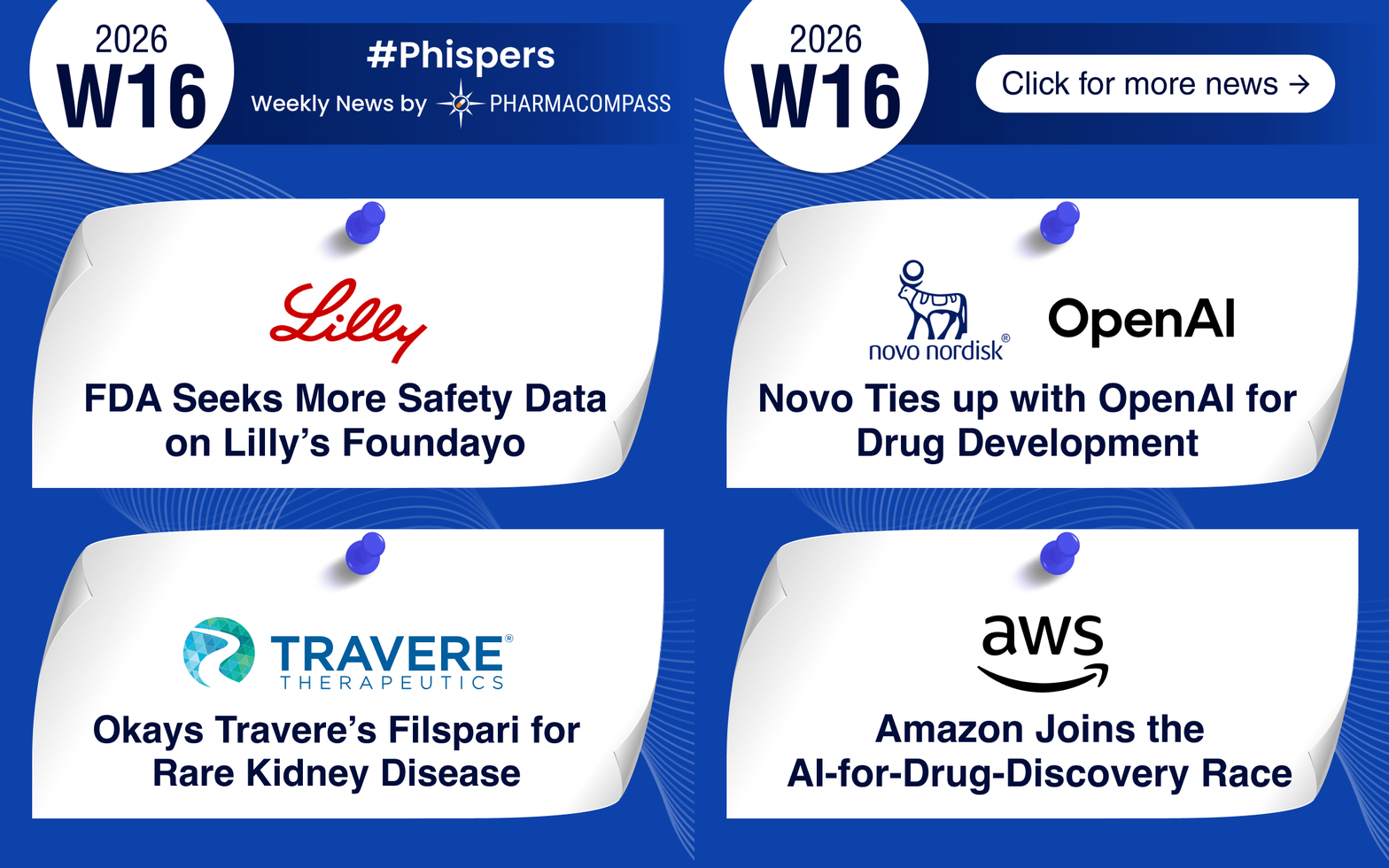
This week’s Phispers brings you news on how artificial intelligence (AI) is taking centerstage in the world of pharmaceuticals. Novo Nordisk has partnered with OpenAI to deploy AI across its business — from drug discovery to manufacturing and commercial operations. Amazon Web Services launched a new AI-driven platform — Amazon Bio Discovery — to speed up early-stage research. And Novartis CEO Vasant Narasimhan joined the board of AI giant Anthropic.
Recently, the US Food and Drug Administration (FDA) had approved Eli Lilly’s GLP-1 obesity drug Foundayo (orforglipron). But this week, there is news that the agency has asked for more data to assess its safety profile, especially risks related to liver injury and cardiovascular events.
Johnson & Johnson posted sales of US$ 24.1 billion in the first quarter (Q1), a growth of 9.9 percent. The company has increased its 2026 guidance with estimated sales of US$ 100.8 billion.
Meanwhile, FDA has expanded the approval of Travere Therapeutics’ Filspari (sparsentan) to treat a rare kidney disease. The agency declined to approve Replimune’s Tudriqev (vusolimogene oderparepvec) for a second time as a treatment for advanced skin cancer.
In news from clinical trials, Eli Lilly’s Jaypirca (pirtobrutinib) showed benefit in chronic lymphocytic leukemia (CLL). And Revolution’s Medicines’ experimental oral drug daraxonrasib helped patients with a highly aggressive form of pancreatic cancer live nearly twice as long as those treated with chemotherapy.
An investigation by an Indian newspaper found that counterfeit versions of Merck’s blockbuster Keytruda (pembrolizumab) were being sold to desperate patients in India.
In deals, Japan’s Suntory Holdings is acquiring Daiichi Sankyo’s over-the-counter (OTC) drug unit for US$ 1.55 billion. And Australia’s Telix Pharmaceuticals has entered into a collaboration with Regeneron Pharmaceuticals to jointly develop and commercialize next-generation radiopharmaceutical therapies.
FDA seeks safety data on Lilly’s newly approved obesity drug Foundayo
FDA has asked for more safety data on liver injury linked to Eli Lilly’s Foundayo (orforglipron), a once-daily oral medication approved recently to treat obesity. The approval was fast-tracked under the agency’s new voucher program. FDA has asked Lilly to conduct post-marketing trials to assess risks related to cardiovascular events and stomach emptying. It has also asked the company to conduct a study in lactating women who have received Foundayo to assess concentrations of the drug in breast milk and to obtain more information about the medicine’s potential link to major adverse cardiovascular events and drug-induced liver injury.
J&J posts 9.9% sales growth in Q1: Johnson & Johnson is off to a good start in 2026 — it posted sales growth of 9.9 percent to US$ 24.1 billion in Q1 2026, thereby beating analyst expectations. The company has increased its 2026 guidance with estimated reported sales of US$ 100.8 billion.
Novo partners OpenAI to speed up drug development; Amazon launches AI platform
Novo Nordisk is partnering OpenAI to deploy AI across its business, from drug discovery to manufacturing and commercial operations. The partnership will apply advanced AI capabilities to analyze complex datasets, identify promising drug candidates, and reduce the time required to move a drug from research to patients.
Amazon joins the AI-for-drug-discovery race: Amazon Web Services has launched Amazon Bio Discovery, an AI-driven platform designed to speed up early-stage drug discovery by allowing researchers to run complex computational workflows without writing code. These models generate and evaluate potential drug molecules, helping scientists accelerate the development of therapies during the early stages of drug discovery.
Meanwhile, AI giant Anthropic has appointed Novartis CEO Vasant Narasimhan to its board of directors.
FDA expands approval for Travere’s Filspari to treat rare kidney disease
FDA has expanded the approval of Travere Therapeutics’ Filspari (sparsentan) to treat a rare kidney disease known as focal segmental glomerulosclerosis (FSGS) without nephrotic syndrome. In this disease, parts of the filtering units of the kidney are scarred, leading to protein in the urine, swelling and even kidney failure. Filspari is the first and only medicine approved by the FDA for this condition. The drug was originally approved in 2023 for the treatment of IgA nephropathy, another kidney disease.
Rejects Replimune’s skin cancer drug: FDA has declined to approve Replimune’s Tudriqev (vusolimogene oderparepvec) for a second time, after rejecting it last year. Tudriqev was being tested in combination with Bristol Myers Squibb’s Opdivo (nivolumab) to treat an advanced skin cancer. In its complete response letter, the agency has raised concerns about the drug’s reliance on a single‑arm study and has asked Replimune to provide data from a well‑controlled trial.
Revolution’s pancreatic cancer drug doubles survival time in key late-stage trial
Revolution Medicines’ experimental oral drug — daraxonrasib — helped patients with a highly aggressive form of pancreatic cancer live nearly twice as long as those treated with chemotherapy in a key late-stage trial. The late-stage trial enrolled patients with metastatic pancreatic ductal adenocarcinoma (PDAC) for whom previous treatment had failed. In an interim analysis of a late-stage trial, daraxonrasib achieved overall survival of 13.2 months compared to 6.7 months for chemotherapy.
Lilly’s Jaypirca shows benefit in lymphocytic leukemia: Eli Lilly’s Jaypirca (pirtobrutinib) scored a phase 3 win in chronic lymphocytic leukemia (CLL), a slow-growing cancer of the blood and bone marrow. The study showed that adding Jaypirca to a fixed-duration regimen of venetoclax and rituximab significantly extended progression-free survival (PFS), compared with the standard combination alone. Treatment in both study arms was administered for up to two years.
Counterfeit Keytruda case exposes oncology supply-chain gaps in India
An investigation by The Indian Express has revealed that counterfeit versions of Merck’s blockbuster immunotherapy Keytruda (pembrolizumab) were allegedly sold to desperate patients in India after genuine vials were diverted from top hospitals in the country. The report also points out how Merck “deployed tactics to inflate the volume of prescriptions and keep the price high through lobbying, while seeking to prevent cheaper versions of Keytruda from reaching hundreds of thousands of cancer patients”.
Japan’s Suntory Holdings to buy Daiichi Sankyo’s OTC drug unit for US$ 1.55 billion
Japanese beverage group Suntory Holdings will acquire the over-the-counter(OTC) drug unit of Daiichi Sankyo for 246.5 billion yen (US$ 1.55 billion). The stock transfer is scheduled to be completed by June 2029. Meanwhile, Merck and Daiichi Sankyo have been granted FDA’s priority review of their biologics license application for ifinatamab deruxtecan to treat extensive-stage small cell lung cancer (ES-SCLC)
Regeneron partners Australia’s Telix: Australia’s Telix Pharmaceuticals has entered into a collaboration with Regeneron Pharmaceuticals to jointly develop and commercialize next-generation radiopharmaceutical therapies. The collaboration will include multiple solid tumor targets from Regeneron’s portfolio of antibodies.
The PharmaCompass Newsletter – Sign Up, Stay Ahead
Feedback, help us to improve. Click here
Image Credit : Phispers Infographic by PharmaCompass license under CC BY 2.0
“ The article is based on the information available in public and which the author believes to be true. The author is not disseminating any information, which the author believes or knows, is confidential or in conflict with the privacy of any person. The views expressed or information supplied through this article is mere opinion and observation of the author. The author does not intend to defame, insult or, cause loss or damage to anyone, in any manner, through this article.”