


NEWS
- Pharma & Biotech News #PharmaBuzz
- Weekly News Recap #Phispers
- Recent Product Approvals #GreenLight
- Quality Compliance Alerts #Warning!
- All News #Library
DRUGS & DEVELOPMENTS
MARKET INTEL by PharmaCompass

Create content with us, ask us
By PharmaCompass
2021-09-02
Impressions: 2,482 Article
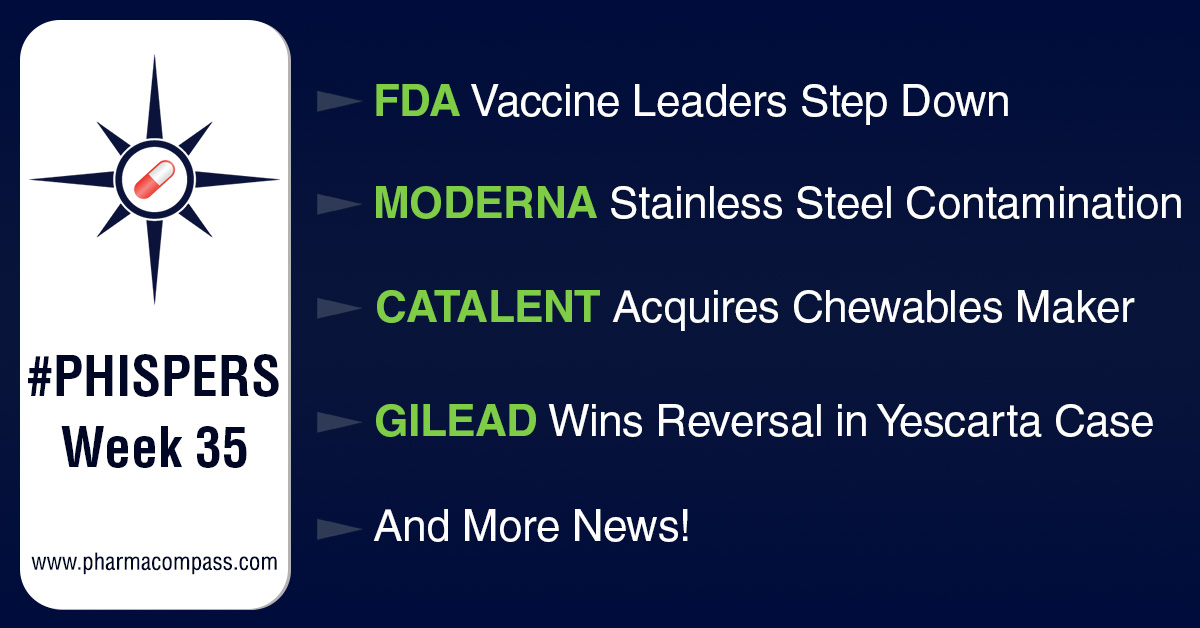
This week, Phispers brings you news about two high profile exits at the US Food and Drug Administration that have led to concerns over rising frustrations within the agency due to the Biden administration getting into its lane insofar as approving booster doses is concerned.
There was more trouble for Moderna’s Covid vaccine as Japan suspended one million additional doses after reports of contamination of more lots. After thorough investigation, Moderna identified the contaminant to be stainless steel.
Contract drug manufacturer Catalent announced it is buying nutritional supplements company Bettera Holdings for US$ 1 billion.
After two former staffers of Roche’s Genentech pleaded guilty to conspiring to steal trade secrets to aid competitors in July, co-founders of Taiwanese company — JHL Biotech — who co-conspired with them have also admitted to the conspiracy.
And Gilead’s Kite Pharma won reversal of the US$ 1.2 billion award to Bristol Myers in a patent infringement case pertaining to their CAR-T cancer therapies.
FDA’s vaccine leaders step down, raising questions over Biden’s decision on booster shots
Two of the US Food and Drug Administration’s most senior vaccine leaders are exiting from their positions, raising some serious questions about how the Biden administration may have sidelined the agency.




Marion Gruber, director of the FDA’s Office of Vaccines Research & Review (OVRR) who has been with the agency for 32-years, is retiring on October 31. OVRR’s deputy director Phil Krause, who has been at the FDA for more than a decade, will leave in November, Center for Biologics Evaluation and Research (CBER) director Peter Marks said. These exits have come at a crucial time, as the agency evaluates vaccines for children below the age of 12 years.
The Biden administration recently jumped ahead of the FDA’s reviews of booster shots, and said they might be available by September 20. By setting a goal for boosters, the White House is getting ahead of where the science is and “prejudging what the FDA would say,” a CNN news report said.
FDA’s former acting chief scientist Luciana Borio said on Twitter: “FDA is losing two giants who helped bring us many safe and effective vaccines over decades of public service.”
Responding to tweets on whether the exits were linked to Biden’s announcement of booster shots, the White House Covid-19 Response Team said in a press briefing that the decision was made by and announced by America’s leading public health officials. “We announced our approach in order to stay ahead of the virus.”
A year ago, hundreds of scientists had written an urgent letter to the FDA in which they had said the agency must not “rush or politicize a vaccine”
The Biden administration has also faced criticism for not choosing a commissioner as yet. “We’re headed into September and there’s no permanant FDA commissioner,” Brad Loncar, a biotech investor said in a tweet. Concurred Walid Gellad, Director, Center for Pharmaceutical Policy and Prescribing: “The FDA is in need of a leader right now. The delay in nominating an FDA commissioner is putting the agency at risk.”
However, the White House Covid response team said the FDA “has strong leadership” in Janet Woodcock and Marks. “And their critical work continues as we work to get safe and effective vaccines to the American people.”
Stainless steel contaminants found in vials of Moderna vaccine in Japan as country suspends its use
Last week, we had brought you news about Japan withholding the supply of 1.63 million doses of Moderna’s Covid-19 vaccine, due to reports of contamination of vials with particulate matter. Moderna had traced the issue to a production line in Spain, where one of its manufacturing partners — Rovi Laboratories — produces the vaccines. Over the weekend, Japan suspended another one million doses of the vaccine over the same contamination concerns.
On Wednesday, Moderna, Takeda (Moderna’s distributor in Japan) and Rovi issued a joint statement wherein they said that after conducting a thorough investigation, they have identified the contaminant in the lots to be grade 316 stainless steel. “Grade 316 is a high grade of stainless steel commonly used in manufacturing and in food processing,” the statement said.
Japan’s health ministry has also said it did not believe the particles of stainless steel pose any additional health risk. Moderna suspects the stainless steel contamination to have occurred during production, due to friction between two pieces of metal in the machinery that puts stoppers on the vials.
Additionally, on Tuesday, a pharmacist in Kanagawa prefecture in Japan, spotted several black particles in a vial. The discovery came after 3,790 shots had been administered from the batch. Japan’s health ministry has said black particles found in a Moderna vaccine vial this week are believed to be rubber stopper material.
The issue of contaminants in Moderna vials gained more media attention due to the deaths of two men — aged 38 and 30 years — within days of receiving their second Moderna dose. Both the men had fever the day after their second dose and died two days after getting the fever. Both the men had been administered a dose from one of the suspended lots. The causes of death are being investigated.
“At this time, we do not have any evidence that these deaths are caused by the Moderna Covid-19 vaccine and it is important to conduct a formal investigation to determine whether there is any connection,” Moderna and Takeda said in a statement.
The news comes as Japan battles a surge in Covid-19 cases brought about by the delta variant. The country has been reporting over 20,000 cases daily over the last 10 days. A number of local governments in Japan have halted the use of the Moderna vaccine after last week’s suspension order. The Moderna vaccine was granted emergency-use authorization in Japan in May.
Catalent to buy chewable supplement maker Bettera Holdings for US$ 1 billion
Contract drug manufacturer Catalent Inc announced this week it has agreed to buy nutritional supplements company Bettera Holdings for US$ 1 billion. The transaction is expected to close by the end of this year.
Texas-based Bettera manufactures gummy, soft-chew and lozenge forms of vitamins and supplements. It is backed by private-equity firm Highlander Partners and has about 500 employees.
The acquisition includes the transfer of all employees, and product development, manufacturing, and packaging assets of Bettera, including its production facilities in California, Indiana, New Jersey, and Virginia.
Bettera posted sales of around US$ 150 million in 2020 and is expected to grow by at least 20 percent annually in the short term. According to Allied Market Research, chewable forms of vitamins are gaining popularity and the market is expected to reach US$ 9.3 billion by 2026.
Catalent has been involved in manufacturing Covid-19 vaccines for companies like Moderna, AstraZeneca and Johnson & Johnson. The all-cash deal expands Catalent’s manufacturing capabilities for vitamins, minerals and supplements.
“As the leading global innovator of softgel and oral technologies, Catalent has a strong, long-standing presence in the rapidly expanding consumer health and nutraceutical marketplace. This acquisition allows us to significantly accelerate the growth of our consumer health business and offer customers access to the substantial potential in gummies, soft chews, and lozenges, which are experiencing double-digit growth,” said Aris Gennadios, President, Softgel and Oral Technologies, Catalent.
After Lams, co-founders of Taiwanese biotech JHL plead guilty in Roche’s Genentech case
In early July, former staffers of Genentech — Xanthe Lam and her husband Allen Lam — had pleaded guilty to conspiring to steal trade secrets from the Roche subsidiary to aid competitors.
The couple had stolen confidential intellectual property related to the company’s top-selling cancer drugs Rituxan, Herceptin and Avastin, plus cystic fibrosis inhalation Pulmozyme and had passed on that information to Taiwanese firm JHL Biotech, now known as Eden Biologics, to help it develop their copycat versions.
This week, the US Department of Justice (DOJ) said the co-conspirators of the Tams and co-founders of JHL Biotech — Racho Jordanov and Rose Lin — have also pleaded guilty to charges of conspiring to steal trade secrets from Genentech and wire fraud. The two face possible prison sentences and monetary punishments, the DOJ said.
In December 2016, Jordanov and Lin had raked in US$ 101 million (including US$ 80 million investment in JHL) by signing a licensing deal for Rituxan biosimilar with Sanofi in China. In order to bag the deal, the duo had concealed the theft of trade secrets and falsely claimed that its biosimilar operations didn’t infringe upon rights of other companies.
Before setting up JHL, Jordanov and Lin were working at Genentech. In January 2014, Lin tapped Xanthe, then a principal scientist at Genentech, to secretly work as JHL’s head of formulation. To conceal Xanthe’s work for JHL, Lin paid Xanthe through her husband, DOJ said.
In September 2019, Genentech had entered into a “memorandum of understanding” with JHL in which the Taiwanese firm was “required to abandon development of and destroy all cell lines and cell banks associated with Genentech’s medicines…and cease from disclosing, using or sharing any confidential Genentech information in any way in its business”.
Gilead wins reversal of US$ 1.2 billion award to Bristol Myers in Yescarta case
In April last year, we had reported on how Bristol Myers Squibb (BMS) had been awarded US$ 1.2 billion in a major patent case win over Gilead’s Kite Pharma.
The two companies have been fighting a dispute in the US over Yescarta, the pioneering CAR-T cancer immunotherapy from Gilead’s Kite Pharma, in which the T-cells of a person’s own immune system are modified to attack cancer cells. BMS’ Juno Therapeutics has a similar therapy, and the company is accusing Gilead on infringing that patent.
Last year, BMS had managed to persuade a federal judge to increase damages to US$ 1.2 billion against Gilead’s Kite Pharma. However, last week there was news that Gilead has won a reversal of the US$ 1.2 billion award, as an appeals court in the US found the accusation to be invalid.
In a statement, BMS said it disagreed with the latest ruling and would seek a review of the Federal Circuit’s decision.
In 2017, Gilead had bought Kite Pharma (which developed CAR-T therapy Yescarta), for US$ 11.9 billion. The same year, Yescarta bagged FDA approval. In 2019, BMS acquired Juno and its CAR-T program through its US$ 74 billion buyout of Celgene.
The PharmaCompass Newsletter – Sign Up, Stay Ahead
Feedback, help us to improve. Click here
Image Credit : Phisper Infographic by SCORR MARKETING & PharmaCompass is licensed under CC BY 2.0
“ The article is based on the information available in public and which the author believes to be true. The author is not disseminating any information, which the author believes or knows, is confidential or in conflict with the privacy of any person. The views expressed or information supplied through this article is mere opinion and observation of the author. The author does not intend to defame, insult or, cause loss or damage to anyone, in any manner, through this article.”