

BLOG
MARKET INTEL by PharmaCompass
CONTENT by Suppliers
- Interview #SpeakPharma
- Video #SupplierSpotlight
- Vlog #PharmaReel
- Company Bio #AboutSupplier
- Services Bio #AboutCapabilities
News

Create content with us, ask us
By PharmaCompass
2021-09-16
Impressions: 1840
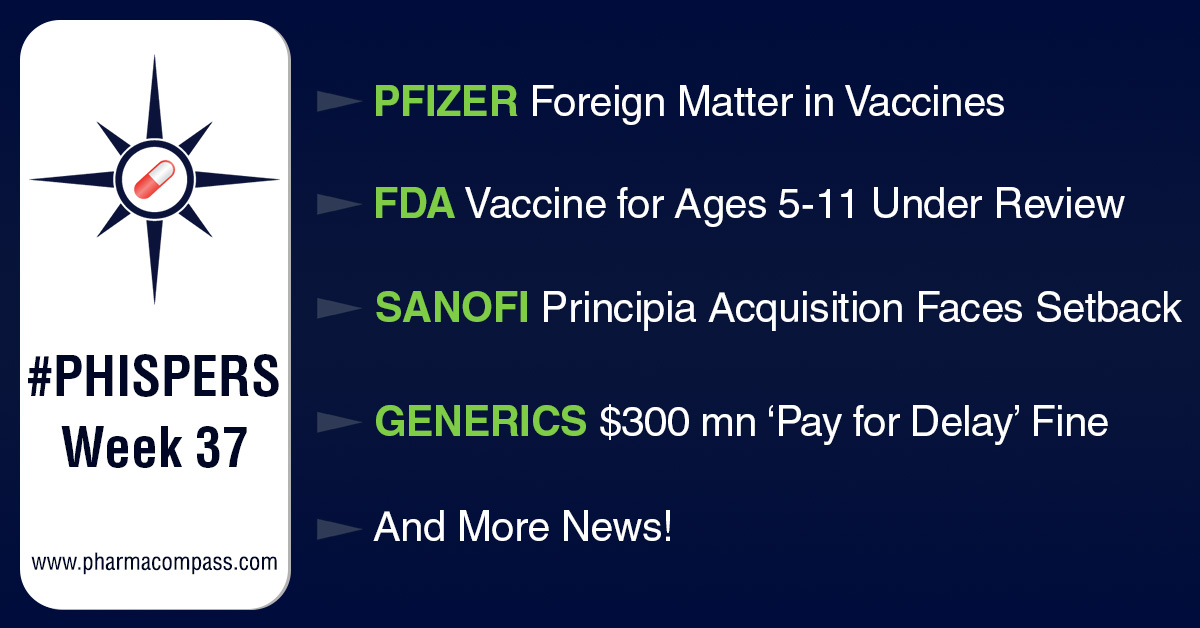
This week, Phispers brings you more updates on Covid-19 vaccines. After finding stainless steel in Moderna’s mRNA vaccine, three vaccination sites in Japan have found floating matter in Pfizer’s Covid-19 vaccine. Pfizer says it is most likely vaccine ingredients that haven’t fully dissolved.
The Biden administration’s deliberations over the need for booster dose of Covid vaccines saw more resistance with the FDA and a Lancet paper undermining its need. The agency has said vaccines cleared in the US currently provide sufficient protection against severe disease and death from Covid-19.
According to news reports, Pfizer’s vaccine for 5 to 11 year olds may bag FDA’s emergency use authorization by October-end.
In M&A news, Perrigo acquired consumer self-care firm HRA Pharma for US$ 2.1 billion. And Sanofi’s US$ 3.7 billion buyout of Principia Biopharma faced a major setback as Principia’s key candidate failed a phase 3 study in its lead indication. Sanofi had bought Principia in August last year.
There were two crucial research collaborations — Boehringer Ingelheim tied up with Twist Bioscience Corporation to use the latter’s proprietary antibody libraries to discover therapeutic antibodies against multiple targets provided by Boehringer Ingelheim; and Eli Lilly signed a US$ 50 million upfront pact with ProQR Therapeutics, along with US$ 1.25 billion in biobucks, for five targets that use ProQR’s Axiomer RNA editing platform.
In other news, Biogen’s CEO admitted that there is just too much controversy around Aduhelm, its Alzheimer’s drug that bagged FDA’s accelerated approval in June. And Bausch Health has agreed to pay US$ 300 million to settle ‘pay for delay’ antitrust lawsuit over its diabetes drug — Glumetza.
After stainless steel in Moderna’s jab, Japan finds foreign matter in Pfizer’s Covid vaccine
Last month, Moderna’s Covid-19 vaccine was in news as Japan had found particulate matter in the vials. The country had identified the contaminant to be a high grade of stainless steel. Moderna had traced the issue to a production line in Spain, where one of its manufacturing partners — Rovi Laboratories — produces the vaccines. As a result of this contamination, millions of doses of the vaccine had been suspended.





This week, there is news that Pfizer’s Covid-19 vaccine too has been found to be contaminated. According to an article published in Japan Times, foreign matter has been found in five unused vials of Pfizer’s Covid-19 vaccine in two cities near Tokyo and one in Osaka Prefecture.
The contaminants were discovered at three vaccination sites in Sagamihara between Saturday and Tuesday, one site in Kamakura on Sunday and one site in Sakai on Tuesday. According to reports, the vials containing a white floating matter belong to the same lot.
The three cities have asked Pfizer to analyze the substances. All three cities said that they did not use the doses containing the foreign matter.
According to Pfizer’s Japanese subsidiary, the material was likely vaccine ingredients that had not been fully dissolved. At a press conference, Pfizer said the foreign matter would not affect the safety or the performance of the vaccine. Since September 5, floating matter had been reported in 95 vials, Pfizer said.
“The Pfizer-BioNTech Covid-19 vaccine is manufactured under the strictest of controls to ensure consistent identity, quality, purity and potency to assure patient safety and efficacy,” the company said in a statement. “Pfizer is aware of the report, and is conducting a full investigation.”
New paper by outgoing FDA regulators undermine importance of Covid-19 booster shots
A fortnight back, we had reported on how two of the US Food and Drug Administration’s most senior vaccine leaders — Marion Gruber and Phil Krause — had exited their positions, raising some serious questions about how the Biden administration may have sidelined the agency.
In a new paper published in the Lancet, the two outgoing FDA vaccine regulators, along with other international experts, have now argued against offering Covid-19 vaccine boosters to the general population. Other authors include experts from the World Health Organization (WHO). The paper is based on a review of available data about the durability of vaccine protection.
In fact, on Wednesday, the FDA reinforced this belief after releasing the findings from a report submitted by Pfizer and BioNTech. The report is part of their request for authorization for their vaccine to be given as a booster shot to those who are 16 years of age, and older.
The FDA said vaccines cleared in the US currently provide sufficient protection against severe disease and death from Covid-19 without additional doses. This finding, coupled with the Lancet paper, potentially complicate the Biden administration’s deliberations over the need for booster shots. An outside panel of scientific advisers will review the FDA report on Friday, when it convenes a meeting of its vaccine advisory committee to discuss Pfizer’s plea for boosters.
CDC officials have also warned against signing off on boosters without adequate data. However, experts have disputed the Lancet report. Scientist Eric Topol said on Twitter that evidence on third shots is unequivocal for Pfizer’s vaccine. According to him, Israel’s data shows that vaccine efficacy is restored by a third shot for those over the age of 60 years.
Pfizer’s vaccine for 5 to 11 year olds may bag FDA’s authorization by Oct-end
Top American health officials believe that Pfizer-BioNTech’s Covid-19 vaccine could be authorized for five to 11 year old children by the end of October, a Reuters report said.
Pfizer and BioNTech expect to have enough data from clinical trials to seek FDA’s emergency use authorization (EUA) for that age group towards the end of this month. And, they expect FDA to make a decision on whether the shot is safe and effective in younger children within three weeks of the EUA submission.
According to sources quoted in the Reuters report, Anthony Fauci, America’s famous infectious disease expert, had recently outlined the timetable for vaccine authorizations. If Pfizer submits its EUA by the end of September, and the data support its use, “by the time we get to October, the first couple of weeks of October... the Pfizer product will likely be ready,” Fauci had said.
Fauci said that Moderna is likely to take about three weeks longer than Pfizer to collect and analyze its data on children aged 5 to 11 years and a decision on the Moderna shot could come around November.
Meanwhile, FDA has said children in clinical trials testing Covid-19 vaccines should be monitored for at least two months for side effects. Pfizer-BioNTech’s vaccine has been currently authorized for children aged 12 to 15 years in the United States. For children between six months and five years, Pfizer has said it expects to release clinical trial data as early as the end of October.
Perrigo acquires consumer self-care firm HRA Pharma for US$ 2.1 billion in cash
Perrigo has embarked on a three-year transformation plan to become a global leader in consumer self-care. And in order to fulfill that goal, the company announced this week that it would acquire leading consumer self-care company, HRA Pharma for US$ 2.1 billion (€1.8 billion) in cash.
To Perrigo, the HRA acquisition is seen as “the crowning achievement” in its multi-year transformation into a “focused and high-performing consumer self-care company,” CEO Murray Kessler said in a release. The buyout is expected to close by mid-2022.
According to a company statement, HRA is one of the fastest growing over-the-counter (OTC) companies globally, with three category-leading self-care brands in blister care (Compeed), women’s health (ellaOne) and scar care (Mederma).
BI, Twist Bioscience in research collaboration: Twist Bioscience Corporation and Boehringer Ingelheim International GmbH have announced a broad-based research collaboration to use Twist’s proprietary antibody libraries to discover therapeutic antibodies against multiple targets provided by Boehringer Ingelheim.
Under the terms of the agreement, Twist Biopharma, a division of Twist, will utilize its “Library of Libraries,” a panel of synthetic antibody phage display libraries derived only from sequences that exist in the human body, to identify potential therapeutic antibody candidates. Though synthetic, the tens of billions of sequences in Twist’s libraries have been structured to mimic only those that naturally appear in the human body.
Twist will receive an upfront payment for each program entry. In addition, Twist could earn up to a total of US$ 710 million in success-based clinical, regulatory and commercial milestone payments for the multiple target discovery programs.
Lilly in RNA alliance with ProQR: After teaming up with MiNA Therapeutics in May this year, Eli Lilly has signed another RNA research deal with ProQR Therapeutics. The collaboration is set to bolster ProQR’s Axiomer RNA editing platform and create new medicines that could treat a range of genetic disorders.
Lilly has signed a US$ 50 million upfront pact with ProQR, along with US$ 1.25 billion in biobucks for five targets that use its Axiomer RNA editing platform.
ProQR has been working on its RNA therapies for genetic eye diseases, including two programs in pivotal stage for Leber congenital amaurosis (LCA), the most common genetic cause of childhood blindness, and Usher syndrome, the leading cause of combined deafness and blindness.
Sanofi’s US$ 3.7 billion buyout of Principia Biopharma faces major setback
In August last year, Sanofi had bought US-based Principia Biopharma for US$ 3.7 billion to gain access to Principia’s pipeline in autoimmune diseases. They include a drug aimed at the rare but painful skin condition — pemphigus — and another against multiple sclerosis. Back then, the pemphigus drug — rilzabrutinib — was in phase 3 trials.
In a setback to Sanofi, rilzabrutinib has failed a key phase 3 study in its lead indication. Investigators randomized 131 newly diagnosed or relapsing moderate-to-severe pemphigus patients to take rilzabrutinib or placebo orally. The primary endpoint looked at the number of patients in each arm who were in complete remission and taking 10 mg or less of corticosteroids a day from week 29 to week 37 of the study. By that yardstick, rilzabrutinib was no better than placebo.
In a statement to disclose the phase 3 failure, Naimish Patel, Sanofi’s head of global development, immunology and inflammation, said the company still believes “the rilzabrutinib clinical program holds great potential to address the unmet treatment needs of people living with immune-mediated diseases.”
There was more bad news from Sanofi pertaining to Principia Biopharma. Days after rilzabrutinib failed clinical testing, Sanofi said it will wind down Principia’s San Francisco laboratories and lay off 38 employees. “This was a difficult decision, and we plan to undertake this process responsibly and assist our employees with this transition, Sanofi said.
Biogen’s CEO says too much controversy around Aduhelm, its Alzheimer’s drug
In June this year, Biogen’s Alzheimer’s drug — Aduhelm — bagged FDA’s accelerated approval. However, over the last three months, the approval has received much criticism.
Post its FDA approval, lawmakers and medical experts had questioned the data Biogen used to support Aduhelm’s approval. Even FDA’s procedures that led to the accelerated nod had been criticized. The FDA had originally endorsed the drug for all Alzheimer’s patients. However, post the criticism, it restricted the label to those with mild cognitive impairment or mild dementia.
Speaking at a Morgan Stanley healthcare event last week, Biogen’s CEO Michel Vounatsos said there is “clearly too much confusion, misinformation and controversy surrounding our data and the approval process.”
Vounatsos admitted that the launch of Aduhelm has been “slower than” anticipated. The company is facing “near-term challenges” Vounatsos said. Now, months after the drug’s approval, he said it’s “imperative” that “society moves its attention [from] the clinical data to the patients in need.”
Bausch to pay US$ 300 million to settle ‘pay for delay’ antitrust lawsuit over its diabetes drug
Bausch Health Companies, formerly known as Valeant, has been embroiled in a controversy over its diabetes drug Glumetza. An antitrust lawsuit has accused the company of illegally maintaining a monopoly over Glumetza, and hiking its price by nearly 800 percent in 2015.
Direct purchasers of Glumetza had filed an antitrust class action lawsuit, which was scheduled to go to trial next month. But now, Bausch Health has agreed to pay US$ 300 million to put those charges to rest.
Lawyers for the plaintiffs are now asking the US District Court for the Northern District of California to approve the settlement. If approved, it would be the largest or second-largest recovery ever obtained in a direct-purchaser class lawsuit.
Glumetza, an extended-release version of metformin, was first marketed in 2005 by Depomed Inc and Santarus Inc, which was later acquired by Bausch. Bausch has claimed that in 2012, Depomed and Santarus had paid off competitor Lupin Pharmaceuticals to delay launching a generic version of Glumetza until 2016 by agreeing to drop a patent lawsuit and provide other benefits.
The resulting monopoly allowed Bausch, then known as Valeant Pharmaceuticals, to hike the drug’s price in 2015 to US$ 51 per tablet, from US$ 5.72, the plaintiffs said.
Depomed, now known as Assertio Therapeutics Inc, and Lupin were also sued in the case. Assertio has settled, though terms have not been disclosed, while Lupin is still expected to go to trial in October.
The PharmaCompass Newsletter – Sign Up, Stay Ahead
Feedback, help us to improve. Click here
Image Credit : Phisper Infographic by SCORR MARKETING & PharmaCompass is licensed under CC BY 2.0
“ The article is based on the information available in public and which the author believes to be true. The author is not disseminating any information, which the author believes or knows, is confidential or in conflict with the privacy of any person. The views expressed or information supplied through this article is mere opinion and observation of the author. The author does not intend to defame, insult or, cause loss or damage to anyone, in any manner, through this article.”