Find Levetiracetam manufacturers, exporters & distributors on PharmaCompass

PharmaCompass

Synopsis

Chemistry

Click the arrow to open the dropdown
read-moreClick the button for full data set
Also known as: 102767-28-2, Keppra, (s)-2-(2-oxopyrrolidin-1-yl)butanamide, Keppra xr, (2s)-2-(2-oxopyrrolidin-1-yl)butanamide, Ucb l059
Molecular Formula
C8H14N2O2
Molecular Weight
170.21  g/mol
InChI Key
HPHUVLMMVZITSG-LURJTMIESA-N
FDA UNII
44YRR34555

Levetiracetam
A pyrrolidinone and acetamide derivative that is used primarily for the treatment of SEIZURES and some movement disorders, and as a nootropic agent.
The physiologic effect of levetiracetam is by means of Decreased Central Nervous System Disorganized Electrical Activity.
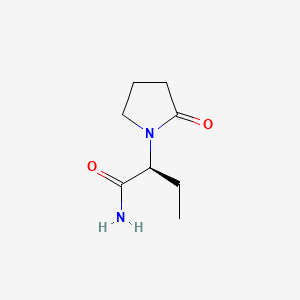
1 2D Structure

Levetiracetam

2 Identification
2.1 Computed Descriptors
2.1.1 IUPAC Name
(2S)-2-(2-oxopyrrolidin-1-yl)butanamide
2.1.2 InChI
InChI=1S/C8H14N2O2/c1-2-6(8(9)12)10-5-3-4-7(10)11/h6H,2-5H2,1H3,(H2,9,12)/t6-/m0/s1
2.1.3 InChI Key
HPHUVLMMVZITSG-LURJTMIESA-N
2.1.4 Canonical SMILES
CCC(C(=O)N)N1CCCC1=O
2.1.5 Isomeric SMILES
CC[C@@H](C(=O)N)N1CCCC1=O
2.2 Other Identifiers
2.2.1 UNII
44YRR34555
2.3 Synonyms
2.3.1 MeSH Synonyms

1. Alpha Ethyl 2 Oxo 1 Pyrrolidineacetamide

2. Alpha-ethyl-2-oxo-1-pyrrolidineacetamide

3. Etiracetam

4. Etiracetam, (r)-

5. Etiracetam, R Isomer

6. Etiracetam, R-isomer

7. Etiracetam, S Isomer

8. Etiracetam, S-isomer

9. Keppra

10. R-isomer Etiracetam

11. S-isomer Etiracetam

12. Ucb 6474

13. Ucb L059

14. Ucb L060

15. Ucb-6474

16. Ucb-l059

17. Ucb-l060

18. Ucb6474

19. Ucbl060

2.3.2 Depositor-Supplied Synonyms

1. 102767-28-2

2. Keppra

3. (s)-2-(2-oxopyrrolidin-1-yl)butanamide

4. Keppra Xr

5. (2s)-2-(2-oxopyrrolidin-1-yl)butanamide

6. Ucb L059

7. Ucb-l 059

8. Matever

9. Ucb-l059

10. Levetiracetame

11. Levetiracetamum

12. Spritam

13. (s)-alpha-ethyl-2-oxo-1-pyrrolidineacetamide

14. Sib-s1

15. Elepsia

16. Levetiracetam Sun

17. (-)-(s)-alpha-ethyl-2-oxo-1-pyrrolidineacetamide

18. Levetiracetam Teva

19. Ucb-22059

20. Levetiracetam Accord

21. Levetiracetam [inn]

22. Levetiracetam Actavis

23. Levetiracetam Hospira

24. N03ax14

25. Ucb 22059

26. Levetiracetamum [inn-latin]

27. Nsc-760119

28. 1-pyrrolidineacetamide, Alpha-ethyl-2-oxo-, (alphas)-

29. Chebi:6437

30. Levetiracetam In Sodium Chloride

31. Agb-101

32. 44yrr34555

33. Levroxa

34. (s)-(-)-alpha-ethyl-2-oxo-1-pyrrolidineacetamide

35. Leviteracetam

36. Levipil

37. Torleva

38. Elepsia Xr

39. (s)-levetiracetam

40. Smr000466303

41. Keppra (tn)

42. Levesam 500

43. Etiracetam Levo-isomer

44. Sr-01000759400

45. Mfcd03265610

46. Unii-44yrr34555

47. E Keppra

48. Hsdb 7528

49. Levetiracetam [usan:usp:inn:ban]

50. E Keppra (tn)

51. Levetiracetam Solution

52. Levetiracetam- Bio-x

53. (s)-2-(2-oxo-1-pyrrolidinyl)butyramide

54. L-059

55. Levetiracetam [mi]

56. Levetiracetam [jan]

57. Chembl1286

58. Levetiracetam [hsdb]

59. Levetiracetam [usan]

60. Levetiracetam [vandf]

61. 1-pyrrolidineacetamide, Alpha-ethyl-2-oxo-, (s)-

62. Mls000759403

63. Mls001424069

64. Mls006010215

65. Bidd:gt0242

66. Levetiracetam [mart.]

67. Schembl118843

68. Levetiracetam Ratiopharm

69. Levetiracetam [usp-rs]

70. Levetiracetam [who-dd]

71. Gtpl6826

72. Levetiracetam (jan/usp/inn)

73. Dtxsid9023207

74. Levetiracetam [ema Epar]

75. Levetiracetam Actavis Group

76. Levetiracetam, >=98% (hplc)

77. Levetiracetam, Analytical Standard

78. Hms2051d07

79. Hms2089l20

80. Hms2235i18

81. Hms3262h11

82. Hms3713p16

83. Hms3884o11

84. Pharmakon1600-01502265

85. Levetiracetam [ep Impurity]

86. Levetiracetam [orange Book]

87. Act02712

88. Albb-027275

89. Bcp11856

90. Hy-b0106

91. Zinc1547851

92. Levetiracetam [ep Monograph]

93. Levetiracetam [usp Impurity]

94. Tox21_500835

95. Bdbm50422542

96. Levetiracetam [usp Monograph]

97. Nsc760119

98. S1356

99. Stl388027

100. Levetiracetam 1.0 Mg/ml In Methanol

101. Akos015841981

102. Ac-1479

103. Ccg-100928

104. Cs-1854

105. Db01202

106. Ks-1176

107. Lp00835

108. Nc00178

109. Nsc 760119

110. Sdccgsbi-0633760.p001

111. (2s)-(2-oxopyrrolidin-1-yl)butyramide

112. Ncgc00186028-01

113. Ncgc00186028-13

114. Ncgc00261520-01

115. (s)-2-(2-oxopyrrolidin-1-yl)butyramide

116. Bl164623

117. (s)-2-(2-oxopyrrolidin-1-yl) Butyramide

118. Am20070676

119. L0234

120. Sw197558-3

121. C07841

122. D00709

123. Ab00639945-06

124. Ab00639945_07

125. Ab00639945_08

126. 767l282

127. A800616

128. (s)-2-(2-oxo-pyrrolidin-1-yl)-butyramide

129. Q-201292

130. Sr-01000759400-4

131. Sr-01000759400-5

132. (2s)-2-(2-oxopyrrolidin-1-yl)butanamide;levetiracetam

133. (-)-(s)-.alpha.-ethyl-2-oxo-1-pyrrolidineacetamide

134. 1-pyrrolidineacetamide, .alpha.-ethyl-2-oxo-, (.alpha.s)-

135. Levetiracetam, European Pharmacopoeia (ep) Reference Standard

136. Levetiracetam, United States Pharmacopeia (usp) Reference Standard

137. (-)-(s)-alpha-ethyl-2-oxo-1-pyrrolidineacetamide (2s)-2-(2-oxo-pyrrolidin-1-yl)butanamide

138. Levetiracetam Solution, 1.0 Mg/ml In Methanol, Ampule Of 1 Ml, Certified Reference Material

139. Levitiracetam, Pharmaceutical Secondary Standard; Certified Reference Material

2.4 Create Date
2005-11-20
3 Chemical and Physical Properties
Molecular Weight 170.21 g/mol
Molecular Formula C8H14N2O2
XLogP3-0.3
Hydrogen Bond Donor Count1
Hydrogen Bond Acceptor Count2
Rotatable Bond Count3
Exact Mass170.105527694 g/mol
Monoisotopic Mass170.105527694 g/mol
Topological Polar Surface Area63.4 Ų
Heavy Atom Count12
Formal Charge0
Complexity203
Isotope Atom Count0
Defined Atom Stereocenter Count1
Undefined Atom Stereocenter Count0
Defined Bond Stereocenter Count0
Undefined Bond Stereocenter Count0
Covalently Bonded Unit Count1
4 Drug and Medication Information
4.1 Drug Information
1 of 6  
Drug NameKeppra
PubMed HealthLevetiracetam (By mouth)
Drug ClassesAnticonvulsant
Drug LabelKEPPRA is an antiepileptic drug available as 250 mg (blue), 500 mg (yellow), 750 mg (orange), and 1000 mg (white) tablets and as a clear, colorless, grape-flavored liquid (100 mg/mL) for oral administration.The chemical name of levetiracetam, a singl...
Active IngredientLevetiracetam
Dosage FormTablet; Injectable; Solution
RouteIv (infusion); Oral
Strength250mg; 500mg; 500mg/5ml (100mg/ml); 100mg/ml; 750mg; 1gm
Market StatusPrescription
CompanyUcb

2 of 6  
Drug NameKeppra xr
PubMed HealthLevetiracetam
Drug ClassesAnticonvulsant
Drug LabelKEPPRA XR is an antiepileptic drug available as 500 mg and 750 mg (white) extended-release tablets for oral administration.The chemical name of levetiracetam, a single enantiomer, is (-)-(S)--ethyl-2-oxo-1-pyrrolidine acetamide, its molecular formu...
Active IngredientLevetiracetam
Dosage FormTablet, extended release
RouteOral
Strength500mg; 750mg
Market StatusPrescription
CompanyUcb

3 of 6  
Drug NameLevetiracetam
PubMed HealthLevetiracetam
Drug ClassesAnticonvulsant
Drug LabelLevetiracetam is an antiepileptic drug available as 250 mg (blue), 500 mg (yellow) and 750 mg (orange) tablets.The chemical name of levetiracetam, a single enantiomer, is (-)-(S)-acetamide, its molecular formula is C8H14N2O2 and its molecular weight...
Active IngredientLevetiracetam
Dosage FormTablet, extended release; Tablet; Injectable; Solution
Routeoral; Iv (infusion); Oral
Strength250mg; 500mg/5ml(100mg/ml); 1000mg; 500mg; 500mg/ml (100mg/ml); 500mg/5ml (100mg/ml); 100mg/ml; 750mg; 1gm
Market StatusTentative Approval; Prescription
CompanyVintage Pharms; Mylan Pharms; Anchen Pharms; Amneal Pharms; Wockhardt; Silarx; Hospira; Breckenridge Pharm; Actavis Labs Fl; X Gen Pharms; Methapharm; Apotex; Lotus Pharm; Accord Hlthcare; Hetero Labs Ltd Iii; Hikma Farmaceutica; Sun Pharm Inds; Aurobindo

4 of 6  
Drug NameKeppra
PubMed HealthLevetiracetam (By mouth)
Drug ClassesAnticonvulsant
Drug LabelKEPPRA is an antiepileptic drug available as 250 mg (blue), 500 mg (yellow), 750 mg (orange), and 1000 mg (white) tablets and as a clear, colorless, grape-flavored liquid (100 mg/mL) for oral administration.The chemical name of levetiracetam, a singl...
Active IngredientLevetiracetam
Dosage FormTablet; Injectable; Solution
RouteIv (infusion); Oral
Strength250mg; 500mg; 500mg/5ml (100mg/ml); 100mg/ml; 750mg; 1gm
Market StatusPrescription
CompanyUcb

5 of 6  
Drug NameKeppra xr
PubMed HealthLevetiracetam
Drug ClassesAnticonvulsant
Drug LabelKEPPRA XR is an antiepileptic drug available as 500 mg and 750 mg (white) extended-release tablets for oral administration.The chemical name of levetiracetam, a single enantiomer, is (-)-(S)--ethyl-2-oxo-1-pyrrolidine acetamide, its molecular formu...
Active IngredientLevetiracetam
Dosage FormTablet, extended release
RouteOral
Strength500mg; 750mg
Market StatusPrescription
CompanyUcb

6 of 6  
Drug NameLevetiracetam
PubMed HealthLevetiracetam
Drug ClassesAnticonvulsant
Drug LabelLevetiracetam is an antiepileptic drug available as 250 mg (blue), 500 mg (yellow) and 750 mg (orange) tablets.The chemical name of levetiracetam, a single enantiomer, is (-)-(S)-acetamide, its molecular formula is C8H14N2O2 and its molecular weight...
Active IngredientLevetiracetam
Dosage FormTablet, extended release; Tablet; Injectable; Solution
Routeoral; Iv (infusion); Oral
Strength250mg; 500mg/5ml(100mg/ml); 1000mg; 500mg; 500mg/ml (100mg/ml); 500mg/5ml (100mg/ml); 100mg/ml; 750mg; 1gm
Market StatusTentative Approval; Prescription
CompanyVintage Pharms; Mylan Pharms; Anchen Pharms; Amneal Pharms; Wockhardt; Silarx; Hospira; Breckenridge Pharm; Actavis Labs Fl; X Gen Pharms; Methapharm; Apotex; Lotus Pharm; Accord Hlthcare; Hetero Labs Ltd Iii; Hikma Farmaceutica; Sun Pharm Inds; Aurobindo

4.2 Therapeutic Uses

Levetiracetam is indicated as adjunctive therapy in the treatment of partial onset seizures in adults and children 4 years of age and older with epilepsy. /included in US product labe/

Thomson/Micromedex. Drug Information for the Health Care Professional. Volume 1, Greenwood Village, CO. 2007., p. 1815


4.3 Drug Warning

Adverse neuropsychiatric effects reported during levetiracetam treatment are classified into 3 categories: somnolence and fatigue, coordination difficulties, and behavioral changes. In controlled studies, 14.8% of patients who received levetiracetam experienced somnolence compared with 8.4% of placebo-treated patients, and about 3% of levetiracetam-treated patients discontinued treatment due to somnolence. About 14.7% of patients who received levetiracetam experienced asthenia compared with 9.1% of placebo-treated patients, and 0.8% of levetiracetam-treated patients discontinued treatment due to asthenia. Coordination difficulties were experienced by 3.4% of levetiracetam patients compared with 1.6% of placebo-treated patients. Somnolence, asthenia, and coordination difficulties occurred most frequently within the first 4 weeks of treatment. Psychotic manifestations and hallucinations were reported rarely in patients receiving levetiracetam in clinical studies. Other behavioral symptoms (e.g., agitation, hostility, anxiety, apathy, emotional lability, depersonalization, depression, aggression, anger, irritability) occurred in 13.3% of levetiracetam-treated patients in clinical studies compared with 6.2% of placebo patients, and 1.7% of levetiracetam-treated patients discontinued treatment because of these events.

McEvoy, G.K. (ed.). American Hospital Formulary Service. AHFS Drug Information. American Society of Health-System Pharmacists, Bethesda, MD. 2007., p. 2240


Because of the possibility of increased seizure frequency, anticonvulsant drugs, including levetiracetam, should not be discontinued suddenly. Levetiracetam should be withdrawn gradually by reducing the dosage by 1g daily at 2-week intervals.

McEvoy, G.K. (ed.). American Hospital Formulary Service. AHFS Drug Information. American Society of Health-System Pharmacists, Bethesda, MD. 2007., p. 2240


Adverse effects occurring in 1% or more of patients receiving levetiracetam and more frequently than placebo include somnolence, asthenia, headache, infection, dizziness, pain, pharyngitis, depression, nervousness, rhinitis, anorexia, ataxia, vertigo, amnesia, anxiety, emotional lability, hostility, paresthesia, increased cough, sinusitis, and diplopia and were reported in clinical studies in which levetiracetam was administered in conjunction with other anticonvulsants. Asthenia, somnolence, and dizziness occurred predominantly during the initial 4 weeks of treatment.

McEvoy, G.K. (ed.). American Hospital Formulary Service. AHFS Drug Information. American Society of Health-System Pharmacists, Bethesda, MD. 2007., p. 2240


Minor decreases in total mean erythrocyte count, mean hemoglobin, and mean hematocrit have been reported. Leukopenia, neutropenia, pancytopenia (with myelosuppression in some cases), and thrombocytopenia also have been observed, although a causal relationship to the drug has not been established.

McEvoy, G.K. (ed.). American Hospital Formulary Service. AHFS Drug Information. American Society of Health-System Pharmacists, Bethesda, MD. 2007., p. 2240


For more Drug Warnings (Complete) data for LEVETIRACETAM (12 total), please visit the HSDB record page.


4.4 Drug Indication

Levetiracetam is indicated as an adjunctive therapy in the treatment of partial onset seizures in epileptic patients who are one month of age and older. Additionally, it is indicated as an adjunct in the treatment of myoclonic seizures in patients with juvenile myoclonic epilepsy who are 12 years of age and older, and in primary generalized tonic-clonic seizures in patients with idiopathic generalized epilepsy who are 6 years of age and older. Levetiracetam is also available as an orally dissolvable tablet that is indicated as an adjunct in the treatment of partial onset seizures in patients with epilepsy who are 4 years of age and older and weigh more than 20kg.


Levetiracetam Actavis is indicated as monotherapy in the treatment of partial-onset seizures with or without secondary generalisation in patients from 16 years of age with newly diagnosed epilepsy.

Levetiracetam Actavis is indicated as adjunctive therapy:

- in the treatment of partial-onset seizures with or without secondary generalisation in adults, children and infants from one month of age with epilepsy;

- in the treatment of myoclonic seizures in adults and adolescents from 12 years of age with juvenile myoclonic epilepsy;

- in the treatment of primary generalised tonic-clonic seizures in adults and adolescents from 12 years of age with idiopathic generalised epilepsy.


Levetiracetam Actavis Group is indicated as monotherapy in the treatment of partial-onset seizures with or without secondary generalisation in patients from 16 years of age with newly diagnosed epilepsy.

Levetiracetam Actavis Group is indicated as adjunctive therapy:

- in the treatment of partial-onset seizures with or without secondary generalisation in adults, children and infants from 1 month of age with epilepsy;

- in the treatment of myoclonic seizures in adults and adolescents from 12 years of age with juvenile myoclonic epilepsy;

- in the treatment of primary generalised tonic-clonic seizures in adults and adolescents from 12 years of age with idiopathic generalised epilepsy.


Levetiracetam Hospira is indicated as monotherapy in the treatment of partial onset seizures with or without secondary generalisation in adults and adolescents from 16 years of age with newly diagnosed epilepsy.

Levetiracetam Hospira is indicated as adjunctive therapy

- in the treatment of partial onset seizures with or without secondary generalisation in adults, adolescents and children from 4 years of age with epilepsy.

- in the treatment of myoclonic seizures in adults and adolescents from 12 years of age with Juvenile Myoclonic Epilepsy .

- in the treatment of primary generalised tonic-clonic seizures in adults and adolescents from 12 years of age with Idiopathic Generalised Epilepsy .

Levetiracetam Hospira concentrate is an alternative for patients when oral administration is temporarily not feasible.


Levetiracetam ratiopharm is indicated as monotherapy in the treatment of partial onset seizures with or without secondary generalisation in patients from 16 years of age with newly diagnosed epilepsy.

Levetiracetam ratiopharm is indicated as adjunctive therapy:

- in the treatment of partial onset seizures with or without secondary generalisation in adults, children and infants from 1 month of age with epilepsy;

- in the treatment of myoclonic seizures in adults and adolescents from 12 years of age with juvenile myoclonic epilepsy;

- in the treatment of primary generalised tonic-clonic seizures in adults and adolescents from 12 years of age with idiopathic generalised epilepsy.


Levetiracetam is indicated as monotherapy in the treatment of partial-onset seizures with or without secondary generalisation in patients from 16 years of age with newly diagnosed epilepsy.

Levetiracetam is indicated as adjunctive therapy:

- in the treatment of partial-onset seizures with or without secondary generalisation in adults, children and infants from one month of age with epilepsy;

- in the treatment of myoclonic seizures in adults and adolescents from 12 years of age with juvenile myoclonic epilepsy;

- in the treatment of primary generalised tonic-clonic seizures in adults and adolescents from 12 years of age with idiopathic generalised epilepsy.


Levetiracetam Teva is indicated as monotherapy in the treatment of partial onset seizures with or without secondary generalisation in adults and adolescents from 16 years of age with newly diagnosed epilepsy.

Levetiracetam Teva is indicated as adjunctive therapy:

- in the treatment of partial onset seizures with or without secondary generalisation in adults, adolescents, children and infants from 1 month of age with epilepsy;

- in the treatment of myoclonic seizures in adults and adolescents from 12 years of age with juvenile myoclonic epilepsy;

- in the treatment of primary generalised tonic-clonic seizures in adults and adolescents from 12 years of age with idiopathic generalised epilepsy.


Keppra is indicated as monotherapy in the treatment of partial-onset seizures with or without secondary generalisation in patients from 16 years of age with newly diagnosed epilepsy.

Keppra is indicated as adjunctive therapy:

- in the treatment of partial-onset seizures with or without secondary generalisation in adults, children and infants from one month of age with epilepsy;

- in the treatment of myoclonic seizures in adults and adolescents from 12 years of age with juvenile myoclonic epilepsy;

- in the treatment of primary generalised tonic-clonic seizures in adults and adolescents from 12 years of age with idiopathic generalised epilepsy.


Matever is indicated as monotherapy in the treatment of partial-onset seizures with or without secondary generalisation in patients from 16 years of age with newly diagnosed epilepsy.

Matever is indicated as adjunctive therapy:

- in the treatment of partial-onset seizures with or without secondary generalisation in adults, children and infants from one month of age with epilepsy;

- in the treatment of myoclonic seizures in adults and adolescents from 12 years of age with juvenile myoclonic epilepsy;

- in the treatment of primary generalised tonic-clonic seizures in adults and adolescents from 12 years of age with idiopathic generalised epilepsy.


Levetiracetam Sun is indicated as monotherapy in the treatment of partial-onset seizures with or without secondary generalisation in patients from 16 years of age with newly diagnosed epilepsy.

Levetiracetam Sun is indicated as adjunctive therapy:

- in the treatment of partial-onset seizures with or without secondary generalisation in adults and children from four years of age with epilepsy;

- in the treatment of myoclonic seizures in adults and adolescents from 12 years of age with juvenile myoclonic epilepsy;

- in the treatment of primary generalised tonic-clonic seizures in adults and adolescents from 12 years of age with idiopathic generalised epilepsy.

Levetiracetam Sun concentrate is an alternative for patients when oral administration is temporarily not feasible.


5 Pharmacology and Biochemistry
5.1 Pharmacology

Levetiracetam appears to prevent seizure activity via the selective inhibition of hypersynchronized epileptiform burst firing without affecting normal neuronal transmission, though the exact mechanism through which this occurs is unclear. The therapeutic index of levetiracetam is wide, making it relatively unique amongst other anti-epileptic medications. Anti-epileptic drugs, including levetiracetam, may increase the risk of suicidal ideation or behaviour - patients taking levetiracetam should be monitored for the emergence or worsening of depressive symptoms, suicidal ideation, and behavioural abnormalities.


5.2 MeSH Pharmacological Classification

Anticonvulsants

Drugs used to prevent SEIZURES or reduce their severity. (See all compounds classified as Anticonvulsants.)


Nootropic Agents

Drugs used to specifically facilitate learning or memory, particularly to prevent the cognitive deficits associated with dementias. These drugs act by a variety of mechanisms. (See all compounds classified as Nootropic Agents.)


5.3 FDA Pharmacological Classification
5.3.1 Active Moiety
LEVETIRACETAM
5.3.2 FDA UNII
44YRR34555
5.3.3 Pharmacological Classes
Decreased Central Nervous System Disorganized Electrical Activity [PE]
5.4 ATC Code

N03AX14


N03AX14


N03AX14


N03AX14


N03AX14


N03AX14


N03AX14


N03AX14


N03AX14


N03AX14

S76 | LUXPHARMA | Pharmaceuticals Marketed in Luxembourg | Pharmaceuticals marketed in Luxembourg, as published by d'Gesondheetskeess (CNS, la caisse nationale de sante, www.cns.lu), mapped by name to structures using CompTox by R. Singh et al. (in prep.). List downloaded from https://cns.public.lu/en/legislations/textes-coordonnes/liste-med-comm.html. Dataset DOI:10.5281/zenodo.4587355


N - Nervous system

N03 - Antiepileptics

N03A - Antiepileptics

N03AX - Other antiepileptics

N03AX14 - Levetiracetam


5.5 Absorption, Distribution and Excretion

Absorption

Levetiracetam is rapidly and nearly completely absorbed following oral administration, with a reported absolute oral bioavailability of essentially 100%. Tmax is approximately 1.3 hours after dosing, and Cmax is 31 g/mL following a single 1000mg dose and 43 g/mL following repeated dosing. Co-administration of levetiracetam with food delays Tmax by approximately 1.5 hours and decreases Cmax by 20%.


Route of Elimination

Approximately 66% of the administered dose of levetiracetam is excreted in the urine as unchanged drug, while only 0.3% of the total dose is excreted via the feces. The primary inactive metabolite of levetiracetam, L057, is also found in the urine as approximately 24% of the administered dose.


Volume of Distribution

The volume of distribution of levetiracetam is approximately 0.5 to 0.7 L/kg.


Clearance

The total plasma clearance of levetiracetam is 0.96 mL/min/kg, with renal clearance comprising 0.6 mL/min/kg. The primary inactive metabolite of levetiracetam, L057, has a renal clearance of 4 mL/min/kg. Given the relatively high proportion of drug undergoing renal clearance, overall clearance of levetiracetam is reduced in patients with renal impairment.


Absorption of levetiracetam is rapid, with peak plasma concentrations occurring in about an hour following oral administration in fasted subjects. The oral bioavailability of levetiracetam tablets is 100% and the tablets and oral solution are bioequivalent in rate and extent of absorption. Food does not affect the extent of absorption of levetiracetam but it decreases C max by 20% and delays T max by 1.5 hours.

Physicians Desk Reference 61st ed, Thomson PDR, Montvale, NJ 2007., p. 3315


The pharmacokinetics of levetiracetam are linear over the dose range of 500-5000 mg. Steady state is achieved after 2 days of multiple twice-daily dosing.

Physicians Desk Reference 61st ed, Thomson PDR, Montvale, NJ 2007., p. 3315


Levetiracetam is not significantly protein-bound (<10% bound) and its volume of distribution is close to the volume of intracellular and extracellular water.

Physicians Desk Reference 61st ed, Thomson PDR, Montvale, NJ 2007., p. 3315


Levetiracetam C max and AUC were 20% higher in women (N=11) compared to men (N=12). However, clearances adjusted for body weight were comparable.

Physicians Desk Reference 61st ed, Thomson PDR, Montvale, NJ 2007., p. 3315


For more Absorption, Distribution and Excretion (Complete) data for LEVETIRACETAM (12 total), please visit the HSDB record page.


5.6 Metabolism/Metabolites

Levetiracetam is minimally metabolized within the body - the major metabolic pathway appears to be the enzymatic hydrolysis of its acetamide group which produces an inactive carboxylic acid metabolite, L057, which accounts for approximately 24% of the total administered dose. The specific enzyme(s) responsible for this reaction are unclear, but this pathway is known to be independent of hepatic CYP enzymes and has been proposed to be driven primarily by type B esterases in the blood and other tissues. Two minor metabolites involving modifications to the pyrrolidone ring have been identified, one involving hydroxylation of the ring (constituting 1.6% of the total dose) and the other involving opening of the ring structure (constituting 0.9% of the total dose).


Levetiracetam is not extensively metabolized in humans. The major metabolic pathway is the enzymatic hydrolysis of the acetamide group, which produces the carboxylic acid metabolite, ucb L057 (24% of dose) and is not dependent on any liver cytochrome P450 isoenzymes. The major metabolite is inactive in animal seizure models. Two minor metabolites were identified as the product of hydroxylation of the 2-oxo-pyrrolidine ring (2% of dose) and opening of the 2-oxo-pyrrolidine ring in position 5 (1% of dose). There is no enantiomeric interconversion of levetiracetam or its major metabolite.

Physicians Desk Reference 61st ed, Thomson PDR, Montvale, NJ 2007., p. 3315


5.7 Biological Half-Life

The plasma half-life of levetiracetam is 6-8 hours and is not affected by dose or repeat administration. Half-life is increased in the elderly (by about 40%) and those with renal impairment.


... The plasma elimination half-life of the unchanged drug varied between 7.4 hr and 7.9 hr. ...

PMID:14530892 Strolin-Benedetti M et al; Eur J Clin Pharmacol 59 (8-9): 621-30 (2003)


Levetiracetam plasma half-life in adults is 7 +/-1 hour and is unaffected by either dose or repeated administration.

Physicians Desk Reference 61st ed, Thomson PDR, Montvale, NJ 2007., p. 3315


5.8 Mechanism of Action

The exact mechanism through which levetiracetam exerts its anti-epileptic effects is unclear, but is thought to be unique amongst other anti-epileptic medications. Current knowledge suggests that levetiracetams binding to synaptic vesicle protein 2A (SV2A) is a key driver of its action. SV2A is a membrane-bound protein that is found on synaptic vesicles and is ubiquitous throughout the CNS - it appears to play a role in vesicle exocytosis and in the modulation of synaptic transmission by increasing the available amount of secretory vesicles available for neurotransmission. Stimulation of pre-synaptic SV2A by levetiracetam may inhibit neurotransmitter release, but this action does not appear to affect normal neurotransmission. This has led to the suggestion that levetiracetam exclusively modulates the function of SV2A only under pathophysiological conditions. Levetiracetam and related analogues showed a correlation between affinity for SV2A and anti-epileptic potency, further suggesting that action at this site contributes to the anti-epileptic activity of the drug. Levetiracetam has also been shown to indirectly affect GABAergic neurotransmission (despite having no direct effect on GABAergic or glutamatergic receptors) and modulate ionic currents. Similarly, levetiracetam has been shown in vitro to inhibit N-type calcium channels. How, or even if, these actions are implicated in its anti-epileptic action have yet to be elucidated.


The precise mechanism by which levetiracetam exerts its antiepileptic effect is unknown. The antiepileptic activity of levetiracetam was assessed in a number of animal models of epileptic seizures. Levetiracetam did not inhibit single seizures induced by maximal stimulation with electrical current or different chemoconvulsants and showed only minimal activity in submaximal stimulation and in threshold tests. Protection was observed, however, against secondarily generalized activity from focal seizures induced by pilocarpine and kainic acid, two chemoconvulsants that induce seizures that mimic some features of human complex partial seizures with secondary generalization. Levetiracetam also displayed inhibitory properties in the kindling model in rats, another model of human complex partial seizures, both during kindling development and in the fully kindled state. The predictive value of these animal models for specific types of human epilepsy is uncertain.

Physicians Desk Reference 61st ed, Thomson PDR, Montvale, NJ 2007., p. 3314


In vitro and in vivo recordings of epileptiform activity from the hippocampus have shown that levetiracetam inhibits burst firing without affecting normal neuronal excitability, suggesting that levetiracetam may selectively prevent hypersynchronization of epileptiform burst firing and propagation of seizure activity.

Physicians Desk Reference 61st ed, Thomson PDR, Montvale, NJ 2007., p. 3314


Levetiracetam at concentrations of up to 10 muM did not demonstrate binding affinity for a variety of known receptors, such as those associated with benzodiazepines, GABA (gammaaminobutyric acid), glycine, NMDA (N-methyl-D-aspartate), re-uptake sites, and second messenger systems. Furthermore, in vitro studies have failed to find an effect of levetiracetam on neuronal voltage-gated sodium or T-type calcium currents and levetiracetam does not appear to directly facilitate GABAergic neurotransmission. However, in vitro studies have demonstrated that levetiractem opposes the activity of negative modulators of GABA- and glycine-gated currents and partially inhibits N-type calcium currents in neuronal cells.

Physicians Desk Reference 61st ed, Thomson PDR, Montvale, NJ 2007., p. 3314


A saturable and stereoselective neuronal binding site in rat brain tissue has been described for levetiracetam. Experimental data indicate that this binding site is the synaptic vesicle protein SV2A, thought to be involved in the regulation of vesicle exocytosis. Although the molecular significance of levetiracetam binding to synaptic vesicle protein SV2A is not understood, levetiracetam and related analogs showed a rank order of affinity for SV2A which correlated with the potency of their antiseizure activity in audiogenic seizure-prone mice. These findings suggest that the interaction of levetiracetam with the SV2A protein may contribute to the antiepileptic mechanism of action of the drug.

Physicians Desk Reference 61st ed, Thomson PDR, Montvale, NJ 2007., p. 3315


For more Mechanism of Action (Complete) data for LEVETIRACETAM (6 total), please visit the HSDB record page.


DRUG PRODUCT COMPOSITIONS

Do you need Business Intel? Ask us

DOSAGE - TABLET;ORAL - 1GM

USFDA APPLICATION NUMBER - 21035

read-more

DOSAGE - TABLET;ORAL - 250MG

USFDA APPLICATION NUMBER - 21035

read-more

DOSAGE - TABLET;ORAL - 500MG

USFDA APPLICATION NUMBER - 21035

read-more

DOSAGE - TABLET;ORAL - 750MG

USFDA APPLICATION NUMBER - 21035

read-more

DOSAGE - INJECTABLE;INTRAVENOUS - 500MG/5ML (...DOSAGE - INJECTABLE;INTRAVENOUS - 500MG/5ML (100MG/ML)

USFDA APPLICATION NUMBER - 21872

read-more

DOSAGE - TABLET, EXTENDED RELEASE;ORAL - 500M...DOSAGE - TABLET, EXTENDED RELEASE;ORAL - 500MG

USFDA APPLICATION NUMBER - 22285

read-more

DOSAGE - TABLET, EXTENDED RELEASE;ORAL - 750M...DOSAGE - TABLET, EXTENDED RELEASE;ORAL - 750MG

USFDA APPLICATION NUMBER - 22285

read-more

Related Excipient Companies

Upload your portfolio for free, ask us

Excipients by Applications

Click here to find the perfect excipient manufacturers by their capabilities

Fillers, Diluents & Binders

read-more
read-more

Coating Systems & Additives

read-more
read-more

Direct Compression

read-more
read-more

Thickeners and Stabilizers

read-more
read-more

Disintegrants & Superdisintegrants

read-more
read-more

Taste Masking

read-more
read-more

Granulation

read-more
read-more

Solubilizers

read-more
read-more

Film Formers & Plasticizers

read-more
read-more

Controlled & Modified Release

read-more
read-more

Parenteral

read-more
read-more

Topical

read-more
read-more

Lubricants & Glidants

read-more
read-more

Chewable & Orodispersible Aids

read-more
read-more

Co-Processed Excipients

read-more
read-more

Emulsifying Agents

read-more
read-more

API Stability Enhancers

read-more
read-more

Surfactant & Foaming Agents

read-more
read-more

Rheology Modifiers

read-more
read-more

Empty Capsules

read-more
read-more

Vegetarian Capsules

read-more
read-more

Coloring Agents

read-more
read-more

Soft Gelatin

read-more
read-more

Digital Content read-more

Create Content with PharmaCompass, ask us

DATA COMPILATION #PharmaFlow

read-more
read-more

NEWS #PharmaBuzz

read-more
read-more

Global Sales Information

Do you need Business Intel? Ask us

Market Place

Do you need sourcing support? Ask us

Patents & EXCLUSIVITIES

Check the patents & exclusivity for this product

REF. STANDARDS & IMPURITIES

Upload your portfolio for free, ask us

ANALYTICAL

Upload your methods for free, ask us

ABOUT THIS PAGE

Looking for 102767-28-2 / Levetiracetam API manufacturers, exporters & distributors?

Levetiracetam manufacturers, exporters & distributors 1

22

PharmaCompass offers a list of Levetiracetam API manufacturers, exporters & distributors, which can be sorted by GMP, USDMF, JDMF, KDMF, CEP (COS), WC, Price,and more, enabling you to easily find the right Levetiracetam manufacturer or Levetiracetam supplier for your needs.

Send us enquiries for free, and we will assist you in establishing a direct connection with your preferred Levetiracetam manufacturer or Levetiracetam supplier.

PharmaCompass also assists you with knowing the Levetiracetam API Price utilized in the formulation of products. Levetiracetam API Price is not always fixed or binding as the Levetiracetam Price is obtained through a variety of data sources. The Levetiracetam Price can also vary due to multiple factors, including market conditions, regulatory modifications, or negotiated pricing deals.

API | Excipient name

Levetiracetam

Synonyms

102767-28-2, Keppra, (s)-2-(2-oxopyrrolidin-1-yl)butanamide, Keppra xr, (2s)-2-(2-oxopyrrolidin-1-yl)butanamide, Ucb l059

Cas Number

102767-28-2

Unique Ingredient Identifier (UNII)

44YRR34555

About Levetiracetam

A pyrrolidinone and acetamide derivative that is used primarily for the treatment of SEIZURES and some movement disorders, and as a nootropic agent.

Etiracetam levo-isomer Manufacturers

A Etiracetam levo-isomer manufacturer is defined as any person or entity involved in the manufacture, preparation, processing, compounding or propagation of Etiracetam levo-isomer, including repackagers and relabelers. The FDA regulates Etiracetam levo-isomer manufacturers to ensure that their products comply with relevant laws and regulations and are safe and effective to use. Etiracetam levo-isomer API Manufacturers are required to adhere to Good Manufacturing Practices (GMP) to ensure that their products are consistently manufactured to meet established quality criteria.

click here to find a list of Etiracetam levo-isomer manufacturers with USDMF, JDMF, KDMF, CEP, GMP, COA and API Price related information on PhamaCompass.

Etiracetam levo-isomer Suppliers

A Etiracetam levo-isomer supplier is an individual or a company that provides Etiracetam levo-isomer active pharmaceutical ingredient (API) or Etiracetam levo-isomer finished formulations upon request. The Etiracetam levo-isomer suppliers may include Etiracetam levo-isomer API manufacturers, exporters, distributors and traders.

click here to find a list of Etiracetam levo-isomer suppliers with USDMF, JDMF, KDMF, CEP, GMP, COA and API Price related information on PharmaCompass.

Etiracetam levo-isomer USDMF

A Etiracetam levo-isomer DMF (Drug Master File) is a document detailing the whole manufacturing process of Etiracetam levo-isomer active pharmaceutical ingredient (API) in detail. Different forms of Etiracetam levo-isomer DMFs exist exist since differing nations have different regulations, such as Etiracetam levo-isomer USDMF, ASMF (EDMF), JDMF, CDMF, etc.

A Etiracetam levo-isomer DMF submitted to regulatory agencies in the US is known as a USDMF. Etiracetam levo-isomer USDMF includes data on Etiracetam levo-isomer's chemical properties, information on the facilities and procedures used, and details about packaging and storage. The Etiracetam levo-isomer USDMF is kept confidential to protect the manufacturer’s intellectual property.

click here to find a list of Etiracetam levo-isomer suppliers with USDMF on PharmaCompass.

Etiracetam levo-isomer JDMF

The Pharmaceuticals and Medical Devices Agency (PMDA) established the Japan Drug Master File (JDMF), also known as the Master File (MF), to permit Japanese and foreign manufacturers of drug substances, intermediates, excipients, raw materials, and packaging materials (‘Products’) to voluntarily register confidential information about the production and management of their products in Japan.

The Etiracetam levo-isomer Drug Master File in Japan (Etiracetam levo-isomer JDMF) empowers Etiracetam levo-isomer API manufacturers to present comprehensive information (e.g., production methods, data, etc.) to the review authority, i.e., PMDA (Pharmaceuticals & Medical Devices Agency).

PMDA reviews the Etiracetam levo-isomer JDMF during the approval evaluation for pharmaceutical products. At the time of Etiracetam levo-isomer JDMF registration, PMDA checks if the format is accurate, if the necessary items have been included (application), and if data has been attached.

click here to find a list of Etiracetam levo-isomer suppliers with JDMF on PharmaCompass.

Etiracetam levo-isomer KDMF

In Korea, the Ministry of Food and Drug Safety (MFDS) is in charge of regulating pharmaceutical products and services.

Pharmaceutical companies submit a Etiracetam levo-isomer Drug Master File in Korea (Etiracetam levo-isomer KDMF) to the MFDS, which includes comprehensive information about the production, processing, facilities, materials, packaging, and testing of Etiracetam levo-isomer. The MFDS reviews the Etiracetam levo-isomer KDMF as part of the drug registration process and uses the information provided in the Etiracetam levo-isomer KDMF to evaluate the safety and efficacy of the drug.

After submitting a Etiracetam levo-isomer KDMF to the MFDS, the registered manufacturer can provide importers or distributors with the registration number without revealing confidential information to Korean business partners. Applicants seeking to register their Etiracetam levo-isomer API can apply through the Korea Drug Master File (KDMF).

click here to find a list of Etiracetam levo-isomer suppliers with KDMF on PharmaCompass.

Etiracetam levo-isomer CEP

A Etiracetam levo-isomer CEP of the European Pharmacopoeia monograph is often referred to as a Etiracetam levo-isomer Certificate of Suitability (COS). The purpose of a Etiracetam levo-isomer CEP is to show that the European Pharmacopoeia monograph adequately controls the purity of Etiracetam levo-isomer EP produced by a given manufacturer. Suppliers of raw materials can prove the suitability of Etiracetam levo-isomer to their clients by showing that a Etiracetam levo-isomer CEP has been issued for it. The manufacturer submits a Etiracetam levo-isomer CEP (COS) as part of the market authorization procedure, and it takes on the role of a Etiracetam levo-isomer CEP holder for the record. Additionally, the data presented in the Etiracetam levo-isomer CEP (COS) is managed confidentially and offers a centralized system acknowledged by numerous nations, exactly like the Etiracetam levo-isomer DMF.

A Etiracetam levo-isomer CEP (COS) is recognised by all 36 nations that make up the European Pharmacopoeia Convention. Etiracetam levo-isomer CEPs may be accepted in nations that are not members of the Ph. Eur. at the discretion of the authorities there.

click here to find a list of Etiracetam levo-isomer suppliers with CEP (COS) on PharmaCompass.

Etiracetam levo-isomer WC

A Etiracetam levo-isomer written confirmation (Etiracetam levo-isomer WC) is an official document issued by a regulatory agency to a Etiracetam levo-isomer manufacturer, verifying that the manufacturing facility of a Etiracetam levo-isomer active pharmaceutical ingredient (API) adheres to the Good Manufacturing Practices (GMP) regulations of the importing country. When exporting Etiracetam levo-isomer APIs or Etiracetam levo-isomer finished pharmaceutical products to another nation, regulatory agencies frequently require a Etiracetam levo-isomer WC (written confirmation) as part of the regulatory process.

click here to find a list of Etiracetam levo-isomer suppliers with Written Confirmation (WC) on PharmaCompass.

Etiracetam levo-isomer NDC

National Drug Code is a comprehensive database maintained by the FDA that contains information on all drugs marketed in the US. This directory includes information about finished drug products, unfinished drug products, and compounded drug products, including those containing Etiracetam levo-isomer as an active pharmaceutical ingredient (API).

Finished drug products

The FDA updates the NDC directory daily. The NDC numbers for Etiracetam levo-isomer API and other APIs are published in this directory by the FDA.

Unfinished drugs

The NDC unfinished drugs database includes product listing information submitted for all unfinished drugs, such as active pharmaceutical ingredients (APIs), drugs intended for further processing and bulk drug substances for compounding.

Pharmaceutical companies that manufacture Etiracetam levo-isomer as an active pharmaceutical ingredient (API) must furnish the FDA with an updated record of all drugs that they produce, prepare, propagate, compound, or process for commercial distribution in the US at their facilities.

Compounded drug products

The NDC directory also contains data on finished compounded human drug products that contain Etiracetam levo-isomer and are produced by outsourcing facilities. While these outsourcing facilities are not mandated to assign a Etiracetam levo-isomer NDC to their finished compounded human drug products, they may choose to do so.

click here to find a list of Etiracetam levo-isomer suppliers with NDC on PharmaCompass.

Etiracetam levo-isomer GMP

Etiracetam levo-isomer Active pharmaceutical ingredient (API) is produced in GMP-certified manufacturing facility.

GMP stands for Good Manufacturing Practices, which is a system used in the pharmaceutical industry to make sure that goods are regularly produced and monitored in accordance with quality standards. The FDA’s current Good Manufacturing Practices requirements are referred to as cGMP or current GMP which indicates that the company follows the most recent GMP specifications. The World Health Organization (WHO) has its own set of GMP guidelines, called the WHO GMP. Different countries can also set their own guidelines for GMP like China (Chinese GMP) or the EU (EU GMP).

PharmaCompass offers a list of Etiracetam levo-isomer GMP manufacturers, exporters & distributors, which can be sorted by USDMF, JDMF, KDMF, CEP (COS), WC, API price, and more, enabling you to easily find the right Etiracetam levo-isomer GMP manufacturer or Etiracetam levo-isomer GMP API supplier for your needs.

Etiracetam levo-isomer CoA

A Etiracetam levo-isomer CoA (Certificate of Analysis) is a formal document that attests to Etiracetam levo-isomer's compliance with Etiracetam levo-isomer specifications and serves as a tool for batch-level quality control.

Etiracetam levo-isomer CoA mostly includes findings from lab analyses of a specific batch. For each Etiracetam levo-isomer CoA document that a company creates, the USFDA specifies specific requirements, such as supplier information, material identification, transportation data, evidence of conformity and signature data.

Etiracetam levo-isomer may be tested according to a variety of international standards, such as European Pharmacopoeia (Etiracetam levo-isomer EP), Etiracetam levo-isomer JP (Japanese Pharmacopeia) and the US Pharmacopoeia (Etiracetam levo-isomer USP).


Inform the supplier about your product requirements, specifying if you need a product with particular monograph like EP (Ph. Eur.), USP, JP, BP, or any other quality. In addition, clarify whether you need hydrochloride (HCl), anhydricum, base, micronisatum or a specific level of purity. To find reputable suppliers, utilize the filters and select those certified by GMP, FDA, or any other certification as per your requirement.
For your convenience, we have listed synonyms and CAS numbers to help you find the best supplier. The use of synonyms and CAS numbers can be helpful in identifying potential suppliers, but it is crucial to note that they might not always indicate the exact same product. It is important to confirm the product details with the supplier before making a purchase to ensure that it meets your requirements.
Ask Us for Pharmaceutical Supplier and Partner
Ask Us, Find A Supplier / Partner
No Commissions, No Strings Attached, Get Connected for FREE

What are you looking for?

How can we help you?

The request can't be empty

Please read our Privacy Policy carefully

You must agree to the privacy policy

The name can't be empty
The company can't be empty.
The email can't be empty Please enter a valid email.
The mobile can't be empty