Find Ticagrelor manufacturers, exporters & distributors on PharmaCompass

PharmaCompass

Synopsis

Chemistry

Click the arrow to open the dropdown
read-moreClick the button for full data set
Also known as: 274693-27-5, Brilinta, Brilique, Azd6140, Azd-6140, Possia
Molecular Formula
C23H28F2N6O4S
Molecular Weight
522.6  g/mol
InChI Key
OEKWJQXRCDYSHL-FNOIDJSQSA-N
FDA UNII
GLH0314RVC

Ticagrelor
An adenosine triphosphate analogue and reversible P2Y12 PURINORECEPTOR antagonist that inhibits ADP-mediated PLATELET AGGREGATION. It is used for the prevention of THROMBOEMBOLISM by patients with ACUTE CORONARY SYNDROME or a history of MYOCARDIAL INFARCTION.
Ticagrelor is a P2Y12 Platelet Inhibitor. The mechanism of action of ticagrelor is as a Phenylalanine Hydroxylase Activator, and P2Y12 Receptor Antagonist, and Cytochrome P450 3A4 Inhibitor, and Cytochrome P450 3A5 Inhibitor, and P-Glycoprotein Inhibitor. The physiologic effect of ticagrelor is by means of Decreased Platelet Aggregation.
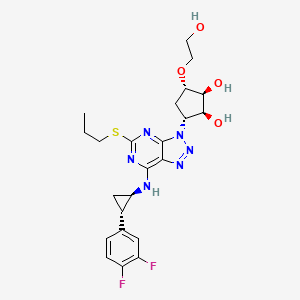
1 2D Structure

Ticagrelor

2 Identification
2.1 Computed Descriptors
2.1.1 IUPAC Name
(1S,2S,3R,5S)-3-[7-[[(1R,2S)-2-(3,4-difluorophenyl)cyclopropyl]amino]-5-propylsulfanyltriazolo[4,5-d]pyrimidin-3-yl]-5-(2-hydroxyethoxy)cyclopentane-1,2-diol
2.1.2 InChI
InChI=1S/C23H28F2N6O4S/c1-2-7-36-23-27-21(26-15-9-12(15)11-3-4-13(24)14(25)8-11)18-22(28-23)31(30-29-18)16-10-17(35-6-5-32)20(34)19(16)33/h3-4,8,12,15-17,19-20,32-34H,2,5-7,9-10H2,1H3,(H,26,27,28)/t12-,15+,16+,17-,19-,20+/m0/s1
2.1.3 InChI Key
OEKWJQXRCDYSHL-FNOIDJSQSA-N
2.1.4 Canonical SMILES
CCCSC1=NC(=C2C(=N1)N(N=N2)C3CC(C(C3O)O)OCCO)NC4CC4C5=CC(=C(C=C5)F)F
2.1.5 Isomeric SMILES
CCCSC1=NC(=C2C(=N1)N(N=N2)[C@@H]3C[C@@H]([C@H]([C@H]3O)O)OCCO)N[C@@H]4C[C@H]4C5=CC(=C(C=C5)F)F
2.2 Other Identifiers
2.2.1 UNII
GLH0314RVC
2.3 Synonyms
2.3.1 MeSH Synonyms

1. 3-(7-((2-(3,4-difluorophenyl)cyclopropyl)amino)-5-(propylthio)-3h-(1-3)-triazolo(4,5-d)pyrimidin-3-yl)-5-(2-hydroxyethoxy)cyclopentane-1,2-diol

2. Azd 6140

3. Azd-6140

4. Azd6140

5. Brilinta

6. Brilique

2.3.2 Depositor-Supplied Synonyms

1. 274693-27-5

2. Brilinta

3. Brilique

4. Azd6140

5. Azd-6140

6. Possia

7. Ar-c126532xx

8. Azd 6140

9. Ticargrelor

10. [14c]-ticagrelor

11. Glh0314rvc

12. (1s,2s,3r,5s)-3-(7-(((1r,2s)-2-(3,4-difluorophenyl)cyclopropyl)amino)-5-(propylthio)-3h-[1,2,3]triazolo[4,5-d]pyrimidin-3-yl)-5-(2-hydroxyethoxy)cyclopentane-1,2-diol

13. Chebi:68558

14. (1s,2s,3r,5s)-3-(7-((1r,2s)-2-(3,4-difluorophenyl)cyclopropylamino)-5-(propylthio)-3h-(1,2,3)triazolo(4,5-d)pyrimidin-3-yl)-5-(2-hydroxyethoxy)cyclopentane-1,2-diol

15. (1s,2s,3r,5s)-3-[7-[[(1r,2s)-2-(3,4-difluorophenyl)cyclopropyl]amino]-5-(propylthio)-3h-1,2,3-triazolo[4,5-d]pyrimidin-3-yl]-5-(2-hydroxyethoxy)-1,2-cyclopentanediol

16. (1s,2s,3r,5s)-3-[7-[[(1r,2s)-2-(3,4-difluorophenyl)cyclopropyl]amino]-5-propylsulfanyltriazolo[4,5-d]pyrimidin-3-yl]-5-(2-hydroxyethoxy)cyclopentane-1,2-diol

17. 1,2-cyclopentanediol, 3-(7-(((1r,2s)-2-(3,4-difluorophenyl)cyclopropyl)amino)-5-(propylthio)-3h-1,2,3-triazolo(4,5-d)pyrimidin-3-yl)-5-(2-hydroxyethoxy)-, (1s,2s,3r,5s)-

18. (1s,2s,3r,5s)-3-(7-((1r,2s)-2-(3,4-difluorophenyl)cyclopropylamino)-5-(propylthio)-3h-[1,2,3]triazolo[4,5-d]pyrimidin-3-yl)-5-(2-hydroxyethoxy)cyclopentane-1,2-diol

19. (1s,2s,3r,5s)-3-[7-[(1r,2s)-2-(3,4-difluorophenyl)cyclopropylamino]-5-(propylthio)- 3h-[1,2,3]triazolo[4,5-d]pyrimidin-3-yl]-5-(2-hydroxyethoxy)cyclopentane-1,2-diol

20. Ticagrelor [usan]

21. Unii-glh0314rvc

22. Ticagrelor [usan:inn:ban]

23. C23h28f2n6o4s

24. Ar-c 126532xx

25. Brilinta (tn)

26. (1s,2s,3r,5s)-3-(7-(((1r)-2-(3,4-difluorophenyl)cyclopropyl)amino)-5-(propylthio)-3h-[1,2,3]triazolo[4,5-d]pyrimidin-3-yl)-5-(2-hydroxyethoxy)cyclopentane-1,2-diol

27. (1s,2s,3r,5s)-3-(7-{[(1r,2s)-2-(3,4-difluorophenyl)cyclopropyl]amino}-5-(propylsulfanyl)-3h-[1,2,3]triazolo[4,5-d]pyrimidin-3-yl)-5-(2-hydroxyethoxy)cyclopentane-1,2-diol

28. (1s,2s,3r,5s)-3-[7-[[(1r,2s)-2-(3,4-difluorophenyl)cyclopropyl]amino]-5-(propylthio)-3h-[1,2,3]triazolo[4,5-d]pyrimidin-3-yl]-5-(2-hydroxyethoxy)cyclopentane-1,2-diol

29. (1s,2s,3r,5s)-3-[7-{[(1r,2s)-2-(3,4-difluorophenyl)cyclopropyl]amino}-5-(propylsulfanyl)-3h-[1,2,3]triazolo[4,5-d]pyrimidin-3-yl]-5-(2-hydroxyethoxy)cyclopentane-1,2-diol

30. Ticagrelor- Bio-x

31. Ar-c126532

32. Ticagrelor [mi]

33. Ticagrelor [inn]

34. Ticagrelor [jan]

35. Ticagrelor [vandf]

36. Ticagrelor [mart.]

37. Ticagrelor [usp-rs]

38. Ticagrelor [who-dd]

39. Ticagrelor (jan/usan/inn)

40. Ticagrelor [ema Epar]

41. Chembl398435

42. Gtpl1765

43. Schembl1979652

44. Ticagrelor [orange Book]

45. Ammd00027

46. Hsdb 8306

47. Ex-a503

48. Ticagrelor (brilinta,azd6140)

49. Ticagrelor [ep Monograph]

50. Dtxsid901009337

51. Hms3885b03

52. Bdbm50397205

53. Mfcd09954148

54. S4079

55. Zinc28957444

56. Akos015900739

57. Am85693

58. Ccg-269870

59. Cs-0619

60. Db08816

61. Ex-6274

62. Ar-c 126532xx;azd6140

63. Compound 17 [pmid: 17827008]

64. Ncgc00379052-01

65. Ncgc00379052-02

66. Ac-24755

67. As-19943

68. Bt164470

69. Hy-10064

70. D09017

71. Ab01565855_02

72. 693t275

73. A850981

74. Q420542

75. J-016772

76. J-524969

77. (1s,2s,3r,5s)-3-(7-(((1s,2s)-2-(3,4-difluorophenyl)cyclopropyl)amino)-5-(propylthio)-3h-[1,2,3]triazolo[4,5-d]pyrimidin-3-yl)-5-(2-hydroxyethoxy)cyclopentane-1,2-diol

78. (1s,2s,3r,5s)-3-(7-((1r,2s)-2-(3,4-difluorophenyl)cyclopropylamino)-5-(propylthio)-3h-[1,2,3]triazolo[4,5-d]pyrimidin-3-yl)-5-(2-hydroxyethoxy) Cyclopentane-1,2-diol

79. (1s,2s,3r,5s)-3-(7-((1r,2s)-2-(3,4-difluorophenyl)cyclopropylamino)-5-(propylthio)-3h-[1,2,3]triazolo[4,5-d]pyrimidin-3-yl)-5-(2-hydroxyethoxy)cyclopentane-1,2 Diol

80. (1s,2s,3r,5s)-3-[7-[[(1r,2s)-2-(3,4-d1,2-cyclopentanediolifluorophenyl)cyclopropyl]amino]-5-(propylthio)-3h-1,2,3-triazolo[4,5-d]pyrimidin-3-yl]-5-(2-hydroxyethoxy)-1,2-cyclopentanediol

81. (1s,2s,3r,5s)-3-[7-[[(1r,2s)-2-(3,4-difluorophenyl)-cyclopropyl]amino]-5-(propylthio)-3h-[1,2,3]-triazolo[4,5-d]pyrimidine-3-yl]-5-(2-hydroxyethoxy) Cyclopentane-1,2-diol

82. (1s,2s,3r,5s)-3-[7-[[(1r,2s)-2-(3,4-difluorophenyl)cyclopropyl]amino]-5-propylsulfanyltriazolo[5,4-d]pyrimidin-3-yl]-5-(2-hydroxyethoxy)cyclopentane-1,2-diol

83. 1,2-cyclopentanediol,3-[7-[[(1r,2s)-2-(3,4-difluorophenyl)cyclopropyl]amino]-5-(propylthio)-3h-1,2,3-triazolo[4,5-d]pyrimidin-3-yl]-5-(2-hydroxyethoxy)-,(1s,2s,3r,5s)-

2.4 Create Date
2006-10-25
3 Chemical and Physical Properties
Molecular Weight 522.6 g/mol
Molecular Formula C23H28F2N6O4S
XLogP32
Hydrogen Bond Donor Count4
Hydrogen Bond Acceptor Count12
Rotatable Bond Count10
Exact Mass522.18608089 g/mol
Monoisotopic Mass522.18608089 g/mol
Topological Polar Surface Area164 Ų
Heavy Atom Count36
Formal Charge0
Complexity736
Isotope Atom Count0
Defined Atom Stereocenter Count6
Undefined Atom Stereocenter Count0
Defined Bond Stereocenter Count0
Undefined Bond Stereocenter Count0
Covalently Bonded Unit Count1
4 Drug and Medication Information
4.1 Drug Information
1 of 2  
Drug NameBrilinta
PubMed HealthTicagrelor (By mouth)
Drug ClassesPlatelet Aggregation Inhibitor
Drug LabelBRILINTA contains ticagrelor, a cyclopentyltriazolopyrimidine, inhibitor of platelet activation and aggregation mediated by the P2Y12 ADP-receptor. Chemically it is (1S,2S,3R,5S)-3-[7-{[(1R,2S)-2-(3,4-difluorophenyl)cyclopropyl]amino}-5-(propylthio)-...
Active IngredientTicagrelor
Dosage FormTablet
RouteOral
Strength90mg
Market StatusPrescription
CompanyAstrazeneca

2 of 2  
Drug NameBrilinta
PubMed HealthTicagrelor (By mouth)
Drug ClassesPlatelet Aggregation Inhibitor
Drug LabelBRILINTA contains ticagrelor, a cyclopentyltriazolopyrimidine, inhibitor of platelet activation and aggregation mediated by the P2Y12 ADP-receptor. Chemically it is (1S,2S,3R,5S)-3-[7-{[(1R,2S)-2-(3,4-difluorophenyl)cyclopropyl]amino}-5-(propylthio)-...
Active IngredientTicagrelor
Dosage FormTablet
RouteOral
Strength90mg
Market StatusPrescription
CompanyAstrazeneca

4.2 Therapeutic Uses

Purinergic P2Y Receptor Antagonists

National Library of Medicine's Medical Subject Headings. Ticagrelor. Online file (MeSH, 2016). Available from, as of January 20, 2016: https://www.nlm.nih.gov/mesh/2016/mesh_browser/MBrowser.html


/CLINICAL TRIALS/ ClinicalTrials.gov is a registry and results database of publicly and privately supported clinical studies of human participants conducted around the world. The Web site is maintained by the National Library of Medicine (NLM) and the National Institutes of Health (NIH). Each ClinicalTrials.gov record presents summary information about a study protocol and includes the following: Disease or condition; Intervention (for example, the medical product, behavior, or procedure being studied); Title, description, and design of the study; Requirements for participation (eligibility criteria); Locations where the study is being conducted; Contact information for the study locations; and Links to relevant information on other health Web sites, such as NLM's MedlinePlus for patient health information and PubMed for citations and abstracts for scholarly articles in the field of medicine. Ticagrelor is included in the database.

NIH/NLM; ClinicalTrials.Gov. Available from, as of March 17, 2016: https://clinicaltrials.gov/ct2/results?term=ticagrelor&Search=Search


Brilinta is indicated to reduce the rate of cardiovascular death, myocardial infarction, and stroke in patients with acute coronary syndrome (ACS) or a history of myocardial infarction (MI). For at least the first 12 months following ACS, it is superior to clopidogrel. /Included in US product label/

NIH; DailyMed. Current Medication Information for Brilinta (Ticagrelor) Tablet (Updated: September 2015). Available from, as of January 20, 2016: https://dailymed.nlm.nih.gov/dailymed/drugInfo.cfm?setid=f7b3f443-e83d-4bf2-0e96-023448fed9a8


Brilinta also reduces the rate of stent thrombosis in patients who have been stented for treatment of acute coronary syndrome (ACS). /Included in US product label/

NIH; DailyMed. Current Medication Information for Brilinta (Ticagrelor) Tablet (Updated: September 2015). Available from, as of January 20, 2016: https://dailymed.nlm.nih.gov/dailymed/drugInfo.cfm?setid=f7b3f443-e83d-4bf2-0e96-023448fed9a8


4.3 Drug Warning

/BOXED WARNING/ BLEEDING RISK. Brilinta, like other antiplatelet agents, can cause significant, sometimes fatal bleeding. Do not use Brilinta in patients with active pathological bleeding or a history of intracranial hemorrhage. Do not start Brilinta in patients undergoing urgent coronary artery bypass graft surgery (CABG). If possible, manage bleeding without discontinuing Brilinta. Stopping Brilinta increases the risk of subsequent cardiovascular events

NIH; DailyMed. Current Medication Information for Brilinta (Ticagrelor) Tablet (Updated: September 2015). Available from, as of January 27, 2016: https://dailymed.nlm.nih.gov/dailymed/drugInfo.cfm?setid=f7b3f443-e83d-4bf2-0e96-023448fed9a8


/BOXED WARNING/ ASPIRIN DOSE AND BRILINTA EFFECTIVENESS. Maintenance doses of aspirin above 100 mg reduce the effectiveness of Brilinta and should be avoided.

NIH; DailyMed. Current Medication Information for Brilinta (Ticagrelor) Tablet (Updated: September 2015). Available from, as of January 27, 2016: https://dailymed.nlm.nih.gov/dailymed/drugInfo.cfm?setid=f7b3f443-e83d-4bf2-0e96-023448fed9a8


In general, treatment with ticagrelor should not be discontinued prematurely because this increases the risk of cardiovascular events. Premature discontinuance of antiplatelet therapy (e.g., P2Y12 adenosine diphosphate (ADP)-receptor antagonists, aspirin) in patients with coronary artery stents has been associated with an increased risk of ischemic cardiovascular events (e.g., stent thrombosis, myocardial infarction (MI), death). If temporary discontinuance of ticagrelor is necessary such as prior to elective surgery or for management of bleeding, the drug should be restarted as soon as possible. Patients should be advised to never stop taking ticagrelor without first consulting the prescribing clinician, even if instructed by another clinician (e.g., dentist) to stop such therapy. Prior to scheduling an invasive procedure, patients should inform clinicians (including dentists) that they are currently taking ticagrelor and clinicians performing the invasive procedure should consult with the prescribing clinician before discontinuing such therapy.

American Society of Health-System Pharmacists 2015; Drug Information 2015. Bethesda, MD. 2015, p. 1546-7


Bradyarrhythmias, including ventricular pauses, have occurred in patients receiving ticagrelor. In the The Study of Platelet Inhibition and Patient Outcomes (PLATO) study, Holter monitor-detected ventricular pauses of at least 3 seconds were reported more frequently during the first week of therapy in patients receiving ticagrelor than in those receiving clopidogrel (5.8 versus 3.6%, respectively). There was no difference in the overall risk of clinically important bradycardic effects (e.g., syncope, need for pacemaker insertion) between the treatment groups. Ventricular pauses were mostly asymptomatic and attributed to sinoatrial nodal suppression. Patients with a baseline increased risk of bradycardia (e.g., those with sick sinus syndrome, second- or third-degree AV block, syncope due to bradycardia without a pacemaker) were excluded from the PLATO study; therefore, some clinicians recommend that ticagrelor be used with caution in such patients.

American Society of Health-System Pharmacists 2015; Drug Information 2015. Bethesda, MD. 2015, p. 1547


For more Drug Warnings (Complete) data for Ticagrelor (15 total), please visit the HSDB record page.


4.4 Drug Indication

Ticagrelor is indicated to reduce the risk of cardiovascular death, myocardial infarction, and stroke in patients with acute coronary syndrome or a history of myocardial infarction. Ticagrelor is also indicated to reduce the risk of a first myocardial infarction or stroke in high risk patients with coronary artery disease.


FDA Label


Brilique, co administered with acetylsalicylic acid (ASA), is indicated for the prevention of atherothrombotic events in adult patients with

- acute coronary syndromes (ACS) or

- a history of myocardial infarction (MI) and a high risk of developing an atherothrombotic event

Brilique, co-administered with acetyl salicylic acid (ASA), is indicated for the prevention of atherothrombotic events in adult patients with a history of myocardial infarction (MI occurred at least one year ago) and a high risk of developing an atherothrombotic event.


Possia, co-administered with acetylsalicylic acid (ASA), is indicated for the prevention of atherothrombotic events in adult patients with acute coronary syndromes (unstable angina, non-ST-elevation myocardial infarction [NSTEMI] or ST-elevation myocardial infarction [STEMI]); including patients managed medically, and those who are managed with percutaneous coronary intervention (PCI) or coronary artery by-pass grafting (CABG).


Prevention of thromboembolic events


5 Pharmacology and Biochemistry
5.1 Pharmacology

Ticagrelor is a P2Y12 receptor antagonist that inhibits the formation of thromboses to reduce the risk of myocardial infarction and ischemic stroke. It has a moderate duration of action as it is given twice daily, and a wide therapeutic index as high single doses are well tolerated. Patients should be counselled regarding the risk of bleeding, dyspnea, and bradyarrhythmias.


5.2 MeSH Pharmacological Classification

Platelet Aggregation Inhibitors

Drugs or agents which antagonize or impair any mechanism leading to blood platelet aggregation, whether during the phases of activation and shape change or following the dense-granule release reaction and stimulation of the prostaglandin-thromboxane system. (See all compounds classified as Platelet Aggregation Inhibitors.)


Purinergic P2Y Receptor Antagonists

Compounds that bind to and block the stimulation of PURINERGIC P2Y RECEPTORS. Included under this heading are antagonists for specific P2Y receptor subtypes. (See all compounds classified as Purinergic P2Y Receptor Antagonists.)


5.3 FDA Pharmacological Classification
5.3.1 Active Moiety
TICAGRELOR
5.3.2 FDA UNII
GLH0314RVC
5.3.3 Pharmacological Classes
Cytochrome P450 3A5 Inhibitors [MoA]; Decreased Platelet Aggregation [PE]; P-Glycoprotein Inhibitors [MoA]; P2Y12 Platelet Inhibitor [EPC]; P2Y12 Receptor Antagonists [MoA]; Phenylalanine Hydroxylase Activators [MoA]; Cytochrome P450 3A4 Inhibitors [MoA]
5.4 ATC Code

B01AC24


B01AC24


B01AC24

S76 | LUXPHARMA | Pharmaceuticals Marketed in Luxembourg | Pharmaceuticals marketed in Luxembourg, as published by d'Gesondheetskeess (CNS, la caisse nationale de sante, www.cns.lu), mapped by name to structures using CompTox by R. Singh et al. (in prep.). List downloaded from https://cns.public.lu/en/legislations/textes-coordonnes/liste-med-comm.html. Dataset DOI:10.5281/zenodo.4587355


B - Blood and blood forming organs

B01 - Antithrombotic agents

B01A - Antithrombotic agents

B01AC - Platelet aggregation inhibitors excl. heparin

B01AC24 - Ticagrelor


5.5 Absorption, Distribution and Excretion

Absorption

Ticagrelor is 36% orally bioavailable. A single 200mg oral dose of ticagrelor reaches a Cmax of 923ng/mL, with a Tmax of 1.5 hours and an AUC of 6675ng\*h/mL. The active metabolite of ticagrelor reaches a Cmax of 264ng/mL, with a Tmax of 3.0 hours and an AUC of 2538ng\*h/mL.


Route of Elimination

A radiolabelled dose of ticagrelor is 57.8% recovered in feces and 26.5% recovered in urine. Less than 1% of the dose is recovered as the unmetabolized parent drug. The active metabolite AC-C124910XX makes up 21.7% of the recovery in the feces. The metabolite AR-C133913XX makes up 9.2% of the recovery in the urine and 2.7% of the recovery in the feces. Other minor metabolites are predominantly recovered in the urine.


Volume of Distribution

The steady state volume of distribution of ticagrelor is 88 L.


Clearance

The renal clearance of ticagrelor is 0.00584L/h.


The drug is metabolized principally by cytochrome P-450 (CYP) isoenzyme 3A4 to an active metabolite that has similar antiplatelet activity as the parent drug.Plasma concentrations of ticagrelor and its active metabolite increase in a dose-dependent manner with peak concentrations achieved within approximately 1.5 and 2.5 hours, respectively. Ticagrelor is primarily eliminated in the feces and to a lesser extent in urine; less than 1% of a dose is recovered in urine as the parent drug and active metabolite. ... Both ticagrelor and its active metabolite are extensively (more than 99%) bound to human plasma proteins. Administration with a high-fat meal increases systemic exposure of ticagrelor by 21% and decreases peak plasma concentrations of the active metabolite by 22%, but has no effect on peak plasma concentrations of ticagrelor or on systemic exposure to the active metabolite.

American Society of Health-System Pharmacists 2015; Drug Information 2015. Bethesda, MD. 2015, p. 1548


Ticagrelor is rapidly absorbed following oral administration.

American Society of Health-System Pharmacists 2015; Drug Information 2015. Bethesda, MD. 2015, p. 1548


The primary route of ticagrelor elimination is hepatic metabolism. When radiolabeled ticagrelor is administered, the mean recovery of radioactivity is approximately 84% (58% in feces, 26% in urine). Recoveries of ticagrelor and the active metabolite in urine were both less than 1% of the dose. The primary route of elimination for the major metabolite of ticagrelor is most likely to be biliary secretion.

NIH; DailyMed. Current Medication Information for Brilinta (Ticagrelor) Tablet (Updated: September 2015). Available from, as of January 27, 2016: https://dailymed.nlm.nih.gov/dailymed/drugInfo.cfm?setid=f7b3f443-e83d-4bf2-0e96-023448fed9a8


/MILK/ It is not known whether ticagrelor or its active metabolites are excreted in human milk. Ticagrelor is excreted in rat milk.

NIH; DailyMed. Current Medication Information for Brilinta (Ticagrelor) Tablet (Updated: September 2015). Available from, as of January 27, 2016: https://dailymed.nlm.nih.gov/dailymed/drugInfo.cfm?setid=f7b3f443-e83d-4bf2-0e96-023448fed9a8


For more Absorption, Distribution and Excretion (Complete) data for Ticagrelor (6 total), please visit the HSDB record page.


5.6 Metabolism/Metabolites

The complete structure of all ticagrelor metabolites are not well defined. Ticagrelor can be dealkylated at postition 5 of the cyclopentane ring to form the active AR-C124910XX. AR-C124910XX's cyclopentane ring can be further glucuronidated or the alkyl chain attached to the sulfur can be hydroxylated. Ticagrelor can also be glucuronidated or hydroxylated. Ticagrelor can also be N-dealkylated to form AR-C133913XX, which is further glucuronidated or hydroxylated.


CYP3A4 is the major enzyme responsible for ticagrelor metabolism and the formation of its major active metabolite. Ticagrelor and its major active metabolite are weak P-glycoprotein substrates and inhibitors. The systemic exposure to the active metabolite is approximately 30-40% of the exposure of ticagrelor.

NIH; DailyMed. Current Medication Information for Brilinta (Ticagrelor) Tablet (Updated: September 2015). Available from, as of January 27, 2016: https://dailymed.nlm.nih.gov/dailymed/drugInfo.cfm?setid=f7b3f443-e83d-4bf2-0e96-023448fed9a8


The drug is metabolized principally by cytochrome P-450 (CYP) isoenzyme 3A4 to an active metabolite that has similar antiplatelet activity as the parent drug.

American Society of Health-System Pharmacists 2015; Drug Information 2015. Bethesda, MD. 2015, p. 1548


Ticagrelor is a reversibly binding oral P2Y(12) receptor antagonist in development for the prevention of thrombotic events in patients with acute coronary syndromes. The pharmacokinetics, metabolism, and excretion of ticagrelor were investigated over 168 hr in six healthy male subjects receiving a single oral suspension dose of 200 mg of (14)C-ticagrelor. ... Major circulating components in the plasma and feces were identified as ticagrelor and AR-C124910XX, whereas in urine the major components were metabolite M5 (AR-C133913XX) and its glucuronide conjugate M4. Levels of unchanged ticagrelor and AR-C124910XX were <0.05% in the urine, indicating that renal clearance of ticagrelor and AR-C124910XX is of minor importance. Interindividual variability was small in both urine and fecal extracts with only small quantitative differences. All 10 of the metabolites were fully or partially characterized and a full biotransformation pathway was proposed for ticagrelor, in which oxidative loss of the hydroxyethyl side chain from ticagrelor forms AR-C124910XX and a second oxidative pathway leads to N-dealkylation of ticagrelor, forming AR-C133913XX.

PMID:20551239 Teng R et al; Drug Metab Dispos 38 (9): 1514-21 (2010)


5.7 Biological Half-Life

Ticagrelor has a plasma half life of approximately 8 hours, while the active metabolite has a plasma half life of approximately 12 hours.


The mean terminal half-lives of ticagrelor and its active metabolite reportedly are about 7 and 9 hours, respectively.

American Society of Health-System Pharmacists 2015; Drug Information 2015. Bethesda, MD. 2015, p. 1548


Ticagrelor is a reversibly binding oral P2Y(12) receptor antagonist in development for the prevention of thrombotic events in patients with acute coronary syndromes. The pharmacokinetics, metabolism, and excretion of ticagrelor were investigated over 168 hr in six healthy male subjects receiving a single oral suspension dose of 200 mg of (14)C-ticagrelor. In most subjects, radioactivity was undetectable in plasma after 20 hr and whole blood after 12 hr (half-life values of 6.3 and 4.6 hr, respectively).

PMID:20551239 Teng R et al; Drug Metab Dispos 38 (9): 1514-21 (2010)


5.8 Mechanism of Action

Ticagrelor is a P2Y12 receptor antagonist. The P2Y12 receptor couples with Gi2 and other Gi proteins which inhibit adenylyl cyclase. Gi mediated signalling also activates PI3K, Akt, Rap1b, and potassium channels. The downstream effects of these activities mediate hemostasis and lead to platelet aggregation. Antagonism of the P2Y12 receptor reduces development of occlusive thromboses, which can reduce the risk of myocardial infarction and ischemic stroke.


Ticagrelor, a cyclopentyltriazolopyrimidine derivative, is a nonthienopyridine, P2Y12 platelet adenosine diphosphate (ADP)-receptor antagonist. In contrast to the thienopyridines (e.g., clopidogrel, prasugrel), ticagrelor binds reversibly to the P2Y12 ADP receptor and does not require hepatic transformation to exert its pharmacologic effect. Ticagrelor exhibits noncompetitive and reversible binding to the P2Y12 platelet ADP receptor, preventing signal transduction of the cyclic adenosine monophosphate (cAMP) pathway. This results in reduced exposure of fibrinogen binding sites to the platelet glycoprotein (GP) IIb/IIIa complex and subsequent inhibition of platelet activation and aggregation. In addition to platelet ADP-receptor blockade, ticagrelor inhibits reuptake of adenosine into erythrocytes, a mechanism that may account for some of the beneficial cardiovascular effects of the drug, while potentially contributing to some of its adverse effects (e.g., dyspnea, ventricular pauses).

American Society of Health-System Pharmacists 2015; Drug Information 2015. Bethesda, MD. 2015, p. 1547


DRUG PRODUCT COMPOSITIONS

Do you need Business Intel? Ask us

DOSAGE - TABLET;ORAL - 60MG

USFDA APPLICATION NUMBER - 22433

read-more

DOSAGE - TABLET;ORAL - 90MG

USFDA APPLICATION NUMBER - 22433

read-more

Related Excipient Companies

Upload your portfolio for free, ask us

Excipients by Applications

Click here to find the perfect excipient manufacturers by their capabilities

Coating Systems & Additives

read-more
read-more

Fillers, Diluents & Binders

read-more
read-more

Disintegrants & Superdisintegrants

read-more
read-more

Chewable & Orodispersible Aids

read-more
read-more

Taste Masking

read-more
read-more

Controlled & Modified Release

read-more
read-more

Direct Compression

read-more
read-more

Lubricants & Glidants

read-more
read-more

Film Formers & Plasticizers

read-more
read-more

Thickeners and Stabilizers

read-more
read-more

Granulation

read-more
read-more

Parenteral

read-more
read-more

Empty Capsules

read-more
read-more

Co-Processed Excipients

read-more
read-more

Vegetarian Capsules

read-more
read-more

API Stability Enhancers

read-more
read-more

Emulsifying Agents

read-more
read-more

Coloring Agents

read-more
read-more

Solubilizers

read-more
read-more

Topical

read-more
read-more

Rheology Modifiers

read-more
read-more

Surfactant & Foaming Agents

read-more
read-more

Digital Content read-more

Create Content with PharmaCompass, ask us

DATA COMPILATION #PharmaFlow

read-more
read-more

NEWS #PharmaBuzz

read-more
read-more

Global Sales Information

Do you need Business Intel? Ask us

Market Place

Do you need sourcing support? Ask us

Patents & EXCLUSIVITIES

Check the patents & exclusivity for this product

REF. STANDARDS & IMPURITIES

Upload your portfolio for free, ask us

ANALYTICAL

Upload your methods for free, ask us

ABOUT THIS PAGE

Looking for 274693-27-5 / Ticagrelor API manufacturers, exporters & distributors?

Ticagrelor manufacturers, exporters & distributors 1

46

PharmaCompass offers a list of Ticagrelor API manufacturers, exporters & distributors, which can be sorted by GMP, USDMF, JDMF, KDMF, CEP (COS), WC, Price,and more, enabling you to easily find the right Ticagrelor manufacturer or Ticagrelor supplier for your needs.

Send us enquiries for free, and we will assist you in establishing a direct connection with your preferred Ticagrelor manufacturer or Ticagrelor supplier.

PharmaCompass also assists you with knowing the Ticagrelor API Price utilized in the formulation of products. Ticagrelor API Price is not always fixed or binding as the Ticagrelor Price is obtained through a variety of data sources. The Ticagrelor Price can also vary due to multiple factors, including market conditions, regulatory modifications, or negotiated pricing deals.

API | Excipient name

Ticagrelor

Synonyms

274693-27-5, Brilinta, Brilique, Azd6140, Azd-6140, Possia

Cas Number

274693-27-5

Unique Ingredient Identifier (UNII)

GLH0314RVC

About Ticagrelor

An adenosine triphosphate analogue and reversible P2Y12 PURINORECEPTOR antagonist that inhibits ADP-mediated PLATELET AGGREGATION. It is used for the prevention of THROMBOEMBOLISM by patients with ACUTE CORONARY SYNDROME or a history of MYOCARDIAL INFARCTION.

Brilique Manufacturers

A Brilique manufacturer is defined as any person or entity involved in the manufacture, preparation, processing, compounding or propagation of Brilique, including repackagers and relabelers. The FDA regulates Brilique manufacturers to ensure that their products comply with relevant laws and regulations and are safe and effective to use. Brilique API Manufacturers are required to adhere to Good Manufacturing Practices (GMP) to ensure that their products are consistently manufactured to meet established quality criteria.

click here to find a list of Brilique manufacturers with USDMF, JDMF, KDMF, CEP, GMP, COA and API Price related information on PhamaCompass.

Brilique Suppliers

A Brilique supplier is an individual or a company that provides Brilique active pharmaceutical ingredient (API) or Brilique finished formulations upon request. The Brilique suppliers may include Brilique API manufacturers, exporters, distributors and traders.

click here to find a list of Brilique suppliers with USDMF, JDMF, KDMF, CEP, GMP, COA and API Price related information on PharmaCompass.

Brilique USDMF

A Brilique DMF (Drug Master File) is a document detailing the whole manufacturing process of Brilique active pharmaceutical ingredient (API) in detail. Different forms of Brilique DMFs exist exist since differing nations have different regulations, such as Brilique USDMF, ASMF (EDMF), JDMF, CDMF, etc.

A Brilique DMF submitted to regulatory agencies in the US is known as a USDMF. Brilique USDMF includes data on Brilique's chemical properties, information on the facilities and procedures used, and details about packaging and storage. The Brilique USDMF is kept confidential to protect the manufacturer’s intellectual property.

click here to find a list of Brilique suppliers with USDMF on PharmaCompass.

Brilique KDMF

In Korea, the Ministry of Food and Drug Safety (MFDS) is in charge of regulating pharmaceutical products and services.

Pharmaceutical companies submit a Brilique Drug Master File in Korea (Brilique KDMF) to the MFDS, which includes comprehensive information about the production, processing, facilities, materials, packaging, and testing of Brilique. The MFDS reviews the Brilique KDMF as part of the drug registration process and uses the information provided in the Brilique KDMF to evaluate the safety and efficacy of the drug.

After submitting a Brilique KDMF to the MFDS, the registered manufacturer can provide importers or distributors with the registration number without revealing confidential information to Korean business partners. Applicants seeking to register their Brilique API can apply through the Korea Drug Master File (KDMF).

click here to find a list of Brilique suppliers with KDMF on PharmaCompass.

Brilique CEP

A Brilique CEP of the European Pharmacopoeia monograph is often referred to as a Brilique Certificate of Suitability (COS). The purpose of a Brilique CEP is to show that the European Pharmacopoeia monograph adequately controls the purity of Brilique EP produced by a given manufacturer. Suppliers of raw materials can prove the suitability of Brilique to their clients by showing that a Brilique CEP has been issued for it. The manufacturer submits a Brilique CEP (COS) as part of the market authorization procedure, and it takes on the role of a Brilique CEP holder for the record. Additionally, the data presented in the Brilique CEP (COS) is managed confidentially and offers a centralized system acknowledged by numerous nations, exactly like the Brilique DMF.

A Brilique CEP (COS) is recognised by all 36 nations that make up the European Pharmacopoeia Convention. Brilique CEPs may be accepted in nations that are not members of the Ph. Eur. at the discretion of the authorities there.

click here to find a list of Brilique suppliers with CEP (COS) on PharmaCompass.

Brilique WC

A Brilique written confirmation (Brilique WC) is an official document issued by a regulatory agency to a Brilique manufacturer, verifying that the manufacturing facility of a Brilique active pharmaceutical ingredient (API) adheres to the Good Manufacturing Practices (GMP) regulations of the importing country. When exporting Brilique APIs or Brilique finished pharmaceutical products to another nation, regulatory agencies frequently require a Brilique WC (written confirmation) as part of the regulatory process.

click here to find a list of Brilique suppliers with Written Confirmation (WC) on PharmaCompass.

Brilique NDC

National Drug Code is a comprehensive database maintained by the FDA that contains information on all drugs marketed in the US. This directory includes information about finished drug products, unfinished drug products, and compounded drug products, including those containing Brilique as an active pharmaceutical ingredient (API).

Finished drug products

The FDA updates the NDC directory daily. The NDC numbers for Brilique API and other APIs are published in this directory by the FDA.

Unfinished drugs

The NDC unfinished drugs database includes product listing information submitted for all unfinished drugs, such as active pharmaceutical ingredients (APIs), drugs intended for further processing and bulk drug substances for compounding.

Pharmaceutical companies that manufacture Brilique as an active pharmaceutical ingredient (API) must furnish the FDA with an updated record of all drugs that they produce, prepare, propagate, compound, or process for commercial distribution in the US at their facilities.

Compounded drug products

The NDC directory also contains data on finished compounded human drug products that contain Brilique and are produced by outsourcing facilities. While these outsourcing facilities are not mandated to assign a Brilique NDC to their finished compounded human drug products, they may choose to do so.

click here to find a list of Brilique suppliers with NDC on PharmaCompass.

Brilique GMP

Brilique Active pharmaceutical ingredient (API) is produced in GMP-certified manufacturing facility.

GMP stands for Good Manufacturing Practices, which is a system used in the pharmaceutical industry to make sure that goods are regularly produced and monitored in accordance with quality standards. The FDA’s current Good Manufacturing Practices requirements are referred to as cGMP or current GMP which indicates that the company follows the most recent GMP specifications. The World Health Organization (WHO) has its own set of GMP guidelines, called the WHO GMP. Different countries can also set their own guidelines for GMP like China (Chinese GMP) or the EU (EU GMP).

PharmaCompass offers a list of Brilique GMP manufacturers, exporters & distributors, which can be sorted by USDMF, JDMF, KDMF, CEP (COS), WC, API price, and more, enabling you to easily find the right Brilique GMP manufacturer or Brilique GMP API supplier for your needs.

Brilique CoA

A Brilique CoA (Certificate of Analysis) is a formal document that attests to Brilique's compliance with Brilique specifications and serves as a tool for batch-level quality control.

Brilique CoA mostly includes findings from lab analyses of a specific batch. For each Brilique CoA document that a company creates, the USFDA specifies specific requirements, such as supplier information, material identification, transportation data, evidence of conformity and signature data.

Brilique may be tested according to a variety of international standards, such as European Pharmacopoeia (Brilique EP), Brilique JP (Japanese Pharmacopeia) and the US Pharmacopoeia (Brilique USP).

Inform the supplier about your product requirements, specifying if you need a product with particular monograph like EP (Ph. Eur.), USP, JP, BP, or any other quality. In addition, clarify whether you need hydrochloride (HCl), anhydricum, base, micronisatum or a specific level of purity. To find reputable suppliers, utilize the filters and select those certified by GMP, FDA, or any other certification as per your requirement.
For your convenience, we have listed synonyms and CAS numbers to help you find the best supplier. The use of synonyms and CAS numbers can be helpful in identifying potential suppliers, but it is crucial to note that they might not always indicate the exact same product. It is important to confirm the product details with the supplier before making a purchase to ensure that it meets your requirements.
Ask Us for Pharmaceutical Supplier and Partner
Ask Us, Find A Supplier / Partner
No Commissions, No Strings Attached, Get Connected for FREE

What are you looking for?

How can we help you?

The request can't be empty

Please read our Privacy Policy carefully

You must agree to the privacy policy

The name can't be empty
The company can't be empty.
The email can't be empty Please enter a valid email.
The mobile can't be empty