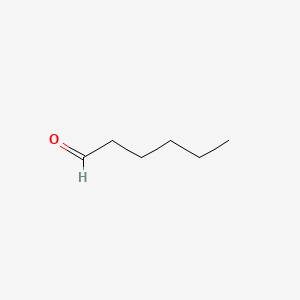
1. (e)-2-hexanal
2. (z)-hex-3-enal
3. Caproic Aldehyde
4. Capronaldehyde
5. E-2-hexanal
6. Hexanaldehyde
7. N-hexanal
1. Caproaldehyde
2. 66-25-1
3. Hexaldehyde
4. Caproic Aldehyde
5. 1-hexanal
6. Capronaldehyde
7. N-hexanal
8. Hexanaldehyde
9. N-caproaldehyde
10. Hexylaldehyde
11. Aldehyde C-6
12. N-capronaldehyde
13. Hexyl Aldehyde
14. N-caproylaldehyde
15. Hexoic Aldehyde
16. N-hexaldehyde
17. C6 Aldehyde
18. N-caproic Aldehyde
19. Kapronaldehyd
20. N-hexylaldehyde
21. Fema No. 2557
22. Nsc 2596
23. Hexan-1-al
24. N-c5h11cho
25. 9dc2k31jjq
26. Chembl280331
27. Chebi:88528
28. Nsc-2596
29. Dsstox_cid_1604
30. Dsstox_rid_76231
31. Dsstox_gsid_21604
32. Hexanal (natural)
33. Kapronaldehyd [czech]
34. Fema Number 2557
35. Aldehyde C6
36. Cas-66-25-1
37. Ccris 3219
38. Hsdb 560
39. Einecs 200-624-5
40. Un1207
41. Unii-9dc2k31jjq
42. Brn 0506198
43. Capronaidehyde
44. Ai3-15364
45. 1-hexanone
46. Aldehydes, C6
47. Mfcd00007027
48. Hexanal, 98%
49. Hexanal [fhfi]
50. Hexanal [inci]
51. Hexanal [fcc]
52. Hexaldehyde [hsdb]
53. Ec 200-624-5
54. Wln: Vh5
55. Hexanal, Analytical Standard
56. Schembl22263
57. 4-01-00-03296 (beilstein Handbook Reference)
58. Caproic Aldehyde [mi]
59. Dtxsid2021604
60. Nsc2596
61. Hexanal, Natural, >=90%, Fg
62. Hexanal, Natural, >=95%, Fg
63. Hexanal, >=97%, Fcc, Fg
64. Zinc1641021
65. Tox21_201933
66. Tox21_303342
67. Bdbm50028824
68. Lmfa06000109
69. Stl280331
70. Akos009156478
71. Fs-3948
72. Hexanal 100 Microg/ml In Acetonitrile
73. Un 1207
74. Ncgc00249137-01
75. Ncgc00257270-01
76. Ncgc00259482-01
77. Bp-31180
78. Db-054893
79. Ft-0631290
80. Ft-0669191
81. H0133
82. Hexaldehyde [un1207] [flammable Liquid]
83. En300-33498
84. A835388
85. Q420698
86. J-660017
87. 861259-78-1
88. O8y
| Molecular Weight | 100.16 g/mol |
|---|---|
| Molecular Formula | C6H12O |
| XLogP3 | 1.8 |
| Hydrogen Bond Donor Count | 0 |
| Hydrogen Bond Acceptor Count | 1 |
| Rotatable Bond Count | 4 |
| Exact Mass | 100.088815002 g/mol |
| Monoisotopic Mass | 100.088815002 g/mol |
| Topological Polar Surface Area | 17.1 Ų |
| Heavy Atom Count | 7 |
| Formal Charge | 0 |
| Complexity | 41.4 |
| Isotope Atom Count | 0 |
| Defined Atom Stereocenter Count | 0 |
| Undefined Atom Stereocenter Count | 0 |
| Defined Bond Stereocenter Count | 0 |
| Undefined Bond Stereocenter Count | 0 |
| Covalently Bonded Unit Count | 1 |
Antifungal Agents
Substances that destroy fungi by suppressing their ability to grow or reproduce. They differ from FUNGICIDES, INDUSTRIAL because they defend against fungi present in human or animal tissues. (See all compounds classified as Antifungal Agents.)
Insecticides
Pesticides designed to control insects that are harmful to man. The insects may be directly harmful, as those acting as disease vectors, or indirectly harmful, as destroyers of crops, food products, or textile fabrics. (See all compounds classified as Insecticides.)
Aldehyde dehydrogenase specific activity was measured in crude homogenates, post-mitochondrial supernatants, cytosolic and microsomal fractions of trout live, using a number of endogenous and xenobiotic aldehydes and both NAD+ and NADP+ as co-factors. All the activity found in the crude homogenate could be accounted for by the sum of the cytosolic and microsomal activities. Highest activities were found with the medium chain length substrates hexanal and nonanal in all fractions. Apparent affinity for hexanal and nonanal in the cytosolic fraction were comparable to that found in rats, but the theoretical maximal velocity for these substrates, and the specific activities for the other substrates, were much lower than found in mammals. In another study with carcinogen fed fish, aldehyde dehydrogenase distribution was evaluated histochemically in cryostat sections. In control trout, aldehyde dehydrogenase was uniformly distributed without an apparent zonal pattern. However, in hepatic tumors, aldehyde dehydrogenase was apparently induced with hexanal, nonanal, and propionaldehyde giving the strongest reaction products.
Parker LM et al; Acuat Toxicol (AMST) 18 (1): 1-12 (1990)
the substrate preference of an aldehyde dehydrogenase induced in rat liver cytosol by 3-methylcholanthrene was examined. This enzyme, T-ALDH, is identical to the aldehyde dehydrogenase inducible in rat liver by 2,3,7,8-tetrachloro-dibenzo-p-dioxin and the tumor associated aldehyde dehydrogenase found in rat hepatocellular neoplasms. With either NAD or NADP as coenzyme, the preferred substrates were the aliphatic aldehydes n-hexanal, n-nonanal, and isobutyraldehyde and the aromatic aldehydes 2,5-dihydroxybenzaldehyde, benzaldehyde, and 3-hydroxybenzaldehyde. T-ALDH may play a role in oxidizing a variety of aldehydes produced in physiological lipid metabolism. On the contrary, this isozyme does not seem to participate in the oxidation of small aliphatic aldehydes generated during lipid peroxidation.
PMID:3420620 Marselos M, Lindahl R; Toxicol Appl Pharmacol 95 (2): 339-45 (1988)
Alcohol dehydrogenase classes exhibit differences in both substrate specificity and tissue distribution which suggest distinct physiological functions. The kinetic constants of the rat alcohol dehydrogenase classes, purified from liver (classes I and III) and from stomach (class IV), with three groups of relevant physiological compounds: cytotoxic aldehydes generated in lipid peroxidation, omega-hydroxy fatty acids, and retinoids /have been studied/. Classes I and IV actively reduce 4-hydroxynonenal, 2-hexenal, and hexanal, which are toxic compounds known to be produced in significant amounts during lipid peroxidation. Class III shows poor activity with these aldehydes. Class IV exhibits the best kcat/Km values (2150 mM-1 X min-1 for 4-hydroxynonenal), which suggest a role for this enzyme in the elimination of the cytotoxic aldehydes in tissues that are susceptible to lipid peroxidation, such as skin, cornea, and mucosa of the respiratory and digestive tracts, where class IV is localized.
PMID:8239669 Boleda MD et al; Arch Biochem Biophys 307 (1): 85-90 (1993)
Similar to saturated aldehydes, hexanal is oxidized to the corresponding caboxylic acid by aldehyde dehydrogenase mainly in the liver, but also in other tissues and cells. The acid can serve as a substrate for the Krebs cycle or is excreted as a salt. Alternatively, it can conjugate with glutathione or the sulfhydryl group of other proteins.
Bingham, E.; Cohrssen, B.; Powell, C.H.; Patty's Toxicology Volumes 1-9 5th ed. John Wiley & Sons. New York, N.Y. (2001)., p. V5:991
Free radical induced lipid peroxidation may play a role in neurodegeneration and peroxidation leads to the formation of hexanal from omega-6 fatty acids. We have previously demonstrated in vitro that pyruvate dehydrogenase (PDH) catalyzes the condensation of saturated aldehydes with pyruvate to form acyloins. We have further shown in perfused rat heart that hexanal, presumably via PDH, is converted to 3-hydroxyoctan-2-one and that it in turn can be reduced to 2,3-octanediol. We now extend this work using intra-striatal microdialysis to show that this reaction also occurs in rat brain. The reduction of hexanal to hexanol was also evaluated. Microdialysis probes were implanted bilaterally in the striatum and were infused with hexanal with and in the absence of added pyruvate. Analysis of microdialysis samples showed a release of 3-hydroxyoctan-2-one (9.5-10.5 pmol/min), 2,3-octanediol (2.2-2.7 pmol/min) and hexanol (64-74 pmol/min). Pyruvate addition did not increase 3-hydroxyoctan-2-one or 2,3-octanediol production. In a second series of experiments where no exogenous hexanal was infused, endogenous production of 3-hydroxyoctan-2-one (1.0-1.3 pmol/min) and 2,3-octanediol (1.0-1.2 pmol/min) was still observed, although no hexanol was detected. We also investigated the possibility that oxidative stress induced by 1-methyl-4-phenylpyridinium (MPP+) would increase lipid peroxidation resulting in increased production of 3-hydroxyoctan-2-one. Analysis of samples collected following MPP+ infusion indicated no additional increase suggesting that brief exposure to MPP+ does not increase hexanal formation over baseline levels during the experimental period.
PMID:10488909 Jaar V et al; Metab Brain Dis 14 (2): 71-82 (1999)
Inhibition of intercellular communication is an important feature in the tumor promotion phase of a multistage carcinogenesis model. In atherosclerosis inhibition of cell-cell communication by atherogenic compounds, e.g., low density lipoproteins (LDL), also seems to be important. For testing atherogenic compounds we used an atherosclerosis relevant cell type, namely human smooth muscle cells. In order to investigate which part of the LDL particle would be involved in inhibition of metabolic co-operation between human smooth muscle cells in culture ... several fatty acids and their breakdown products /were tested/, namely aldehydes. Unsaturated C-18 fatty acids markedly influenced gap-junctional intercellular communication (GJIC), whereas saturated (C18:0, C16:0) and unsaturated fatty acids with > 20 carbon atoms did not inhibit GJIC. In the case of oleic and elaidic acid, orientation seemed important; however, after exposure to palmitoleic and palmitelaidic acid no differences were found. The most potent inhibitor of GJIC was linoleic acid, which inhibited GJIC by 75%. No correlation was found between degrees of unsaturation and ability to inhibit GJIC. Of the tested aldehydes, hexanal, propanal, butanal and 4-hydroxynonenal did significantly inhibit GJIC, while pentanal had no effect. Since modification of LDL was shown to be important in order for LDL to inhibit GJIC, these results show that fatty acids and their oxidative breakdown products may be of importance for the inhibition of GJIC by LDL.
PMID:8313516 de Haan LH et al; Carcinogenesis 15 (2): 253-6 (1994)
MARKET PLACE