
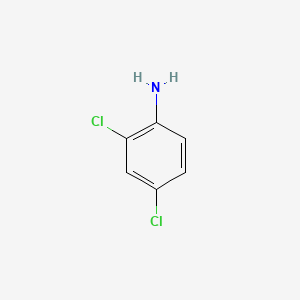
1. 554-00-7
2. Benzenamine, 2,4-dichloro-
3. 2,4-dichlorobenzenamine
4. 2,4-dichloranilin
5. O,p-dichloroaniline
6. Aniline, 2,4-dichloro-
7. 2,4-dca
8. 1-amino-2,4-dichlorobenzene
9. 2,4-dichlorophenylamine
10. 19ae42m6ws
11. Dtxsid1024966
12. Nsc-8756
13. Dtxcid404966
14. Chebi:46635
15. Refchem:443431
16. 209-057-8
17. Mfcd00007661
18. 2,4-dichloro Aniline
19. 2,4-dichloro-phenylamine
20. Cas-554-00-7
21. 2,4-dichloranilin [german]
22. Ccris 6012
23. Hsdb 5428
24. Nsc 8756
25. Einecs 209-057-8
26. 2,4-dichlorobenzene Aniline
27. Brn 0386422
28. Unii-19ae42m6ws
29. 2,4-dichloraniline
30. 2,4-dichloroanilin
31. Clonidine Impurity 4
32. 2,4-di-chloroaniline
33. 2,4-dichloro-aniline
34. Wln: Zr Bg Dg
35. Ec 209-057-8
36. 2,4dichloro Aniline
37. 2,4-dichloroaniline, 99%
38. 4-12-00-01241 (beilstein Handbook Reference)
39. Bidd:er0533
40. Schembl158279
41. Schembl660048
42. Schembl1358936
43. Schembl3118468
44. Schembl6381071
45. Schembl6790265
46. Dichloroaniline, 2,4-
47. Chembl1528820
48. Schembl29732941
49. Nsc8756
50. 2,4-dichloroaniline [hsdb]
51. Tox21_201522
52. Tox21_303206
53. Msk1259-100t
54. Sbb007569
55. Stl168887
56. Akos000118881
57. Msk1259-1000t
58. Ccg-302558
59. Fd36980
60. Ps-6249
61. Rp10174
62. Ncgc00091375-01
63. Ncgc00091375-02
64. Ncgc00091375-03
65. Ncgc00257110-01
66. Ncgc00259072-01
67. 2,4-dichloroaniline, >=97.0% (gc)
68. Ac-10180
69. Db-030787
70. D0321
71. Ns00009494
72. St45255273
73. En300-18059
74. 2,4-dichloroaniline 100 Microg/ml In Methanol
75. F022088
76. 2,4-dichloroaniline Solution In Toluene, 100ug/ml
77. Q3102438
78. 2,4-dichloroaniline Solution In Toluene, 1000ug/ml
79. Z57127562
80. 2,4-dichloroaniline, Pestanal(r), Analytical Standard
81. F2190-0455
82. Inchi=1/c6h5cl2n/c7-4-1-2-6(9)5(8)3-4/h1-3h,9h
| Molecular Weight | 162.01 g/mol |
|---|---|
| Molecular Formula | C6H5Cl2N |
| XLogP3 | 2.9 |
| Hydrogen Bond Donor Count | 1 |
| Hydrogen Bond Acceptor Count | 1 |
| Rotatable Bond Count | 0 |
| Exact Mass | Da |
| Monoisotopic Mass | Da |
| Topological Polar Surface Area | 26 |
| Heavy Atom Count | 9 |
| Formal Charge | 0 |
| Complexity | 97.1 |
| Isotope Atom Count | 0 |
| Defined Atom Stereocenter Count | 0 |
| Undefined Atom Stereocenter Count | 0 |
| Defined Bond Stereocenter Count | 0 |
| Undefined Bond Stereocenter Count | 0 |
| Covalently Bonded Unit Count | 1 |
The metabolism of four (14)C-labeled thiobis(formamidine) insecticides was studied in Sprague Dawley rats & ICR mice. The insecticides were derived from a series of 2,4-disubstituted anilines. The compounds studied included 2,4-dichloroaniline. Each compound was orally admin in corn oil solution to 2 female rats & 4 female mice in doses of 10-13 mg/kg. In every case, the corresponding anilines were detected as free aniline, in minor amounts except for the dichloro series. There were no significant differences observed between the compounds studied. The general metabolism schemes for all 4 compounds were similar. Metabolism of these compounds involves rapid hydrolysis of the parent compound in the stomach to simple formamidine, which is then converted to an N-formylaniline that has various metabolic fates, particularly through oxidation of methyl groups.
Hornish RE; J Agri Food Chem 32 (1): 114-9 (1984)
In order to reveal the urinary metabolites of p-chloronitrobenzene (CNB), an investigation was conducted to separate and identify urinary metabolites by gas chromatography/mass spectrometry following the administration of the compound to rats. Six male Sprague-Dawley-rats were given a single dose of 100 mg/kg CNB diluted in olive-oil and injected intraperitoneally. Urine was collected from the six rats at from 8 to 24 hours after exposure. Trace amounts of unchanged CNB were detected in the urine of the rats, but most of the CNB appeared to have been metabolized prior to excretion. Nine substances were identified: p-chloroaniline, 2,4-dichloroaniline, p-nitrothiophenol, 2-chloro-5-nitrophenol, 2-amino-5-chlorophenol, p-chloroformanilide, 4-chloro-2-hydroxyacetanilide, a small amount of p-chloroacetanilide and traces of unchanged CNB.
Yoshida T et al; Archives of Toxicol 65 (1): 52-8 (1991)
The urinary metabolites of p-chloronitrobenzene (p-CNB) in humans were determined using urine samples from acutely poisoned subjects. The six subjects were longshoremen hospitalized after being exposed to p-CNB while loading torn bags of the substance. Moment analysis and compartment model analysis of the urinary excretion rate of metabolites of p-CNB versus time curves were used for the pharmacokinetic evaluation. The findings suggest that the average values of the ratio of excreted amount of each metabolite to the total amount of the five metabolites and mean residence time in the six subjects were, respectively, 12.2% and 6.7 days for 2-chloro-5-nitrophenol (619103), 48.0% and 7.0 days for N-acetyl-S-(4-nitrophenyl)-L-cysteine, 1.2% and 3.7 days for 2,4-dichloroaniline, 29.9% and 10.0 days for p-chloroaniline, and 8.7% and 6.0 days for 2-amino-5-chlorophenol. The rates of transformation of p-CNB to 2-chloro-5-nitrophenol and p-chloroaniline appeared to be slow, but the resulting p-chloroaniline was metabolized relatively rapidly in the human body. The authors note that the ratio of the excretion amounts of the five metabolites was nearly constant among the subjects, whereas the rate of metabolism of the parent compound and the mean residence time varied widely among the individuals.
PMID:7905396 Yoshida T et al; Drug Metabolism and Disposition 21 (6): 1142-6 (1993)
BUILDING BLOCK