
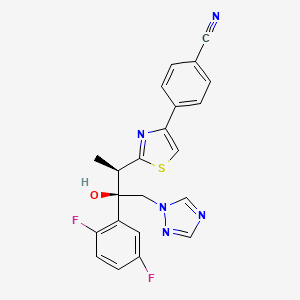
1. 4-(2-((2r,3r)-3-(2,5-difluorophenyl)-3-hydroxy-4-(1h-1,2,4-triazol-1-yl)butan-2-yl)-1,3-thiazol-4-yl)benzonitrile
1. 241479-67-4
2. Isavuconazol
3. Bal-4815
4. Bal 4815
5. Isavuconazolum
6. 60uto373ke
7. Chebi:85979
8. 4-{2-[(2r,3r)-3-(2,5-difluorophenyl)-3-hydroxy-4-(1h-1,2,4-triazol-1-yl)butan-2-yl]-1,3-thiazol-4-yl}benzonitrile
9. 4-(2-((2r,3r)-3-(2,5-difluorophenyl)-3-hydroxy-4-(1h-1,2,4-triazol-1-yl)butan-2-yl)-1,3-thiazol-4-yl)benzonitrile
10. Dtxsid2058251
11. Refchem:56947
12. Dtxcid6032069
13. J02ac05
14. 889-355-8
15. Isavuconazole [inn]
16. Mfcd06407745
17. C22h17f2n5os
18. 1286730-05-9
19. 4-[2-[(1r,2r)-2-(2,5-difluorophenyl)-2-hydroxy-1-methyl-3-(1h-1,2,4-triazol-1-yl)propyl]-4-thiazolyl]benzonitrile
20. Isavuconazole (inn)
21. 4-[2-[(2r,3r)-3-(2,5-difluorophenyl)-3-hydroxy-4-(1,2,4-triazol-1-yl)butan-2-yl]-1,3-thiazol-4-yl]benzonitrile
22. 4-(2-((2r,3r)-3-(2,5-difluorophenyl)-3-hydroxy-4-(1h-1,2,4-triazol-1-yl)butan-2-yl)thiazol-4-yl)benzonitrile
23. 4-[2-[(1r,2r)-2-(2,5-difluorophenyl)-2-hydroxy-1-methyl-3-(1,2,4-triazol-1-yl)propyl]thiazol-4-yl]benzonitrile
24. Bal4815
25. 4-(2-((2r,3r)-rel-3-(2,5-difluorophenyl)-3-hydroxy-4-(1h-1,2,4-triazol-1-yl)butan-2-yl)thiazol-4-yl)benzonitrile
26. Unii-60uto373ke
27. Ro 0094815
28. Isavuconazole (standard)
29. Ro-0094815
30. Isavuconazole [mi]
31. Bal-8557(pro-drug)
32. Schembl939038
33. Isavuconazole [who-dd]
34. Chembl409153
35. Orb1305740
36. Schembl30524137
37. Asp9766
38. Ddfousqfmyruqk-rcdicmhdsa-n
39. Ex-a1785
40. Bdbm50595118
41. Hy-14273r
42. S3722
43. Akos027250772
44. Ccg-269093
45. Cs-3492
46. Db11633
47. Fi24654
48. Ncgc00390646-01
49. Ncgc00390646-02
50. Ac-31076
51. As-30128
52. Hy-14273
53. Sy278497
54. Bal-4815;ro-0094815
55. Isavuconazole; Bal-4815; Ro-0094815
56. Ns00066825
57. A12327
58. D10750
59. En300-7401534
60. Q6079042
61. (2r,3r)-3-[4-(4-cyanophenyl)thiazol-2-yl]-1-(1h-1,2,4-triazol-1-yl)-2-(2,5-difluorophenyl)-butan-2-ol
62. 2r,3r)-3-[4-(4-cyanophenyl)thiazol-2-yl]-2-(2,5- Difluorophenyl)-1-(1h-1,2,4-triazol-1-yl)butan-2-ol
63. 4-(2-((1r,2r)-1-(2,5-difluorophenyl)-1-hydroxy-1-(1h-1,2,4-triazol-1-yl)propan-2-yl)thiazol-4-yl)benzonitrile
64. 4-[2-[(1r,2r)-2-(2,5-difluorophenyl)-2-hydroxy-1-methyl-3-(1h-1,2,4-triazol-1-yl)propyl]-4-thiazolyl]benzonitrile;2r,3r)-3-[4-(4-cya Nophenyl)thiazol-2-yl]-2-(2,5-difluorophenyl)-1-(1h-1,2,4-triazol-1-yl)butan-2-ol
65. 4-{2-[(1r,2r)-2-(2,5-difluoro-phenyl)-2-hydroxy-1-methyl -3-[1,2,4]triazol-1-yl-propyl]-thiazol-4-yl}-benzonitrile
66. 4-{2-[(1r,2r)-2-(2,5-difluoro-phenyl)-2-hydroxy-1-methyl-3-[1,2,4]triazol-1-yl-propyl]-thiazol-4-yl }-benzonitrile
67. Benzonitrile, 4-[2-[(1r,2r)-2-(2,5-difluorophenyl)-2-hydroxy-1-methyl-3-(1h-1,2,4-triazol-1-yl)propyl]-4-thiazolyl]-
| Molecular Weight | 437.5 g/mol |
|---|---|
| Molecular Formula | C22H17F2N5OS |
| XLogP3 | 3.5 |
| Hydrogen Bond Donor Count | 1 |
| Hydrogen Bond Acceptor Count | 8 |
| Rotatable Bond Count | 6 |
| Exact Mass | Da |
| Monoisotopic Mass | Da |
| Topological Polar Surface Area | 116 |
| Heavy Atom Count | 31 |
| Formal Charge | 0 |
| Complexity | 657 |
| Isotope Atom Count | 0 |
| Defined Atom Stereocenter Count | 2 |
| Undefined Atom Stereocenter Count | 0 |
| Defined Bond Stereocenter Count | 0 |
| Undefined Bond Stereocenter Count | 0 |
| Covalently Bonded Unit Count | 1 |
- Indicated for patients 18 years of age and older for the treatment of invasive aspergillosis. - Indicated for patients 18 years of age and older for the treatment of invasive mucormycosis, including patients where treatment amphotericin B is inappropriate.
FDA Label
Antifungal Agents
Substances that destroy fungi by suppressing their ability to grow or reproduce. They differ from FUNGICIDES, INDUSTRIAL because they defend against fungi present in human or animal tissues.
J02AC05
S76 | LUXPHARMA | Pharmaceuticals Marketed in Luxembourg | Pharmaceuticals marketed in Luxembourg, as published by d'Gesondheetskeess (CNS, la caisse nationale de sante, www.cns.lu), mapped by name to structures using CompTox by R. Singh et al. (2021) DOI:10.1021/acsenvironau.1c00008. List downloaded from https://cns.public.lu/en/legislations/textes-coordonnes/liste-med-comm.html. Dataset DOI:10.5281/zenodo.4587355
J - Antiinfectives for systemic use
J02 - Antimycotics for systemic use
J02A - Antimycotics for systemic use
J02AC - Triazole and tetrazole derivatives
J02AC05 - Isavuconazole
ATCvet Code
QJ - Antiinfectives for systemic use
QJ02 - Antimycotics for systemic use
QJ02A - Antimycotics for systemic use
QJ02AC - Triazole and tetrazole derivatives
QJ02AC05 - Isavuconazole
Absorption
Following oral administration of 200 mg isavuconazole, the mean peak plasma concentration (Cmax) at steady state was 7499 ng/mL. Cmax following oral administration of 600 mg isavuconazole was 20028 ng/mL. It is proposed that the Cmax at steady state is reached approximately 23 hours after single and multiple dosing of isavuconazole. Administration of 400 mg of oral and intravenous isavuconazole resulted in mean AUC of 189462.8 h*ng/mL and 193906.8 h*ng/mL, respectively. While isavuconazole can be administered with or without food, concurrent consumption of a high-fat meal reduced oral isavuconazole Cmax by 9% and increased AUC by 9%. The absolute bioavailability of isavuconazole following oral administration of a single dose of isavuconazole is 98%.
Route of Elimination
Following oral administration, 46.1% of total radiolabelled isavuconzaole was detected in the feces, and about 45.5% was recovered in urine. Unchanged isavuconazole in the urine was less than 1% of the total dose administered.
Volume of Distribution
The mean steady state volume of distribution (Vss) was approximately 450 L following intravenous administration.
Clearance
The clearance (CL) rate was 2.5 1.6 L/h in patients receiving 200 mg isavuconazole orally or intravenously.
Following rapid conversion of the prodrug isavuconazonium to isavuconazole via esterase-mediated hydrolysis, a number of minor metabolites were identified in addition to the active moiety itself and the inactive cleavage product of isavuconazonium. However, no individual metabolite was observed with an AUC greater than 10% of total radio-labeled material. The main enzymes involved in the metabolism of isavuconazole are CYP3A4, CYP3A5, and subsequently uridine diphosphate- glucuronosyltransferases (UGT) according to the findings of _in vivo_ and _in vitro_ studies.
Based on a population pharmacokinetics analysis of healthy subjects and patients, the mean plasma half-life of isavuconazole was 130 hours. The mean half life following oral and intravenous administration of 400 mg isavuconazole was 110 and 115 hours, respectively.
Isavuconazole displays fungicidal actions by disrupting the biosynthesis of ergosterol, which is a key component of fungal cell membrane. It inhibits cytochrome P-450 dependent enzyme lanosterol 14-alpha-demethylase that mediates the conversion of lanosterol to ergosterol. The side arm of of the active isavuconazole molecule allows for greater affinity for the binding pocket in the fungal CYP51 protein by orienting the triazole ring of the molecule to engage with the heme moiety at the bottom of the binding pocket. This explains the wide antifungal spectrum of isavuconazole and possible cross-resistance to other triazoles. As a result of lanosterol 14-alpha-demethylase inhibition, toxic methylated sterol precursors such as 14--methylated lanosterol, 4,14-dimethylzymosterol, and 24-methylenedihydrolanosterol alter the function of fungal membrane and accumulate within the fungal cytoplasm. Depletion of ergosterol within the fungal cell membrane leads to decreased structural integrity and function of the cell membrane, inhibited fungal cell growth and replication, and ultimately cell death. Mammalian cell demethylation is less sensitive to isavuconazole inhibition. Mechanism of resistance and reduced susceptibility to isavuconazole arises from mutations in the fungal cyp51A and cyp51B genes coding for the target protein lanosterol 14-alpha-demethylase. Other multiple mechanisms leading to resistance, including changes in sterol profile and elevated efflux pump activity of fungal species, cannot be excluded.