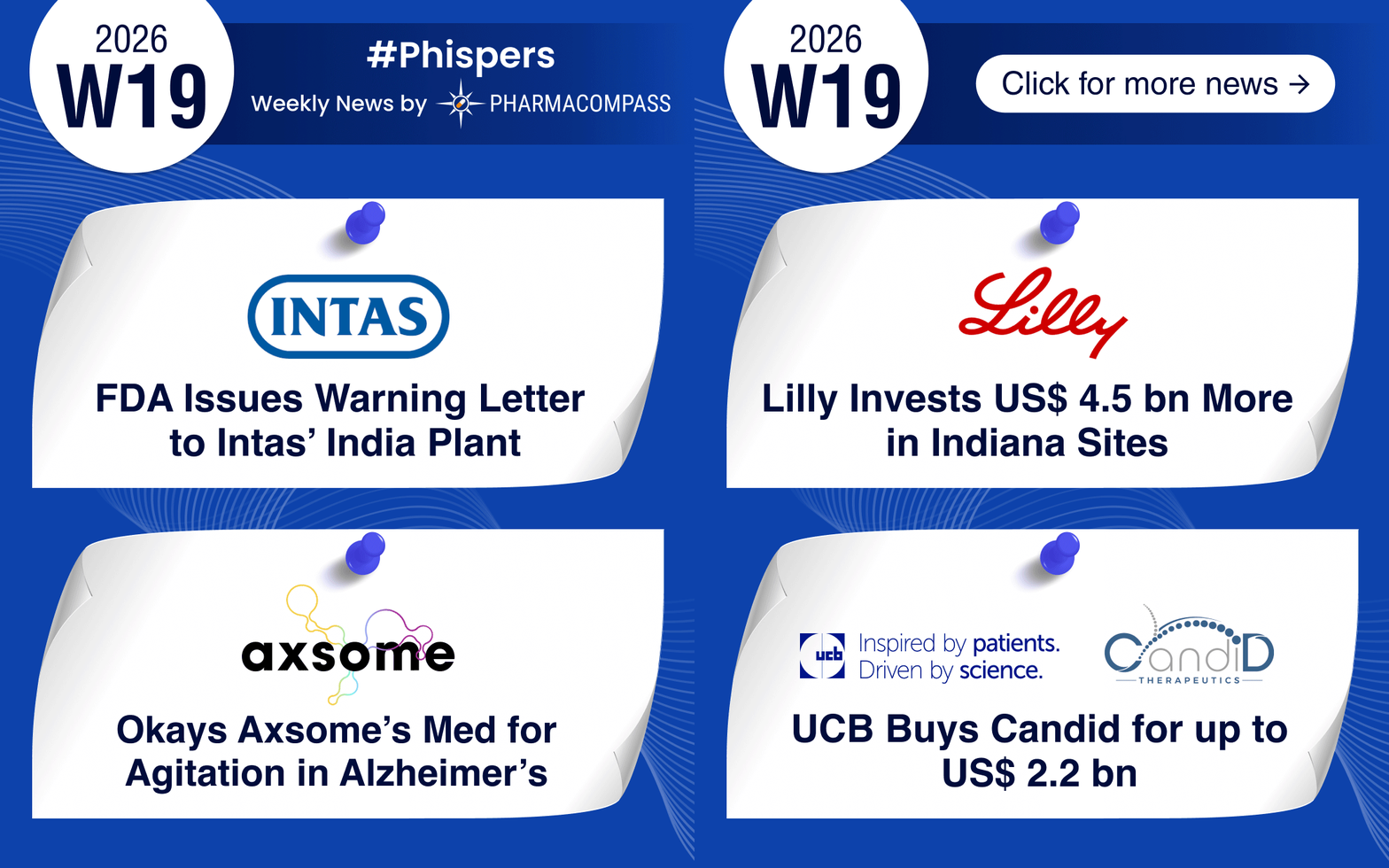
In Phispers this week, India’s Intas Pharmaceuticals received a warning letter from the US Food and Drug Administration (FDA) over serious violations of current good manufacturing practice (CGMP) at its plant in Dehradun in north India.The regulator expanded the approval of Axsome Therapeutics’ Auvelity (dextromethorphan HBr and bupropion HCl) to treat agitation associated with dementia in patients with Alzheimer’s disease. FDA also approved Arvinas and Pfizer’s Veppanu (vepdegestrant) to treat an advanced type of breast cancer.Over recent months, Eli Lilly
has announced several acquisitions. This week, it announced an additional US$ 4.5 billion investment across two manufacturing sites in Lebanon, Indiana, bringing its investment in the state since 2020 to US$ 21 billion. Novartis announced its plans to add its seventh facility — an active pharmaceutical ingredient (API) plant in Morrisville, North Carolina — in the US under its US$ 23 billion investment commitment.In deals, Belgian
biopharma UCB announced the acquisition of privately-held Candid Therapeutics in
a deal worth up to US$ 2.2
billion. Madrigal Pharmaceuticals struck a license agreement worth up to
US$ 1 billion with Arrowhead Pharmaceuticals for its RNA interference (RNAi)
therapy to treat metabolic
dysfunction-associated steatohepatitis (MASH), a severe form of fatty
liver disease.American biotech Celcuity announced positive results from a large phase 3 trial testing its experimental drug gedatolisib in patients with a specific type of advanced breast cancer. And Moderna’s mRNA flu vaccine (mRNA-1010) outperformed the standard flu shot in a phase 3 trial.Intas’ Dehradun plant in India receives FDA’s warning letter over GMP violationsIndia’s Intas Pharmaceuticals has received a warning letter from the FDA over serious manufacturing violations at its facility in Dehradun (India),
following an inspection in September 2025. The warning letter highlights
significant CGMP violations.The letter said Intas’ investigations into out-of-specification (OOS) assay results were inadequate. Moreover, their corrective and preventive actions (CAPAs) to address the problem were not robust. In addition, a quality assurance employee had instructed a software vendor to make undisclosed changes to electronic batch records — alterations that were not captured in the audit trail or managed through the quality system.The Dehradun plant had received an FDA Form 483 last year. The company had provided a response which the FDA found to be “inadequate”. This is not Intas’ first brush with the FDA. In November 2023, its Gujarat plant had been put on import alert
due to data manipulation.FDA approves Axsome’s drug to treat Alzheimer’s-related agitationFDA has expanded the use of Axsome Therapeutics’ approved drug Auvelity (dextromethorphan HBr and bupropion HCl) for the treatment of agitation associated with dementia in patients with Alzheimer’s disease.The drug is the first FDA-approved
treatment for this condition that is not an antipsychotic. FDA initially
approved Auvelity in 2022 to treat major depressive disorder in adults. Axsome
Therapeutics has projected peak sales for Auvelity to reach
US$ 8 billion.Approves Arvinas’ drug for advanced breast cancer: FDA has approved Arvinas and Pfizer’s Veppanu (vepdegestrant) to treat an advanced type of breast cancer known as estrogen receptor-positive (ER+)/human epidermal growth factor receptor
2-negative (HER2-), estrogen receptor 1 (ESR1)-mutated advanced or metastatic
breast cancer. This is the first time the FDA has approved a new kind of protein degrading therapy, known as
PROTAC.Lilly commits additional US$ 4.5 bn across two sites in IndianaEli Lilly has announced an additional US$ 4.5 billion investment across two of its manufacturing sites in
Lebanon, Indiana, bringing its total capital expansion commitments in this American state to more than US$ 21 billion since 2020. Lilly’s total capital expansion commitments in the US since 2020 have now exceeded US$ 50 billion.The investment aims to support production of Lilly’s recently approved once-daily oral weight-loss pill Foundayo (orforglipron) and retatrutide, its next-generation obesity
candidate in late-stage development.Novartis adds seventh facility in US: Swiss drug major Novartis has announced its plans to add its seventh facility in the US under its US$ 23 billion investment commitment — a 56,200-square-foot API plant in Morrisville, North Carolina. The facility will produce ingredients for solid dosage tablets, capsules, and RNA therapeutics, and will be Novartis’ fifth site in the state.UCB buys Candid for up to US$
2.2 bn for its autoimmune disease therapiesBelgian biopharma UCB has agreed to buy privately-held Candid Therapeutics in a deal worth up to US$ 2.2 billion.
UCB will pay US$ 2 billion in upfront payments and up to US$ 200 million in potential future milestone payments for Candid Therapeutics, which is
headquartered in California and is working on treatments for autoimmune
diseases. Candid is focused on developing treatments for autoimmune and
inflammatory diseases through the use of novel T-cell engagers (TCEs).Madrigal in MASH deal with Arrowhead: Madrigal Pharmaceuticals has struck an exclusive worldwide license agreement with Arrowhead Pharmaceuticals for its RNAi therapy to treat MASH. Madrigal will
pay US$ 25 million upfront, with up to US$ 975 million in milestone payments.GSK in obesity deal with China’s SiranBio: GSK has licensed a siRNA therapy (outside Greater China) from China’s SiranBio which is currently in a phase 1 trial. GSK is paying the Chinese firm US$ 55 million upfront and is liable to pay up to US$ 1
billion in milestone payments. The drug can reduce visceral abdominal fat while
preserving lean muscle mass.Celcuity’s therapy beats Novartis’ Piqray in phase 3 breast cancer trialCelcuity, a US biotech focused on
cancer treatments, has announced positive results from a large phase 3 trial testing its
experimental drug gedatolisib in patients with a specific type of advanced
breast cancer. The trial enrolled patients with HR-positive, HER2-negative
breast cancer who carry a mutation in the PIK3CA gene and whose cancer had
worsened despite earlier treatment. The trial found that both a three-drug combination
(gedatolisib + AstraZeneca’s Faslodex + Pfizer’s Ibrance) and a two-drug combination (gedatolisib + Faslodex) significantly delayed cancer progression compared to Novartis’ Piqray (alpelisib) plus Faslodex — the regimen against which gedatolisib was tested.Moderna’s mRNA flu vaccine outperforms standard shot: Moderna’s mRNA flu vaccine (mRNA-1010) outperformed the standard flu shot in a phase 3 trial, with the mRNA
shot performing about 27 percent better. The trial enrolled over 40,000 adults
aged 50 and above across 11 countries.



















 Share
Share