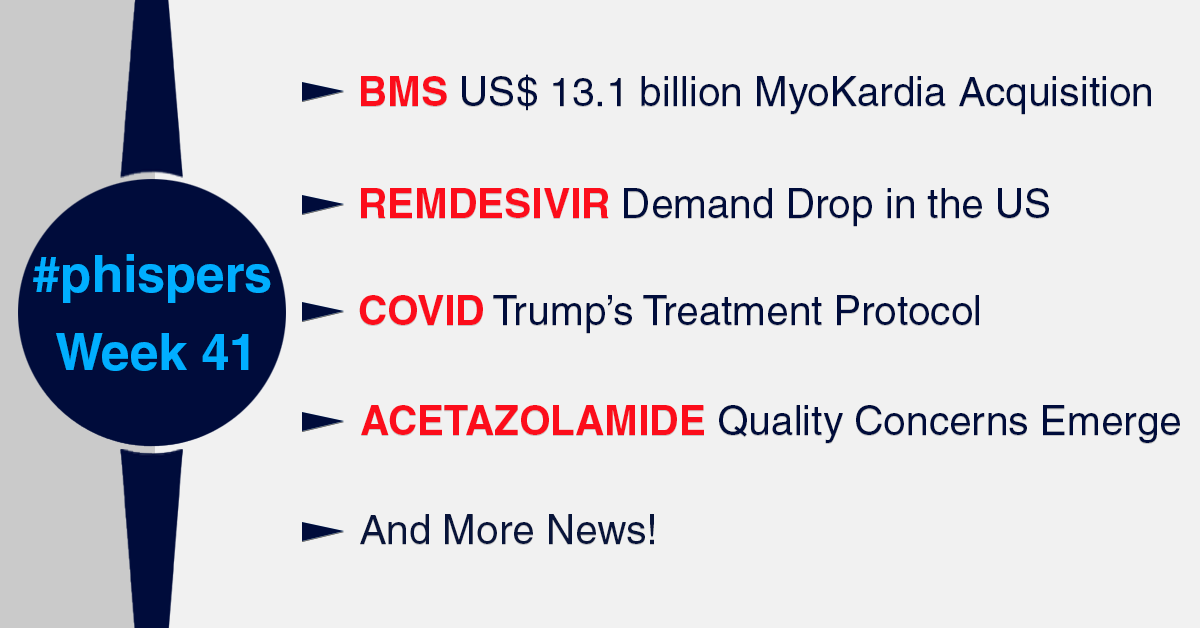
This week, Phispers has more updates on Covid-19 vaccines and therapies.
In the US, President Donald Trump contracted the virus and subsequently returned to the White House after undergoing treatment at a hospital for four days.
Trump vouched for Regeneron’s experimental monoclonal antibody treatment and has promised to give access to the therapy, free of cost, to all Covid patients in America.
The WHO chief said there is hope that
a vaccine against Covid-19 may be ready by the end of the year.
After acquiring Celgene last year, BMS has bought MyoKardia for US$ 13.1 billion in cash.
Three scientists won the Nobel Prize in Physiology or Medicine for identifying the hepatitis C virus, while the Nobel Prize in Chemistry was awarded to two scientists for developing a revolutionary
gene-editing tool, the
CRISPR/Cas9 genetic scissors.
The USFDA has found high levels of impurity in injectable diuretic acetazolamide.
And while some European countries are facing a shortage of Gilead’s remdesivir, the US is witnessing excess supply of the antiviral drug.
As a result, Gilead will now
be selling remdesivir to American hospitals directly.
BMS
buys biopharma firm MyoKardia for US$ 13.1 billion
This
week, Bristol Myers Squibb and MyoKardia Inc announced a definitive merger agreement under which the former will acquire the latter for
US$ 13.1 billion.
The
transaction was unanimously approved by the boards of both Bristol Myers Squibb
and MyoKardia and is anticipated to close during the fourth quarter of 2020. Bristol Myers
will utilize some of the US$ 20 billion in cash and equivalents it had at the
end of June for this deal.
MyoKardia
is a clinical-stage biopharmaceutical company discovering and developing
targeted therapies for the treatment of serious cardiovascular diseases.
With the deal, Bristol Myers gains mavacamten, an experimental heart disease therapy with
blockbuster potential. The drug is being tested for treating obstructive
hypertrophic cardiomyopathy — a disease where a heart
muscle thickens and obstructs blood flow. It affects up to 200,000 people
across the US and Europe. Bristol Myers’ willingness to pay a hefty premium to buy
MyoKardia reflects a belief that mavacamten can be a significant growth driver
in the medium to long term.
Nobel
Prizes awarded for Medicine and Chemistry
Three scientists —Harvey J. Alter, Michael Houghton, and Charles M. Rice — have won the Nobel Prize
in Physiology or Medicine for their discoveries that led to the identification
of the hepatitis C virus, which affects more people than HIV worldwide.
Alter is an emeritus researcher at the National Institutes of Health;
Rice is a virologist at Rockefeller University; and Houghton is a British
virologist at the University of Alberta in Canada.
The three scientists “made a decisive contribution to the fight against blood-borne hepatitis,” the Nobel Assembly said in a press release.
The 10 million Swedish kronor (or US$ 1,118,000) prize was announced at
the Karolinska Institute in Stockholm, Sweden.
The Nobel Assembly said the work of Alter, Houghton, and Rice — during the 1970s and 1980s — “revealed the cause of the remaining cases of chronic hepatitis and made possible blood tests and new medicines that have saved millions of lives.”
Alter
began his work in the hepatitis field back in the 1960s and 1970s, around the
time when the hepatitis B virus was first discovered. Nearly a decade later,
Houghton and his co-workers at the pharmaceutical company, Chiron isolated the
genetic sequence of the virus through experiments with chimpanzees.
“For the first time in history, the disease can now be cured, raising hopes of eradicating Hepatitis C virus from the world population,” the Nobel committee said in a statement.
According
to numbers from the WHO, there are over 70 million cases of hepatitis C around
the world with approximately 400,000 deaths per year.
Nobel Prize in Chemistry: A pair of scientists — Jennifer A. Doudna, a biochemist at the University of California at Berkeley, and Emmanuelle Charpentier, a French microbiologist — won the 2020 Nobel Prize in Chemistry on Wednesday
for their work on developing a revolutionary gene-editing tool that can change
the DNA of plants and animals with extraordinary precision.
Since Charpentier and
Doudna discovered the CRISPR/Cas9 genetic scissors in 2012 their use has exploded.
This tool has contributed to many important discoveries in basic research, and
plant researchers have been able to develop crops that withstand mold, pests,
and drought.
Charpentier and Doudna will equally share the prize money of roughly $1.1 million. Because of the
coronavirus pandemic, the usual Nobel Prize ceremonies will be held virtually,
with winners receiving their medals and diplomas in their home countries.
After
valsartan & metformin, concerns emerge over quality of acetazolamide
Over
the last two years, we have seen potential carcinogens, such as N-Nitrosodimethylamine (NDMA) and N-Nitrosodiethylamine (NDEA), being
found in various drugs, such as valsartan, ranitidine, and of late, metformin.
With
the Covid-19 pandemic raging across the world, experts at the US Food and Drug
Administration (FDA) have been concerned about the quality of drugs flowing
into the US. And, researchers at the University of Kentucky have filed a petition with the FDA to recall one lot of Mylan and Hikma’s versions of the injectable diuretic — acetazolamide — after finding high impurity levels in tested lots. As a result, UK filed a petition on September 30 with the US Food and Drug Administration (FDA) to recall identified lots of the medication.
After testing acetazolamide in August, researchers found that samples of Mylan's version of the drug contained only 80 to 87 percent of the listed active pharmaceutical ingredient (API). The rest was composed of unknown impurities that UK HealthCare Chief Pharmacist, Philip Almeter called “obscure chemicals that could result from breakdown of product or from reagents used in the manufacturing process.”
In
some cases, the impurity levels in
Mylan’s version were more than seven times higher than the FDA’s accepted amount. Those findings were later confirmed by AMRI, a contract manufacturer
and independent testing lab, the university said.
There is little to no data on the danger these impurities pose as they have not been studied. "Given the unknowns we felt it was important to file the petition with the FDA as soon as possible,” Almeter said. Mylan’s version of the injectable was manufactured in India, while Hikma’s version was made in Portugal.
Meanwhile, drugs are continuously being recalled due to probable
cancer-causing impurities. India’s Marksans Pharma has recalled an
additional 76 lots of its generic diabetes drug metformin off US
shelves after finding high levels of NDMA in more sampled lots. Late last
month, Sun Pharmaceuticals recalled one
lot of its Riomet ER, an extended-release version of metformin hydrochloride, after
finding high NDMA levels.
Drop in demand in US for Gilead’s remdesivir leads to change in distribution
Gilead Sciences is now taking
distribution of remdesivir into its own hands. According to a company statement, Gilead will directly sell remdesivir, branded as Veklury, to American hospitals.
Over
the last five months, the US Department of Health and Human services was
responsible for allocating remdesivir. Starting October 1, drug wholesale
company AmerisourceBergen will be the sole distributor of Veklury through the end
of the year.
Gilead has been collecting revenue on the drug since July at the wholesale acquisition cost of US$ 3,120 for a typical five-day treatment course. That’s when its US donation of about 1.5 million doses ran out.
At
that price, Wolfe Research analyst Tim Anderson projects remdesivir peak sales
in both 2020 and 2021 at just below US$ 3 billion. Gilead expects to sell about
1 million to 1.5 million courses this year, which roughly equates to US$
3.5 billion in revenue.
Gilead
quickly worked to ramp up supply by increasing internal manufacturing capacity
and by signing on contractors. However, now the supply of remdesivir is
exceeding market demand. Gilead is currently seeking full FDA approval for
remdesivir in treating Covid-19.
Meanwhile, a Reuters report said European countries, such as the
Netherlands, Poland and the UK, are facing shortages of
remdesivir because limited supplies are running out. Spain, which has Europe’s highest infection rate, experienced
shortages in late August, its medicine agency said. It now has enough doses to
meet the needs for the coming weeks, the health ministry said on Tuesday.
Britain, which has joined the EU procurement for remdesivir, has rationed its
supply, prioritizing Covid-19 patients who need it most, the health ministry
said.
Trump avoids HCQ, promises to give Regeneron’s therapy to Covid patients for free
The
biggest news that came late last week was that US President Donald Trump had
tested positive for the novel coronavirus. What followed this announcement was
a mystery behind the medications that were given to Trump by his doctors.
Trump
was not given HCQ, convalescent plasma
therapy, or even oleandrin, a substance
extracted from a toxic shrub and touted as a miracle by Mike Lindell, CEO of
MyPillow, a Trump supporter and donor.
Journalist
and author Katherine Eban pointed out that instead of hydroxychloroquine (HCQ),
oleandrin, or any of the other “shiny objects” his administration has pushed, the president is mixing cutting-edge experimental treatments with a familiar drug that the Pentagon has been studying — famotidine, better known
as Pepcid AC.
Trump, who has several risk factors working against him (age, gender, and BMI), was given an 8
gram dose of Regeneron’s monoclonal
antibody treatment. Regeneron said it provided the drug to the president in
response to a “compassionate use” request from Trump’s doctors.
The founder and CEO of Regeneron, Leonard Schleifer, said Trump’s use of the company’s experimental Covid drug creates “a very tough situation” for the drugmaker since it hasn’t been cleared for broader use.
Before
Trump checked out of Walter Reed National Medical Centre to get back to the
White House on Monday evening, his doctors had administered the fourth dose of Gilead’s antiviral drug, remdesivir. He had been receiving intravenous infusions of remdesivir since Friday. Typically given to patients with severe infection, it works by hindering the virus’ replication in the body.
Trump
was also given dexamethasone, a steroid that
the National Institutes of Health’s clinical guidelines recommend for use only
in severe cases of Covid-19.
On
Wednesday, Trump returned to the Oval Office. He said in a video that he
considered getting ill with a virus a “blessing in disguise” because he ended up taking an experimental drug from Regeneron which is still in clinical trials.
Trump suggested that Regeneron’s drug, as well as a similar therapy from Eli Lilly, could soon be authorized for emergency use.
“I want everybody to be given the same treatment as your president, because I feel great,” he said.
He
then said everyone should have access to the not-yet-approved drug for “free” and that he would make sure it was in every hospital as soon as possible. “To me it wasn’t therapeutic — it just made me better, OK? I call that a cure,” said Trump.
However,
experts point out that there has been no formal publication of Regeneron’s results, not
even an unreviewed preprint. All that Regeneron has published are some press
releases. Earlier last week, Regeneron had said the treatment improved
symptoms and reduced viral loads in non-hospitalized patients who have
mild to moderate Covid-19. That was based on results for the first 275 trial
patients.
Vaccine Update: WHO says shot may be ready by year-end, EU
reviews data in real-time
On
Tuesday, the WHO Director-General, Tedros Adhanom Ghebreyesus, said “there is hope” that a vaccine against Covid-19 may be ready by the end of this year. The WHO head called for solidarity and political commitment from all leaders to ensure equitable distribution of the vaccine when it becomes available.
There are
nine vaccine candidates in various stages of trials that are part of the
WHO-led COVAX global vaccine initiative that plans to distribute 2 billion
doses by the end of 2021. A total of 172 countries have joined WHO’s COVAX initiative. However, this
excludes the United States, China, and Russia.
EU
reviewing real-time data of vaccines: The European Medicines Agency (EMA) is reviewing a Covid-19 vaccine being
developed by Pfizer and BioNTech in real time. Last week, the
European regulator had launched a similar process for
reviewing AstraZeneca’s vaccine.
The EMA is
using “rolling reviews” to speed up evaluations of vaccines by studying data as it is submitted, rather than waiting for all data to be made available along with a formal application. Pfizer and BioNTech said the start of the review is based on data from laboratory and animal testing, as well as early testing on humans, while continuing talks to submit data as it emerged.
Uncertainty
in US over EUAs before Nov 3: This week, the US
Food and Drug Administration (FDA) published briefing documents
related to an upcoming advisory committee meeting on Covid-19 vaccines, as well as guidance for the industry.
In
these documents, the agency has outlined stricter criteria that need to be met
in order to support an emergency-use authorization
(EUA) request. According to a New York Times report, White House officials objected to new federal guidelines for the emergency release of a vaccine,
including one that would ensure that no vaccine could be authorized before the
November 3 presidential election.
However,
a few hours later, another report by the same publication said the White House
has approved stricter guidelines for vaccine makers. The guidelines make it “highly unlikely that a coronavirus vaccine will be given” an EUA before the election day.
Pfizer’s CEO, Albert Bourla, said in a tweet that “Pfizer has never discussed” FDA’s Covid-19 vaccine guidelines with the White House and will never do so since
that could undermine the agency’s independence.
These
developments were accompanied by another tweet by an FDA reporter, who said Operation Warp Speed’s scientific head Moncef Slaoui has suggested that AstraZeneca’s vaccine could still win an EUA in late October or early November based on the trials in the UK, Brazil and South Africa. Its trials in the US are still on hold.
Moderna fails to enroll enough minorities in trials: A Reuters
report has said Moderna’s vaccine trial contractors
have failed to enroll enough minorities (Blacks, Latinos and Native American
participants) as volunteers. And this could slow down the approval process. To
make up for the shortfall, Moderna slowed enrollment of its late-stage trial
and instructed research centers to focus on increasing participation among
minority volunteers, the company said.
Covid-19
infects Blacks in the United States at nearly three times the rate of white
Americans, and they are twice as likely to die from the virus, according to a
report by the National Urban League and other studies. During the last two
weeks of September, Moderna said it increased the proportion of Black
enrollment, but declined to provide details.














 Share
Share