Please Wait
Applying Filters...
Menu
Xls

Digital Content read-more

Create Content with PharmaCompass, ask us

DATA COMPILATION #PharmaFlow

read-more
read-more
DMF filings hit all-time high in Q3 2024; China tops list with 58% increase in Type II submissions
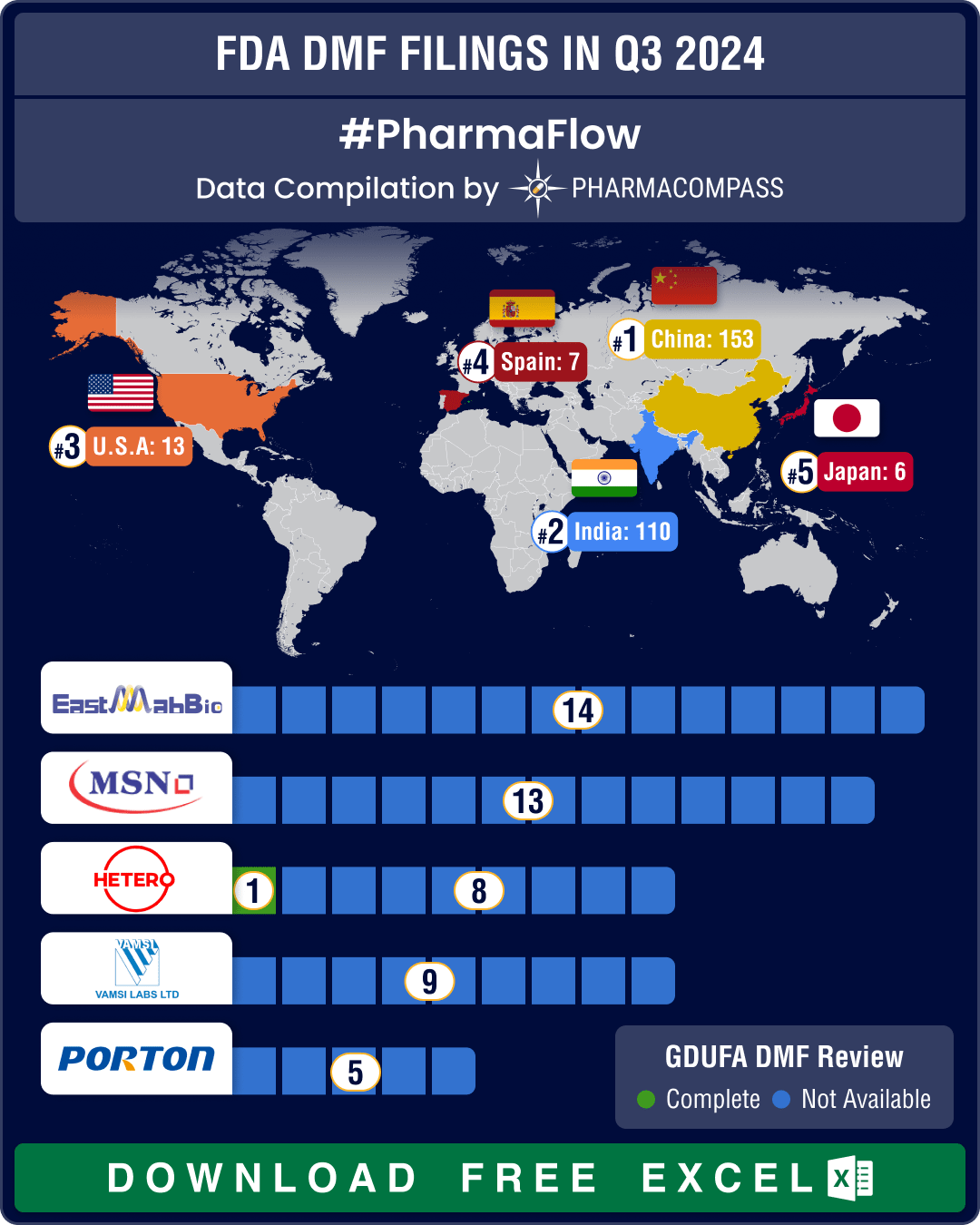
Drug Master Files, or DMFs, are confidential documents that play a crucial role in the pharmaceutical industry. These files, submitted to the US Food and Drug Administration (FDA), contain detailed information about ingredients, manufacturing processes, and packaging of medicines. They help the FDA oversee drug quality. Of the four types, Type II DMFs involve active pharmaceutical ingredients (APIs) for both branded and generic drugs. The third quarter (Q3) of 2024 saw Type II DMF submissions set a new record. A total of 309 Type II DMFs were submitted to the FDA during this period, a substantial 24.6 percent increase over Q3 2023 (with 248 submissions). The second quarter of 2024 too saw a remarkable increase, with 237 Type II DMFs being submitted compared to 178 in Q2 2023. View FDA DMF Filings in Q3 2024 (Power BI Dashboard, Free Excel Available) China witnesses steep rise in DMF submissions, beats India with maximum filings In Q3 2024, China filed 153 DMFs submissions, marking a substantial 57.7 percent increase from the 97 submissions filed in Q3 2023. India maintained its strong position but fell to the number two spot with 110 DMFs, representing a modest 3.8 percent increase from 106 in Q3 2023. The US, which came a distant third, saw a slight decline in DMF submissions, with 13 filed in Q3 2024, as compared to 18 in Q3 2023. For several years, India had a lead in Type II DMFs. Since 2020, which marked the start of the pandemic, we have noticed a gradual increase in DMFs filed by China. This year, China has surpassed India considerably in the first three quarters. During the first nine months of 2024, China submitted 372, while India filed 286 DMFs. If this lead is maintained in Q4, DMFs from China will surpass that of India in 2024.  Amongst European countries, Spain led with seven DMFs, followed by Italy at four, and Germany and the Netherlands at three each. Among other nations, Japan contributed six while Israel submitted four DMFs. In company-wise tally, China’s Jiangsu East-Mab Biomedical Technology topped the list with an impressive 14 DMFs. On its heels were Indian companies — MSN at 13 DMFs, and Vamsi Labs and Hetero Drugs at nine DMFs each. China’s Porton Pharma and Wuxi AppTec filed five, while Shanghai Keze Yongxin Biotechnology, and Qingdao Glycogene Pharmaceutical contributed four submissions each. India's Maithri Drugs also submitted four. Japanese company Santeja filed five. Overall, Asia accounted for nearly 90 percent, with China contributing a dominant 49.5 percent of all DMF submissions. India was at 35.6 percent, the US at 4.2 percent, while Europe contributed 6.5 percent.  View FDA DMF Filings in Q3 2024 (Power BI Dashboard, Free Excel Available) Diabetes, obesity, cancer, women’s health drugs emerge as hot molecules in Q3 2024 In terms of molecules, semaglutide (used for the treatment of type 2 diabetes and weight management) and relugolix (to treat prostate cancer and uterine fibroids) saw six DMF filings each in Q3 2024, indicating significant industry interest in these compounds. Following closely behind were semaglutide’s competitor tirzepatide and overactive bladder therapy vibegron, garnering four DMFs each. Finerenone (a non-steroidal drug for chronic kidney disease associated with type 2 diabetes) and voclosporin (an immunosuppressant for lupus nephritis) saw three DMFs each.  The last quarter also witnessed the introduction of 14 molecules with first-time DMFs. Among them were acetoxy empagliflozin, cabozantinib fumarate, tivozanib hydrochloride monohydrate, diosmetin, trilaciclib, clenbuterol hydrochloride, fenoterol hydrobromide, tapinarof and fezolinetant. Fezolinetant, with a DMF from Spain’s Moehs Iberica, is the active ingredient in Astellas’ Veozah, which is the first non-hormonal treatment for menopausal symptoms approved by the FDA. Tapinarof, filed by India’s Maithri Drugs, is used in Vtama, a novel steroid-free psoriasis cream. Other compounds that made their DMF debut include berotralstat, calcium phosphoryl choline chloride, phloroglucinol dihydrate, belumosudil mesylate and trimethylphloroglucinol. During Q2 2024, there were 19 drugs that saw DMF submissions for the first time, including molecules like triptorelin, sorafenib, pralsetinib, trilaciclib dihydrochloride, resmetirom (hepatology) and teneligliptin hydrochloride hydrate (metabolic disorders).  View FDA DMF Filings in Q3 2024 (Power BI Dashboard, Free Excel Available)    GDUFA fee for FY 2025: The FDA’s Generic Drug User Fee Amendments (GDUFA) is a law designed to speed access to safe and effective generic drugs to the public and reduce costs to the industry. The fiscal year 2025 fee rates were published on July 31, 2024. The FDA has revised fees under GDUFA III for all categories. While there is a slight increase in the DMF fee from US$ 94,682 in 2024 to US$ 95,084 in 2025, the ANDA fee has witnessed a significant jump — from US$ 252,453 in 2024 to US$ 321,920 in 2025. FY 2024 and FY 2025 User Fee Rates Generic drug fee category Fees rates for FY 2024 Fees rates for FY 2025 Applications: Abbreviated New Drug Application (ANDA) US$ 2,52,453   US$ 3,21,920   Drug Master File (DMF) US$ 94,682 US$ 95,084 Facilities: Active Pharmaceutical Ingredient (API)—Domestic US$ 40,464 US$ 41,580 API—Foreign US$ 55,464 US$ 56,580 Finished Dosage Form (FDF)—Domestic US$ 2,20,427   US$ 2,31,952 FDF—Foreign US$ 2,35,427   US$ 2,46,952 Contract Manufacturing Organization (CMO)—Domestic US$ 52,902 US$ 55,668 CMO—Foreign US$ 67,902 US$ 70,668 GDUFA Program: Large size operation generic drug applicant US$ 17,29,629   US$ 18,91,664 Medium size operation generic drug applicant US$ 6,91,852   US$ 7,56,666 Small business generic drug applicant US$ 1,72,963   US$ 1,89,166 Our view The highlight of the last few quarters has been the sharp rise in Type II DMF filings from China. The submission of a DMF is not required by law or any FDA regulation. FDA’s DMF guideline offers guidance on acceptable approaches to meeting regulatory requirements. Moreover, DMFs establish trust in APIs from lesser-known companies. With a growing emphasis on compliance and quality assurance, it appears that Chinese drug companies are eager to demonstrate their commitment to high standards and build trust in the US market. And that’s good news for the pharmaceutical industry.   

Impressions: 10787

https://www.pharmacompass.com/radio-compass-blog/dmf-filings-hit-all-time-high-in-q3-2024-china-tops-list-with-58-increase-in-type-ii-submissions

#PharmaFlow by PHARMACOMPASS
24 Oct 2024

WEEKLY NEWS RECAP #Phispers

read-more
read-more
FDA proposes limits on ‘sartan’ nitrosamine impurities; Text messages add new twist to US generic price fixing litigation
In our final Phispers of 2018, we bring you news on how the big pharmaceutical companies in the US plan to ring in the new year with price hikes. In the price fixing case, three drugmakers are being accused of working in collusion to hike the price of nystatin, a generic anti-fungal drug. At the heart of this allegation is a text message from an employee working at Heritage Pharmaceuticals.  FTC has approved an application by Teva to reopen and modify its decision and order in connection with the 2012 merger of Watson Pharmaceuticals and Actavis. In the sartan adulteration saga, Torrent has voluntarily recalled two lots of losartan potassium tablets due to the detection of NDEA impurity. Meanwhile, FDA has proposed limits on nitrosamine impurities in angiotensin II receptor blockers (ARBs) for drugmakers to use. And after last year, EU inspectors have uncovered data integrity violations at Kores India once again. A ‘smiley-faced’ text message is at the center of generic price fixing lawsuit   In the US, three drugmakers have been accused of working in collusion to hike the price of a decades-old generic anti-fungal medicine, known as nystatin. According to a major federal lawsuit, the drugmakers colluded to increase the price of nystatin back in 2014.  At the heart of this accusation is a ‘smiley-faced’ text message from an employee working for the New Jersey drugmaker Heritage Pharmaceuticals. The text message was sent to an employee of a rival company. It read: “Work news: we are raising price on Nystatin. Just letting you know. :),”  According to the attorneys, post receiving that text message, the competitor (Indian drugmaker Sun Pharmaceuticals) also started increasing the price of its nystatin. A Sun representative, however, said the allegations were meritless and that the company would continue to defend itself “vigorously.” The complaint alleges that rival companies shared information about price increases by way of phone calls and text messages, and often doubled drug prices in unison. This large civil antitrust complaint includes communications between employees. According to the complaint, nystatin was made by at least three generic drugmakers, all of which had employees in close contact and exchanged notes on the ensuing price hike. Forms of nystatin are used to treat common fungal infections such as yeast infections and diaper rash. The attorneys general claim that conversations between two nystatin manufacturers Teva and Heritage date back to mid-2013. They allege the price increases had been broached internally at Teva first. However, the Teva employee who headed the pricing team initially opposed them. Teva said in a statement that it denied the allegations and “will continue to vigorously defend itself.” Other medications outlined in the complaint treat conditions like epilepsy, heart failure, anxiety, insomnia, hypertension, diabetes, asthma, and arthritis. While Heritage fired its former president and CEO in 2016 after an internal investigation revealed “serious misconduct”, it said it is also suing a former executive in a separate ongoing suit. The high-ranking employees of former Heritage Pharmaceuticals, who also happen to be brothers-in-law — Jason Malek, its former president, and Jeffrey Glazer, its former CEO — have previously pleaded guilty to price-fixing and other charges in separate criminal cases. FDA proposes limits on nitrosamine impurities; Torrent recalls losartan made with Hetero’s API   Last month, Sandoz Inc had issued a voluntary recall of one lot of losartan potassium and hydrochlorothiazide due to the detection of trace amounts of NDEA (N-Nitrosodiethylamine) impurity found in the API which was manufactured by Zhejiang Huahai Pharmaceutical Co Limited. And last week, there was news that Torrent Pharmaceuticals Limited too is voluntarily recalling two lots of losartan potassium tablets to the consumer level due to the detection of trace amounts of the same impurity — NDEA — in its API manufactured by Hetero Labs Limited. To date, Torrent Pharmaceuticals has not received any reports of adverse events related to this recall, FDA said. Losartan is used in the treatment of hypertension and hypertensive patients with left ventricular hypertrophy. It is also used to treat nephropathy in type 2 diabetes. Meanwhile, the agency has also published interim acceptable intake levels of nitrosamine impurities in angiotensin II receptor blockers (ARBs) for manufacturers to use. This should help ensure their finished drug products are safe for patients. The agency evaluated safety data for N-Nitrosodimethylamine (NDMA) and NDEA to determine an interim acceptable intake level for these impurities. The agency will use the interim limits to recommend manufacturers to conduct a voluntary recall if laboratory testing confirms the presence of nitrosamine impurities in their finished drug product. FDA’s Interim Limits for NDMA and NDEA in Angiotensin II Receptor Blockers (ARBs) Drug Maximum Daily Dose (mg/day) Acceptable Intake NDMA (ng/day)*    Acceptable Intake NDMA (ppm)** Acceptable Intake NDEA (ng/day)*     Acceptable Intake NDEA (ppm)** Valsartan 320 96 0.3 26.5 0.083 Losartan 100 96 0.96 26.5 0.27 Irbesartan 300 96 0.32 26.5 0.088 Azilsartan 80 96 1.2 26.5 0.33 Olmesartan 40 96 2.4 26.5 0.66 Eprosartan 800 96 0.12 26.5 0.033 Candesartan 32 96 3.0 26.5 0.83 Telmisartan 80 96 1.2 26.5 0.33 * The acceptable intake is a daily exposure to a compound such as NDMA or NDEA that results in a 1:100,000 cancer risk after 70 years exposure  ** These values are based on a drug's maximum daily dose as reflected in the drug label In the US, big pharma to ring in the new year with price hikes   Pharmaceutical companies in the US have been under pressure from the Trump administration to lower drug prices. But it seems like they don’t intend to cower down to that pressure anymore. Thirty drug companies, including AstraZeneca Plc., Biogen Inc., Allergan, GlaxoSmithKline Plc, Amgen, Novartis AG and Bayer AG, have taken steps to raise the prices of their medicines in January. Several drugmakers filed notifications with California agencies in early November disclosing that they planned to raise prices in the next 60 days or more. Under a state law passed last year, companies are required to notify payers in California if they intend to raise the US list price on any drug by more than 16 percent over a two-year period. Drug behemoth Pfizer has also announced plans to hike prices on 41 of its drugs in mid-January. In July, Pfizer had rolled back planned price increases after President Trump said in a tweet that the drugmaker “should be ashamed” and that his administration would respond to the hikes. Novartis is planning to raise prices on more than 100 indications of over 30 different drugs in January, with increases ranging from 4.5 percent to 9.9 percent. Drugs on the list are expected to account for more than US$ 20 billion of Novartis’ revenue this year and include multiple sclerosis drug Gilenya, psoriatic arthritis treatment Cosentyx, and leukemia treatment Tasigna. The list also includes Novartis’ Diovan, the brand name version of blood pressure treatment valsartan. Generic versions of Diovan have been facing shortages ever since a potential carcinogen was detected in its active pharmaceutical ingredient (API) made in China, prompting widespread recalls. Similarly, Bayer filed notifications with California agencies to increase prices on six of its drugs in January, many of which are birth control products. Most of these price increases are 5 percent. The hikes scheduled for next month will pose a new challenge to the Trump administration and its pledge to lower the costs of prescription drugs. FTC opens Teva’s plea to modify decision regarding Watson’s acquisition of Actavis   In the US, the Federal Trade Commission (FTC) has approved an application by Teva to reopen and modify its decision and order in connection with the 2012 merger of Watson Pharmaceuticals Inc. and Actavis Inc. The Commission had alleged that the merger might lessen future competition for a number of generic drugs, including the generic version of the abuse-resistant opioid painkiller sold under the brand name Embeda. The 2012 decision and order required Watson and Actavis to supply Embeda to Pfizer for four years after Pfizer’s relaunch of Embeda, which occurred in January 2015.  The decision and order also required Watson and Actavis to assist in the transfer of technology for manufacturing Embeda to Pfizer or a third party. In 2016, Teva acquired Actavis’ rights and obligations under the Embeda supply agreement. At Pfizer’s request, Teva sought to extend the Embeda supply agreement for an additional period as Pfizer has not yet completed the technology transfer for Embeda manufacturing to a third party. Without Teva’s supply of Embeda, Pfizer will be unable to supply patients with Embeda after December 2018. This year too, EU inspectors uncover data integrity violations at Kores India    In 2017, an inspection by Italian health authorities at the API manufacturing facilities of Kores (India) Limited uncovered “serious GMP non-compliance”. The inspectors found major deficiencies related to electronic and paper analytical data integrity.  The inspection was performed in the framework of the CEP (certificate of suitability) dossier for the manufacture of ambroxol hydrochloride and the inspection team recommended the suspension of all CEPs from the manufacturing site. A year later, in October 2018, the French health agency (ANSM) came to inspect the manufacturing process of ambroxol at Kores and once again uncovered data integrity violations. The French inspectors also raised concern over the cross contamination risk pertaining to the production equipment. As a follow-up to the inspection, the EDQM will consider the withdrawal of the CEPs n°2013-115 Ambroxol HCl, n°2015-012 Ambroxol HCl and n°2015-224 Glimepiride. The inspection report states that the deficiencies found could affect the other APIs manufactured at the site. These include Doxofylline, Etofylline, Acefylline, Glimepiride, 3-Methylxanthine, 2-Amino-3,5-dibromobenzaldehyde, 8-ChloroTheophylline, 8-Benzyl Theophylline, Theobromine, Acebrophylline, Theophylline, Piperazine/Acepifylline, Pamabrom, Ivabradine HCl, Dorzolamide Hydrochloride.

Impressions: 5104

https://www.pharmacompass.com/radio-compass-phisper/fda-proposes-limits-on-sartan-nitrosamine-impurities-text-messages-add-new-twist-to-us-generic-price-fixing-litigation

#Phispers by PHARMACOMPASS
27 Dec 2018

NEWS #PharmaBuzz

read-more
read-more

https://www.prnewswire.com/news-releases/thea-pharma-inc-statement-related-to-akorns-voluntary-nationwide-recall-of-various-human-and-animal-drug-branded-ophthalmic-products-within-expiry-due-to-company-shutdown-301811331.html

PR NEWSWIRE
28 Apr 2023

https://www.accessdata.fda.gov/scripts/cder/daf/index.cfm?event=overview.process&ApplNo=215520

FDA
19 Sep 2022

https://www.accessdata.fda.gov/scripts/cder/daf/index.cfm?event=overview.process&ApplNo=215660

FDA
27 Jan 2022

https://www.accessdata.fda.gov/scripts/cder/daf/index.cfm?event=overview.process&ApplNo=215936

FDA
25 Jan 2022

https://news.google.com/topics/CAAqIQgKIhtDQkFTRGdvSUwyMHZNRE15YlhnU0FtVnVLQUFQAQ?hl=en-IN&gl=IN&ceid=IN:en

GOOGLE
18 May 2021

https://www.accessdata.fda.gov/scripts/cder/daf/index.cfm?event=overview.process&ApplNo=213099

FDA
11 May 2021